
CL Stunt legend turns 90
by Bob Hunt [email protected]
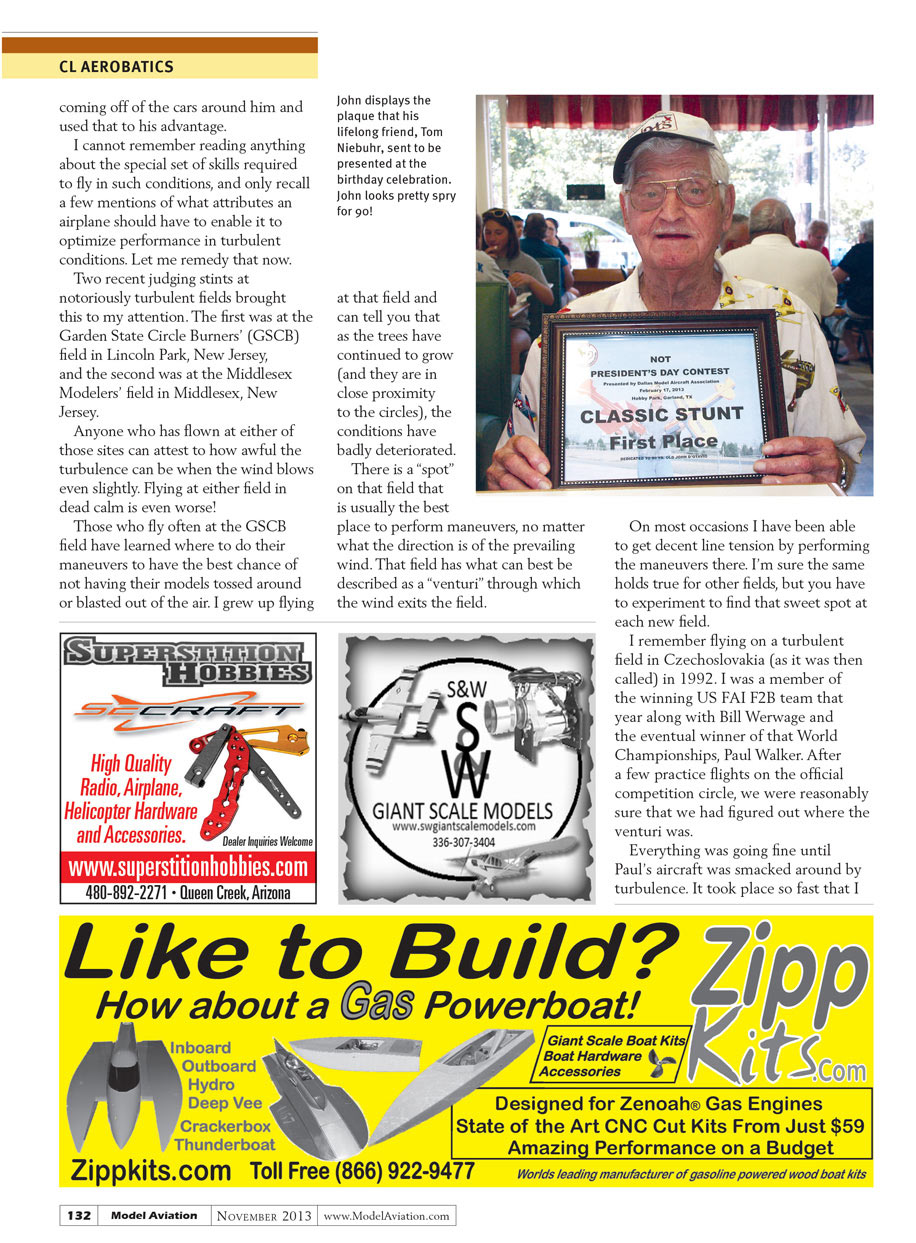
In February of this year, CL Stunt legend John D'Ottavio turned 90. John's influence on CL Aerobatics model design can be detected in nearly every original aerobatic model that comes out of the Eastern region.
Elements of his smooth, precise flying style can easily be recognized in the performances of his many protégés—and in those of their protégés! John has mentored and inspired several generations, and he has made friends worldwide within aeromodeling.
I've been honored to have been invited to many of John's birthday parties, which are celebrated by large gatherings each year. His 90th birthday party was slated to be something special. The word went out and Stunt fliers from across the country planned to attend. A few days before his big celebration, John fell seriously ill, and the party was canceled.
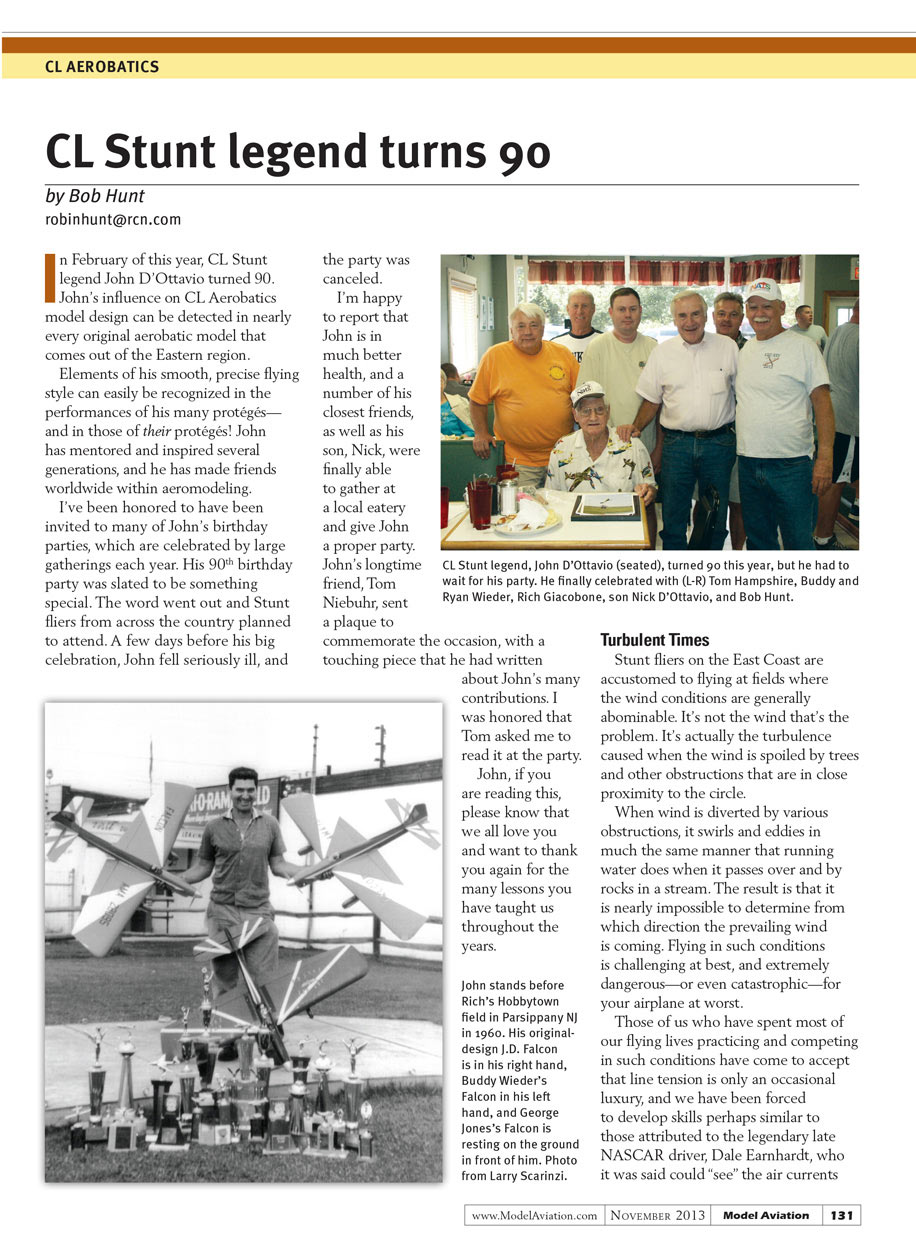
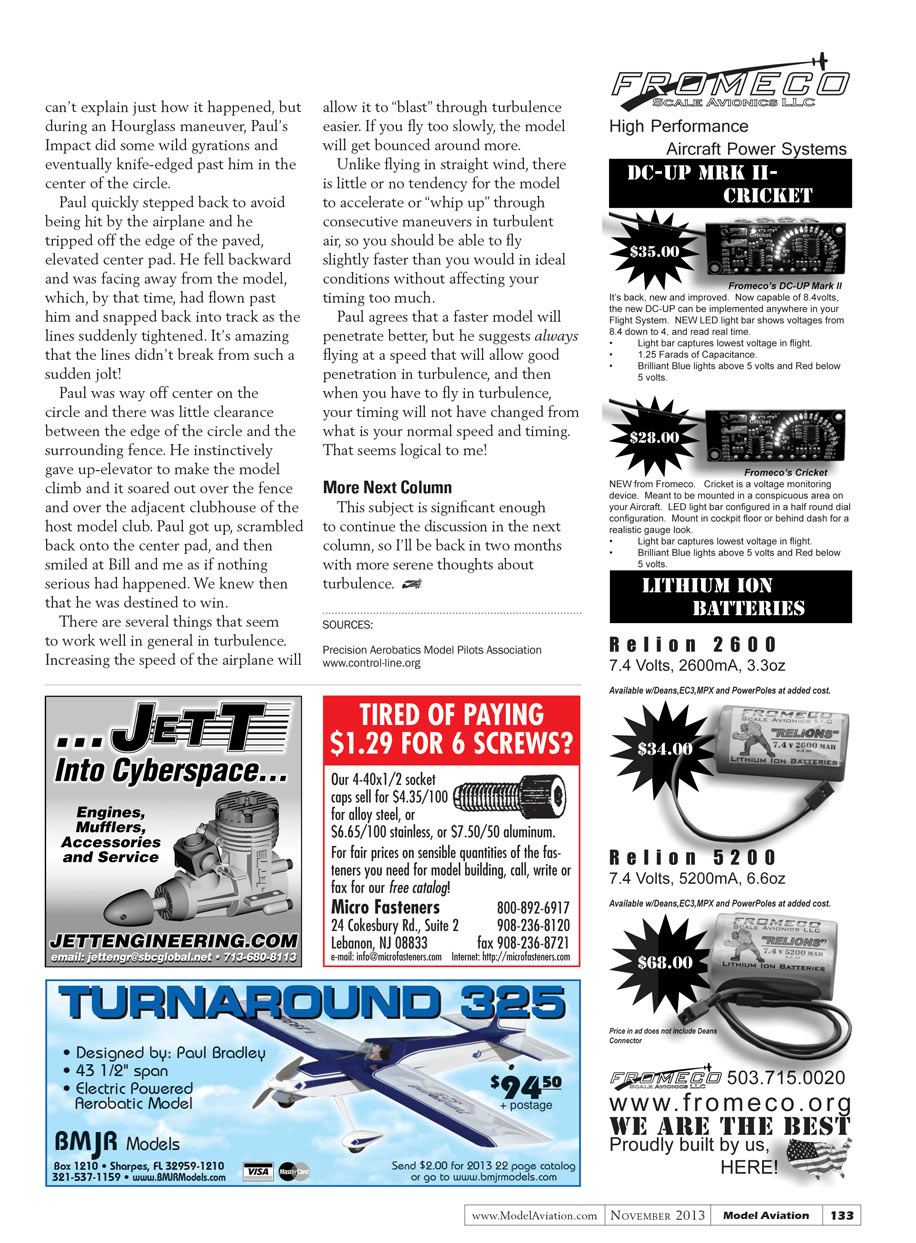
I'm happy to report that John is in much better health, and a number of his closest friends, as well as his son, Nick, were finally able to gather at a local eatery and give John a proper party. John's longtime friend, Tom Niebuhr, sent a plaque to commemorate the occasion, with a touching piece that he had written about John's many contributions. I was honored that Tom asked me to read it at the party.
John, if you are reading this, please know that we all love you and want to thank you again for the many lessons you have taught us throughout the years.
Turbulent Times
Stunt fliers on the East Coast are accustomed to flying at fields where the wind conditions are generally abominable. It's not the wind that's the problem. It's actually the turbulence caused when the wind is spoiled by trees and other obstructions that are in close proximity to the circle.
When wind is diverted by various obstructions, it swirls and eddies in much the same manner that running water does when it passes over and by rocks in a stream. The result is that it is nearly impossible to determine from which direction the prevailing wind is coming. Flying in such conditions is challenging at best, and extremely dangerous—or even catastrophic—for your airplane at worst.
Those of us who have spent most of our flying lives practicing and competing in such conditions have come to accept that line tension is only an occasional luxury, and we have been forced to develop skills perhaps similar to those attributed to the legendary late NASCAR driver, Dale Earnhardt, who it was said could "see" the air currents
CL Aerobatics
Bob Hunt
I cannot remember reading anything about the special set of skills required to fly in such conditions, and only recall a few mentions of what attributes an airplane should have to enable it to optimize performance in turbulent conditions. Let me remedy that now.
Two recent judging stints at notoriously turbulent fields brought this to my attention. The first was at the Garden State Circle Burners' (GSCB) field in Lincoln Park, New Jersey, and the second was at the Middlesex Modelers' field in Middlesex, New Jersey.
Anyone who has flown at either of those sites can attest to how awful the turbulence can be when the wind blows even slightly. Flying at either field in dead calm is even worse!
Those who fly often at the GSCB field have learned where to do their maneuvers to have the best chance of not having their models tossed around or blasted out of the air. I grew up flying at that field and can tell you that as the trees have continued to grow (and they are in close proximity to the circles), the conditions have badly deteriorated.
There is a "spot" on that field that is usually the best place to perform maneuvers, no matter what the direction is of the prevailing wind. That field has what can best be described as a "venturi" through which the wind exits the field.
On most occasions I have been able to get decent line tension by performing the maneuvers there. I'm sure the same holds true for other fields, but you have to experiment to find that sweet spot at each new field.
I remember flying on a turbulent field in Czechoslovakia (as it was then called) in 1992. I was a member of the winning US FAI F2B team that year along with Bill Werwage and the eventual winner of that World Championships, Paul Walker. After a few practice flights on the official competition circle, we were reasonably sure that we had figured out where the venturi was.
Everything was going fine until Paul's aircraft was smacked around by turbulence. It took place so fast that I can't explain just how it happened, but during an Hourglass maneuver, Paul's Impact did some wild gyrations and eventually knife-edged past him in the center of the circle.
Paul quickly stepped back to avoid being hit by the airplane and he tripped off the edge of the paved, elevated center pad. He fell backward and was facing away from the model, which, by that time, had flown past him and snapped back into track as the lines suddenly tightened. It's amazing that the lines didn't break from such a sudden jolt!
Paul was way off center on the circle and there was little clearance between the edge of the circle and the surrounding fence. He instinctively gave up-elevator to make the model climb and it soared out over the fence and over the adjacent clubhouse of the host model club. Paul got up, scrambled back onto the center pad, and then smiled at Bill and me as if nothing serious had happened. We knew then that he was destined to win.
There are several things that seem to work well in general in turbulence. Increasing the speed of the airplane will allow it to "blast" through turbulence easier. If you fly too slowly, the model will get bounced around more.
Unlike flying in straight wind, there is little or no tendency for the model to accelerate or "whip up" through consecutive maneuvers in turbulent air, so you should be able to fly slightly faster than you would in ideal conditions without affecting your timing too much.
Paul agrees that a faster model will penetrate better, but he suggests always flying at a speed that will allow good penetration in turbulence, and then when you have to fly in turbulence, your timing will not have changed from what is your normal speed and timing. That seems logical to me!
More Next Column
This subject is significant enough to continue the discussion in the next column, so I'll be back in two months with more serene thoughts about turbulence.
SOURCES:
Precision Aerobatics Model Pilots Association www.control-line.org
Transcribed from original scans by AI. Minor OCR errors may remain.

