
CL Aerobatics
In last month's Nationals coverage, I mentioned Kaz Minato's model as an example of high technology in flying. During the past few years, we have seen various components molded using carbon/epoxy composite, such as props, bellcranks, spinners, landing gear, etc.
Covering the solid areas of our airplanes with 2-ounce carbon veil has become commonplace. Many have been waiting for the first major components to be fabricated and proven in a successful Stunter.
We have seen fiberglass fuselages. We have seen balsa molded shells in part or full fuselages. All have been successful, but some more than others. The key to success is how light you can produce the component, and that it integrates into your design at equal or less weight.
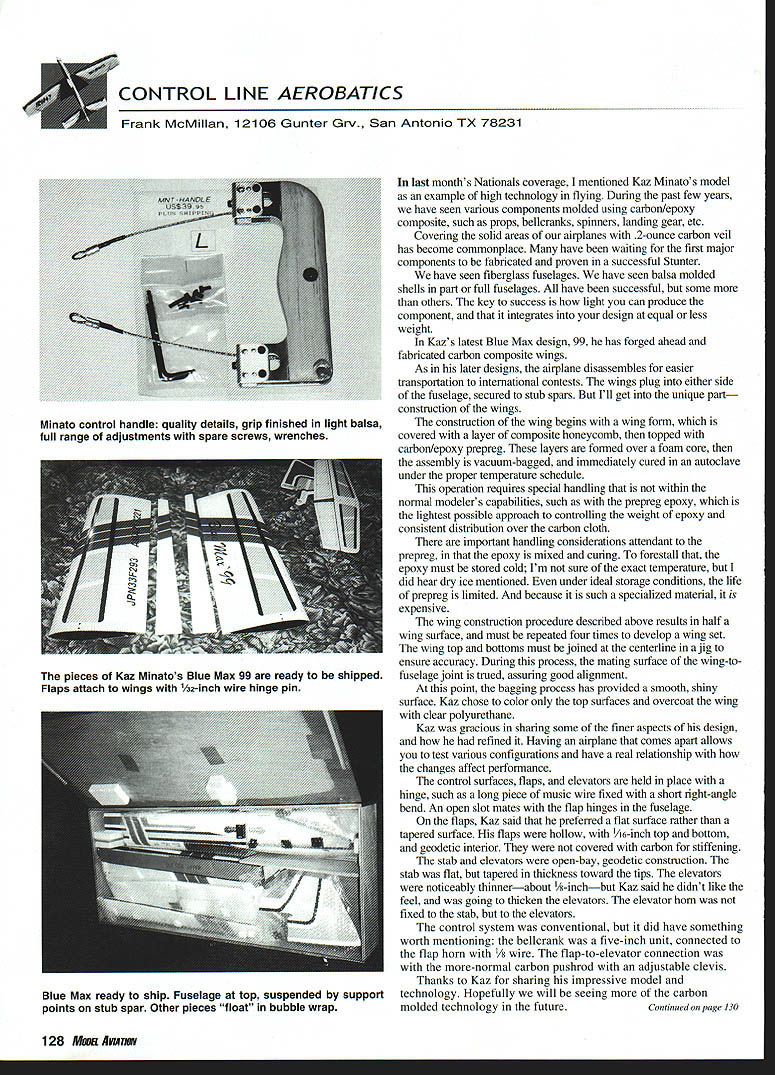
In Kaz's latest Blue Max design, 99, he has forged ahead and fabricated carbon composite wings.
As in his later designs, the airplane disassembles for easier transportation to international contests. The wings plug into either side of the fuselage, secured to stub spars. But I'll get into the unique part—construction of the wing.
The construction of the wing begins with a wing form, which is covered with a layer of composite honeycomb, then topped with carbon/epoxy prepreg. These layers are formed over a foam core, then the assembly is vacuum-bagged, and immediately cured in an autoclave under the proper temperature schedule.
This operation requires special handling that is not within the normal modeler's capabilities, such as with the prepreg epoxy, which is the lightest possible approach to controlling the weight of epoxy and consistent distribution over the carbon cloth.
There are important handling considerations attendant to the prepreg, in that the epoxy is mixed and curing. To forestall that, the epoxy must be cold; I'm not sure of the exact temperature, but I did hear dry ice mentioned. Even under ideal storage conditions, the life of prepreg is limited. And because it is such a specialized material, it is expensive.
The wing construction procedure described above results in half a wing surface, and must be repeated four times to develop a wing set. The wing top and bottoms must be joined at the centerline in a jig to ensure accuracy. During this process, the mating surface of the wing-to-fuselage joint is trued, assuring good alignment.
At this point, the bagging process has provided a smooth, shiny surface. Kaz chose to color only the top surfaces and overcoat the wing with clear polyurethane.
Kaz was gracious in sharing some of the finer aspects of his design, and how he had refined it. Having an airplane that comes apart allows you to test various configurations and have a real relationship with how the changes affect performance.
The control surfaces, flaps, and elevators are held in place with a hinge, such as a long piece of music wire fixed with a short right-angle bend. An open slot mates with the flap hinges in the fuselage.
On the flaps, Kaz said that he preferred a flat surface rather than a tapered surface. His flaps were hollow, with 1/16-inch top and bottom, and geodetic interior. They were not covered with carbon for stiffening.
The stab and elevators were open-bay, geodetic construction. The stab was flat, but tapered in thickness toward the tips. The elevators were noticeably thinner—about 1/8-inch—but Kaz said he didn't like the feel, and was going to thicken the elevators. The elevator horn was not fixed to the stab, but to the elevators.
The control system was conventional, but it did have something worth mentioning: the bellcrank was a five-inch unit, connected to the flap horn with 1/8 wire. The flap-to-elevator connection was with the more-normal carbon pushrod with an adjustable clevis.
Thanks to Kaz for sharing his impressive model and technology. Hopefully we will be seeing more of the carbon molded technology in the future.
CL AEROBATICS
Continued from page 128
New items
Among his many accomplishments, Kaz Minato is a hobby supplier and manufacturer. He is offering an optional handle that is ideal for the discriminating modeler and competitor.
This handle is versatile and light, at 60 grams, with all the adjustable features. The construction is from 1/8" minimum, with standoffs in the center to give the proper thickness. The grip is then formed with balsa for lightness.
The supplied aircraft cable is crimped at both ends, and secured against fraying with heat shrink material. The cable length is adjustable with a clamp in the handle center. The post length and the line spacing are independently variable using predrilled and threaded holes. Capscrews are used, and to show a continuing attention to detail, spare screws and wrenches are provided.
I have flown with the handle, and it is comfortable and easy to use. The range of adjustments are right on target for the current control systems.
The handle comes in two sizes, large and small. If you have a small hand, try the small. My hand fits a size 7 glove, and the large is comfortable.
This is a high-quality product that you can only appreciate when you use it. I highly recommend this extremely well-engineered and well-executed design.
Contact:
- Kaz Minato, MNT. International Wisteria 102, 2-2-31 Tohoku Niza-Shi, Saitama, 352-0011 Japan
- E-mail: [email protected]
- Price: $39.95 (US dollars)
Dan Winship has produced standard and custom horns for the Stunt community for some time; he used them for my control systems for many years. The jewel-like quality of Dan's products has recently been upgraded further, by having the horn uprights laser-cut from 1/16" steel. They are available in the standard sizes and throw, and some custom horns are available.
Dan's recent additions are newly-designed clevises, which have angled bearing seats to provide right angles to the pushrods for linear control. There are also original lightweight carbon bellcranks, upgraded with a turned bearing for the pushrod.
All of these items are the finest available, and Dan is very quick on delivery.
Contact:
- Winship Models, 5971 Oak Hill East Dr., Plainfield IN 46168
- Tel: (317) 839-8316
For several years, many of us have been using Aero Poxy Lite for fillers. It has been mentioned in Stunt News and in this column. However, it was only available in conventional two-part. Now Windy Utzow is offering more convenient quantities to his customers of Pro Stunt Products. He is also offering a companion video, which shows the procedures for using this wonderful product.
Aero Poxy Lite is very light and forms easily. It can be feathered rapidly, and normal dopes and paints adhere extremely well. The one caution is that you must mix it in a two to one ratio, by weight.
This is the best filler material available, and highly recommended. It is $12.95 for six ounces.
Contact:
- Pro Stunt Products, 93 Elliott Pl., Rutherford NJ 07070
- Tel.: (201) 896-8740
MA
Transcribed from original scans by AI. Minor OCR errors may remain.

