
CL Aerobatics
Frank McMillan, 12106 Gunter Grv., San Antonio TX 78231
Overview
Judging by the number of contestants (roughly 25), the US Control Line Aerobatics (F2B) team trials for the 2000 world championships, held September 4–5, was a small contest. However, there isn't a tougher, better-run contest in the US, or arguably in the world.
The wonderful International Aeromodeling Center at Muncie, fortunate weather, and plenty of flying time made for the best contest of the year for the competitors. What more could the serious flier want? The best pilots in the country show at this contest, and the best win! Because of the format and the superior judging, there are no one-flight miracles.
Format
Each contestant started with a package of four official flights on Saturday—two flights against two sets of judges, with the highest score of each set counting. The top 10 scoring fliers advanced to Sunday's finals. Saturday was actually the first of two contests, because the qualifying-round scores do not count on Sunday.
Because of the number of flights and the random draws, a real challenge is presented to each flier.
Conditions
Muncie usually enjoys pleasant weather in the late summer, with cool mornings in the 50s and 60s, warming throughout the long day into the high 80s. Add to that, dead air interspersed with thermal activity, and it makes for some head-shaking. As Bill Wernage said early in the competition, "no matter how many times you've been to Muncie, the site makes you earn it, every time."
The contestants struggled with setups, such as propellers, as the air changed throughout the day. Mix that with the sometimes 12–15 mph winds for just a minute or two, usually in the high-"K" (degree of difficulty) maneuvers, and it could make your day!
Speaking of the special "K," the trials use the same scoring as required by the international rules. This system has the same pattern as the US pattern, but it emphasizes the cornering maneuvers by putting a high "K" factor, or multiplier, against the 1–10 scoring. This puts a high premium on accurate, sharp corners, but also on consistent flying. A bobble in a corner can very quickly lead to a severe drop in the overall scores.
Competitors and equipment
As with all qualifying eliminations, some worthy fliers were eliminated in this contest; many Nationals top-20 fliers had to watch on Sunday. Most had put in a long week of great flying to make the first cut.
- Flying buddies Stan Powell and Dave Hemstrought worked very hard to get their "packages" sorted out for the conditions. Their Randy Smith Tempest designs worked very well.
- Bob McDonald's yellow P-47 Unlimited was exceptional all week; it required virtually no changes, and powered through the varying conditions.
- Rookie-of-the-Year Curt Contrata split an engine mount on his primary Nationals airplane and had to switch to his backup early in the week. With his characteristic hard work, he forced the model to perform well.
- John Davis had a very nice, new SV series model, with his usual color scheme. It was as good as he's had in many years, and his flying looked good.
- PAMPA (Precision Aerobatics Model Pilots Association) historian Wynn Paul flashed some of the form that made him a top-five flier and one-time team member.
- Randy Smith had a new SV-11 with only a few flights on it, but he showed that it is a great airplane. Randy is an excellent flier, with much more to show in this model.
- The Bear was also in the top 10; former world champion Bob Gieseke showed some excellent corners.
Team selection and top finishers
I've heard many rationalizations throughout the years, that because a current team or team member doesn't do well overall, they should step aside and "let" someone else try. That's baloney! You earn your way onto the team in front of the best-trained judges and your fellow competitors.
The team of David Fitzgerald, Bill Werwage, and Paul Walker, with alternate Ted Fancher, were simply the best fliers on the field, period. They carry the flag, and they deserve it, so let's support them.
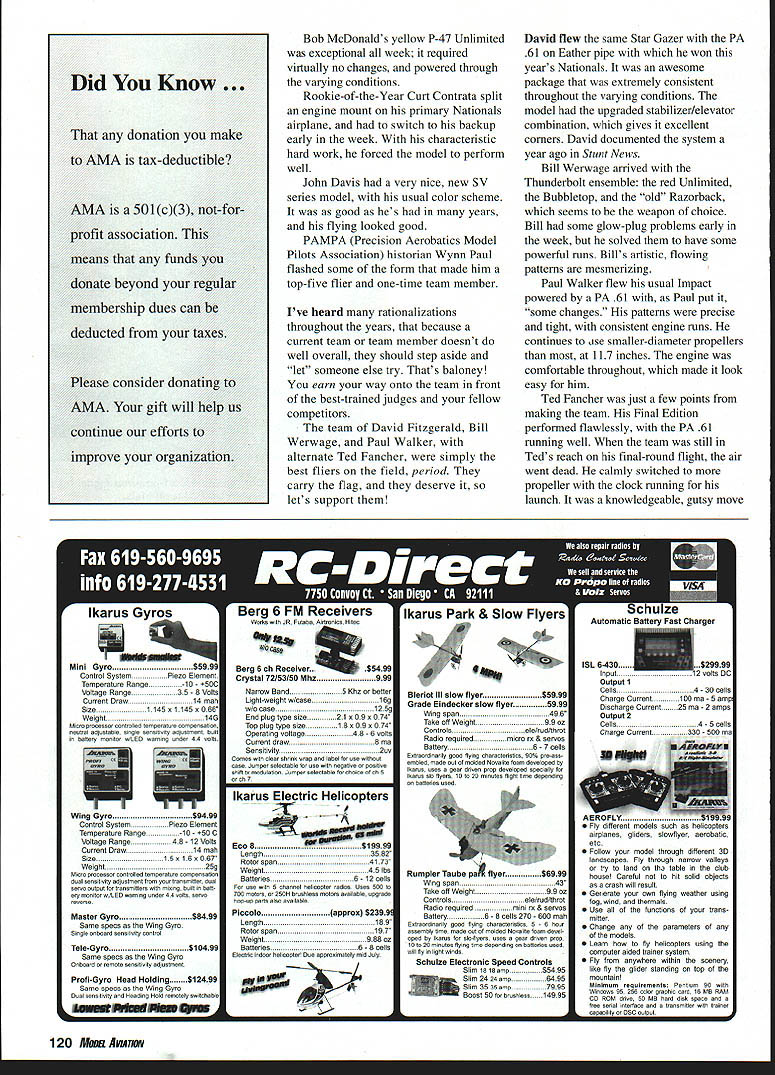
- David Fitzgerald flew the same Star Gazer with the PA .61 on Eather pipe with which he won this year's Nationals. It was an awesome package that was extremely consistent throughout the varying conditions. The model had the upgraded stabilizer/elevator combination, which gives it excellent corners. David documented the system a year ago in Stunt News.
- Bill Werwage arrived with the Thunderbolt ensemble: the red Unlimited, the Bubbletop, and the "old" Razorback, which seems to be the weapon of choice. Bill had some glow-plug problems early in the week, but he solved them to have some powerful runs. Bill's artistic, flowing patterns are mesmerizing.
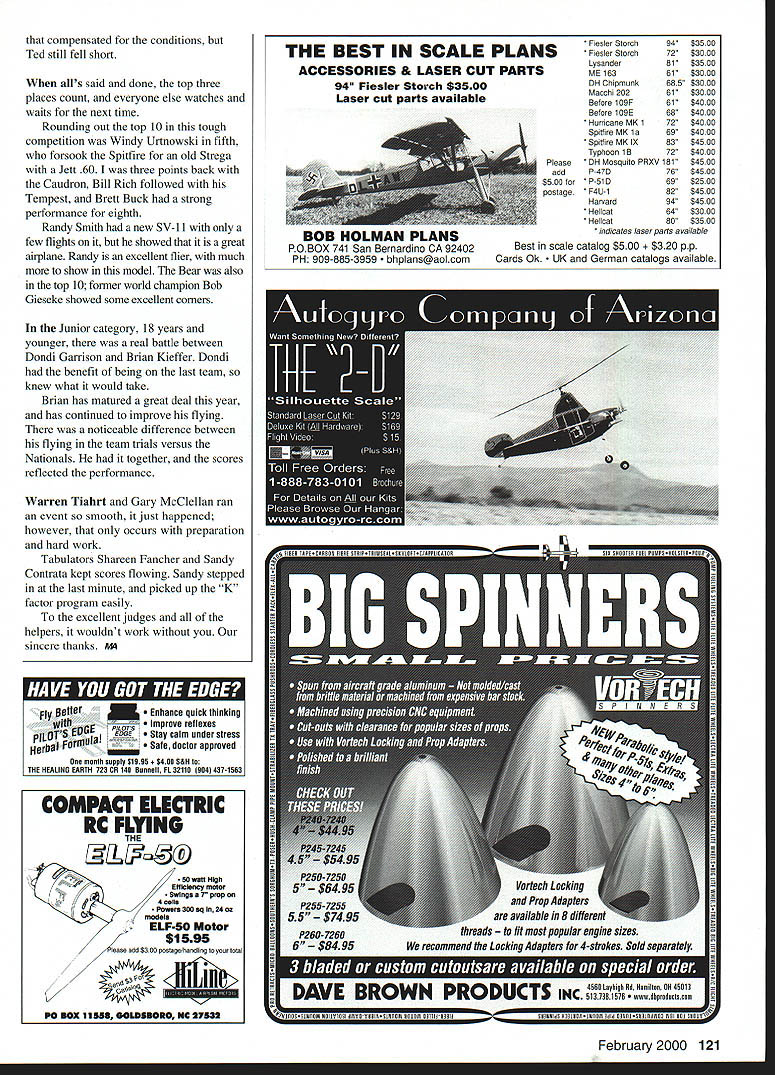
- Paul Walker flew his usual Impact powered by a PA .61 with, as Paul put it, "some changes." His patterns were precise and tight, with consistent engine runs. He continues to use smaller-diameter propellers than most, at 11.7 inches. The engine was comfortable throughout, which made it look easy for him.
- Ted Fancher was just a few points from making the team. His Final Edition performed flawlessly, with the PA .61 running well. When the team was still in Ted's reach on his final-round flight, the air went dead. He calmly switched to more propeller with the clock running for his launch. It was a knowledgeable, gutsy move that compensated for the conditions, but Ted still fell short.
When all's said and done, the top three places count, and everyone else watches and waits for the next time.
Rounding out the top 10 in this tough competition:
- Windy Urtnowski in fifth, who forsook the Spitfire for an old Strega with a Jett .60.
- Frank McMillan (author) was three points back with the Caudron.
- Bill Rich followed with his Tempest.
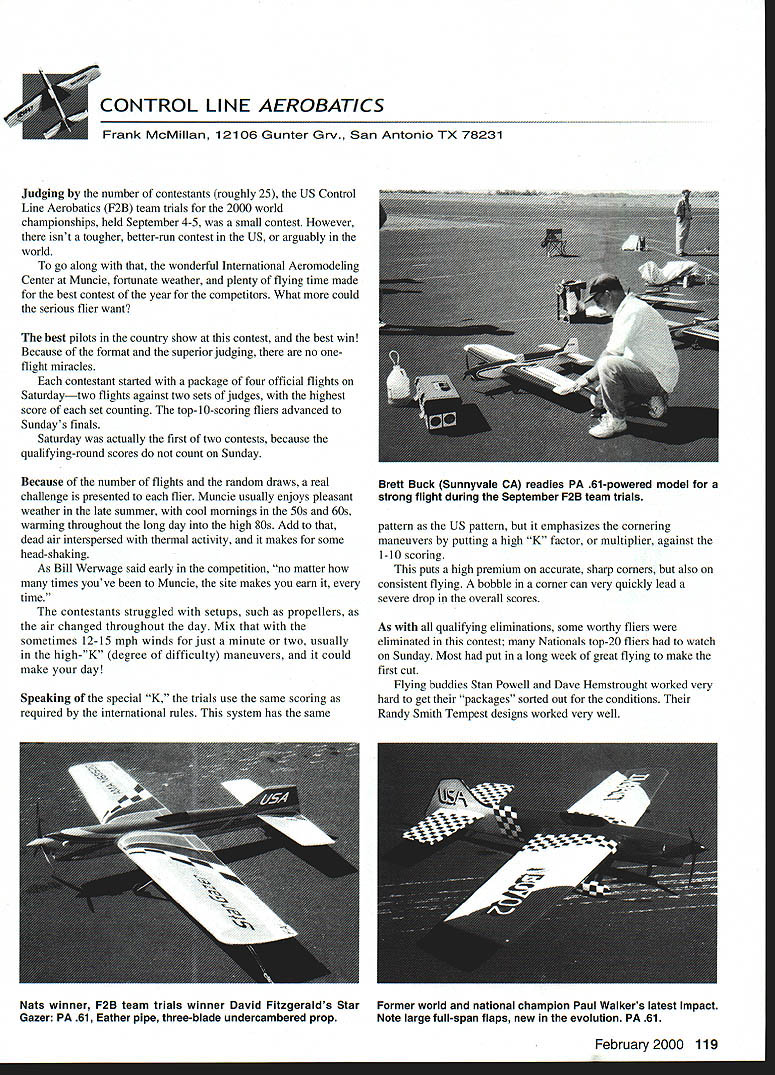
- Brett Buck had a strong performance for eighth.
Junior category
In the Junior category (18 years and younger), there was a real battle between Dondi Garrison and Brian Kieffer. Dondi had the benefit of being on the last team, so knew what it would take. Brian has matured a great deal this year and has continued to improve his flying. There was a noticeable difference between his flying in the team trials versus the Nationals. He had it together, and the scores reflected the performance.
Organization and thanks
Warren Tiahrt and Gary McClellan ran an event so smooth, it just happened; however, that only occurs with preparation and hard work. Tabulators Sharen Fancher and Sandy Contrata kept scores flowing. Sandy stepped in at the last minute and picked up the "K" factor program easily.
To the excellent judges and all of the helpers, it wouldn't work without you. Our sincere thanks. MA
Transcribed from original scans by AI. Minor OCR errors may remain.

