
CL Combat
IT IS EARLY February as I write this column, and the rain is coming down outside. This is the time of year I like to do maintenance on all my support equipment. I like to look at the stuff I have thrown in the miscellaneous-parts box that is in my bigger flight box.
Some of these items are of no practical use and will be thrown out, and other items need to be replaced.
Parts and tools to carry
I like to travel with a few extra bolts of various sizes, sleeves for line ends, pins, copper wire, single-edge razor blades, nuts, washers, pushrod clevises, practice glow plugs, and extra lengths of fuel tubing in the parts box.
This is the time of year to replace your old lamp-cord wire that connects your battery to your glow-plug clip. I like to use the clear, insulated lamp cord so I can see if it is starting to turn green from old age. Seventy-five cents worth of new wire will give you better performance from your battery.
Check your lines and clips to make certain they do not have any kinks or broken strands.
If you are into recycling, consider cutting your 60-foot lines down to 52 feet. Your old Fédération Aéronautique Internationale lines might work better with your Cyclon .049 when they are cut to 35 feet.
Cut away the curled, frayed, or kinked portions of the lines for the recycling to work.
Propellers and gloves
Propeller balancing is best done when you are under no pressure to get the job finished. Now is the time to sand and balance a dozen of your favorite props so they are ready for contest use. Use a permanent marker to indicate that you have balanced a particular prop.
Take the time to sand the flashing off plastic composite props so they don't cut your finger while just turning an engine over.
You may even want to look at the condition of your starting glove, to see if it will last another season. I like to flip an engine with my middle finger on my right hand. I am very fond of this finger, so I like to protect it with a glove that has a piece of spruce spar on the top and bottom portions of the glove.
Glue the spar sticks to the glove with cyanoacrylate adhesive, then wrap the glove finger with several layers of duct tape. I have used this method of protection for many years with great success.
Don't throw the left-hand glove away! With a bit of clever cutting, you can make a second starting glove to fit your right hand.
At one time I used only a glove, without the extra spruce protection, but after the introduction of carbon-fiber and fiberglass props and some burst blood vessels in my middle finger, I decided to change the method of protection.
Fuel bladders and fuelproofing
Look at any bladders left over from last year's flying season. Throw the bladders away and start with new ones if they have not been used in the last three or four months. The fuel they hold costs more than the material to make a new bladder.
A burst bladder will ruin your day and your model if the compartment has not been properly fuelproofed. I have seen Russian-style models fill their wings with fuel when a bladder bursts. The fuel will soften the ribs and eat at the foam.
I want to get you to look at your equipment before you go out for your first flying session of the year. Preparation adds to how much luck you will have during the season.
Join MACA
I have mentioned the Miniature Aircraft Combat Association (MACA) time and again, as a group you should consider joining. You might be asking yourself, "Why should I?"
The most compelling reason is that it is the official Special Interest Group (SIG) recognized by the Academy of Model Aeronautics (AMA). That means this group will be the one asked to give opinions and its official positions on matters relating to Combat events and competition.
AMA sees MACA as the group responsible for running the United States Team Selection Program for the World Championships and the Combat events at the AMA National Championships.
If you become an active member, you may be one of the individuals who will be instrumental in expanding and promoting our chosen sport. Each organization will change with time and as older competitors retire and are replaced with new individuals.
The innovations in equipment will change how and what events are flown. At one time 1/2A Combat was a single-manufacturer and single-engine event with given limitations. Now there are engine classes that make the old rules almost unworkable.
It is up to the individual who only flies the event to modify the rules so they meet the needs of the current participants.
Through MACA's SIG mail and the SIG's publication, the members have a forum to express their views and present proposals that can be considered as possible rules changes. This is really the governance part of the organization.
A more practical reason to join MACA is to gain current information on the latest equipment, tips for construction, and interesting accounts of competitions. You can be part of all this for $15 per year in dues.
All of MACA's officers and representatives are volunteers. They do the work because they enjoy the event and want to see it flourish.
Send a check to MACA, c/o treasurer Gene Berry, 4610 89th St., Lubbock TX 79424.
Bill Maywald has been publishing MACA News, and has done an excellent job. We all need to support his efforts.
Contests and events
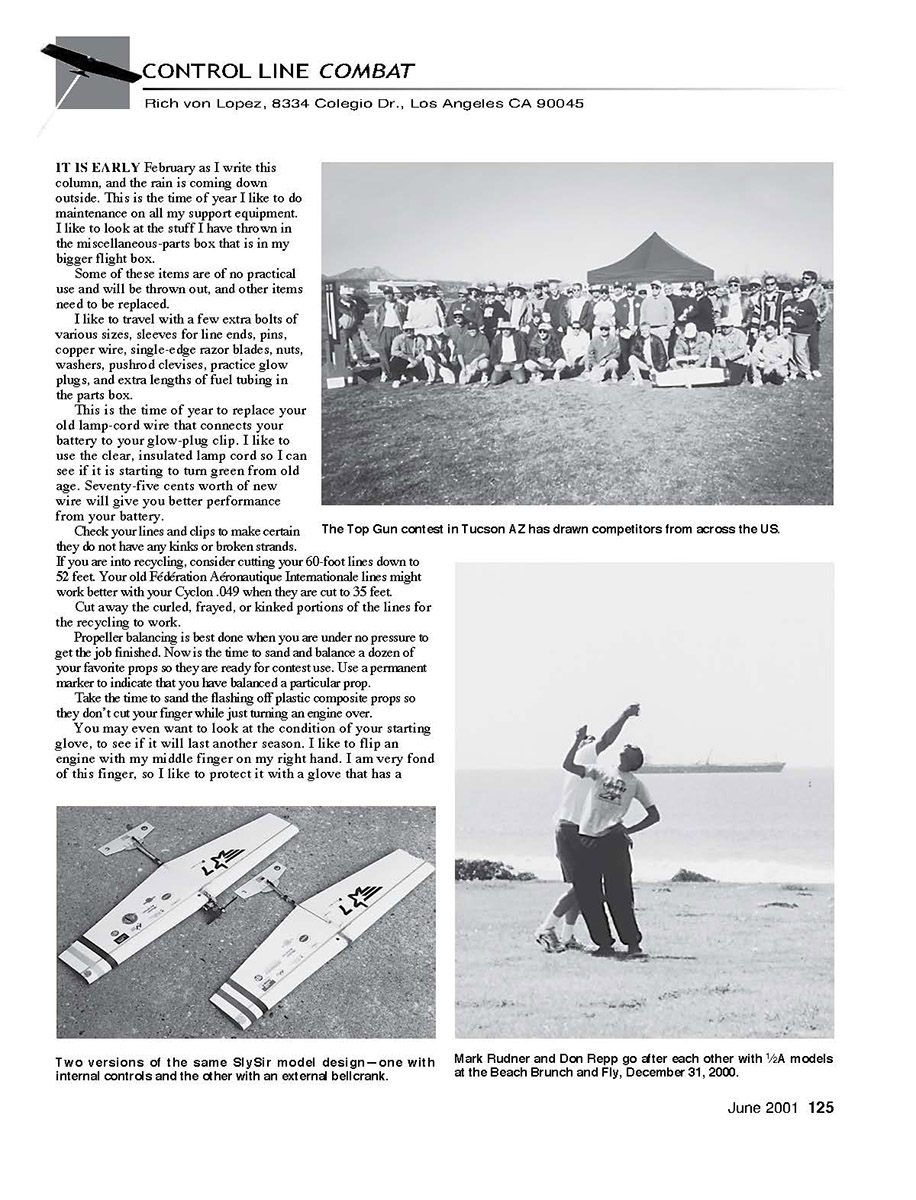
As I write this, it is almost time for the first big contest of the season: the Top Gun Shootout in Tucson, Arizona, March 17-18, 2001. You can tell because the fliers in Southern California have been turning their Fast Combat models and trying new shutoff devices.
The winners will have been decided by the time you read this column, and the lives originally told about particular matches have been exaggerated two or three times.
One contest to consider is the 30th annual Paul Argenter Northwest Control Line Regionals, to be held May 25-27. Various clubs in the Pacific Northwest come together to put on this AMA AAA-sanctioned contest. The venue is the Roseburg Regional Airportland at the Douglas County Fairgrounds in Oregon.
Contact Craig Bartlett, 205 NE Cedar Ln., Corvallis OR 97404; Tel.: (541) 745-2025; E-mail: [email protected]. I have not been to the Northwest Regionals in quite some time, but I hear that this is one contest you do not want to miss.
You may also want to start making plans to be in the Seattle WA area the last weekend of June, for the famous Bladder Grabber contest.
As of this date, I do not have information on where the Team Trials will be held for the 2002 Control Line World Championships. There were no bids as of February.
The news is that the World Air Games this summer will not include Control Line modeling. The Spanish aero clubs have put together a bid to host a European Championship instead.
There is talk of allowing countries outside Europe to enter. This might present a problem for us, since we do not have a way determined to select a team to represent the United States.
Beach Brunch and Fly
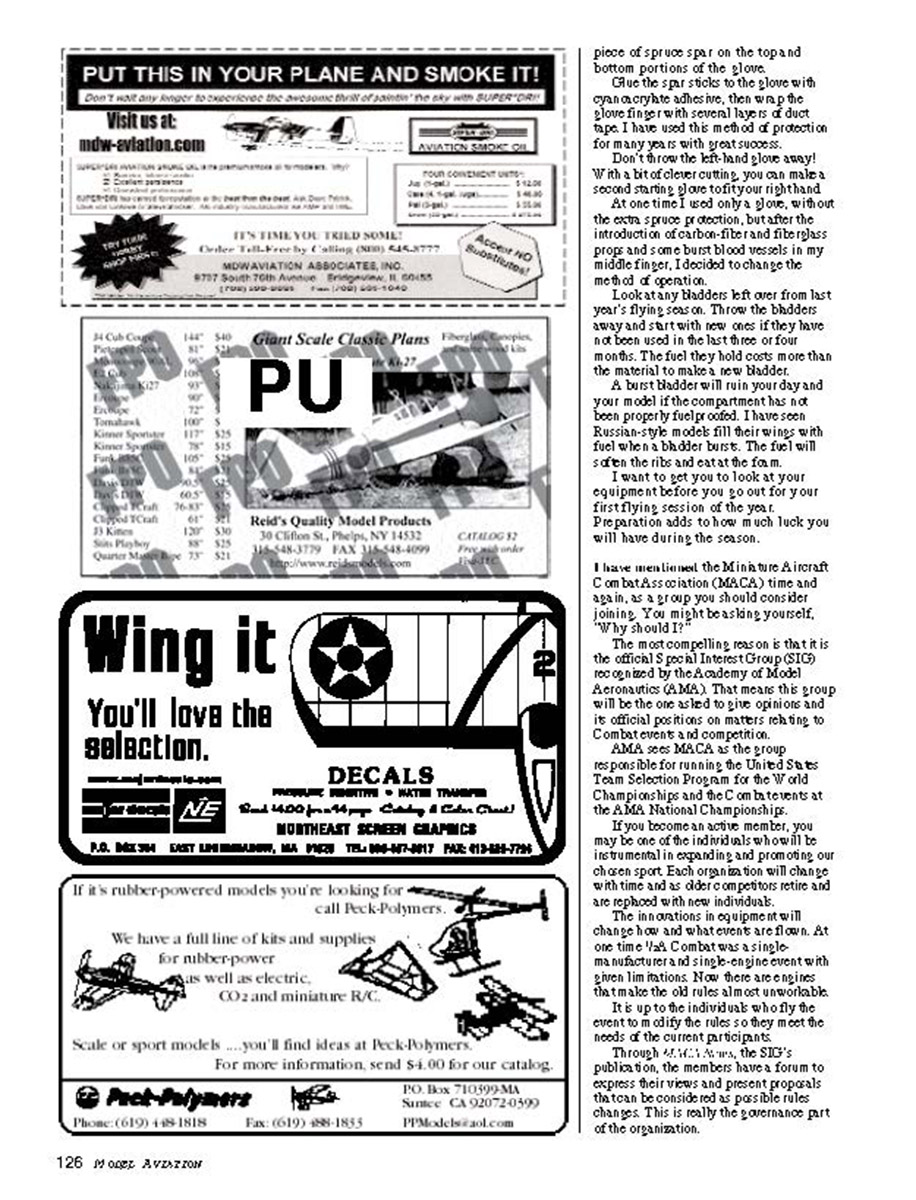
In the April column I mentioned the Beach Brunch and Fly event that I host December 31. It did take place, and we had a beautiful day to determine who would get the last kill of the year and who would be the unlucky pilot to be killed last.
This past year I made two trophies—one for the killer and one for the killed. We pass them out to the person who gets the first kill and is killed first, then we continue to pass them around as the day goes on.
Pete Athans managed a kill on Chuck Rudher late in the day and ended up with the desired trophy; Chuck got the other one.
We use only Tee Dee engines for this 1/2A outing, and we fly at a beautiful location overlooking the Pacific Ocean. I can think of no better way to end the year.
Engine data keeping
I have started keeping data on all my engines. I write the information on the back of old business cards. Recently I began dating the date when I last ran an engine. I like to take rpm readings from time to time and note if the engine had any problems.
If an engine has not been run in a while I make a point to run it the next session, just to keep everything in working order and so it will get new storage oil. Lap times are also good to record.
You may want to use one propeller to collect your data so you are not measuring two different elements. I know that atmospheric conditions will have an effect, but we need to do the best we can.
Start collecting data of your own that is important to your application. Those old business cards can also be used to mix epoxy on, so don't throw them away.
-MK
Transcribed from original scans by AI. Minor OCR errors may remain.

