
Control Line Combat
Iskandar Taib, 517 Tulip Tree Apts., Bloomington IN 47408
This was a good year for Control Line (CL) Combat at the Nationals (Nats). Turnout was relatively high compared to recent years, and the competition was of high caliber.
Last year three fliers showed up for Slow Combat and eight showed up for Fast Combat (or "Combat"). This year Fast Combat drew 20 fliers, including three Juniors.
The unofficial 75 mph Speed Limit event had 18 entries. Of those, six were beginners or infrequent fliers.
A few new things were tried this year, such as the absence of Slow Combat. After many years of a long decline in popularity, it was decided last year that the event would be dropped from the schedule.
With the requirement of hard tanks, large and fragile airplanes, and ever-increasing speeds, it was felt that Slow Combat had long outlived its usefulness as a beginner's event.
This year we flew full-rules F2D and the unofficial 75 mph event, in addition to Fast Combat and 1/2A.
We also experimented with the event order. Fast Combat is usually held at the end of the week. This year we flew it first, on Monday (July 9), and 75 mph last, on Friday (July 13).
Instead of the usual double-elimination format, Fast Combat and 1/2A were flown as full triple-elimination contests, ensuring a great deal of flying for everyone.
This year's Nats was a novel experience for me; I surprised myself by taking third place in Fast Combat—my first Nats trophy. It took 11 matches (all against former Nats champions, I was later reminded) and two blown engines, but it was worth it.
The storm that hit Sunday evening before Combat began was almost biblical. The sky got dark, and the rain came down horizontally. Visibility was roughly 10 feet. One expected the lake to part and the bluegill to start walking up to the new Headquarters building.
The next morning there were puddles in the circles, and the paths over which one had to drive threatened to become muddy swamps. So did the pilot's circle, but Nats HQ provided us with industrial rubber matting, which worked very well.
As a result of the rain, Monday and Tuesday were quite humid, but the extra moisture did make the ground nice and soft—just what one needs for Combat, since airplanes will hit the ground.
In Fast Combat, held Monday and Tuesday, the "kill" rules prevailed. The first pilot to take the other pilot's entire streamer wins outright. The early rounds were relatively clean, with many kills and relatively few midairs and line tangles.
Using shutoffs has become routine, and few matches were affected, or delayed, by malfunctioning shutoffs.
Not much was new in airplane design or construction. Most pilots used Russian/Ukrainian/Czech Ready-to-Flys (RTFs) or foam-shaft airplanes.
I was looking forward to seeing Lee Liddle's Euro-style foamie perform, but the only examples I saw were some repaired ones that belonged to Pat Willcox. These were folding in midair when the repaired spars broke.
In Fast Combat, the foamies were generally stronger than the wood-and-foam models but fell apart under high loads. RTFs; most of the latter would break behind the spars when they hit the ground.
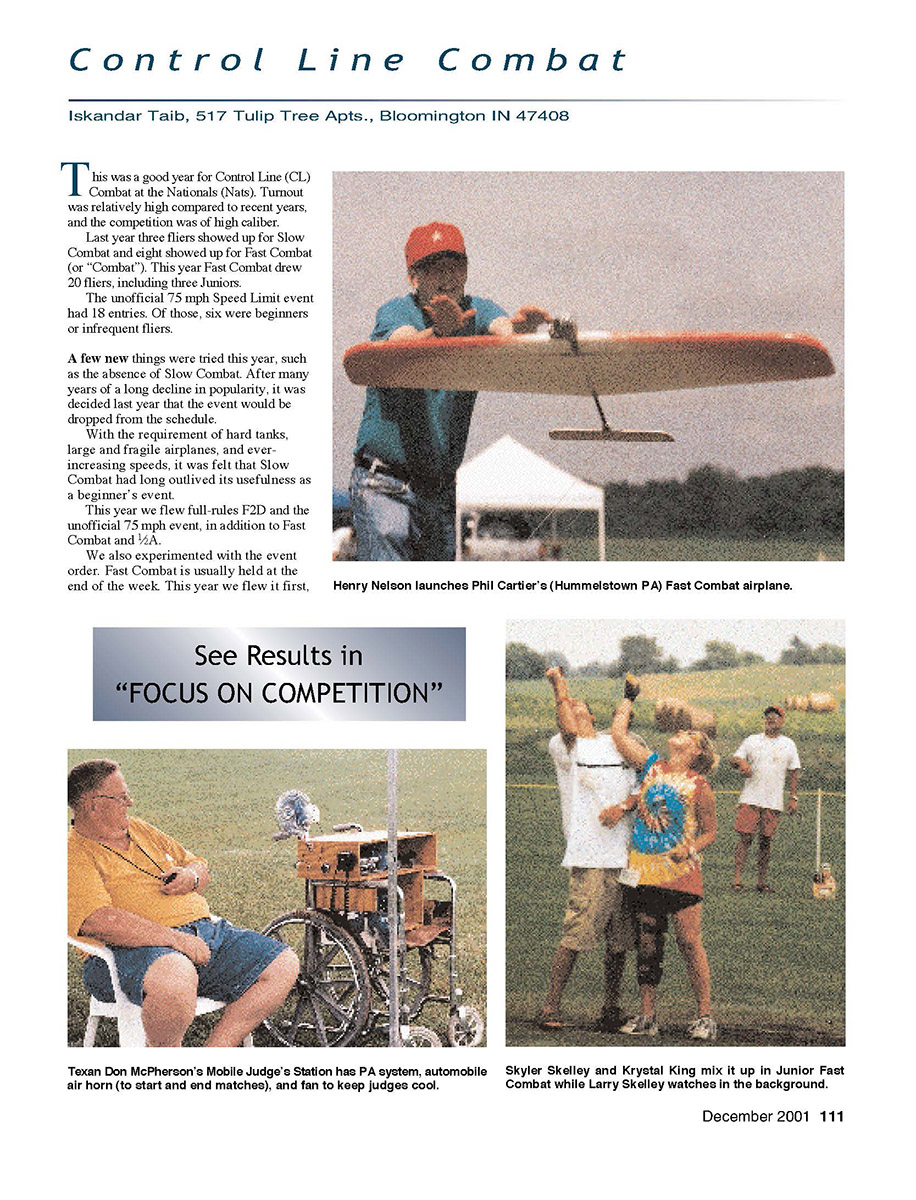
Most fliers used the excellent Nelson Combat Special engine, but George Cleveland brought some new Fora .36s from the Ukraine. They were anodized a deep blue and were just as fast as a Nelson.
Some Foses were probably in use (aside from my Mark VI), but I did not notice them.
Most of the shutoffs in use were of the swinging-weight variety. The Czech-produced imports made up a major portion of these, and King shutoffs made up the rest.
Phil Cartier used a line-tension unit of his own design, and I used a modified Fourmost RC Pylon shutoff. The Mears clan used a sliding-bellcrank unit.
The field was tough; almost everyone who entered was a "brand name" with more than five years of Combat experience.
Although this was good on one level, it wasn't a good sign for the future.
Fortunately, the Speed Limit event made up for it; that's where the beginners entered.
There were three cutaways in Fast Combat. Shutoffs worked great in two of them. In one, the airplane looped twice over the circle, and the engine had shut off after the first loop. In another, an airplane did a wingover above the tent, with the engine shut off before it had left the circle.
In the first cutaway of the contest Monday morning, a spectator was hit and suffered propeller cuts on his elbow. There was no time for the shutoff to work, since the distance was too short. After that incident, the line of spectators was moved back 60 feet.
Since I was in the thick of things for a change, I wasn't able to take as many notes and pictures as I would have, but I can give an account of what happened to me.
My first few matches ended with clean kills—no line tangles, no hitting the ground.
I was slower than everyone else; I used a Magnum .36 until it blew the crank in the fourth match, then I used a Fox Mark VI, then a Wylie .36.
Since I was using a slow engine, people were turning in front of me. George Cleveland decided in the third round that flying a Speed Limit airplane against me would turn the tables. He used an O.S. Max .25 LA engine set up to run 75 mph on an F2D airplane. It didn't work.
The ability to fly up the other person's tailpipe was quite welcome, for a change, but I did have to be careful.
I finished Monday with a 4-0 record. Also with a 4-0 record was Henry Nelson, the eventual winner.
Tuesday was hot and humid but without the cloud cover that made Monday so much more pleasant for flying. (No sun in the eyes.)
Perhaps it was the sun, but I had midairs in the sixth and seventh rounds against Phil Cartier and David Owen. The win against David was my last, and it was all downhill from there.
David "Davey Crockett" Owen of Tennessee was one of the best pilots in the country in the mid-1990s, but he dropped out of the game for a few years. I was glad to see him back, and I hope to see him at many contests in the future. He finished in fifth place, just behind Roy Krupa.
The last four of my matches were against Henry Nelson and Don Cranfill. By the end of the seventh round, Henry and I had one loss apiece, and Don had lost two, so we were flying a round-robin for the trophies.
I had already flown against Don in the second round, but he beat me twice, as did Henry. Henry beat Don to take first place, ending up with a 9-2 record. Don's record was 8-3, and mine was 7-4.
Three Juniors flew in the three official events: Nick Mears (Andy's son), Krystal King—the Princess of Combat—and Skyler Skelley. The standard of flying was high, and any of the three would have done very well if he or she had been competing with the Open fliers.
Nick and Krystal duked it out in the final match of Fast Combat, and Nick won after a spectacular midair.
1/2A was flown Wednesday. There were no big surprises; most fliers used V/A or Cyclon .049 engines, with the odd AMA, and the airplanes were a mix of Eastern European RTFs and American arrow-shaft foamies.
Most of the latter were influenced by Larry Driskill's Lighthawk, with its swept-back leading edge and long tailboom. Many people used molded fiberglass fuselages and propellers rather than the usual cut-down nylon Tornados.
Texans tend to dominate 1/2A, since it is a very popular event in that part of the country.
Flying 1/2A is much more demanding than flying Fast Combat, since perceived airplane speeds from inside the circle are higher and the airplanes don’t pull as much, making eyes-off flying difficult.
The engines can be difficult to start, but that did not turn out to be much of a problem at this meet.
On the plus side, the airplanes are small and tend to bounce rather than break when they hit the ground. Damage from midairs is also less serious.
The Texans have 1/2A down to an art; they know how to start the engines, they know how to make them run fast, and they know how to fly the airplanes.
One of the best matches was in the sixth round. Andy Mears got four cuts on Don Cranfill, but ended up losing the match when Don cut the string to score a kill.
Pat Willcox and Bobby Mears battled it out in another match, getting one cut each. Pat flew evasively in the end, and the match was decided by one second of airtime—Bob’s 209 seconds to Pat’s 208.
Only the experts were left by this time, and all the matches were spectacular.
Bob Mears was the only pilot who had no losses at the end of seventh round. Four other fliers were left, all with two losses.
Bob had to fly against his brother Andy, beating him and eliminating him from the competition.
George Cleveland, Pat Willcox, and Bob Mears were in contention for the first three trophies. George and Pat had two losses each, and Bob had none. To prevent Bob from taking first place at that point, the other two would have had to beat him three times.
George won the first match against Bob, who then defeated Pat, which put Pat in third place. Then George managed another win against Bob, but was not able to do it a third time in the next match.
Larry Driskill took fourth place after defeating Don Cranfill.
The three Juniors repeated their Fast Combat placings; Nick Mears won, followed by Krystal King then by Skyler Skelley.
F2D was held Thursday. F2D is the international class, and its popularity has never been higher. No fewer than 17 pilots competed, including the three Juniors who were put in the same pool as the Open fliers.
Rich Tupper of Chicago IL was initially entered, but he decided to run the contest instead; he spent the day as center marshal.
This is a change from the past, when F2D at the Nats was poorly attended, and there wasn’t enough expertise to run full rules.
The weather had turned much cooler; it was actually quite cold in the morning, with sparse cloud cover and hardly any wind.
F2D has a complicated set of rules. A pilot or his/her pitmen can commit numerous fouls, resulting in loss of points or disqualification.
Unlike in Fast Combat and 1/2A, taking the whole streamer is just considered another cut and is, in fact, something to avoid, since one cannot earn any more cuts after taking the whole streamer.
A pilot who does this early in the match ends up having to evade during the rest of the match.
Each pilot is allowed two airplanes. When one crashes, the pit crew must remove the streamer (or what is left of it) from the downed airplane and attach it to the spare airplane.
Pitting is crucial in this game; pickup pit crews are rare. F2D is the event in which the helmets come out. Everyone in the match (pilots, pitmen, and center marshal) wears a helmet.
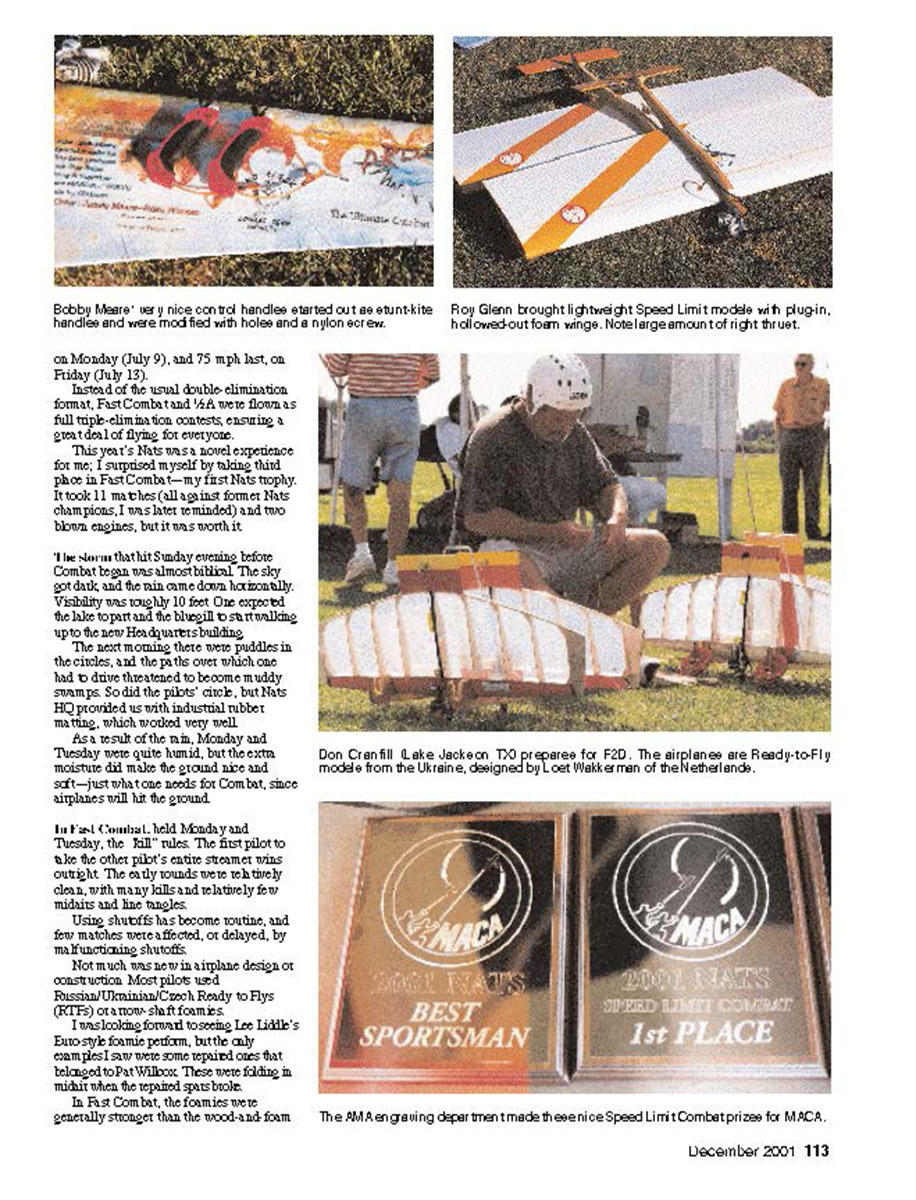
The Mears clan wore chrome-plated motorbike helmets, which earned them the name “Team Chrome Dome.”
Equipment is dominated by imports from Eastern Europe. Several brands of engines and several varieties of RTF airplanes are available from Russia and the Ukraine, which sport paper-covered, foam leading edges and a balsa framework behind the spars.
The engines turn more than 30,000 rpm and use small, thin-bladed fiberglass propellers.
There were some exceptions. Bob Mears was flying lemon-yellow arrow-shaft ones he designed, and some Lee Liddle-designed European-styled foamies were present.
F2D airplanes fly fast, turn very tight, and can usually hit the ground without damage. F2D matches are fun to watch; the action rarely ceases. At the start of the match, each pilot's pitman will start the models. The first airplane that starts is used to begin the match. Both running models are launched at the launch signal.
If an airplane goes down, the line tangle (if there is one) is cleared and one pitman rushes off to retrieve the model, remove the streamer, and run back to the pits, where the other pitman is busy starting the second engine.
The streamer is attached to the second airplane, and it is launched. Then the pitmen start working on the first model, changing the propeller, if necessary, and making repairs, if possible, in order to be able to use it again if the second airplane comes down.
One of the best matches took place in the second round, with Ray Glenn scoring two cuts vs. Don Crandall scoring seven cuts.
Ray took his cuts early, and spent the next three minutes evading. Don managed to get close and scored five cuts in the space of approximately 10 seconds.
Watching F2D is fun, but judging it can be trying. It took three reflies (four matches total) to decide Tom Fluker vs. Aleksey Tupounov in the second round.
The scores were tied in the first match. One of the airplanes got cut loose in the second match (which also merits a refly). The third match also resulted in a tied score. Tom finally won the fourth match, three cuts to one.
Two of the three Juniors were among the six top flyers in the sixth round. Krystal King, Nick Mears, and Don Crandall had to fly off for the third-, fourth-, and fifth-place spots.
Krystal finished in third place, also earning the Highest Placing Junior trophy. Nick finished in fourth place, and Don ended up fifth.
Tom Fluker, the 1982 F2D World Champion, and George Cleveland, 2000 US team member, flew off for the top two spots. George scored a cut but lost on airtime, so Tom Fluker is the 2001 FAI CL Combat Nats Champion.
Friday was the day to let one's hair down, relatively speaking; it was the day for the unofficial Speed Limit Combat event. With a 25 mph limit, almost anyone can join in using any engine and airplane.
As with most Speed Limit contests, the equipment was varied. There was everything from a Czech F2D airplane with a .25 attached to the nose to an old Fast Combat airplane with a Fox Stunt engine.
The most popular engines were in the .25 to .28 range. Several people flew the inexpensive OS Max .25LA and the Thunder Tiger GP .25, but I had a Magnum .28 XLA, Mike Ogren had a Merco .28, and Larry Driskill flew with a Fox .28-R.
Bob Mears even flew a Nelson with a severely restricted intake to get the speed down.
In contrast to the other events, the atmosphere was laid-back, and several beginners and occasional fliers entered. A Top Sportsman trophy was to be awarded to the irregular flier who made it furthest in the contest.
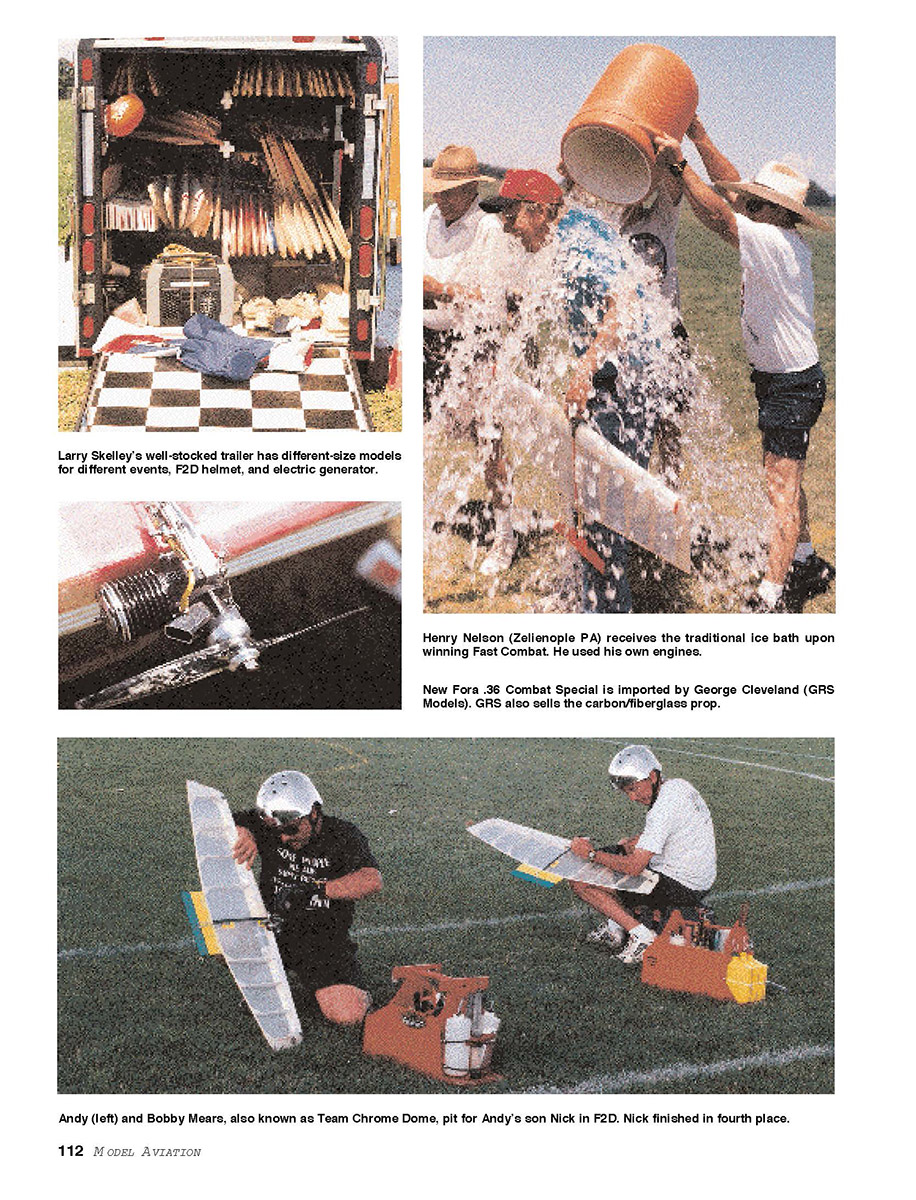
Two designs stood out from the rest. Roy Glenn brought out some large, very lightweight foamies with hollowed-out, plug-in wings. The plug-in wings make repair easy.
Mike Ogren brought some very unusual foam-wing airplanes with upright engines, which he kits. The models were on the small side, and the upright engine was prone to flooding if you didn't shut off the fuel immediately upon a forced landing, but they seemed to fly okay.
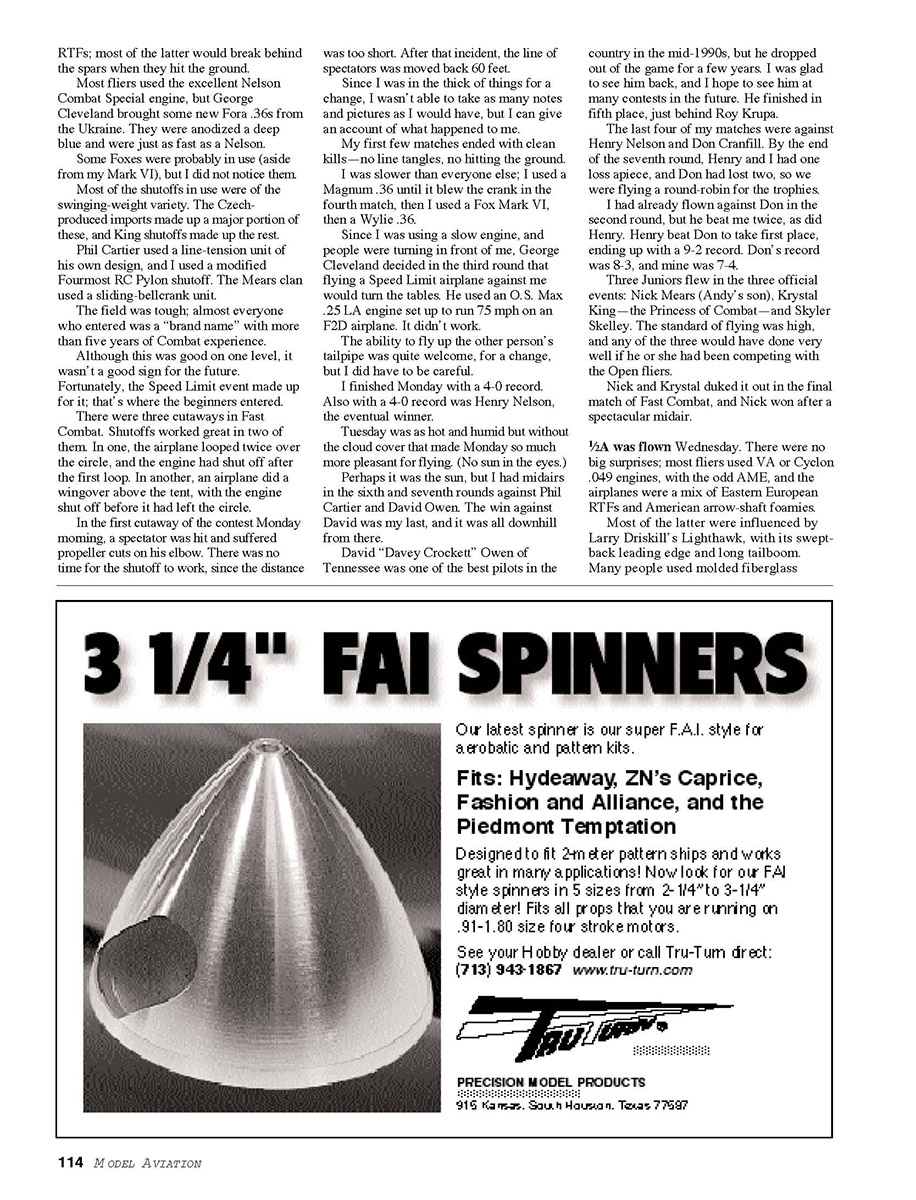
Larry Driskill arranged with the AMA engraving department (which makes all the trophies for the Nats) to obtain plaques for the winners. The price was very reasonable, and the plaques looked very nice, with an engraved Miniature Aircraft Combat Association (MACA) emblem on the front.
It was decided by popular vote that a kill would not end the match; tactics that worked in Fast Combat would not work here. The better fliers tried to feed entire streamers to the other fliers before leisurely going for at least four cuts.
Larry Driskill used this strategy against me, handing me my second loss and ending my contest in the fourth round. Larry ended up with a 7-1 record to win the event.
Wayne McDaniel went 5-2 to finish second, and George Cleveland took third at 5-2.
Mike Ogren took the Top Sportsman award. He tied with two others in terms of matches won and lost, but he scored the most points in aggregate.
Although the number of entries cannot begin to compare with the Navy Nats of yore, it was a better turnout than we've had in years.
With Fast Combat and 1/2A run as triple-elimination contests, everyone got his or her fill of flying. There were events for everyone, from rank beginner to seasoned pro to international competitor.
Although the weather was not ideal, it was pleasant in general. No rain fell during the competition, and the soggy ground helped save many an airplane and engine. Hopefully we can repeat this next year.
The major challenge is finding enough people to run the contest, since Muncie is not home to a group of Combat fliers. We ended up with an adequate number of workers this year since not everyone flew in every event, and several volunteers came out mainly to judge.
Special thanks to Sheila Cranfill, who tabulated and posted the scores all week; to Rich Tupper, who volunteered to run Fast Combat and F2D; to Phil Gaff, who won a 1/2A; to Riley Wooten, who ran Speed Limit; and to Walt Siedecki, Don McPherson, Pat Zerfas, and the Mears brothers, who did a lot of judging during the week.
Many others helped judge, and I apologize for not having all your names.
Join the Combat Mailing List to keep up with the latest news about CL Combat! Go to http://groups.yahoo.com/group/combat-L to join.
And join MACA! The Web site is http://www.aerovents.com/maca/. MA
Transcribed from original scans by AI. Minor OCR errors may remain.

