
CL Combat
Rich von Lopez, 8334 Colegio Dr., Los Angeles CA 90045
BY THE TIME you read this column, we will be well into the 2002 contest season. The Combat season begins during the month of March with the now-famous Top Gun contest in Tucson, Arizona.
Arizona usually has good weather in late winter and is an ideal spot to travel to if you have been fighting off bitter cold in your part of the world. Pilots came from as far away as Pennsylvania, Illinois, and Washington. The usual crowds from California and Texas were in attendance, making the field of 29 interesting.
The addition of 1/2A Combat on Friday gave the start of the season some flavor. This has become a Cyclon-powered event on 42-foot lines. The little Cyclon can only be described as a jewel of an engine that has the temperament of a well-trained beagle hunting hound. These engines are fast, reliable, dependable, and quick to start.
At the pilots' meeting everyone agreed that the use of electric starters would be permitted. Through GRS Models (2121 N. Causeway Blvd., Suite 156A, Metairie LA 70001; Tel.: (504) 443-4640; E-mail: [email protected]), George Cleveland is able to supply plenty of good-quality airframes to anyone who wants to try his or her hand at this event.
I finally got around to flying my Cyclon-size Wakkerman model and was thoroughly pleased with the flying characteristics. This model is stable yet responsive. It can be flown inverted and low to the ground without worry that it will suddenly twitch and break one of those $5 propellers.
Darrin Albert of the San Diego, California area was the winner in 1/2A. He has been working hard at refining his skills with the likes of Greg Hill and Roger Ochoa. Several other pilots from that area fly practice matches but don't make it out to the big meets.
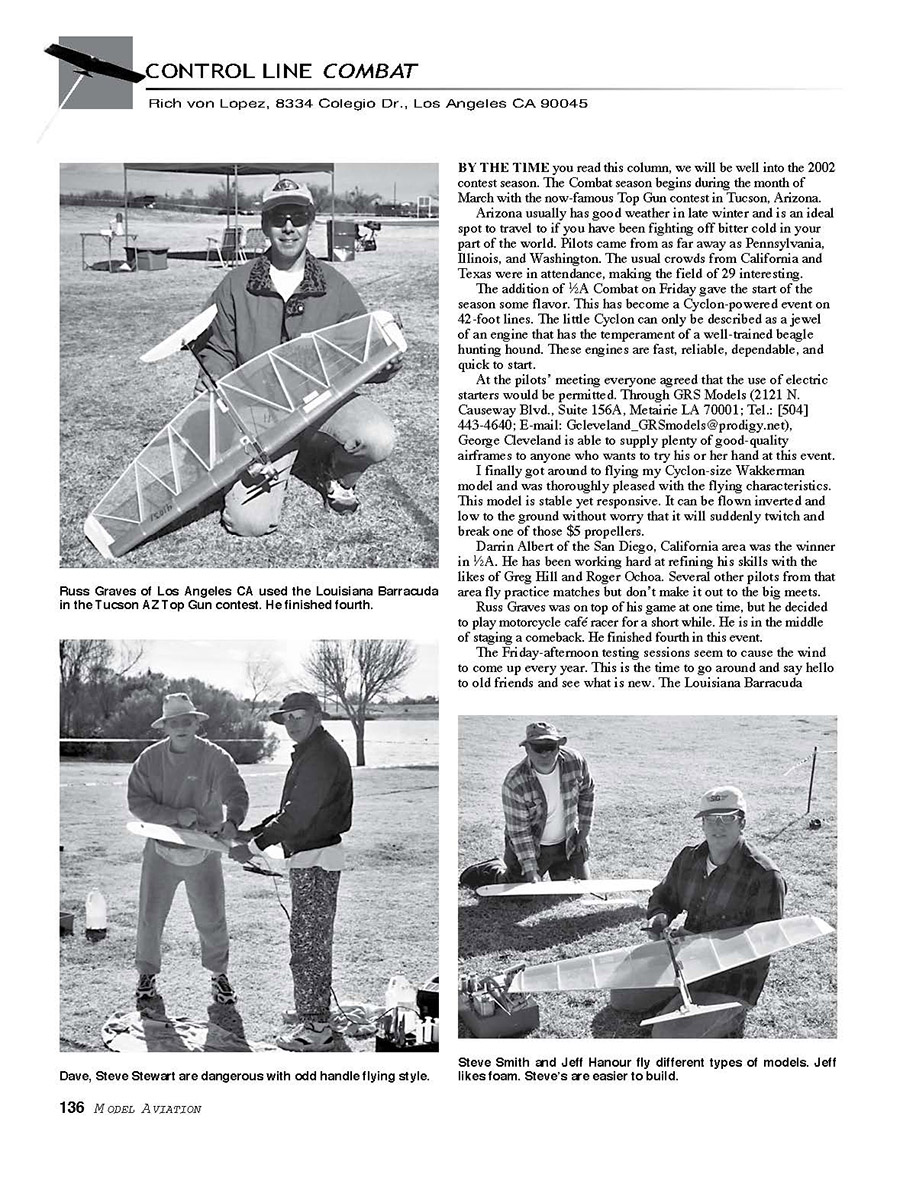
Russ Graves was on top of his game at one time, but he decided to play motorcycle café racer for a short while. He is in the middle of staging a comeback. He finished fourth in this event.
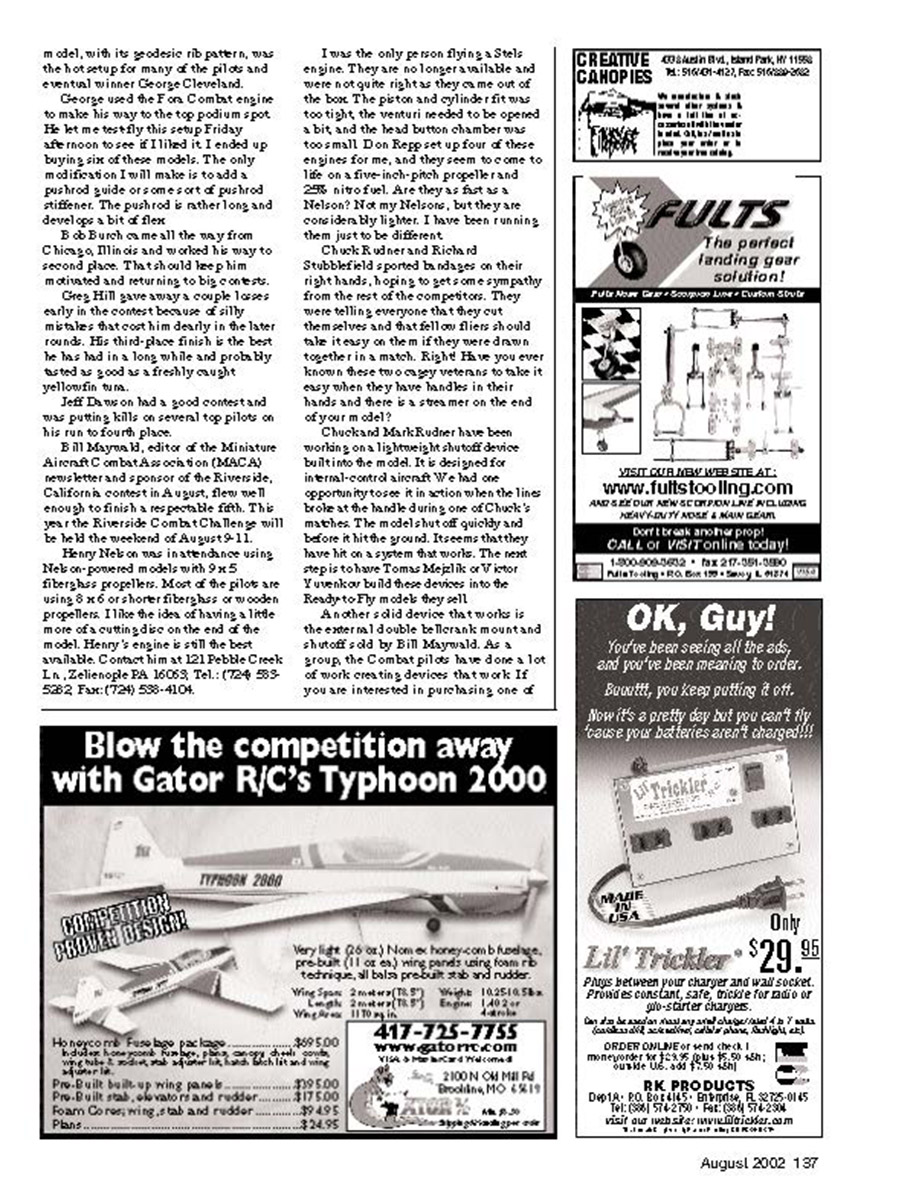
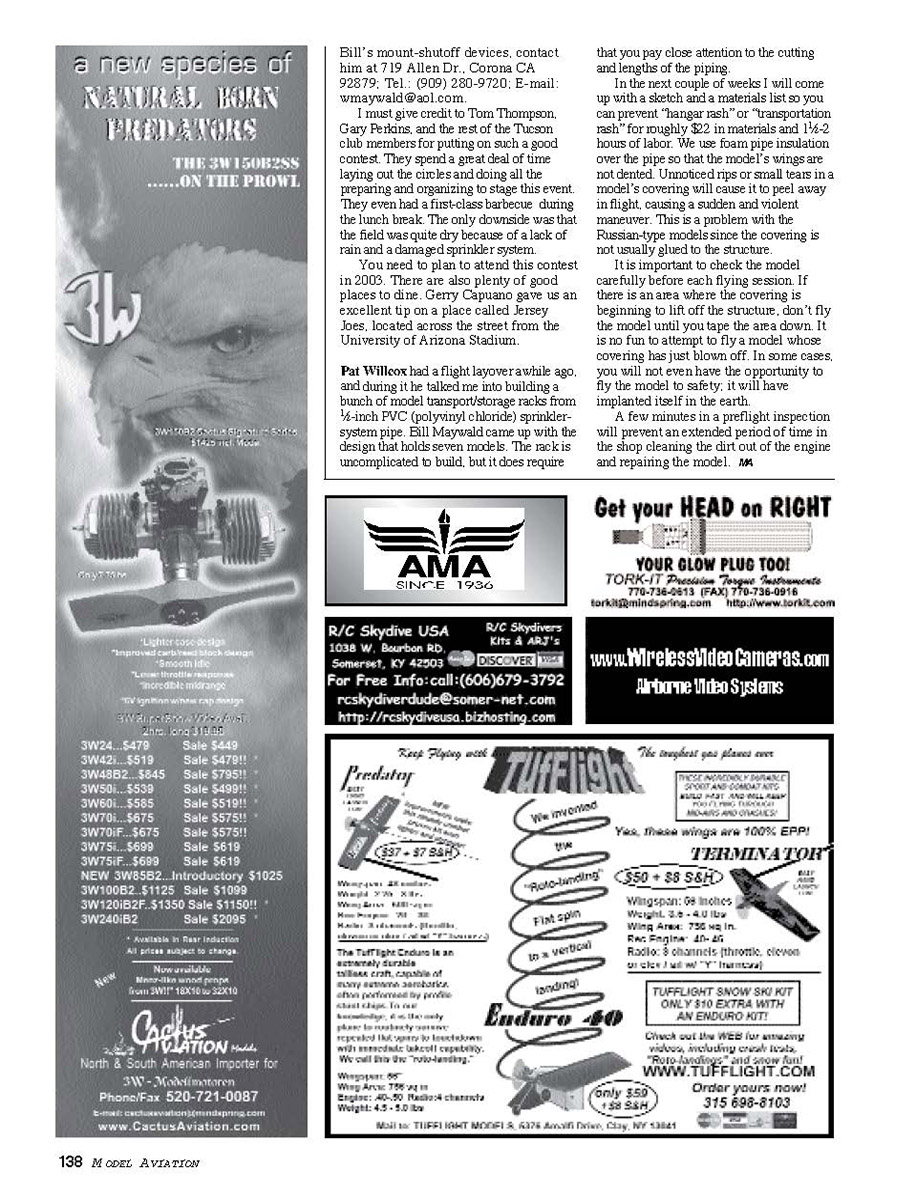
The Friday-afternoon testing sessions seem to cause the wind to come up every year. This is the time to go around and say hello to old friends and see what is new. The Louisiana Barracuda
I was the only person flying a Stels engine. They are no longer available and were not quite right as they came out of the box. The piston and cylinder fit was too tight, the venturi needed to be opened a bit, and the head button chambers were too small. Don Repp set up four of these engines for me, and they seem to come to life on a five-inch-pitch propeller and 28% nitro fuel. Are they as fast as Nelson? Not my Nelsons, but they are considerably lighter. I have been running them just to be different.
Chuck Rudner and Richard Stubblefield sported bandages on their right hands, hoping to get some sympathy from the rest of the competitors. They were telling everyone that they cut themselves and that fellow fliers should take it easy on them if they were drawn together in a match. Right! Have you ever known these two gents to take it easy when they have handles in their hands and there is a streamer on the end of your model?
Chuck and Mark Rudner have been working on a lightweight shutoff device built into the model. It is designed for internal-control aircraft. We had one opportunity to see it in action when the lines broke at the handle during one of Chuck's matches. The model shut off quickly and before it hit the ground. It seems that they have hit on a system that works. The next step is to have Tomas Mejlik or Victor Yuvanov build these devices into the Ready-to-Fly models they sell.
Another solid device that works is the external model double bellcrank mount and shutoff sold by Bill Maywald. As a group, the Combat pilots have done a lot of work creating devices that work. If you are interested in purchasing one of these items, contact the manufacturer directly. Bill's mount-shutoff devices, contact him at 719 Allen Dr., Corona CA 92879; Tel.: (909) 280-9720; E-mail: [email protected].
I must give credit to Tom Thompson, Gary Perkins, and the rest of the Tucson club members for putting on such a good contest. They spend a great deal of time laying out the circles and doing all the preparing and organizing to stage this event. They even had a first-class barbecue during the lunch break. The only downside was that the field was quite dry because of a lack of rain and a damaged sprinkler system.
You need to plan to attend this contest in 2003. There are also plenty of good places to dine. Gerry Capuano gave us an excellent tip on a place called Jersey Joes, located across the street from the University of Arizona Stadium.
Pat Willcox had a flight layover awhile ago, and during it he talked me into building a bunch of model transport/storage racks from 1/2-inch PVC (polyvinyl chloride) sprinkler-system pipe. Bill Maywald came up with the design that holds seven models. The rack is uncomplicated to build, but it does require that you pay close attention to the cutting and lengths of the piping.
In the next couple of weeks I will come up with a sketch and a materials list so you can prevent "hangar rash" or "transportation rash" for roughly $22 in materials and 1-1/2-2 hours of labor. We use foam pipe insulation over the pipe so that the model's wings are not dented. Unnoticed nips or small tears in a model's covering will cause it to peel away in flight, causing a sudden and violent maneuver. This is a problem with the Russian-type models since the covering is not usually glued to the structure.
It is important to check the model carefully before each flying session. If there is an area where the covering is beginning to lift off the structure, don't fly the model until you tape the area down. It is no fun to attempt to fly a model whose covering has just blown off. In some cases, you will not even have the opportunity to fly the model to safety; it will have implanted itself in the earth.
A few minutes in a preflight inspection will prevent an extended period of time in the shop cleaning the dirt out of the engine and repairing the model. MA
Transcribed from original scans by AI. Minor OCR errors may remain.

