
CL Combat
Wayne McDaniel, 5009 Preakness Ct., Muncie IN 47304; E-mail: [email protected]
IT IS NATIONALS (Nats) coverage time again! The Control Line (CL) Combat events were held July 14-20. I went out to the Combat site on Sunday, and the setup was the same as last year. They gave us three circles, a fenced-off safety area that was larger than last year, and the restrooms were there and we did not even have to ask for them.
Larry Driskill was already there, and right after I arrived Roy Krupa drove up, then Phil Granderson came wandering across the field from the CL stunt circle. We all shook hands, then Larry and Phil had a moment. A number of people started coming up, including Ray Krupa.
We discussed with Don McPherson, Howard Rush, and Larry Driskill when we were going to get started Monday morning because it is always difficult to get going the first day of the Nats. It was decided that 10 a.m. would be the goal.
Fast Combat started Monday morning. I arrived at the field at 8 a.m., and there was already activity. Many were test flying and others were making up lines. Co-event directors were Don McPherson, Phil Cartier, and Larry Driskill. Being an even-numbered year, the entry level was down; this can be attributed mainly to the CL World Championships. Fast Combat had 10 entries.
The equipment used in this category were home-built foamie models—GFS and Mezjlik store-bought—and mainly Nelson engines with a couple of GRS-Poros and at least one Fox.
After the first three rounds, four guys were clean and looked to be in the drivers' seats: Phil Granderson, Phil Cartier, Tim Soukup, and Roy Krupa. We went through four rounds the first day and were to start at 9 a.m. Tuesday.
To move things along, we used an eight-minute clock. For people who have never been to the Nats, we have a large clock on the circle. When one match was finished and the circle was clear, the clock would be started at eight minutes. That meant you had three minutes to get in the circle and get set up, and at five minutes they were going to give the start signal. They did not make any exceptions, and it moved the matches along very well.
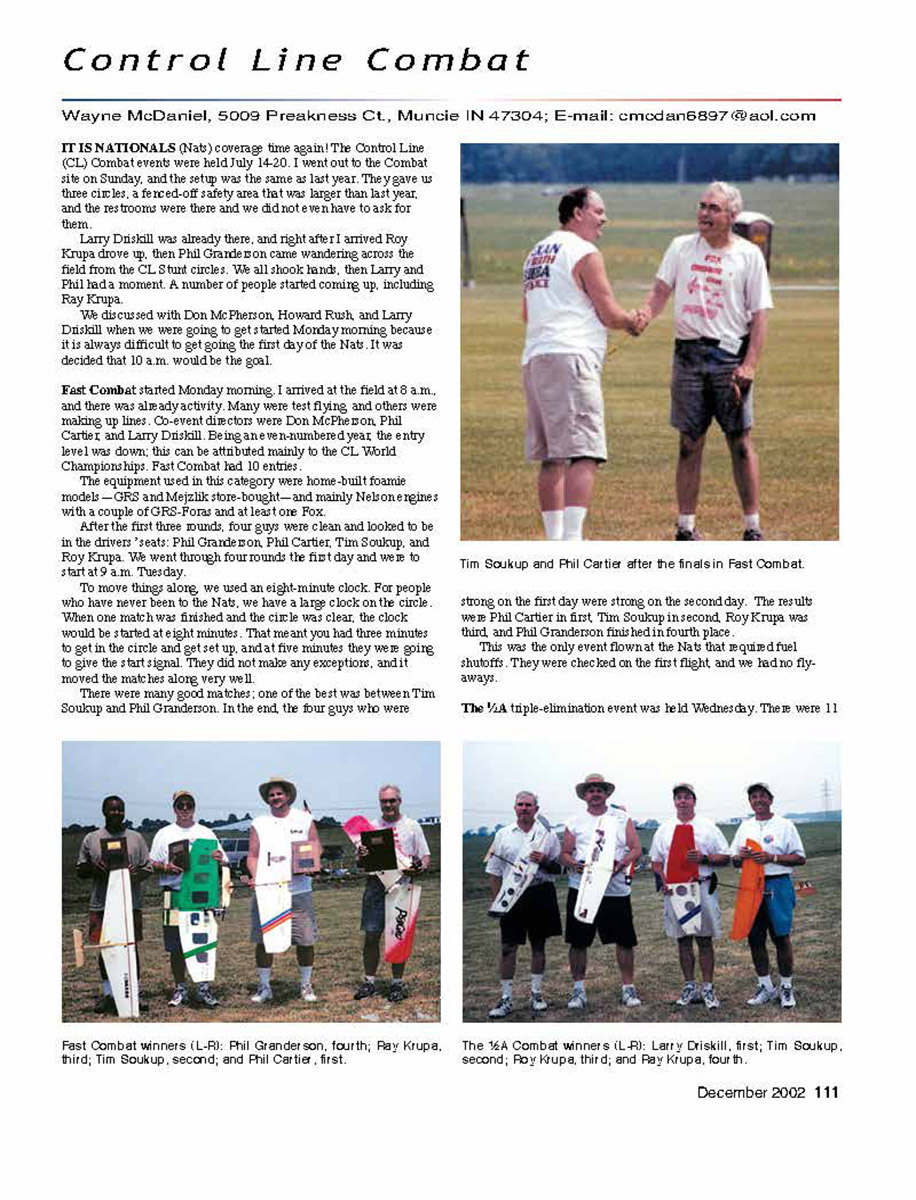
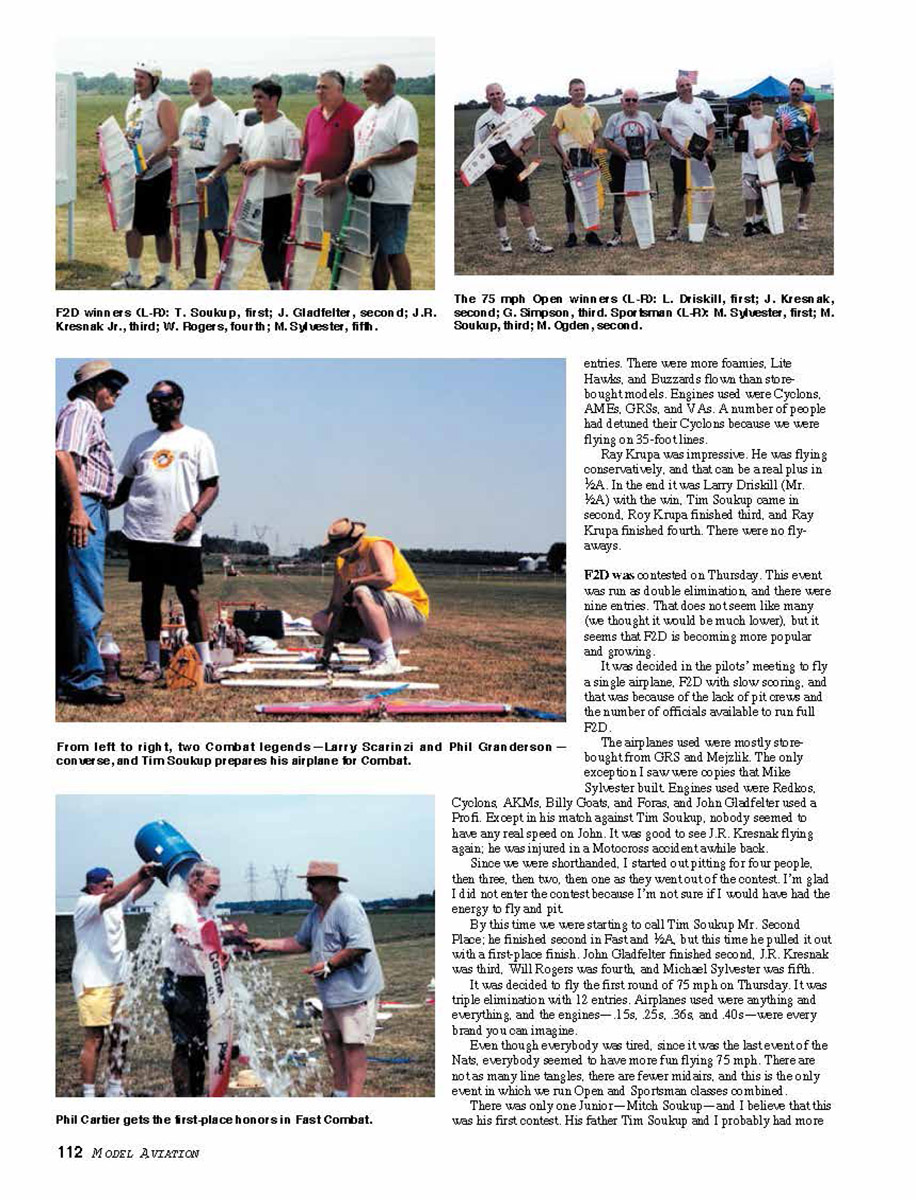
There were many good matches; one of the best was between Tim Soukup and Phil Granderson. In the end, the four guys who were strong on the first day were strong on the second day. The results were Phil Cartier in first, Tim Soukup in second, Roy Krupa was third, and Phil Granderson finished in fourth place.
This was the only event flown at the Nats that required fuel shutoffs. They were checked on the first flight, and we had no flyaways.
The 1/4A triple-elimination event was held Wednesday. There were 11 entries. There were more foamies, Lite Hawks, and Buzzards flown than store-bought models. Engines used were Cyclons, AMEs, GRSs, and VAs. A number of people had detuned their Cyclons because we were flying on 35-foot lines.
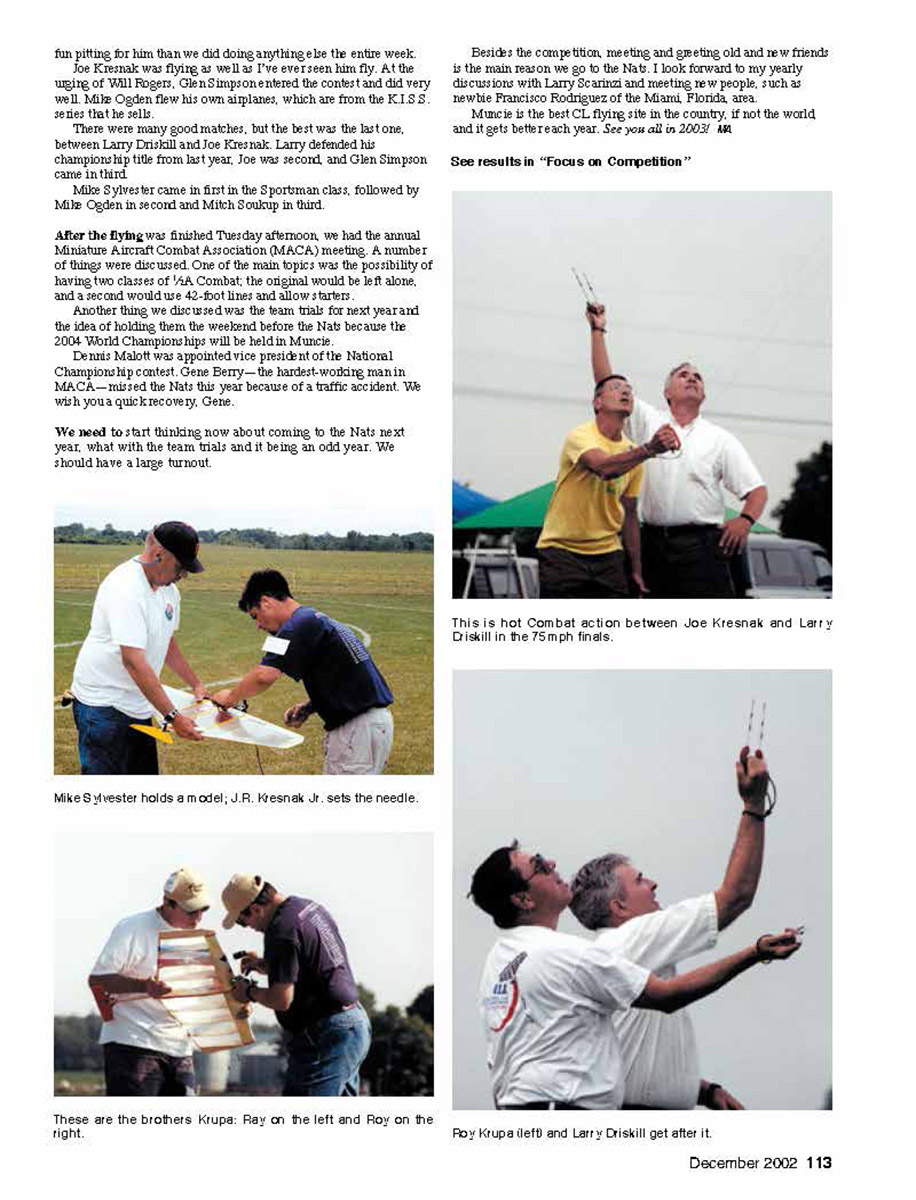
Ray Krupa was impressive. He was flying conservatively, and that can be a real plus in 1/2A. In the end it was Larry Driskill (Mr. 1/2A) with the win. Tim Soukup came in second, Roy Krupa finished third, and Ray Krupa finished fourth. There were no flyaways.
F2D was contested on Thursday. This event was run as double elimination, and there were nine entries. That does not seem like many (we thought it would be much lower), but it seems that F2D is becoming more popular and growing.
It was decided in the pilots' meeting to fly a single airplane, F2D with slow scoring, and that was because of the lack of pit crews and the number of officials available to run full F2D.
The airplanes used were mostly store-bought from GRS and Meszlik. The only exception I saw were copies that Mike Sylvester built. Engines used were Redkos, Cyclons, AKMs, Billy Goats, and Foras, and John Gladfelter used a Profi. Except in his match against Tim Soukup, nobody seemed to have any real speed on John. It was good to see J.R. Kresnak flying again; he was injured in a Motocross accident a while back.
Since we were shorthanded, I started out pitting for four people, then three, then two, then one as they went out of the contest. I'm glad I did not enter the contest because I'm not sure if I would have had the energy to fly and pit.
By this time we were starting to call Tim Soukup Mr. Second Place; he finished second in Fast and 1/2A, but this time he pulled it out with a first-place finish. John Gladfelter finished second, J.R. Kresnak was third, Will Rogers was fourth, and Michael Sylvester was fifth.
It was decided to fly the first round of 75 mph on Thursday. It was triple elimination with 12 entries. Airplanes used were anything and everything, and the engines—.15s, .25s, .36s, and .40s—were every brand you can imagine.
Even though everybody was tired, since it was the last event of the Nats, everybody seemed to have more fun flying 75 mph. There are not as many line tangles, there are fewer midairs, and this is the only event in which we run Open and Sportsman classes combined.
There was only one Junior—Mitch Soukup—and I believe that this was his first contest. His father Tim Soukup and I probably had more fun pitting for him than we did doing anything else the entire week.
Joe Kresnak was flying as well as I've ever seen him fly. At the urging of Will Rogers, Glen Simpson entered the contest and did very well. Mike Ogden flew his own airplanes, which are from the K.I.S.S. series that he sells.
There were many good matches, but the best was the last one, between Larry Driskill and Joe Kresnak. Larry defended his championship title from last year, Joe was second, and Glen Simpson came in third.
Mike Sylvester came in first in the Sportsman class, followed by Mike Ogden in second and Mitch Soukup in third.
After the flying was finished Tuesday afternoon, we had the annual Miniature Aircraft Combat Association (MACA) meeting. A number of things were discussed. One of the main topics was the possibility of having two classes of 1/2A Combat; the original would be left alone, and a second would use 42-foot lines and allow starters.
Another thing we discussed was the team trials for next year and the idea of holding them the weekend before the Nats because the 2004 World Championships will be held in Muncie.
Dennis Malott was appointed vice president of the National Championship contest. Gene Gerry—the hardest-working man in MACA—missed the Nats this year because of a traffic accident. We wish you a quick recovery, Gene.
We need to start thinking now about coming to the Nats next year, what with the team trials and it being an odd year. We should have a large turnout.
Besides the competition, meeting and greeting old and new friends is the main reason we go to the Nats. I look forward to my yearly discussions with Larry Scarinzi and meeting new people, such as newbie Francisco Rodriguez of the Miami, Florida, area.
Muncie is the best CL flying site in the country, if not the world, and it gets better each year. See yous all in 2003! KM
See results in "Focus on Competition"
Transcribed from original scans by AI. Minor OCR errors may remain.

