
CL Combat
Rich von Lopez, 8334 Colegio Dr., Los Angeles CA 90045
IN THE PAST few months I have been giving considerable thought to practice and the most efficient and effective way to do it. We can probably agree that one needs to practice on a regular basis if one wants to become proficient.
If you look at the best "tricks" fliers (Precision Aerobatics, or Stunt) and their practice schedules, you will find that almost every spare moment they have is devoted to practicing the pattern. They generally fly the entire pattern repeatedly, although I have observed some pilots doing the same maneuver again and again until they are satisfied that it is acceptable.
Please don't get me wrong when I use the term "tricks" to describe what they do; I mean it as a term of endearment. I have nothing but respect for tricks fliers, having been at most of the World Championships since 1982 with them and having seen their dedication to a highly competitive event. Nor do I want to anger my longtime friend and boss Bob Hunt, who is a Stunt flier.
Quite a few successful Combat pilots have turned to Stunt as they have gotten over their adolescent tendencies to destroy models and go head to head against other fliers; among them are Phil Granderson, Howard Rush, Dirty Dan Rutherford, and Gordan Delaney. If you ask each of them, he would tell you that Combat practice was nothing compared to that for Stunt.
So then, what are the implications for the novice and veteran Combat pilots in terms of what their practice schedules should look like? As an example, I will go through what I do as an aging veteran who isn't as quick and nimble as he was in his youth.
I fly 40-45 Sundays of the year with longtime sparring partner Chuck Rudner. During daylight-saving time, I do try to test-fly by myself once or twice a week. If I can talk some other local pilots into making the trek to the beach site, we will fly practice matches using Tee Dee-powered 1/2A models.
In Southern California we can fly almost every weekend because of our favorable weather. We had a great deal of rain this past winter, but we still got out to the field at least one of the two weekend dates.
The Sunday practice consists of test-flying models, engines, and propellers. We dewarp models and get them ready for competition, and we test propellers on various engines to see which ones work best with each power plant. Sometimes it is only a matter of clipping a propeller a bit to change it from a lazy dog to a hard-charging hunting beagle with the scent of its prey. Once we've done some of this grunt work, we devote time to flying practice matches.
We like the FAI/F2D-size models for these practice matches. We paint a center circle, use regulation-size streamers, and go hard at one another. This may mean that we push, bump, knock glasses off, and wreck some models from time to time.
During most of the year we use rebuilt or repaired aircraft. As a big contest approaches, we start upgrading to contest-quality airplanes and engines since that is what we face at big, important contests such as the World Championships or the US Team Trials.
So that is how we do it; sometimes it works and other times it doesn't. Chuck, his son Mark, and I usually fly practice matches regularly. We are supplemented by other pilots on a random basis. It would be better if we had more variety; flying against the same pilots means that we get to know each other's style well and don't get the opportunity to respond to the unexpected move.
Toward the end of my recent cancer-surgery recovery period, I was feeling well enough to get to the beach site almost on a daily basis. During one stretch I flew for eight straight days, in the middle of winter and in the middle of the day. This is impossible for most working individuals who have family responsibilities.
Mike Willcox, the 2002 Combat World Champion, travels to Europe to fly in contests. While at the Red Flag competition in Phoenix, Arizona, I learned from Alan Dewevue that he, Mike, and one other individual will be traveling to Moscow, Russia, for a contest. Mike prearranges to have models and pit crews at his disposal when he arrives. They need only take their engines and a desire to participate.
The objective is to get contest-situation practice-flying against some of the best in the world in preparation for the US Team Trials. Not many of us can afford to do this, nor do we have the time off to make it happen. Mike has been on many US World Championships teams, so no one can argue with his success.
Another top pilot is Mark Rudner, who is now at MIT (the Massachusetts Institute of Technology) in Cambridge doing graduate work. His practice schedule has suffered tremendously from the frigid Northeast weather and his commitment to a rigorous academic program. He will have to compress his practice schedule into a few months just before the Team Trials, to be held in Lubbock, Texas, Labor Day weekend.
I have had conversations with Charlie Johnson and Chuck Rudner throughout the course of many years about how the Russians practice in an effort to analyze keys to success. During the USSR era, the team chosen to represent the Soviet Bloc states contained team members who were true champions in their own right. They were state sponsored, and their responsibility was to be the best they could be.
In 1988 at the Kiev World Championships, we were able to observe the Russians' practice regimen roughly a week before the first official flight took place. They went out in the morning, flew for an hour and a half or so, packed everything up, and went back to the dorms for coffee, smokes, a shower, or a meal. Then they returned later in the day to do it again. Sometimes they flew two-up and with streamers.
It looked as though they wanted to get a couple of short but intense sessions in each day. I never observed them doing such things as making lines during these times. If your job in life is to fly Combat, perhaps short sessions are the way to go. Each of us has to determine what will work best for us, taking into account job, family, and available free time.
I give credit to Steve and Dave Stewart and Jeff Hanauer for putting together the Red Flag contest in Phoenix the weekend of April 2-3, 2005. The site was Estaban Park, which has plenty of parking, trees for shade, and grass.
There was a quick single-elimination 1/2A contest Friday that drew only six pilots. Jeff Hanauer won, with Steve Stewart and Chuck Rudner coming in second and third respectively. I expected quite a few pilots for Fast Combat and was a bit disappointed when the final number of entries was only 13.
It is always good to see the guys from Texas make the trip west. Alan Dewevue, Gary James, and James, Bobby, Andy, and Nick Mears were in attendance. Bob Burch made the trip out from Chicago, Illinois. The rest were from either California or Arizona.
Bill Maynard ended up winning the contest, with Alan Dewevue finishing second and Bobby Mears finishing third. Bobby showed some great sportsmanship when he granted Chris Jensen a rematch after the judges had given the match to Bobby. He likes to fly and win in the air. Put this contest on your schedule for next year. The hotels are close to the freeway and the flying field.
I love to spend time in such places as The Home Depot and local hardware stores looking for items that I may be able to use in my workshop. Throughout the years I have purchased many of the storage boxes or bins with various sizes of pull-out drawers in which to keep small parts. I had so many that I spent a great deal of time looking for an item I knew I had. I pulled out each drawer until I found what I was looking for.
I finally took the time to type labels for each drawer and arrange them in alphabetical order. This has made life so much easier. Now I can find the right-size bolt instantly. You may want to take an afternoon to do this yourself.
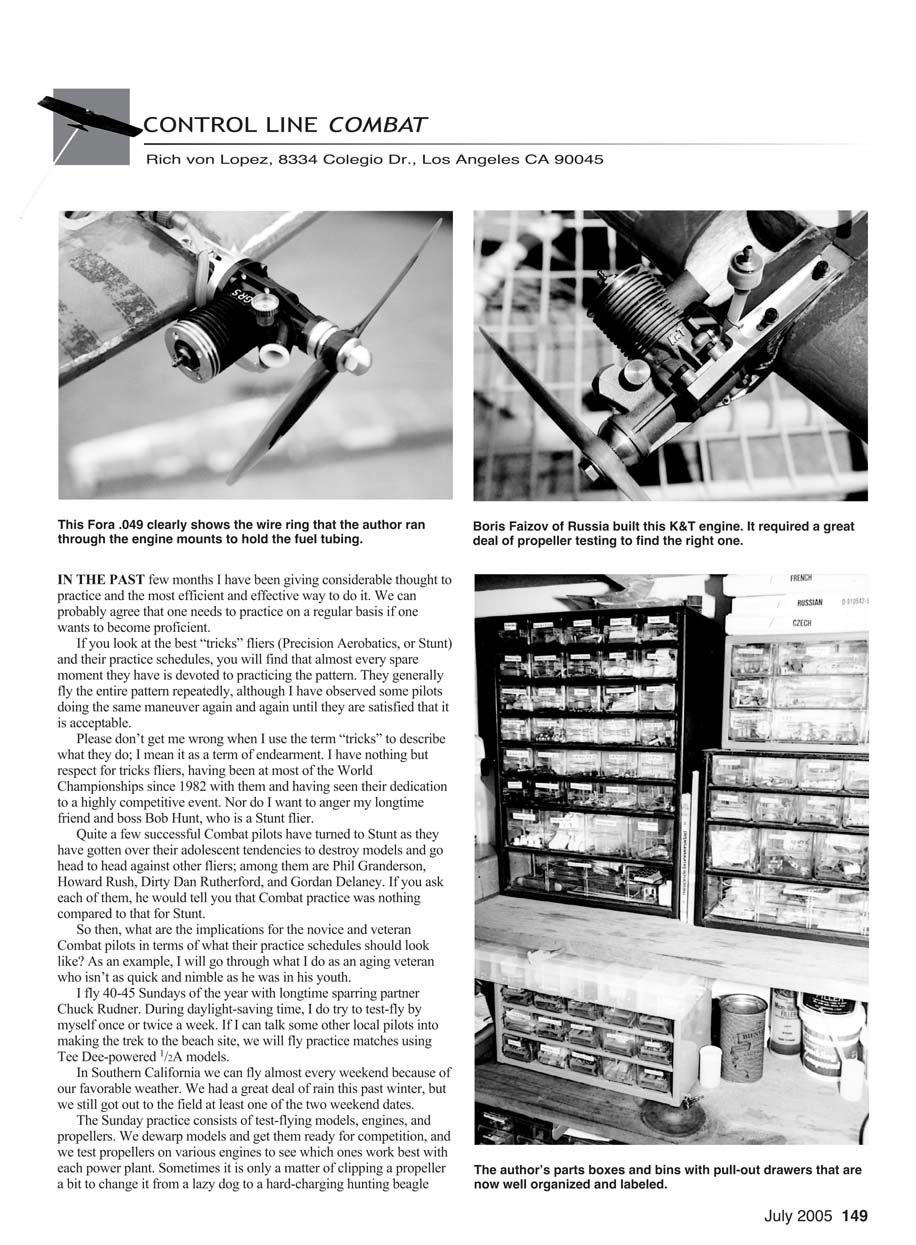
You may also want to drill a small hole in your metal engine mounts so you can run a small wire ring to hold fuel tubing. The rings come from springs you can buy at hardware stores. Cut off a section that is roughly one-third more than a full circle. This keeps the fuel line from flopping around. MA
Transcribed from original scans by AI. Minor OCR errors may remain.

