
Putting the pieces back together
By Mark Rudner
When preparing to write a column, I try to think about what could be interesting or useful for my readers. This can be a strange process because of the complexities of the publication schedule.
As you read this in the May issue, I imagine the sun is shining, birds are chirping, the grass is green, and your engines are working. Okay, I admit this vision assumes you're in the Northern Hemisphere, but roll with me if you're not.
Back through the time warp: here I am, writing this column in the dark days of early February. The "polar vortex" is in full force, and Punxsutawney Phil saw his shadow this morning. While I'm trying to think of a way to convince someone to come out into the snow and fly with me, you're probably already a few contests into the season. It appears our situations couldn't be more different.
As CL Combat fliers, there is one thing we all have in common throughout the year: somewhere in the shop (or the living room) there's a pile of broken models in need of fixing. I'm currently patching models that were damaged last year to get them ready for the upcoming season.
A few contests in, you've likely dinged up a few and are ready for a rebuilding session to prepare for Kansas City F2D contest, the Nats, or the summer World Cup circuit. For our friends in the Southern Hemisphere, you may be getting ready for the World Championships or your season may be drawing to a close. In any case, fixing airplanes appears to be a timely topic for everyone.
When you learned how to build airplanes, the wings were often made of foam. We had various options for covering them: FliteKote, MonoKote, FasCal, Seal-Lamin. Most of these films came with some sort of preapplied sticky glue, which could be activated with a sealing iron. For non-sticky film, a light dusting of 3M 77 spray adhesive over the entire wing did the trick.
Today we use open bay-style wings in F2D. All of the aforementioned covering films are too soft to hold a good airfoil shape over the wide-open bays. Furthermore, it doesn't make sense to use a film that is coated in glue when 90% of the covering is not touching anything solid.
We now enter the world of Mylar covering. It's tough, holds its shape much better than FasCal or MonoKote, and it comes without adhesive (simply add your own). In the US, I use contact cement from Home Depot, although I've heard Wilsonart H2O is a great water-based product that is better for your lungs and safe on foam.
When covering new airplanes I never had much problem, but until recently I did not have a procedure for patching airplanes that would satisfy my aesthetic senses. The trouble was always how to get the glue exactly where I wanted it, none where I didn't, and to end up with good, solid borders that wouldn't start peeling the first time I flew the aircraft. It's nothing earth-shattering, but because I finally discovered such a method, I thought others might benefit from it.
Patching procedure
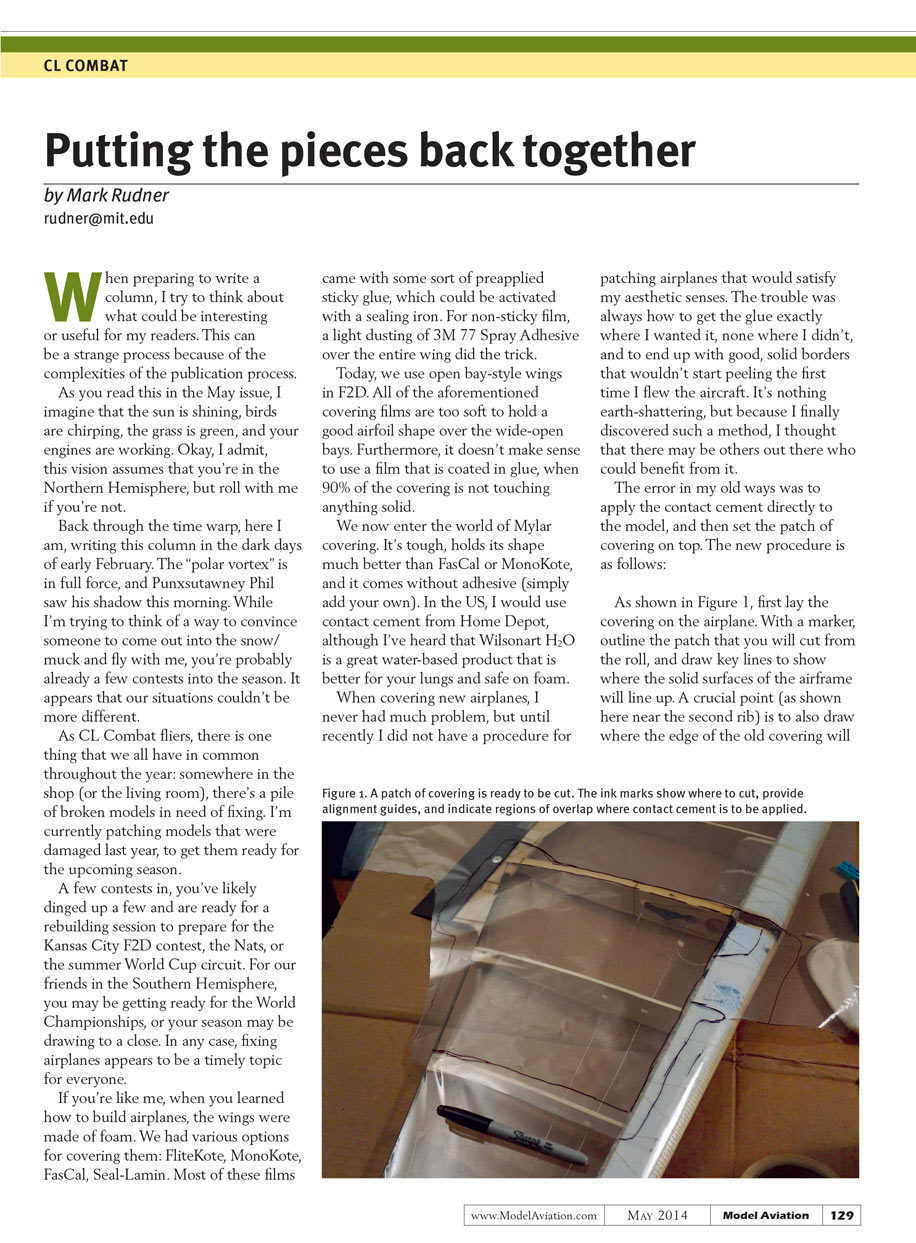
- Lay the covering on the airplane. With a marker, outline the patch you will cut from the roll, and draw key lines to show where the solid surfaces of the airframe will line up. A crucial point is to also draw where the edge of the old covering will be to demarcate your overlap region.
- Instead of trying to match a patch to whatever hole may have existed in the model, cut a big area with edges supported by the model's structure. This will give you something firm to press against to make sure your patch sticks.
- Cut the patch and flip it upside down on your work surface (one on which you won't be afraid to get a little glue). If it's nice out, open the window for ventilation. If it's cold and unpleasant, throw on an extra sweater and open the window for ventilation.
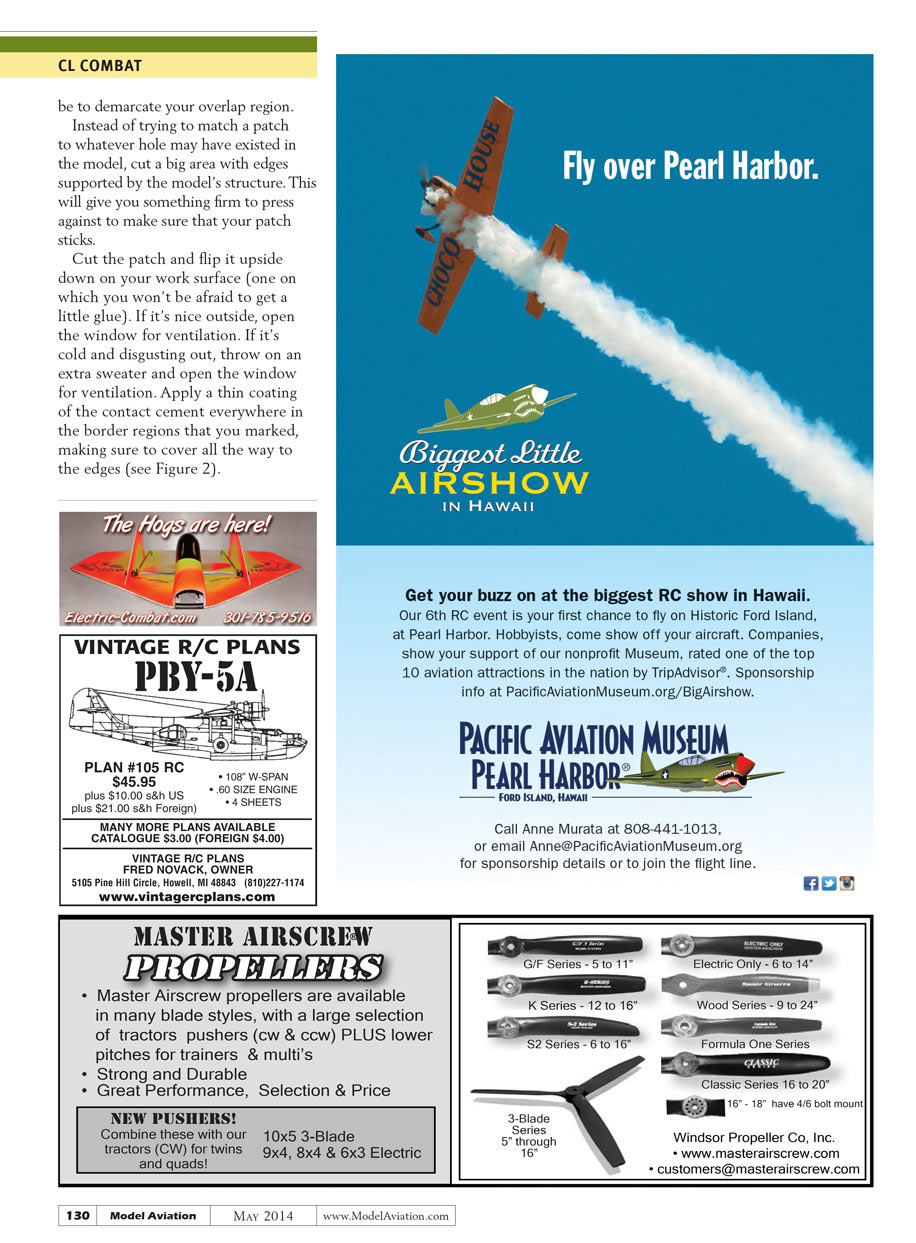
- Apply a thin coating of contact cement everywhere in the border regions you marked, making sure to cover all the way to the edges.
Figure 2. With the patch lying flat and upside down, apply contact cement in the overlap regions where it will need to stick to the airplane. Coat it to the edges for a good, solid patch.
- Thinner may help make the contact glue more spreadable. At this point, it's also a good idea to put some glue on the rib surfaces, trailing edge (TE), and balsa around the engine mount if you're covering that region. If you're not using the water-based cement, don't allow the cement to touch any foam.
- Carefully flip the patch back over and lay it on the model, using your marks as a guide. For this step it's helpful if someone can lend a hand to keep the covering tight and get it laid down straight the first time.
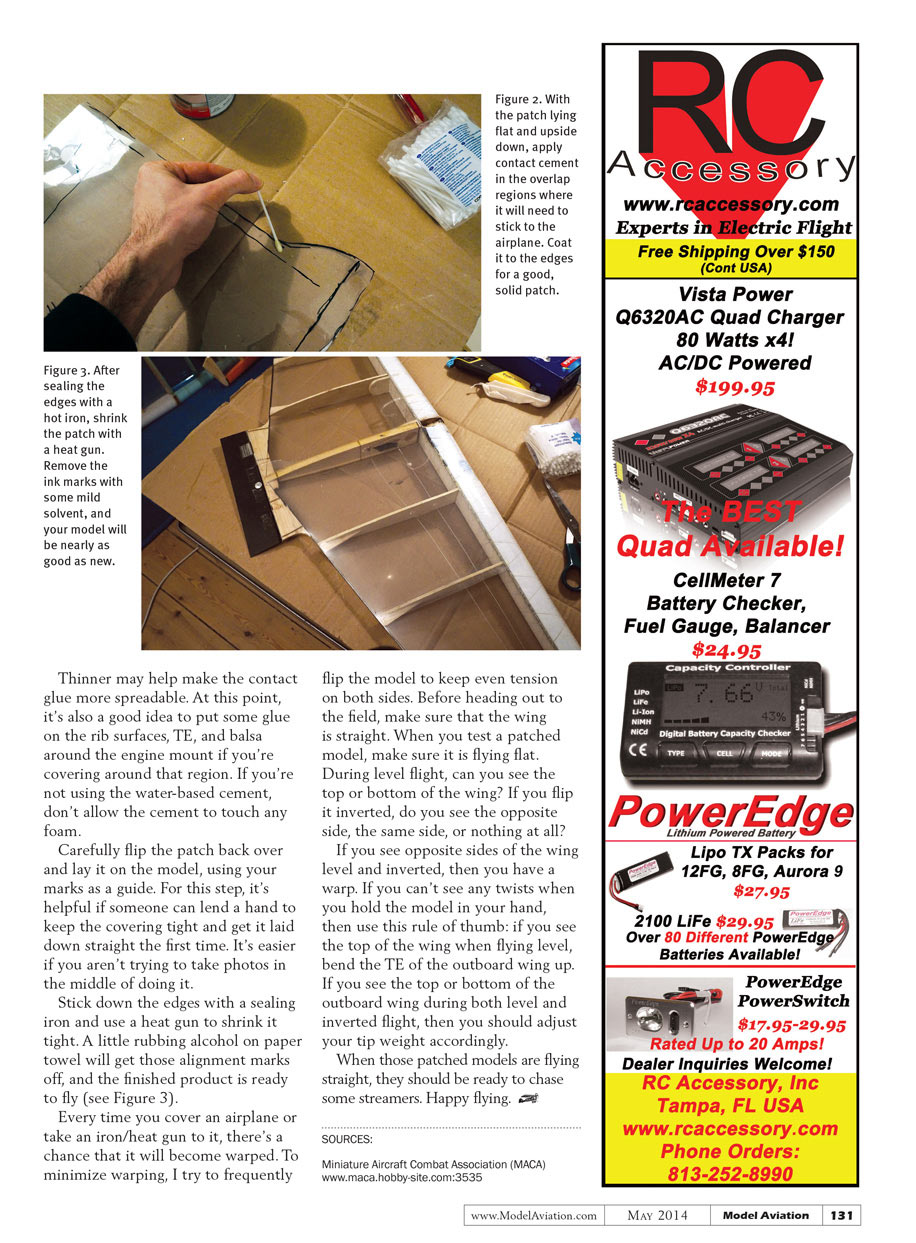
- Stick down the edges with a sealing iron and use a heat gun to shrink it tight. A little rubbing alcohol on a paper towel will remove the alignment marks, and the finished product will be nearly as good as new.
Figure 3. After sealing the edges with a hot iron, shrink the patch with a heat gun. Remove the ink marks with some mild solvent, and your model will be nearly as good as new.
Minimizing warps and testing
Every time you cover an airplane or use an iron/heat gun on it, there's a chance it will become warped. To minimize warping, frequently flip the model during the covering process to keep even tension on both sides. Before heading out to the field, make sure the wing is straight.
When you test a patched model, make sure it is flying flat. During level flight, can you see the top or bottom of the wing? If you flip it inverted, do you see the opposite side, the same side, or nothing at all? If you see opposite sides of the wing during level and inverted flight, then you have a warp.
If you can't see any twists when you hold the model in your hand, use this rule of thumb:
- If you see the top of the wing when flying level, bend the trailing edge of the outboard wing up.
- If you see the top or bottom of the outboard wing during both level and inverted flight, adjust your tip weight accordingly.
When those patched models are flying straight, they should be ready to chase some streamers. Happy flying.
Sources
- Miniature Aircraft Combat Association (MACA)
Transcribed from original scans by AI. Minor OCR errors may remain.

