
A little Combat history
by Rich Lopez <REDACTED>
My September 2012 column generated much email correspondence. Marvin Denny had a correction for me to make regarding the 1979 AMA Nats results. Marvin did not win Fast Combat; however, he did win Slow Combat that year and he had finished second, third, and fifth at other Nats.
Marvin also gave me a rundown on Carl Berryman's designs. First was the Big Iron, then the Oklahoma Twister, followed by the Percolator, then the Super Twister. His last one was an elliptical-wing design called Phantasy.
Pete Plunket also caught my error since he was standing next to the first-place finisher in Fast Combat, George Cleveland, and second-place finisher, Mike Guthomson. He sent me a photograph as proof; however, the young, bushy-haired guy standing in the third-place position does not look like the Pete Plunket I saw at the 2012 Nats. Pete also said that there were roughly 63 pilots at that Nats.
Paul Smith wrote that he began flying Combat in 1961 and flew a Midwest-kitted model called the Hornet. It featured an upright mount and, according to Paul, was terrible. He also mentioned that when Carl Goldberg kitted the VooDoo, it sold for $2.95 for a single kit or $4.95 for a double kit. Paul built and flew Big Irons, Hornets, and Wasps as well.
Jim Wesch of Oberlin, Kansas, said that he flew Jack-O-Diamonds, VooDoos, and T-Squares, powered by Fox Combat Specials in 1962 and 1963. Douglas Dahlke said he saw a model called the Whittier Wing, powered by an Anderson .65 glow engine on 15% nitro.
Burt Goldsmith flew in Southern California and saw Half-Fast, Reactor, Wow, Bandit, Giant Killer, Orbit Ace, Super Nose Cone, Darwing, Wingmaster, Quicker, Butterfly, and Renegade designs being flown in competitions.
James McKinney sent me a list of all of the AMA Nats winners from 1952 to 2007. This list is on the Miniature Aircraft Combat Association (MACA) website, listed in "Sources."
World Cup, Pazardzhik, Bulgaria
On the Friday and Saturday before the 2012 CL World Championships, the Bulgarian organizers hosted a World Cup contest open to all. This was an opportunity for national team members, their mechanics, and others, to have a chance to fly.
The official flying site for the World Championships was not used. A large, open, soccer field was used instead. There was neither shade nor restroom facilities until portables were brought in late in the afternoon. With so many people at the site, restrooms are a must!
Americans Allen DeVeuve, Cary Minor, Andy Minor, Bobby Mears, Andy Mears, Mark Rudner, Tom Siegler, and Rylan Ritch all entered to get some additional international experience and, of course, to try to win.
With 62 pilots entered, the organizers used two circles with six cut counters at each circle to complete the contest in two days. I joined Chuck Rudner as a cut counter.
The matches were going on simultaneously throughout the day. Slowdowns in the contest came from matches that had to be relown. Those moved to the end of the round, slowing the drawing for the next round.
The best-placing American was Mark Rudner, who made it into the seventh round where he ran into the Lithuanian female Junior contestant, Odetta Restenyte. Odetta had already developed a reputation as the American slayer, having beaten Allen in the second round and Andy Mears in the third.
Odetta made it to the finals where she faced off against her father, Audrius Rastenis. I don't remember ever hearing of or seeing a father-daughter first- and second-place finish. If this young lady continues flying Combat, she will find herself on the podium at more competitions. Igor Dementiev from Moldova was third. Bobby Mears and Cary Minor both had 3-2 records, so it was not a bad contest for them.
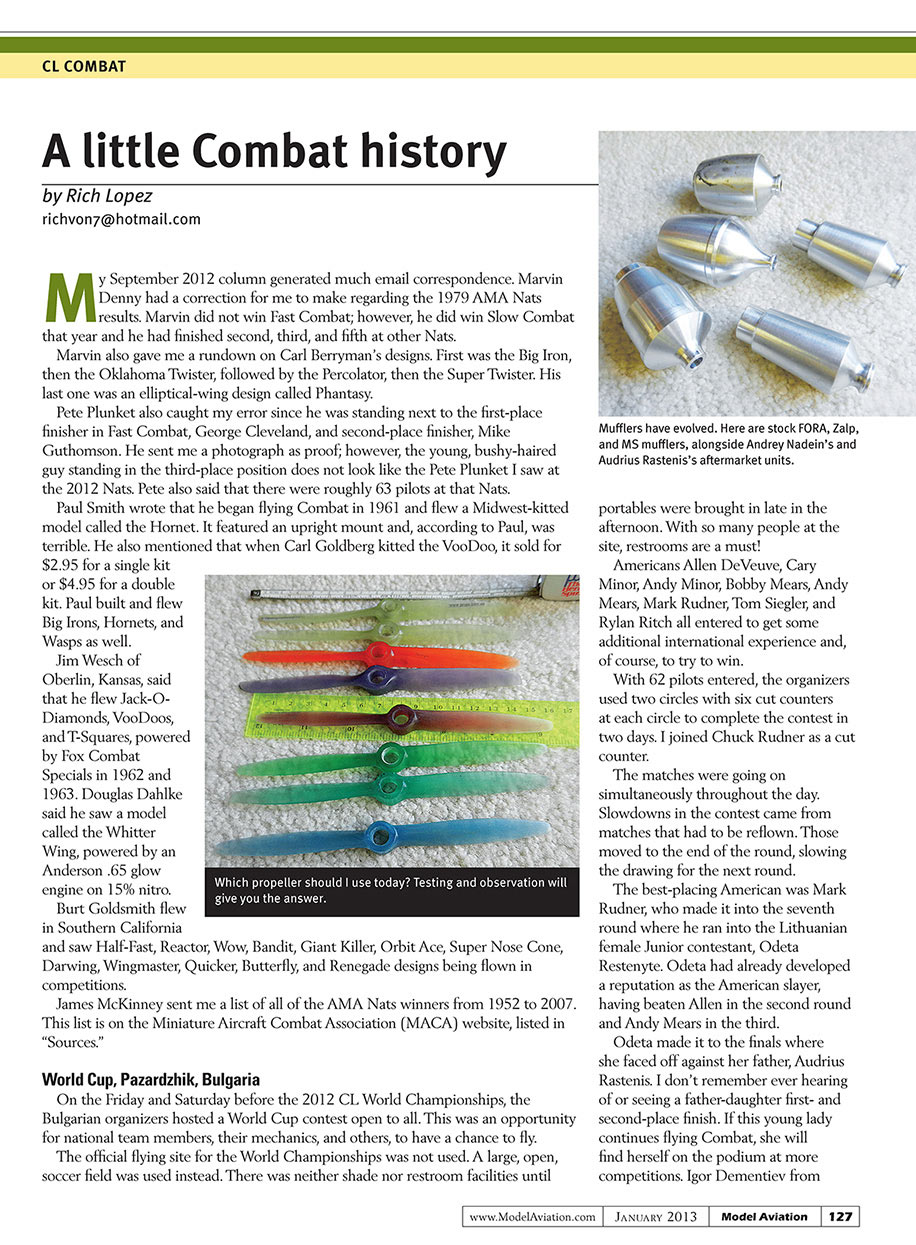
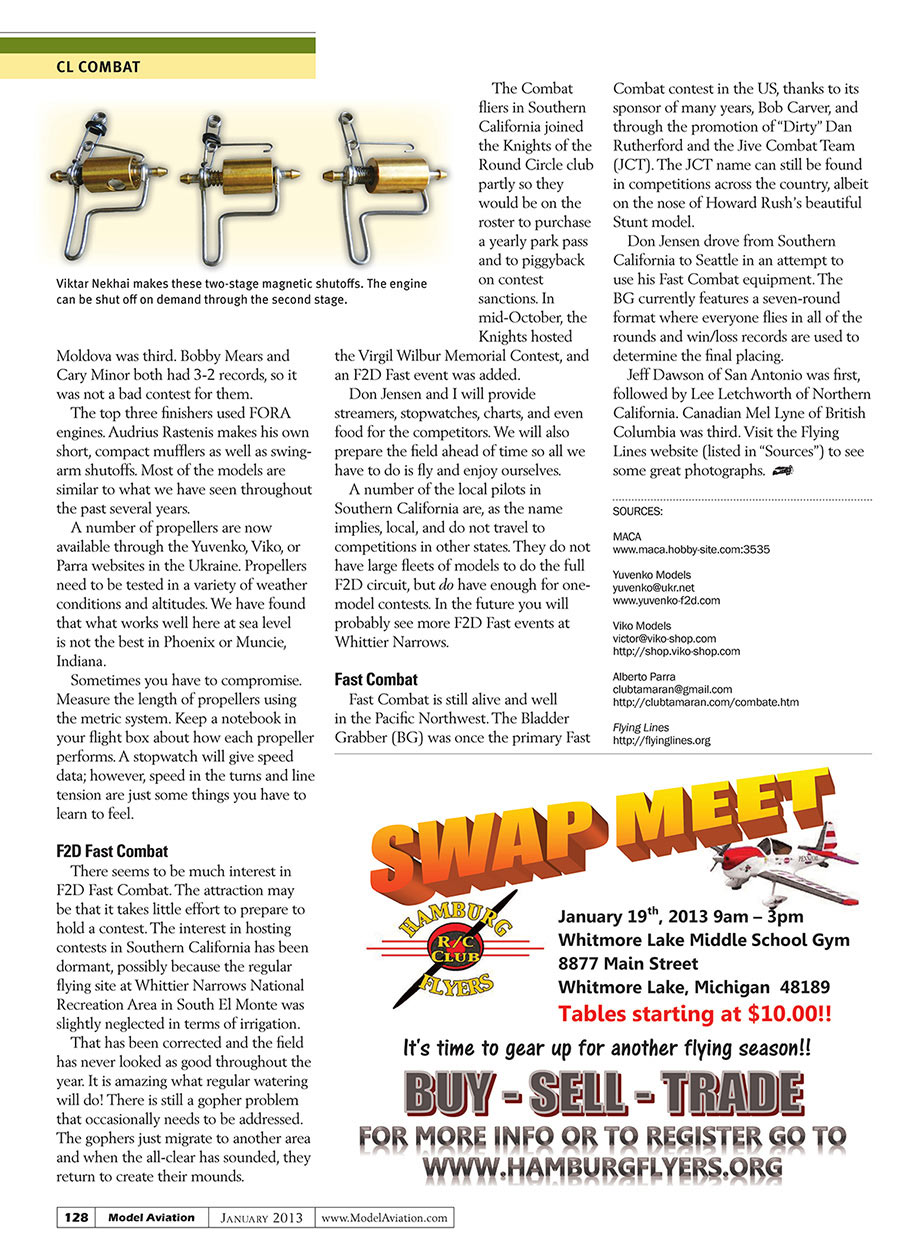
The top three finishers used FORA engines. Audrius Rastenis makes his own short, compact mufflers as well as swing-arm shutoffs. Most of the models are similar to what we have seen throughout the past several years.
A number of propellers are now available through the Yuvensko, Viko, or Parra websites in the Ukraine. Propellers need to be tested in a variety of weather conditions and altitudes. We have found that what works well here at sea level is not the best in Phoenix or Muncie, Indiana.
Sometimes you have to compromise. Measure the length of propellers using the metric system. Keep a notebook in your flight box about how each propeller performs. A stopwatch will give speed data; however, speed in the turns and line tension are just some things you have to learn to feel.
F2D Fast Combat
There seems to be much interest in F2D Fast Combat. The attraction may be that it takes little effort to prepare to hold a contest. The interest in hosting contests in Southern California has been dormant, possibly because the regular flying site at Whittier Narrows National Recreation Area in South El Monte was slightly neglected in terms of irrigation.
That has been corrected and the field has never looked as good throughout the year. It is amazing what regular watering will do! There is still a gopher problem that occasionally needs to be addressed. The gophers just migrate to another area and when the all-clear has sounded, they return to create their mounds.
The Combat fliers in Southern California joined the Knights of the Round Circle club partly so they would be on the roster to purchase a yearly park pass and to piggyback on contest sanctions. In mid-October, the Knights hosted the Virgil Wilbur Memorial Contest, and an F2D Fast event was added.
A number of the local pilots in Southern California are, as the name implies, local, and do not travel to competitions in other states. They do not have large fleets of models to do the full F2D circuit, but do have enough for one-model contests. In the future you will probably see more F2D Fast events at Whittier Narrows.
Fast Combat
Fast Combat is still alive and well in the Pacific Northwest. The Bladder Grabber (BG) was once the primary Fast Combat contest in the US, thanks to its sponsor of many years, Bob Carver, and through the promotion of “Dirty” Dan Rutherford and the Jive Combat Team (JCT). The JCT name can still be found in competitions across the country, albeit on the nose of Howard Rush’s beautiful Stunt model.
Don Jensen drove from Southern California to Seattle in an attempt to use his Fast Combat equipment. The BG currently features a seven-round format where everyone flies in all of the rounds and win/loss records are used to determine the final placing.
Jeff Dawson of San Antonio was first, followed by Lee Letchworth of Northern California. Canadian Mel Lyne of British Columbia was third. Visit the Flying Lines website (listed in “Sources”) to see some great photographs.
SOURCES:
MACA www.maca.hobby-site.com:3535
Yuvensko Models <REDACTED> www.yuvensko-f2d.com
Viko Models <REDACTED> http://shop.viko-shop.com
Alberto Parra <REDACTED> http://clubaraman.com/combate.htm
Flying Lines http://flyinglines.org
Transcribed from original scans by AI. Minor OCR errors may remain.

