
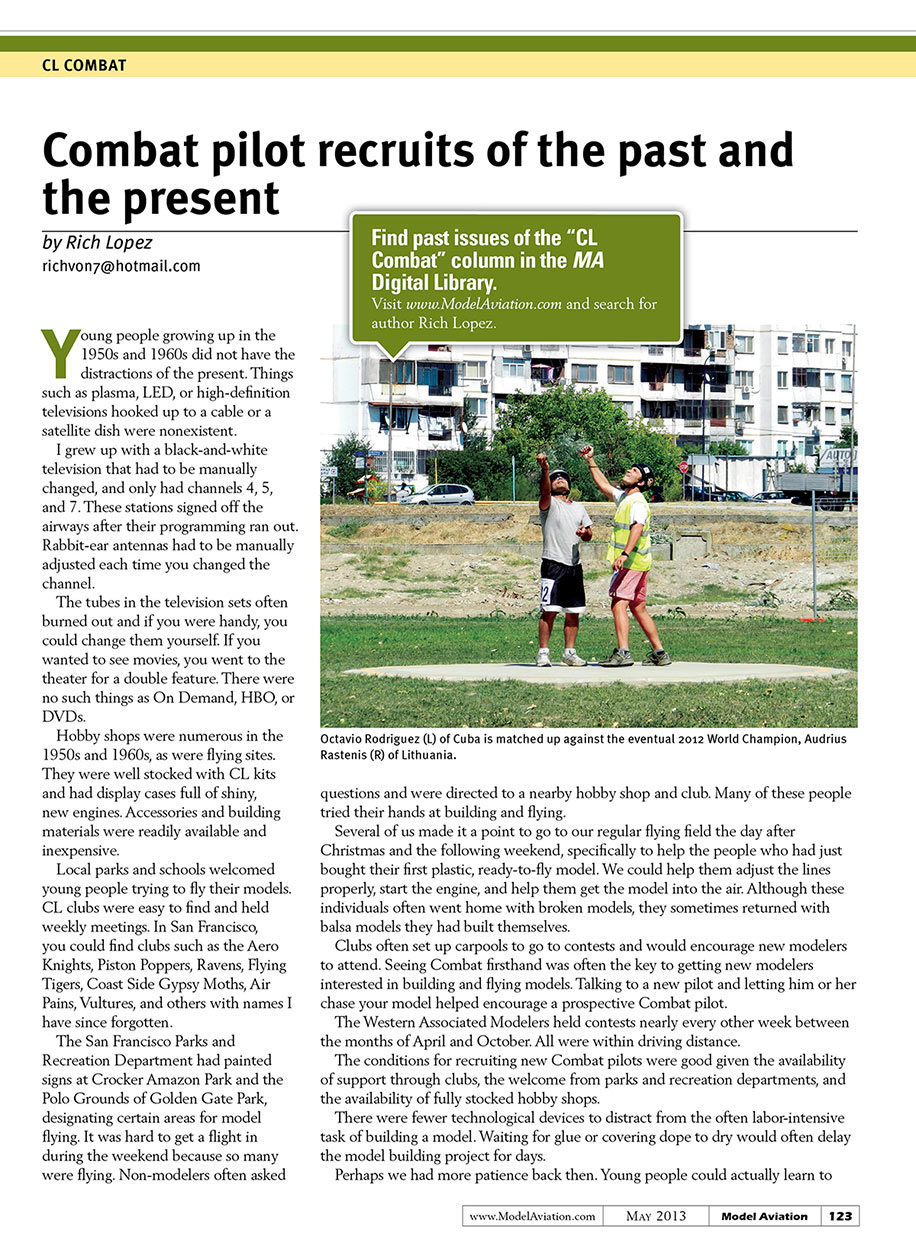
Combat pilot recruits of the past and the present
by Rich Lopez [email protected]
Young people growing up in the 1950s and 1960s did not have the distractions of the present. Things such as plasma, LED, or high-definition televisions hooked up to a cable or a satellite dish were nonexistent.
I grew up with a black-and-white television that had to be manually changed, and only had channels 4, 5, and 7. These stations signed off the airways after their programming ran out. Rabbit-ear antennas had to be manually adjusted each time you changed the channel.
The tubes in the television sets often burned out and if you were handy, you could change them yourself. If you wanted to see movies, you went to the theater for a double feature. There were no such things as On Demand, HBO, or DVDs.
Hobby shops were numerous in the 1950s and 1960s, as were flying sites. They were well stocked with CL kits and had display cases full of shiny, new engines. Accessories and building materials were readily available and inexpensive.
Local parks and schools welcomed young people trying to fly their models. CL clubs were easy to find and held weekly meetings. In San Francisco, you could find clubs such as the Aero Knights, Piston Poppers, Ravens, Flying Tigers, Coast Side Gypsy Moths, Air Pains, Vultures, and others with names I have since forgotten.
The San Francisco Parks and Recreation Department had painted signs at Crocker Amazon Park and the Polo Grounds of Golden Gate Park, designating certain areas for model flying. It was hard to get a flight in during the weekend because so many were flying. Non-modelers often asked questions and were directed to a nearby hobby shop and club. Many of these people tried their hands at building and flying.
Several of us made it a point to go to our regular flying field the day after Christmas and the following weekend, specifically to help the people who had just bought their first plastic, ready-to-fly model. We could help them adjust the lines properly, start the engine, and help them get the model into the air. Although these individuals often went home with broken models, they sometimes returned with balsa models they had built themselves.
Clubs often set up carpools to go to contests and would encourage new modelers to attend. Seeing Combat firsthand was often the key to getting new modelers interested in building and flying models. Talking to a new pilot and letting him or her chase your model helped encourage a prospective Combat pilot.
The Western Associated Modelers held contests nearly every other week between the months of April and October. All were within driving distance.
The conditions for recruiting new Combat pilots were good given the availability of support through clubs, the welcome from parks and recreation departments, and the availability of fully stocked hobby shops.
There were fewer technological devices to distract from the often labor-intensive task of building a model. Waiting for glue or covering dope to dry would often delay the model building project for days.
Perhaps we had more patience back then. Young people could actually learn to
CL Combat
build and fly CL models without the assistance of their parents, as I did.
Combat Pilot Recruits: the Present
Things have changed during the past 50 or 60 years in terms of available technology, organized sports, and other recreational activities. Brick-and-mortar hobby shops are hard to find and seldom carry CL kits, engines, and supplies. Although there are still plenty of modeling clubs, most focus on RC.
The two San Francisco parks that I mentioned now have signs posted prohibiting model flying. I used to mention in my columns and include photos of us flying at Dockweiler State Beach on New Year’s Eve for our annual Beach Brunch and Fly gathering, but no more. The park staff first planted a row of trees across the flying surface; however, there was still enough space to fly 1/2A models. The staff then installed iron poles that dispense bags for dog droppings in the middle of the usable flying space.
The once-famous Charles T. Zimmerman Flying Field in Redwood City, California, and the home of Norm McFadden and Rich Brasher’s Condor Legion Combat Club, has been paved and developed.
I cannot remember the last time I saw someone flying models at a school playground. Young people simply do not build and fly CL models on their own.
I am certain that many flying sites have suffered the same fate as the ones I have mentioned. The flying site situation in Western Europe suffers a strong bias against model engine noise and modelers have been squeezed out of parks and urban areas.
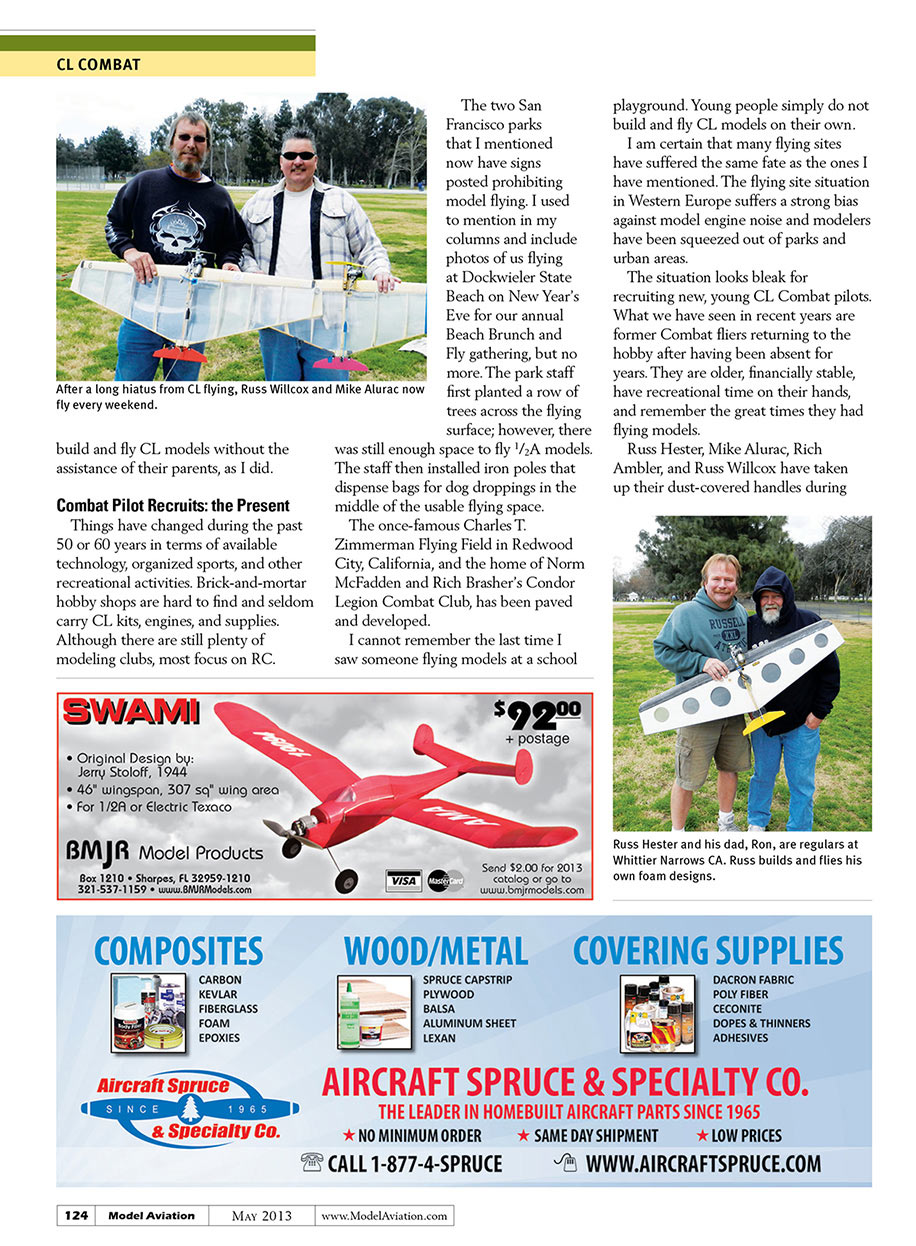
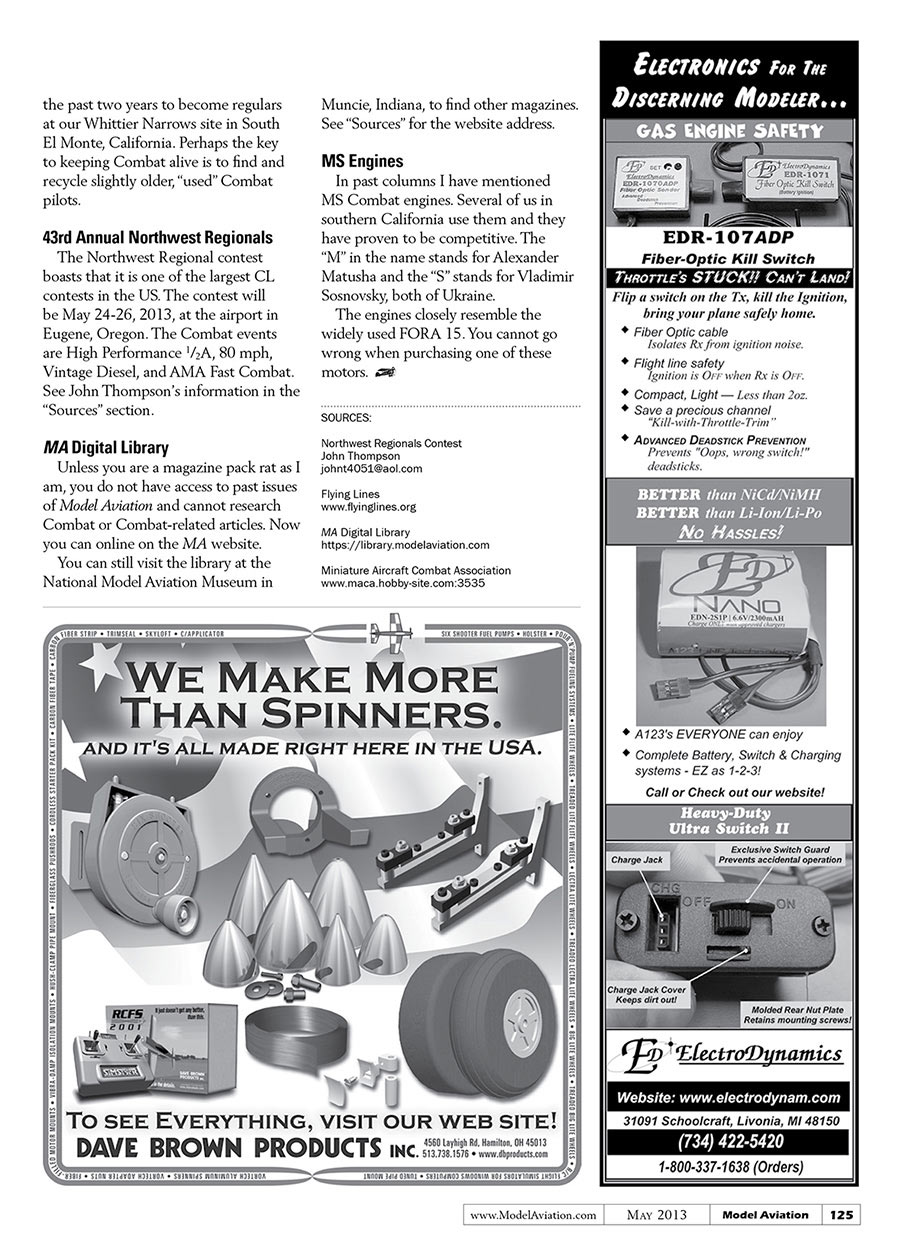
The situation looks bleak for recruiting new, young CL Combat pilots. What we have seen in recent years are former Combat fliers returning to the hobby after having been absent for years. They are older, financially stable, have recreational time on their hands, and remember the great times they had flying models.
Russ Hester, Mike Alurac, Rich Ambler, and Russ Willcox have taken up their dust-covered handles during
43rd Annual Northwest Regionals
The Northwest Regional contest boasts that it is one of the largest CL contests in the US. The contest will be May 24-26, 2013, at the airport in Eugene, Oregon. The Combat events are High Performance 1/2A, 80 mph, Vintage Diesel, and AMA Fast Combat. See John Thompson's information in the "Sources" section.
MA Digital Library
Unless you are a magazine pack rat as I am, you do not have access to past issues of Model Aviation and cannot research Combat or Combat-related articles. Now you can online on the MA website.
You can still visit the library at the National Model Aviation Museum in Muncie, Indiana, to find other magazines. See "Sources" for the website address.
MS Engines
In past columns I have mentioned MS Combat engines. Several of us in southern California use them and they have proven to be competitive. The "M" in the name stands for Alexander Matusha and the "S" stands for Vladimir Sosnovsky, both of Ukraine.
The engines closely resemble the widely used FORA 15. You cannot go wrong when purchasing one of these motors.
SOURCES:
- Northwest Regionals Contest
John Thompson [email protected]
- Flying Lines
- MA Digital Library
https://library.modelaviation.com
- Miniature Aircraft Combat Association
Transcribed from original scans by AI. Minor OCR errors may remain.

