
CL Combat
Rich von Lopez, 8334 Colegio Dr., Los Angeles CA 90045
The summer of 1999 was quite memorable for me in terms of Combat-related activities—or non-activities. For the first time in many years, I missed the Bladder Grabber and the FAI (Federation Aeronautique Internationale) team trials. It was one of those years when there were just too many things going on.
My job as an elementary school principal prevents me from attending a number of events. Culmination for our fifth-graders was happening at the same time as the Bladder Grabber. And our family vacation in Maui had been bought and paid for long before the team trials site vote was taken, so the trip could not be changed to avoid the conflict.
On the positive side, I built more first-line models than I had in a long time. I completed eight Fast Combat models and eight 1/2A models. Then I really went mad, and built six 1/2As with Pat Willcox and another four for Pete Athans. These models are for Tee Dee .049 or .051 engines. Most pilots have given up on using Tee Dees in favor of the more powerful AME, VA, or Cyclon engines.
Beach flying site
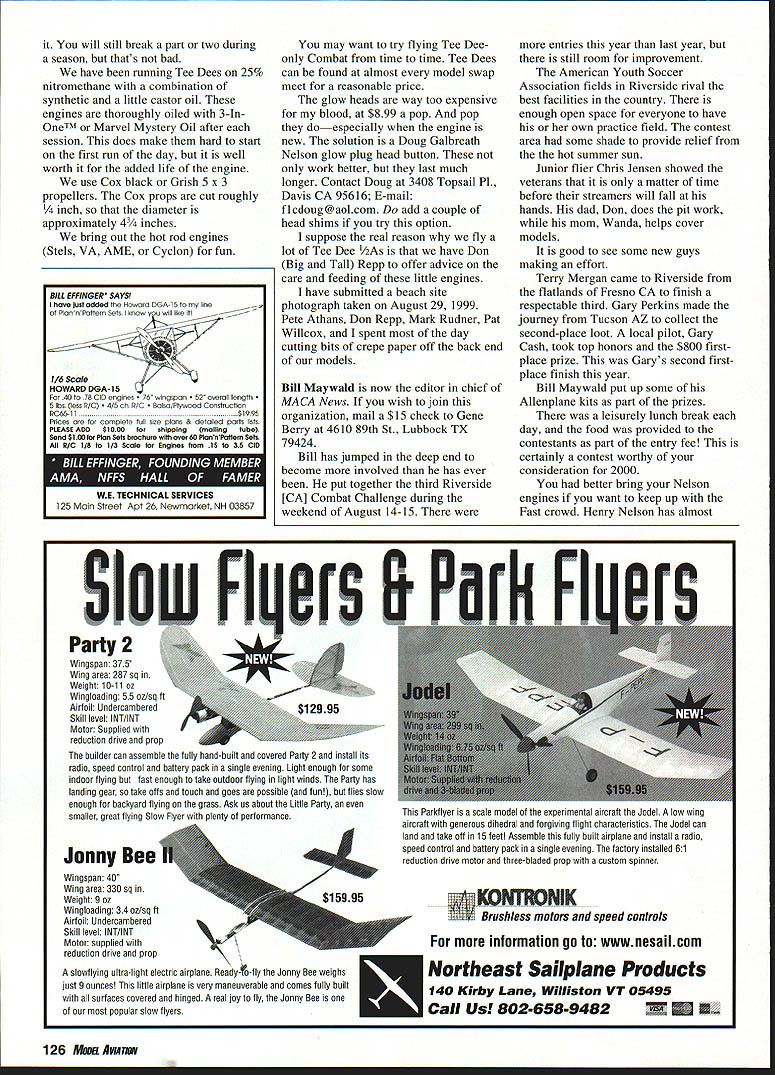
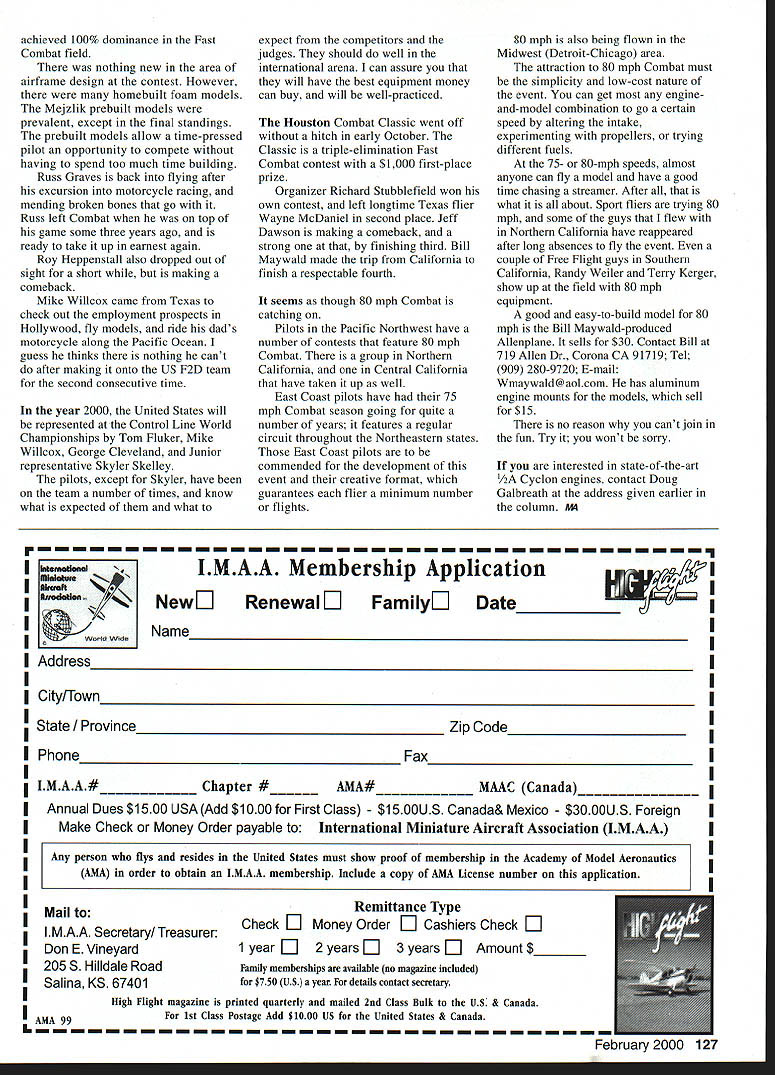
I have often spoken about flying at our beach site that overlooks the Pacific Ocean and offers a steady breeze most of the year. We have limited flying there to 1/2A models so we do not get run off by the lifeguards for a noise complaint by some recreational-vehicle owner parked down by the sand.
We have taken to flying at the site in the mid- to late-afternoon hours during the summer months, when it stays light until 8:30 p.m. or so. The Tee Dee engines offer a good opportunity to fly at reasonable speeds and not trash out too many models. We also have a bunch of the Cox stuff to play with.
If you take time to properly fit a Tee Dee, and run it with good fuel and good propellers, you can get a great deal of service out of it. You will still break a part or two during a season, but that's not bad.
Engine care and props
We have been running Tee Dees on 25% nitromethane with a combination of synthetic and a little castor oil. These engines are thoroughly oiled with 3-In-One™ or Marvel Mystery Oil after each session. This does make them hard to start on the first run of the day, but it is well worth it for the added life of the engine.
We use Cox black or Grish 5 x 3 propellers. The Cox props are cut roughly 1/4 inch so that the diameter is approximately 4 1/4 inches.
We bring out the hot rod engines (Stels, VA, AME, or Cyclon) for fun. You may want to try flying Tee Dee-only Combat from time to time. Tee Dees can be found at almost every model swap meet for a reasonable price.
The glow heads are way too expensive for my blood, at $8.99 a pop. And pop they do—especially when the engine is new. The solution is a Doug Galbreath Nelson glow-plug head button. These not only work better, but they last much longer. Contact Doug at 3408 Topsail Pl., Davis CA 95616; E-mail: [email protected]. Do add a couple of head shims if you try this option.
I suppose the real reason why we fly a lot of Tee Dee 1/2As is that we have Don (Big and Tall) Repp to offer advice on the care and feeding of these little engines.
I have submitted a beach-site photograph taken on August 29, 1999. Pete Athans, Don Repp, Mark Rudner, Pat Willcox, and I spent most of the day cutting bits of crepe paper off the back end of our models.
MACA News and Riverside Combat Challenge
Bill Maywald is now the editor in chief of MACA News. If you wish to join this organization, mail a $15 check to Gene Berry at 4610 89th St., Lubbock TX 79424.
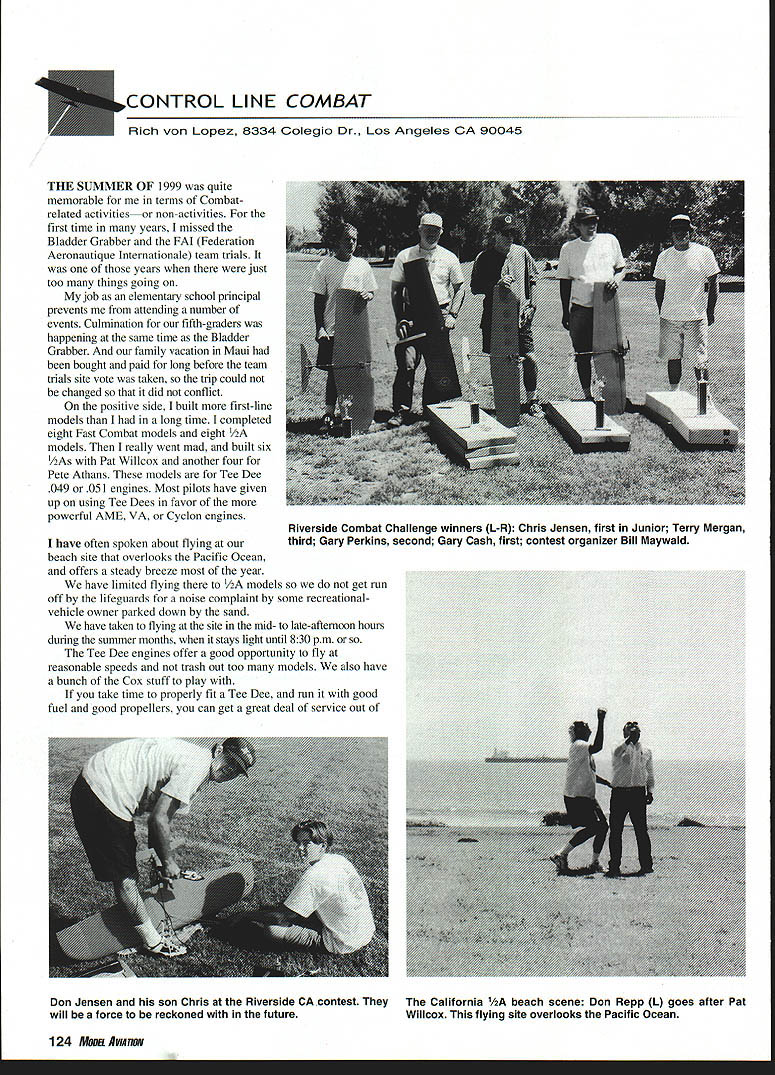
Bill has jumped in the deep end to become more involved than he has ever been. He put together the third Riverside (CA) Combat Challenge during the weekend of August 14–15. There were more entries this year than last year, but there is still room for improvement.
The American Youth Soccer Association fields in Riverside rival the best facilities in the country. There is enough open space for everyone to have his or her own practice field. The contest area had some shade to provide relief from the hot summer sun.
Junior flier Chris Jensen showed the veterans that it is only a matter of time before their streamers will fall at his hands. His dad, Don, does the pit work, while his mom, Wanda, helps cover models. It is good to see some new guys making an effort.
Terry Mergan came to Riverside from the flatlands of Fresno CA to finish a respectable third. Gary Perkins made the journey from Tucson AZ to collect the second-place loot. A local pilot, Gary Cash, took top honors and the $800 first-place prize. This was Gary's second first-place finish this year.
Bill Maywald put up some of his Allplane kits as part of the prizes. There was a leisurely lunch break each day, and the food was provided to the contestants as part of the entry fee. This is certainly a contest worthy of your consideration for 2000.
Fast Combat and equipment
You had better bring your Nelson engines if you want to keep up with the Fast crowd. Henry Nelson has almost achieved 100% dominance in the Fast Combat field.
There was nothing new in the area of airframe design at the contest. However, there were many homebuilt foam models. The Meijizlik prebuilt models were prevalent, except in the final standings. The prebuilt models allow a time-pressed pilot an opportunity to compete without having to spend too much time building.
Russ Craves is back into flying after his excursion into motorcycle racing and mending broken bones that go with it. Russ left Combat when he was on top of his game some three years ago and is ready to take it up in earnest again.
Roy Heppenstall also dropped out of sight for a short while but is making a comeback.
Mike Willcox came from Texas to check out the employment prospects in Hollywood, fly models, and ride his dad's motorcycle along the Pacific Ocean. I guess he thinks there is nothing he can do after making it on the US F2D team for the second consecutive time.
In the year 2000, the United States will be represented at the Control Line World Championships by Tom Fluker, Mike Willcox, George Cleveland, and junior representative Skyler Skelley.
The pilots, except for Skyler, have been on the team a number of times and know what is expected of them and what to expect from the competitors and the judges. They should do well in the international arena. I can assure you that they will have the best equipment money can buy and will be well-practiced.
Houston Combat Classic
The Houston Combat Classic went off without a hitch in early October. The Classic is a triple-elimination Fast Combat contest with a $1,000 first-place prize.
Organizer Richard Stubblefield won his own contest and left longtime Texas flier Wayne McDaniel in second place. Jeff Dawson is making a comeback, and a strong one at that, by finishing third. Bill Maywald made the trip from California to finish a respectable fourth.
80 mph Combat
It seems as though 80 mph Combat is catching on. Pilots in the Pacific Northwest have a number of contests that feature 80 mph Combat. There is a group in Northern California and one in Central California that have taken it up as well.
East Coast pilots have had their 75 mph Combat season going for quite a number of years; it features a regular circuit throughout the Northeastern states. Those East Coast pilots are to be commended for the development of the event and their creative format, which guarantees each flier a minimum number of flights.
80 mph is also being flown in the Midwest (Detroit–Chicago area).
The attraction to 80 mph Combat must be the simplicity and low-cost nature of the event. You can get most any engine-and-model combination to go a certain speed by altering the intake, experimenting with propellers, or trying different fuels.
At the 75- or 80-mph speeds, almost anyone can fly a model and have a good time chasing a streamer. After all, that is what it is all about. Sport fliers are trying 80 mph, and some of the guys that I flew with in Northern California have reappeared after long absences to fly the event. Even a couple of Free Flight guys in Southern California, Randy Weiler and Terry Kerger, show up at the field with 80 mph equipment.
A good and easy-to-build model for 80 mph is the Bill Maywald-produced Alpenplane. It sells for $30. Contact Bill at 719 Allen Dr., Corona CA 91719; Tel: (909) 280-9720; E-mail: [email protected]. He has aluminum engine mounts for the models, which sell for $15.
There is no reason why you can't join in the fun. Try it; you won't be sorry.
If you are interested in state-of-the-art 1/2A Cyclone engines, contact Doug Galbreath at the address given earlier in the column.
Transcribed from original scans by AI. Minor OCR errors may remain.

