
CONTROL LINE COMBAT
Rich von Lopez, 8334 Colegio Dr., Los Angeles CA 90045
ONE OF THE things that has been on my mind lately is the notion of dominance and how it relates to Combat.
In many sports or hobbies, from time to time there emerges a person or piece of equipment that is dominant. Such sports figures as Tiger Woods, Michael Jordan, and Martina Hingis come to mind. In the sport of Indy auto racing, Offenhauser and Ford were dominant during a particular era.
When we look at Control Line Combat, there are several engine manufacturers that come to mind at specific periods in time.
Engine dominance over the years
- In the very early days, pilots were using a number of engines such as K&B Torpedos, Foxes, and Johnsons. Each had a moment when it was the "must-have" piece of equipment.
- In the 1960s, the SuperTigre G21s and C-series were the engines you had to have in order to be competitive.
- The SuperTigres were pushed aside in the 1970s by the Fox Mark III and Mark IV, whose power output was considerably better. These Foxes required considerable work so that they would be more reliable. These Foxes were the engine of choice into the 1980s.
- Once Henry Nelson designed and developed his Combat Special, all other makes were pushed aside.
(Granted, there are still some die-hards out there who insist on using their old Foxes. Chuck Rudner, his son Mark, and Peter Athans still have quite a few Fox engines that will run with an average Nelson. The Rudners happen to have very light and rigid models that make their vintage Foxes look good.)
One could say without reservation that the Nelson Combat Special is currently the dominant engine in Fast and Slow Combat. What is more interesting is that there is no challenger to the dominance on the horizon.
1/2A engines
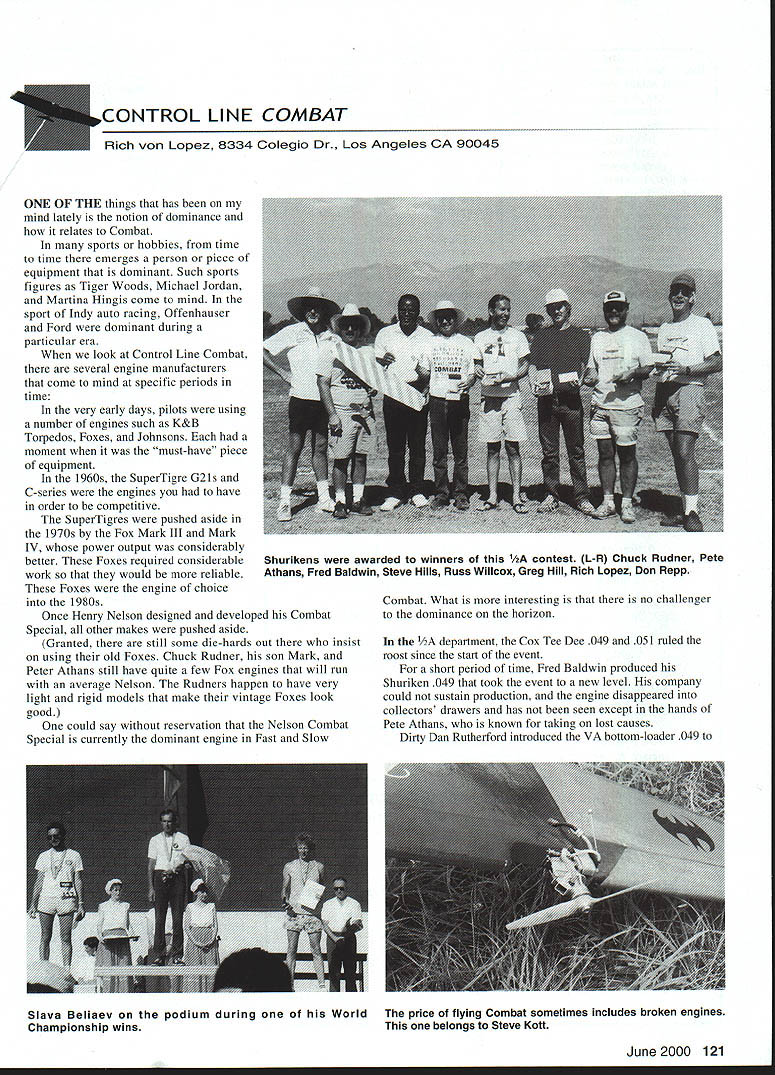
- In the 1/2A department, the Cox Tee Dee .049 and .051 ruled the roost since the start of the event.
- For a short period of time, Fred Baldwin produced his Shuriken .049 that took the event to a new level. His company could not sustain production, and the engine disappeared into collectors' drawers and has not been seen except in the hands of Pete Athans, who is known for taking on lost causes.
- Dirty Dan Rutherford introduced the VA bottom-loader .049 to the United States Combat scene. Most American Combat pilots had difficulties getting them to stay together or run fast, in spite of Dan's extensive manual on how to run the engine.
- Then there was the AME .049 and the second VA, followed by the Cyclon .049. I suspect that the Cyclon will be the dominant engine during the foreseeable future.
I can also predict that Alexander Kalmikov, the brains behind Cyclon, will have a new version or several new versions out during the next few years. He does not seem content to leave well enough alone. His Speed background keeps him striving to get more and more from a given size of engine.
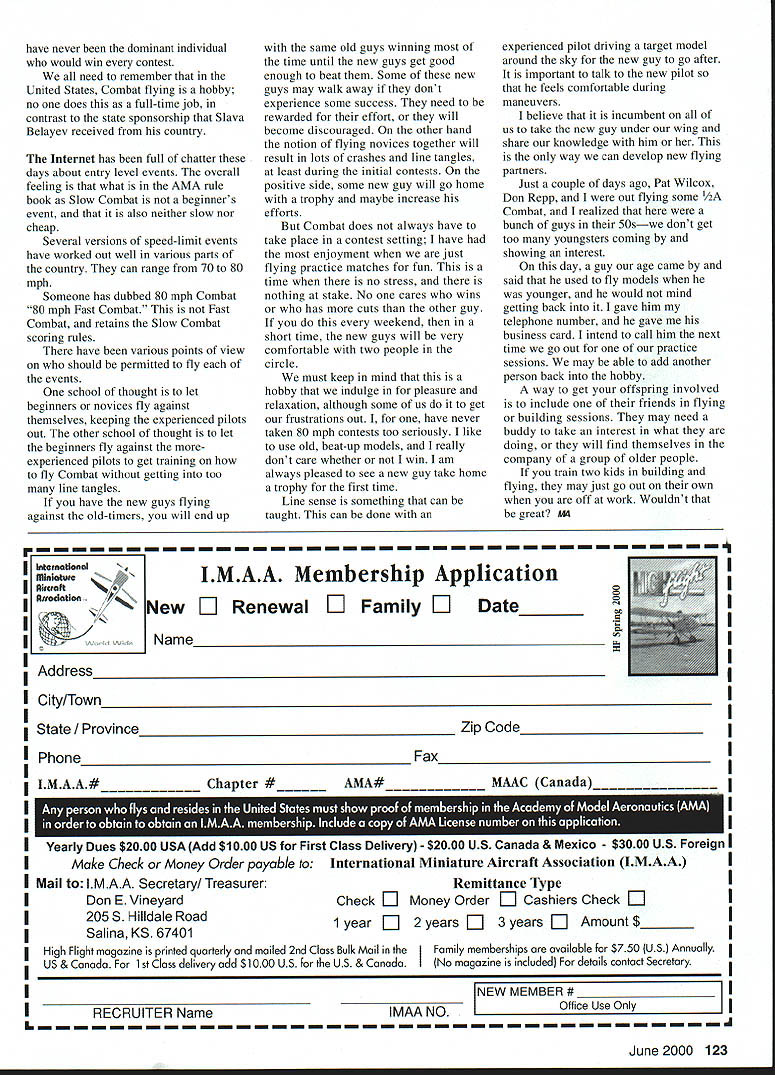
Progress must be made, but it sure was fun when the only game in town was the Cox engine. Everyone was on equal footing, and if you pushed the engine too hard, out came the ball-and-socket joint, rod or snap! went the rod, or the crankshaft would break. This is just the price of playing the game.
On the West Coast, we still fly plenty of Tee Dee–only Combat, and have lots of fun doing so. For serious competition, it looks like the Cyclon is the way to go.
FAI engines
In the FAI arena, there has never been one dominant engine. Some have been on top for a short period of time in certain parts of the world.
The Nelson 15 enjoyed a short stint on top here in the United States, but not throughout the world.
Fox, SuperTigre, and a variety of makes have won the World Championships, but none has dominated.
Currently there is a whole crop of strong and reliable engines that one can choose from. All are fast and reliable. There are Redoks, Burans, Cyclons, Proffs, Koizols, Zorros, Zalps, Doroshenkos, LTSs, and many more. This makes it very interesting to watch Combat matches. It places more emphasis on pilot skill rather than on the best equipment. It will be interesting to see if one .15 brand becomes dominant in the near future.
Dominant pilots
Dominant Combat pilots? Only a few stand out.
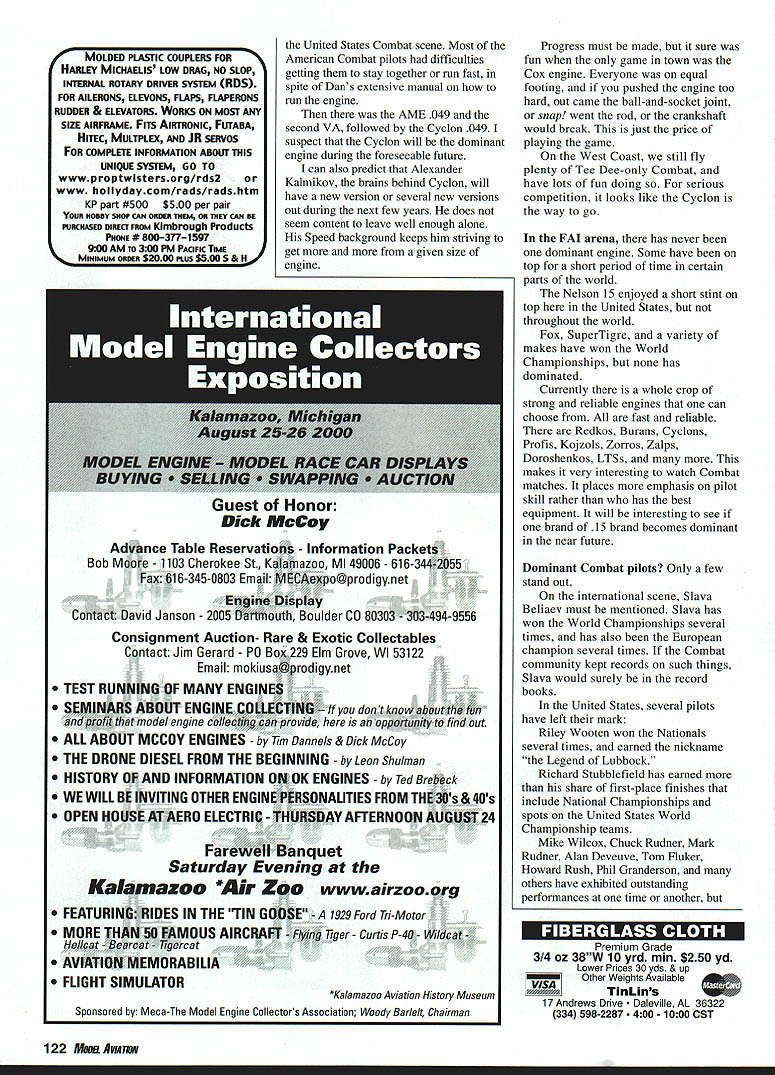
On the international scene, Slava Belaiev must be mentioned. Slava has won the World Championships several times, and has also been the European champion several times. If the Combat community kept records on such things, Slava would surely be in the record books.
In the United States, several pilots have left their mark:
- Riley Wooten won the Nationals several times, and earned the nickname "the Legend of Lubbock."
- Richard Stubblefield has earned more than his share of first-place finishes that include National Championships and spots on the United States World Championship teams.
- Mike Wilcox, Chuck Rudner, Mark Rudner, Alan Devere, Tom Fluker, Howard Rush, Phil Granderson, and many others have exhibited outstanding performances at one time or another, but have never been the dominant individual who would win every contest.
We all need to remember that in the United States, Combat flying is a hobby; no one does this as a full-time job, in contrast to the state sponsorship that Slava Belayev received from his country.
Entry-level events and training newcomers
The Internet has been full of chatter these days about entry level events. The overall feeling is that what is in the AMA rule book as Slow Combat is not a beginner's event, and that it is also neither slow nor cheap.
Several versions of speed-limit events have worked out well in various parts of the country. They can range from 70 to 80 mph.
Someone has dubbed 80 mph Combat "80 mph Fast Combat." This is not Fast Combat, and retains the Slow Combat scoring rules.
There have been various points of view on who should be permitted to fly each of the events.
- One school of thought is to let beginners or novices fly against themselves, keeping the experienced pilots out.
- The other school of thought is to let the beginners fly against the more-experienced pilots to get training on how to fly Combat without getting into too many line tangles.
If you have the new guys flying against the old-timers, you will end up with the same old guys winning most of the time until the new guys get good enough to beat them. Some of these new guys may walk away if they don't experience some success. They need to be rewarded for their effort, or they will become discouraged. On the other hand, the notion of flying novices together will result in lots of crashes and line tangles, at least during the initial contests. On the positive side, some new guy will go home with a trophy and maybe increase his efforts.
But Combat does not always have to take place in a contest setting; I have had the most enjoyment when we are just flying practice matches for fun. This is a time when there is no stress, and there is nothing at stake. No one cares who wins or who has more cuts than the other guy. If you do this every weekend, then in a short time, the new guys will be very comfortable with two people in the circle.
We must keep in mind that this is a hobby that we indulge in for pleasure and relaxation, although some of us do it to get our frustrations out. I, for one, have never taken 80 mph contests too seriously. I like to use old, beat-up models, and I really don't care whether or not I win. I am always pleased to see a new guy take home a trophy for the first time.
Line sense is something that can be taught. This can be done with an experienced pilot driving a target model around the sky for the new guy to go after. It is important to talk to the new pilot so that he feels comfortable during maneuvers.
I believe that it is incumbent on all of us to take the new guy under our wing and share our knowledge with him or her. This is the only way we can develop new flying partners.
Just a couple of days ago, Pat Wilcox, Don Repp, and I were out flying some 1/2A Combat, and I realized that here were a bunch of guys in their 50s—we don't get too many youngsters coming by and showing an interest.
On this day, a guy our age came by and said that he used to fly models when he was younger, and he would not mind getting back into it. I gave him my telephone number, and he gave me his business card. I intend to call him the next time we go out for one of our practice sessions. We may be able to add another person back into the hobby.
A way to get your offspring involved is to include one of their friends in flying or building sessions. They may need a buddy to take an interest in what they are doing, or they will find themselves in the company of a group of older people.
If you train two kids in building and flying, they may just go out on their own when you are off at work. Wouldn't that be great?
MA
Transcribed from original scans by AI. Minor OCR errors may remain.

