
CL Combat
CONTROL LINE (CL) Combat does not get a wide range of exposure to the general public, or even to our fellow hobbyists.
A big factor is that there are so few contests where there is a large audience. The events are never spread evenly throughout the country.
A person who has seen CL Combat in action cannot help but ask a few questions, and come away with the feeling that he or she would like to try a hand at it.
Videos and public exposure
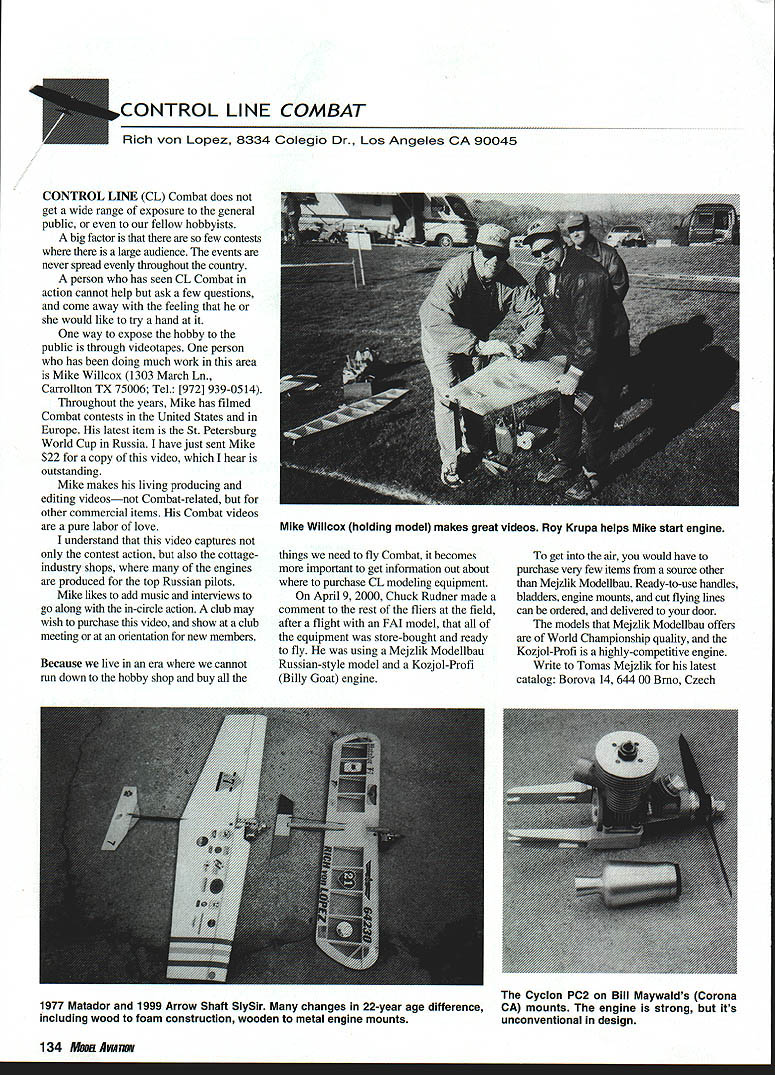
One way to expose the hobby to the public is through videotapes. One person who has been doing much work in this area is Mike Willcox (1303 March Ln., Carrollton TX 75006; Tel.: (972) 939-0514).
Throughout the years, Mike has filmed Combat contests in the United States and in Europe. His latest item is the St. Petersburg World Cup in Russia. I have just sent Mike $22 for a copy of this video, which I hear is outstanding.
Mike makes his living producing and editing videos—not Combat-related, but for other commercial items. His Combat videos are a pure labor of love.
I understand that this video captures not only the contest action, but also the cottage-industry shops where many of the engines are produced for the top Russian pilots.
Mike likes to add music and interviews to go along with the in-circle action. A club may wish to purchase this video, and show it at a club meeting or at an orientation for new members.
Availability of equipment
Because we live in an era where we cannot run down to the hobby shop and buy all the things we need to fly Combat, it becomes more important to get information out about where to purchase CL modeling equipment.
On April 9, 2000, Chuck Rudner made a comment to the rest of the fliers at the field, after a flight with an FAI model, that all of the equipment was store-bought and ready to fly. He was using a Mejzlik Modellbau Russian-style model and a Kozjol-Profi (Billy Goat) engine.
To get in the air, you would have to purchase very few items from a source other than Mejzlik Modellbau. Ready-to-use handles, bladders, engine mounts, and cut flying lines can be ordered and delivered to your door.
The models that Mejzlik Modellbau offers are of World Championship quality, and the Kozjol-Profi is a highly competitive engine.
Write to Tomas Mejzlik for his latest catalog:
- Borova 14, 644 00 Brno, Czech Republic, Europe
- Tel.: 011420-5-43218888
- Web: www.mejzlikmodellbau.com
I have mentioned this company a number of times throughout the years because it consistently produces and delivers a quality product that customers rave about. If you are short of time and like to fly more than you like to build, this is the source for your Ready-to-Fly models.
I have received word that Mejzlik Modellbau has some competition. GRS Models (2121 N. Causeway Blvd., Suite 160, Metairie LA 70001; Tel.: (504) 443-4640) has entered the prefabricated model market as a provider.
The entrepreneur of this endeavor is George Cleveland.
George has quite a few models for sale that look to be of high quality. His shipping prices are much less than from the Czech Republic. Pat Willcox dropped off one of George's color brochures that lists a number of models for 1/2A, FAI, Slow, and Fast Combat. There are some Ready-to-Fly Slow designs as well.
George would easily be in the Hall of Fame, if we had such a thing for Combat pilots. He has quite a number of wins under his belt, and has been on the US team more than any other person I know of.
George has a reputation to uphold, and would not offer a substandard product to the public. I will be going after some of his state-of-the-art Fast Ukraine models.
Write or call for a brochure.
Those of you who like to build your own models should look to the Core House, which is run by Phil Cartier, a former national champion.
- Core House: 1249 Jill Dr., Hummelstown PA 17036; Tel.: (717) 566-3810
Give him a call; I am sure he can set you up with something that will suit you.
Bill Maywald is the current editor for the Miniature Aircraft Combat Association (MACA), and is the producer of the Allenplane Fast Combat kits.
These are quality kits that are cut with computerized foam-cutting equipment. Bill can be contacted at:
- 719 Allen Dr., Corona CA 92879; Tel.: (909) 280-9720
- E-mail: [email protected]
A one-year membership to MACA will cost $15, and can be sent to the treasurer, Gene Berry, at:
- 4610 89th St., Lubbock TX 79424
MACA is always looking for new members. Give it a try for a year—you will not be sorry.
Kitting It Together is run by Larry Driskill:
- 6806 Third St., Lubbock TX 79416
This company offers 1/2A kits, engines, and accessories. Larry spends a lot of time tuning 1/2A engines, and he knows how to get the most out of these little power plants.
If you join MACA, you will get a complete listing of all current manufacturers of Combat-related items.
Ready-to-Fly and attachment methods
I enjoy the building and flying aspects of the hobby. But I also go through phases where I don't want to go out to the shop and build. It is during these periods that I am grateful for Ready-to-Fly models.
There are many quick and strong ways to attach stabilators to the rears of models.
- The Russians like to use a music-wire pin running through a brass bushing and through two nylon brackets. The pin is bent at an angle, so it runs parallel to the leading edge of the stabilator, which allows it to be held in place by a small amount of tape. I have been using electrical tape for this application. This is a quick way to mount and unmount the stabilator. It will allow you to pack your models in a rather small space for traveling.
- An even simpler way of attachment that I have seen is to eliminate the brass bushing and glue a straight music-wire pin to the model. The nylon brackets will need to be attached to the stabilator after they have been located on the pin. This latter method is lighter, and it eliminates the need for electrical tape.
- If you are not going to need to remove the stabilators, sewing the tails to a mini-stabilizer works really well. In all the years I have been using this method, I have never suffered a failure in this area.
At one time I used a total of 16 holes on the stabilator. This is overkill. Now I use six holes on Fast models, and four holes on 1/2A models.
I have been using braided nylon fishing line and carpet needles to do the sewing. This is the last procedure I do on a new model. The advantage is that you can line up the stabilator parallel to the wing before you glue the fishing line in place with cyanoacrylate glue.
Building tips and weight control
The Southern California resident engine expert, Don Repp, is a fine builder who pays close attention to all of the details.
His latest 1/2A model is extra light and flies super. He used unwaxed dental floss as his hinge thread; it is strong, and weighs next to nothing.
Don also figured out a way to run the pushrod through the arrow shaft. This makes it much easier to glue the wing halves together.
If you do not have a gram scale, you may want to consider purchasing one. I have gotten to the point where I weigh all the sheets of balsa that will be used to make stabilators, and each stabilator after it has been covered. You would be amazed at the difference in weight from one sheet of balsa to the next.
I have also started weighing and marking the weights on each spar. After building a fleet of 1/2A models last summer, I discovered that a few of them were tail-heavy and others were right on. The only variable was spar weight.
Don Repp goes one step further by marking each spar's center, then determining which side is heavier by balancing the spar on his finger. The heavier side is the one you want on the outboard side of the model. If you can avoid adding tip weight, or at least limit tip weight, you will have a better-flying model.
All of these details, when taken as a whole, will yield a light and strong model with exceptional performance. A lightweight model will make an average engine perform better, because it does not have to work as hard.
Engines and mounts
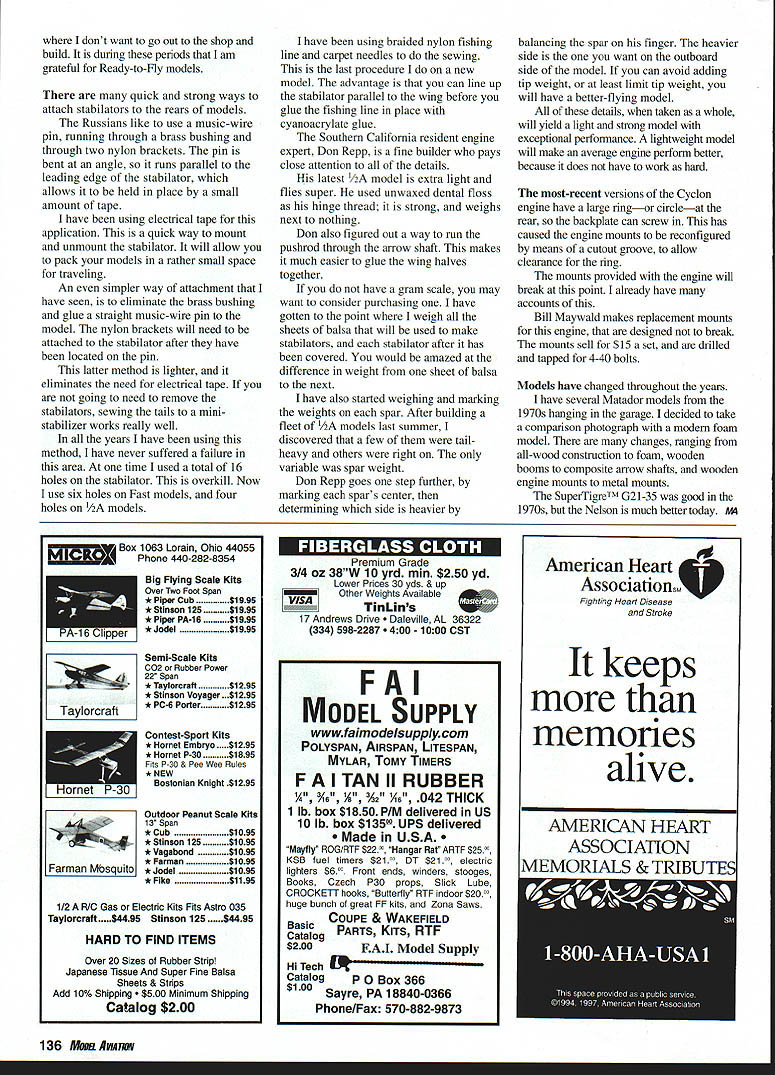
The most-recent versions of the Cyclon engine have a large ring—or circle—at the rear, so the backplate can screw in. This has caused the engine mounts to be reconfigured by means of a cutout groove, to allow clearance for the ring.
The mounts provided with the engine will break at this point. I already have many accounts of this.
Bill Maywald makes replacement mounts for this engine that are designed not to break. The mounts sell for $15 a set, and are drilled and tapped for 4-40 bolts.
How models have changed
Models have changed throughout the years.
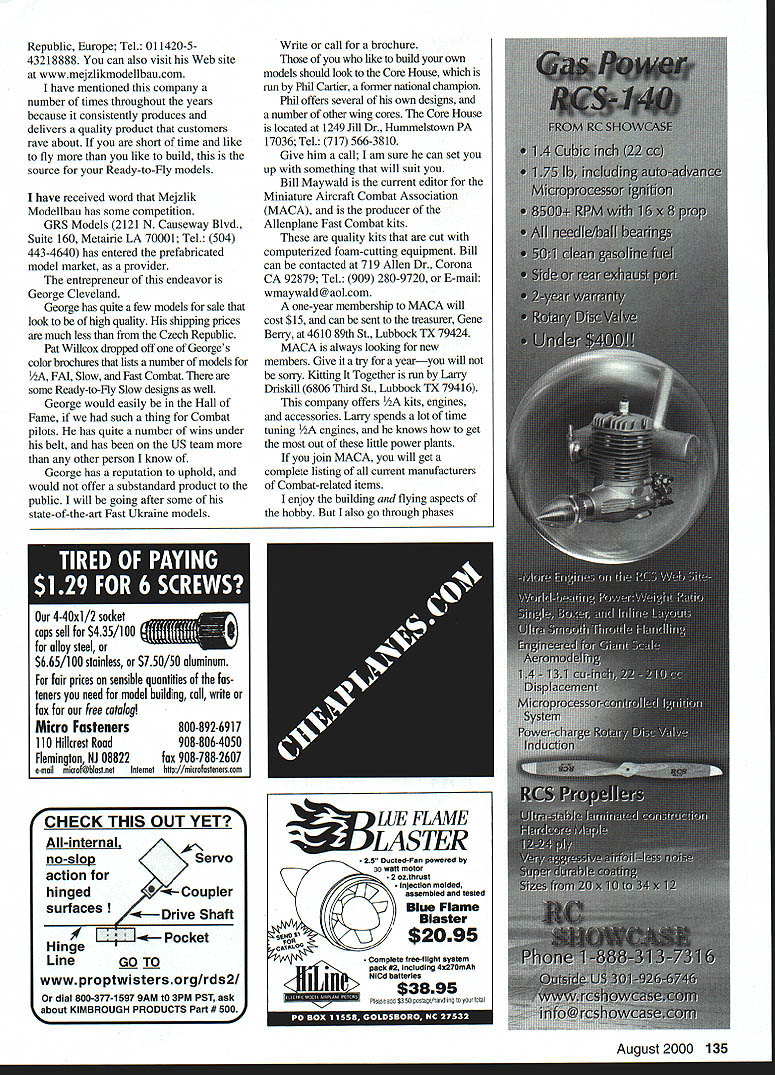
I have several Matador models from the 1970s hanging in the garage. I decided to take a comparison photograph with a modern foam model. There are many changes, ranging from all-wood construction to foam, wooden booms to composite arrow shafts, and wooden engine mounts to metal mounts.
The SuperTigreTM G21-35 was good in the 1970s, but the Nelson is much better today.
Transcribed from original scans by AI. Minor OCR errors may remain.

