

CL Combat
Iskandar Taib, 517 Tulip Tree Apts., Bloomington IN 47408
Although I have written three Control Line (CL) Combat Nationals reports in past years, this is the first time I am writing from the point of view of event director.
Since Special Interest Groups (SIGs) are responsible for running their respective Nationals (Nats) categories, the Miniature Aircraft Combat Association (MACA) had to recruit a director. The usual culprits weren't available, so it fell to me, the "local," to govern the events, which were held July 10–14.
Entries were way down from previous years. There were only three competitors in Slow Combat (perhaps it's time to retire this event, or replace it with a speed-limit event), eight in 1/2A, and eight in Fast Combat.
One possible reason for the low turnout was that it is a World Championship year. Many of the best fliers were in France.
[One sentence in the original scan is unreadable at this resolution; the text below continues from the next legible line.]
I cut institutional paper-towel stock to length, stripped it to the proper width with a paper guillotine, then colored the strips with Rit™ dye. The result was very nice streamers; they hold up well when damp and don't shred in the air, but aren't too strong for cuts.
Judges and helpers
Getting judges was another problem. Fortunately, Andy Taylor saw my pleas for help on the various Control Line bulletin boards, and he volunteered himself, his wife Marsha, and his grandson Michael.
We also had Dave Decker of Anderson IN, Dan Hay of Michigan, Denny Mallott of Fort Wayne IN, and Wayne McDaniel of Muncie helping out at various times.
Thanks, guys. It couldn't have happened without you.
Field and conditions
Field conditions were better than we've had in previous years. We were given a corner of the landscaped area north of the main road, which was flagged off with rope. Three circles and the pit areas were marked off.
Since we had had plenty of rain, the ground was fairly soft. Digging engines out of the turf is an integral part of Combat, and the flexible surface cut down on the damage. I saw many 1/2A airplanes stuck in the ground multiple times, with no harm—not even a broken propeller!
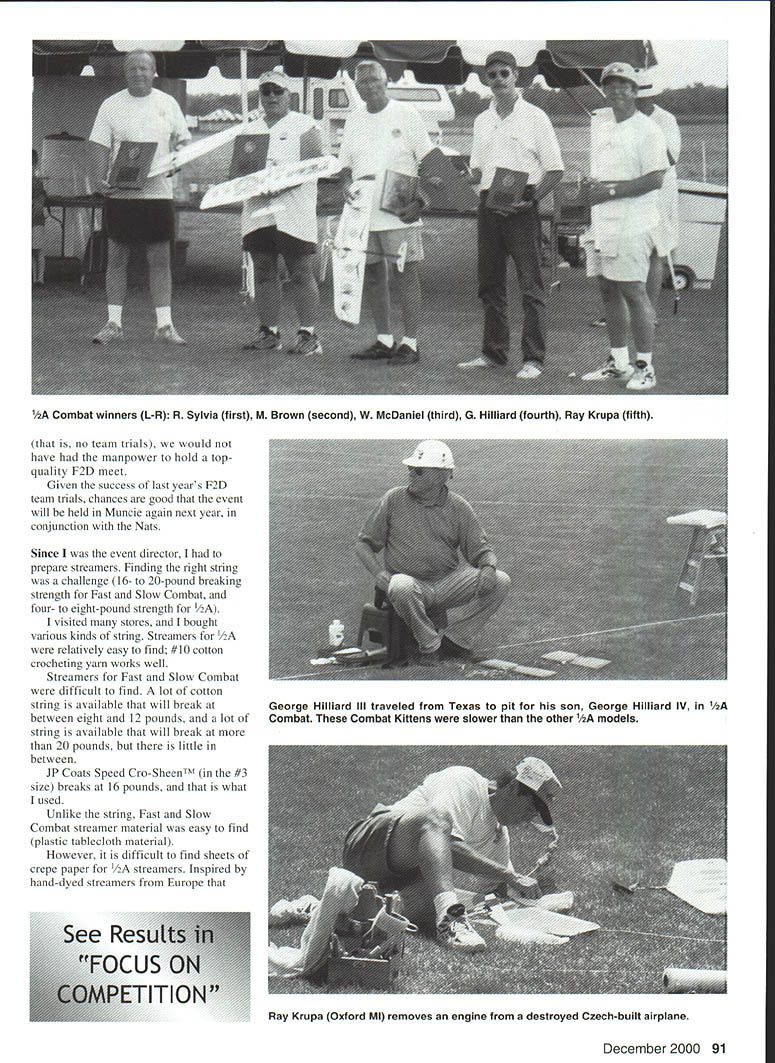
Slow Combat
Slow Combat was flown Monday morning, July 10, under the threat of rain. Nats Headquarters announced that we had a three-hour window of opportunity.
However, there wasn't very much pressure with three fliers; the five matches only took two hours to run, and were finished by noon.
Mickey Brown, who had driven in from Texas in a motor home, emerged from the initial round-robin with one loss. Ray Krupa had no losses, and his twin brother Roy was out with two losses.
Mickey had to beat Roy twice to win, which he did. In all, Mickey and Ray flew against each other four times, including one re-fly. The last two rounds were plagued by bad engine runs, which may have been caused by problems with shutoffs.
Since pitmen were in short supply, the pilots (by mutual agreement) started their own engines and we used F2D starting procedures (one minute to start the engine before the signal to launch is given).
Thomas Hardison was the only Junior who entered Slow Combat. Since it would have been a shame if he'd come all the way to the Nats and didn't get to fly, we put him in the circle with Don McPherson (who is on the other end of the age scale).
Later, I let Thomas pilot one of my 1/2A models. He demonstrated that he knew how to make a Combat model fly, doing loops and figure 8s with ease—he only put it in the ground a couple times, when he let it fly behind him.
Thomas will be back next year, so watch out Krystal King and Skyler Skelley!
1/2A Combat
We started 1/2A Combat Tuesday afternoon. The rainstorms that had come through the area were finished by then.
In contrast to Monday morning, by the time I arrived at the site there was a good crowd of people and a few airplanes in the pits. Although only three pilots had preregistered, a total of eight were entered, including a contingent of four from Florida.
Wayne Trivin (Lake Worth FL) showed up with some very fast bar-stock engines, and his own molded-carbon propellers. Wayne normally flies CL Racing and Speed events, but he decided to give Combat a try.
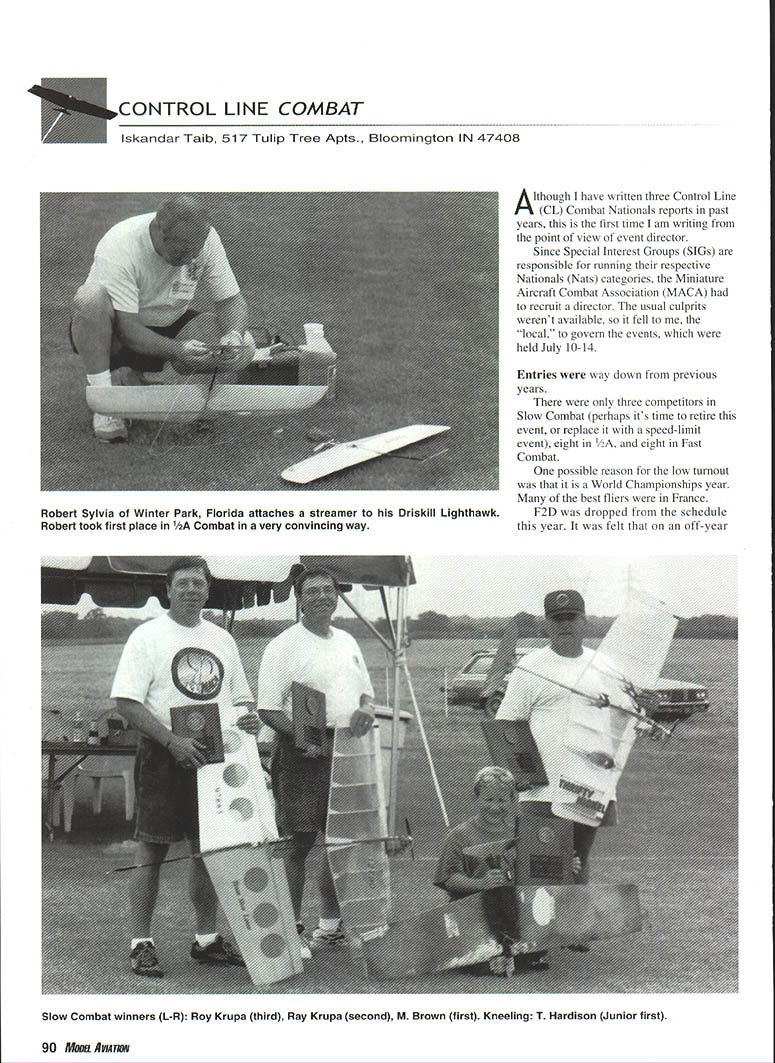
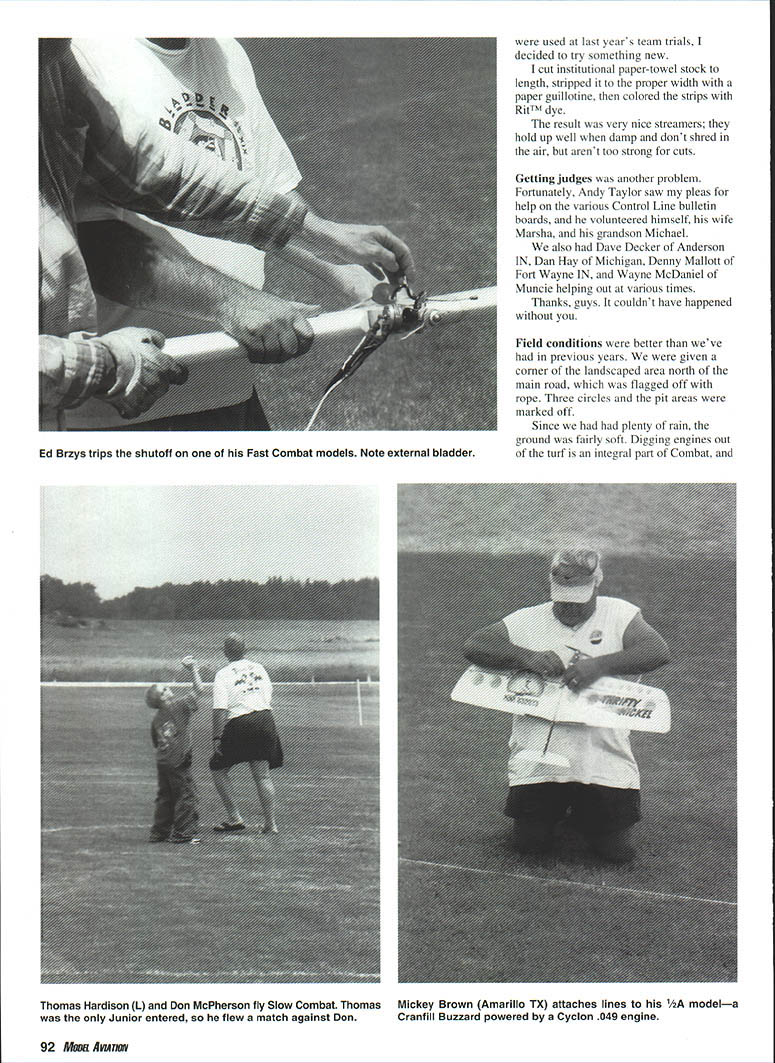
Robert Sylvia (Winter Park FL) was also a Racer, but he has entered 1/2A Combat at the Nats several times. This was his year.
Rounding out the field were the Krupa twins (Ray lives in Michigan and Roy lives in Texas, and they come to the Nats each year for a reunion), Wayne McDaniel (a Texan who has moved to Muncie), and George Hilliard IV, of Cincinnati OH.
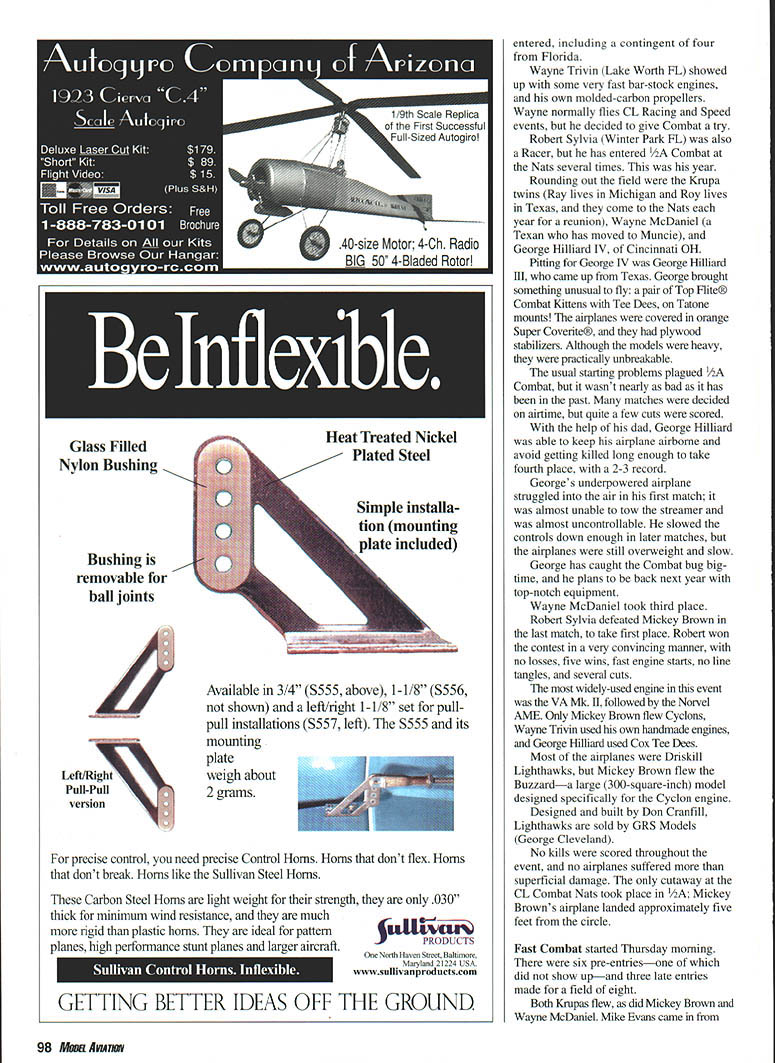
Pitting for George IV was George Hilliard III, who came up from Texas. George brought something unusual to fly: a pair of Top Flite® Combat Kittens with Tee Dees, on Tatone mounts! The airplanes were covered in orange Super Coverite®, and they had plywood wing stabilizers. Although the models were heavy, they were practically unbreakable.
The usual starting problems plagued 1/2A Combat, but it wasn’t nearly as bad as it has been in the past. Many matches were decided on airtime, but quite a few cuts were scored.
With the help of his dad, George Hilliard was able to keep his airplane airborne and avoid getting killed long enough to take fourth place, with a 2–3 record.
George’s underpowered airplane struggled into the air in his first match; it was almost unable to tow the streamer and was almost uncontrollable. He slowed the controls down enough in later matches, but the airplanes were still overweight and slow.
George has caught the Combat bug big-time, and he plans to be back next year with top-notch equipment.
Wayne McDaniel took third place.
Robert Sylvia defeated Mickey Brown in the last match, to take first place. Robert won the contest in a very convincing manner, with no losses, five wins, fast engine starts, no line tangles, and several cuts.
The most widely-used engine in this event was the V4 Mk. II, followed by the Norvel AME. Only Mickey Brown flew Cyclons; Wayne Trivin used his own handmade engines, and George Hilliard used Cox Tee Dees.
Most of the airplanes were Driskill Lighthawks, but Mickey Brown flew the Buzzard—a large (300-square-inch) model designed specifically for the Cyclon engine.
Designed and built by Don Cranfill, Lighthawks are sold by GRS Models (George Cleveland).
No kills were scored throughout the event, and no airplanes suffered more than superficial damage. The only cutaway at the CL Combat Nats took place in 1/4A; Mickey Brown’s airplane landed approximately five feet from the circle.
Fast Combat
Fast Combat started Thursday morning. There were six pre-entries—one of which did not show up—and three late entries made for a field of eight.
Both Krupas flew, as did Mickey Brown and Wayne McDaniel. Mike Evans came in from Ohio, and Ed Brzys and Ron Colombo drove in late Wednesday night from Michigan. Henry Nelson, the manufacturer of most engines used in Fast and Slow Combat, was also flying.
The Nelson .36 engine—the only .36 still made for Combat—was used almost exclusively. Shutoffs were mostly the swing-weight variety, although Mickey Brown used some Bellerank Bullets.
As in Slow Combat, shutoffs were tested before each match by having the pit crews start the engines and activate the shutoffs.
The airplanes in Fast Combat were a mix of arrowshaft foamies and Ready-to-Fly Czech-built airplanes.
Ed Brzys brought his distinctive hollow-winged foamies. With very large wing areas (perhaps 600 square inches) and very low weight, they turn very tightly. However, they do provide an impressive shower of confetti when involved in a midair.
In one collision, Ed’s airplane lost part of its starboard wing, which shed Styrofoam® and Mylar™ for approximately one minute; the rest of the airplane kept flying at 120 mph.
Relatively few kills were scored in this event, and most matches were won with a combination of airtime and cuts.
Quite a few people had problems with their shutoffs, with engines cutting out right after launch. Henry Nelson suffered a shaft run in one of the later rounds; we thought the shaft had broken, but the prop nut had come loose.
Roy Krupa made it through five matches with no losses, and he was matched up with Ed Brzys, who had one loss.
In the first match, a problem with the shutoff kept Roy on the ground until the final minute or so, giving Ed the win.
The second match was much more exciting, with a great deal of close-quarter maneuvering. Roy took the entire streamer for a kill and the contest, with a 6–1 record.
Ed was second with a 4–2 record, and Henry Nelson took third (3–2), beating Wayne McDaniel (2–3) in a flyoff match.
Post-event discussion and invitation
When the flying was over, a short meeting was held to discuss what we should do in the next year to attract more CL Combat participants.
Among the things discussed were:
- Going to a single-elimination format.
- Adding an unofficial speed-limit event.
- Having most of the activity (speed-limit and Fast) during two weekends, rather than the middle of the week. This would allow those who can’t afford the vacation time to attend.
- The possibility of having the team trials right before the Nats, as was done in 1999.
I invite all CL Combat pilots and enthusiasts to join the Combat-L E-mail list. To join, send a blank E-mail message to [email protected].
Among the topics of discussion will be the Nationals, and what to do about it in subsequent years.
Transcribed from original scans by AI. Minor OCR errors may remain.

