
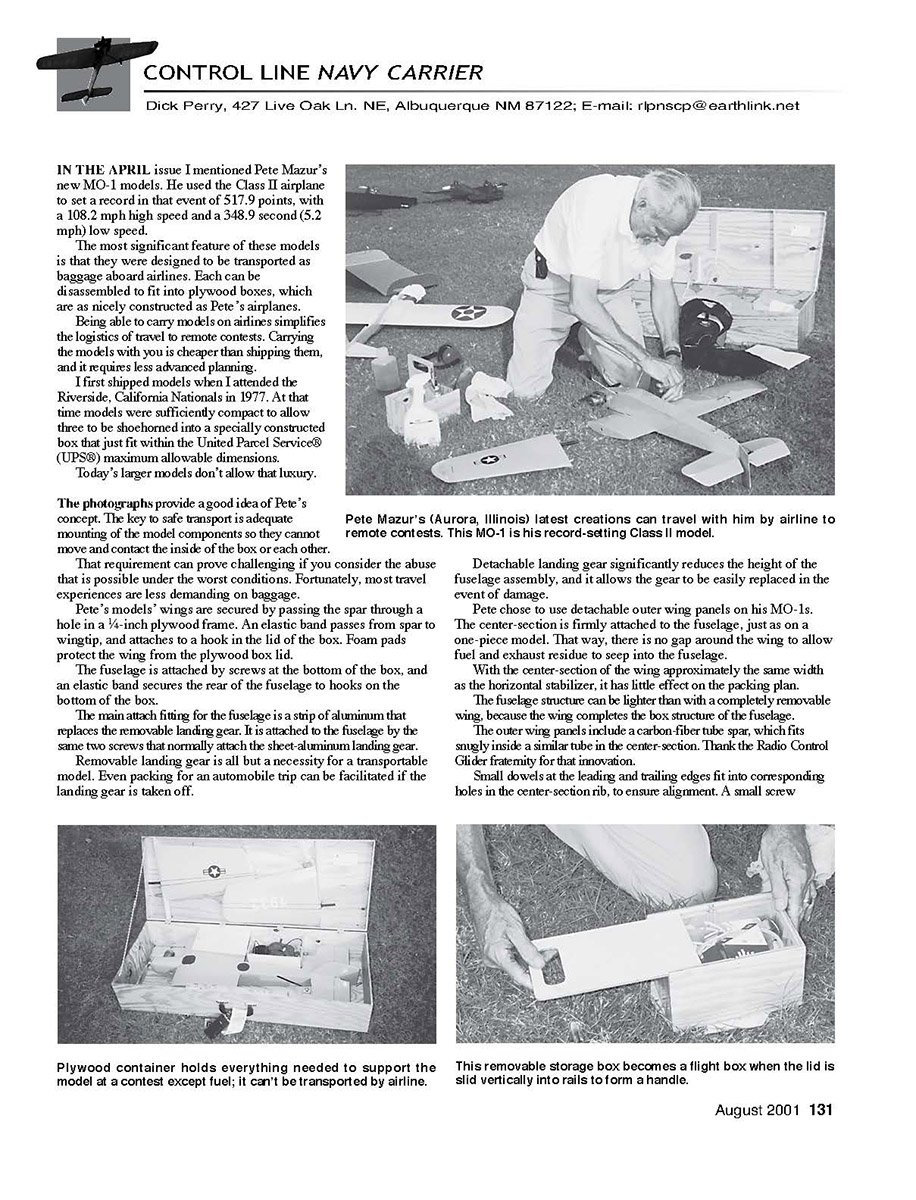
CONTROL LINE NAVY CARRIER
Dick Perry, 427 Live Oak Ln. NE, Albuquerque NM 87122; E-mail: [email protected]
Overview
In the April issue I mentioned Pete Mazur's new MO-1 models. He used the Class II airplane to set a record in that event of 517.9 points, with a 108.2 mph high speed and a 348.9 second (5.2 mph) low speed.
The most significant feature of these models is that they were designed to be transported as baggage aboard airlines. Each can be disassembled to fit into plywood boxes, which are as nicely constructed as Pete's airplanes.
Being able to carry models on airlines simplifies the logistics of travel to remote contests. Carrying the models with you is cheaper than shipping them, and it requires less advanced planning.
Shipping history and challenges
I first shipped models when I attended the Riverside, California Nationals in 1977. At that time models were sufficiently compact to allow three to be shoehorned into a specially constructed box that just fit within the United Parcel Service (UPS) maximum allowable dimensions.
Today's larger models don't allow that luxury.
The key to safe transport is adequate mounting of the model components so they cannot move and contact the inside of the box or each other. That requirement can prove challenging if you consider the abuse that is possible under the worst conditions. Fortunately, most travel experiences are less demanding on baggage.
Packing and mounting details
Pete's models' wings are secured by passing the spar through a hole in a 1/4-inch plywood frame. An elastic band passes from spar to wingtip, and attaches to a hook in the lid of the box. Foam pads protect the wing from the plywood box lid.
The fuselage is attached by screws at the bottom of the box, and an elastic band secures the rear of the fuselage to hooks on the bottom of the box.
The main attach fitting for the fuselage is a strip of aluminum that replaces the removable landing gear. It is attached to the fuselage by the same two screws that normally attach the sheet-aluminum landing gear.
Removable landing gear is all but a necessity for a transportable model. Even packing for an automobile trip can be facilitated if the landing gear is taken off. Detachable landing gear significantly reduces the height of the fuselage assembly, and it allows the gear to be easily replaced in the event of damage.
Pete chose to use detachable outer wing panels on his MO-1s. The center-section is firmly attached to the fuselage, just as on a one-piece model. That way, there is no gap around the wing to allow fuel and exhaust residue to seep into the fuselage.
With the center-section of the wing approximately the same width as the horizontal stabilizer, it has little effect on the packing plan. The fuselage structure can be lighter than with a completely removable wing, because the wing completes the box structure of the fuselage.
The outer wing panels include a carbon-fiber tube spar, which fits snugly inside a similar tube in the center-section. Thank the Radio Control Glider fraternity for that innovation.
Small dowels at the leading and trailing edges fit into corresponding holes in the center-section rib, to ensure alignment. A small screw [text incomplete]
Flight/Storage box
A plywood container holds everything needed to support the model at a contest except fuel; it can't be transported by airline.
This removable storage box becomes a flight box when the lid is slid vertically into rails to form a handle.
Pete's concept could be adapted to any number of models, though each would require special considerations for the size of the box and the configuration of the model when it is disassembled.
Airline and shipper limits
The dimensions allowed by the airlines and package-shipping companies need to be considered when planning a shippable model.
Rules can vary from airline to airline, so check with the carrier you are most likely to use rather than accepting what I write as universal truth.
- United and American Airlines accept baggage up to 62 inches total dimension (length plus width plus height). United accepts a maximum of two carry-on bags and two checked bags; American accepts a total of three bags, checked and carry-on combined.
- TWA and Northwest have accepted my oversize, but relatively light, model box without additional fee, though most are allowed to charge (usually roughly $75) for oversize bags. It all depends on the agent.
- The dimension limits for UPS are complex. The basic domestic limit is 84 inches linear measurement (length plus girth), and it will accept packages as large as 108 inches, but will use an arbitrary weight to compute shipping charges if the box is more than 84 inches.
The overall dimensions allowed by airlines and shippers for the cheapest method of transport make it difficult to use a single-piece removable wing. The 44-inch wingspan of most of my models doesn't leave much for width and height to fit within the 62-inch or 84-inch limits. My box holds two L-10s with one-piece wings, but the dimensions are 76 inches by airline standard and 104 inches for UPS.
Travel tips
When traveling by air with your models, remember that it's illegal to transport fuel on a commercial airline. It can be shipped, but a hazardous-material fee applies.
The best option is to arrange for one of the local contestants to supply your fuel for the contest.
Closing
That's all for this month. Keep your hook dry. KA
Transcribed from original scans by AI. Minor OCR errors may remain.

