
CL Navy Carrier
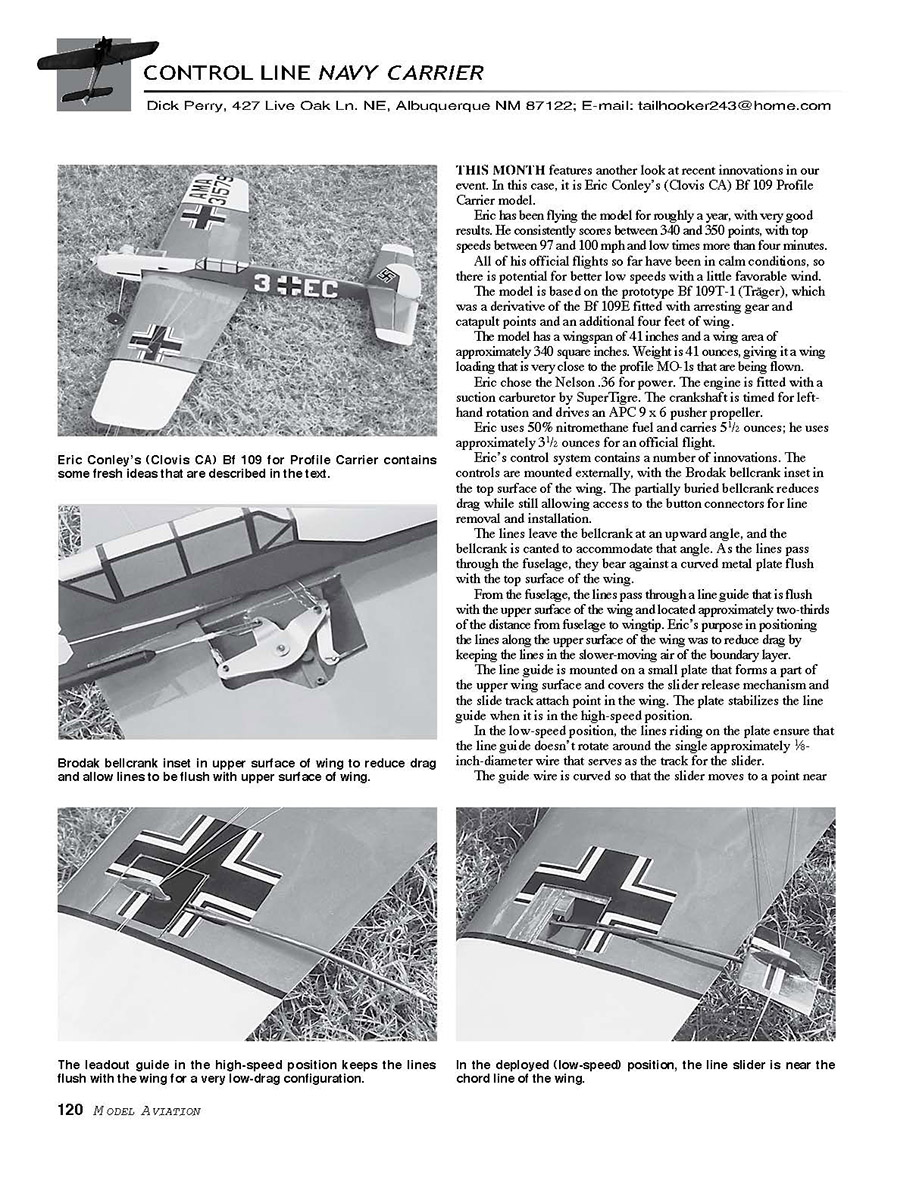
THIS MONTH features another look at recent innovations in our event. In this case, it is Eric Conley's (Clovis, CA) Bf 109 Profile Carrier model.
Flight performance
Eric has been flying the model for roughly a year, with very good results. He consistently scores between 340 and 350 points, with top speeds between 97 and 100 mph and low times of more than four minutes.
All of his official flights so far have been in calm conditions, so there is potential for better low speeds with a little favorable wind.
Prototype and model dimensions
The model is based on the prototype Bf 109T-1 (Träger), which was a derivative of the Bf 109E fitted with arresting gear, catapult points, and an additional four feet of wing.
Model characteristics:
- Wingspan: 41 inches
- Wing area: approximately 340 square inches
- Weight: 41 ounces
This gives a wing loading very close to the profile MO-1s that are being flown.
Powerplant and fuel
Eric chose the Nelson .36 for power. The engine is fitted with a suction carburetor by SuperTiger. The crankshaft is timed for left-hand rotation and drives an APC 9 x 6 pusher propeller.
Fuel and consumption:
- Fuel: 50% nitromethane
- Fuel carried: 5½ ounces
- Fuel used for an official flight: approximately 3½ ounces
Control system innovations
Eric's control system contains a number of innovations. The controls are mounted externally, with the Brodak bellcrank inset in the top surface of the wing. The partially buried bellcrank reduces drag while still allowing access to the button connectors for line removal and installation.
Key features:
- The lines leave the bellcrank at an upward angle, and the bellcrank is canted to accommodate that angle.
- As the lines pass through the fuselage, they bear against a curved metal plate flush with the top surface of the wing.
- From the fuselage, the lines pass through a line guide that is flush with the upper surface of the wing and located approximately two-thirds of the distance from fuselage to wingtip.
- The purpose of positioning the lines along the upper surface of the wing is to reduce drag by keeping the lines in the slower-moving air of the boundary layer.
The line guide is mounted on a small plate that forms part of the upper wing surface and covers the slider release mechanism and the slide-track attach point in the wing. The plate stabilizes the line guide when it is in the high-speed position.
In the low-speed position, the lines riding on the plate ensure that the line guide doesn't rotate around the single approximately 1/8-inch-diameter wire that serves as the track for the slider. The guide wire is curved so that the slider moves to a point near the trailing edge of the wing in its fully deployed position.
The whole assembly is very streamlined in the high-speed position. When the throttle drops, the line slider is released by means of a flexible cable in a plastic tube (borrowed from the radio control community). The tubing directs the cable from the point it enters the fuselage near the trailing edge of the wing to the slider-release mechanism.
Appearance
It's a shame that the photos are printed in black-and-white. The model is very well constructed, and it looks quite nice in its olive color scheme with yellow nose and tips.
Future projects
Eric's next project is a profile Spitfire Mk XV with an elliptical wing. It is also planned for a 41-inch wingspan, but will have slightly more wing area to improve low-speed flight.
It's great to see people building and flying aircraft other than the MO-1. Eric is demonstrating that other prototypes can produce models with performance potential to rival the MO-1 if a modeler devotes sufficient time to development.
Society news and closing
This month's column will include a report on the Carrier competition at the Nationals.
The Navy Carrier Society annual meeting and awards banquet is held at the Nationals each year. This year I expect there will be a discussion of possible rule changes with the potential to increase interest and participation in our Navy Carrier events. The rules-change cycle starts again in January. Give it some thought and contact me or your Navy Carrier Society officers with your input.
I have taken the new e-mail address in the header for this column. I've changed providers, and the old address will be closed by the time you receive this magazine.
That wraps it up for this month. Keep your hook dry.
Transcribed from original scans by AI. Minor OCR errors may remain.

