
CL Navy Carrier
Dick Perry, 427 Live Oak Ln. NE, Albuquerque NM 87122; E-mail: [email protected]
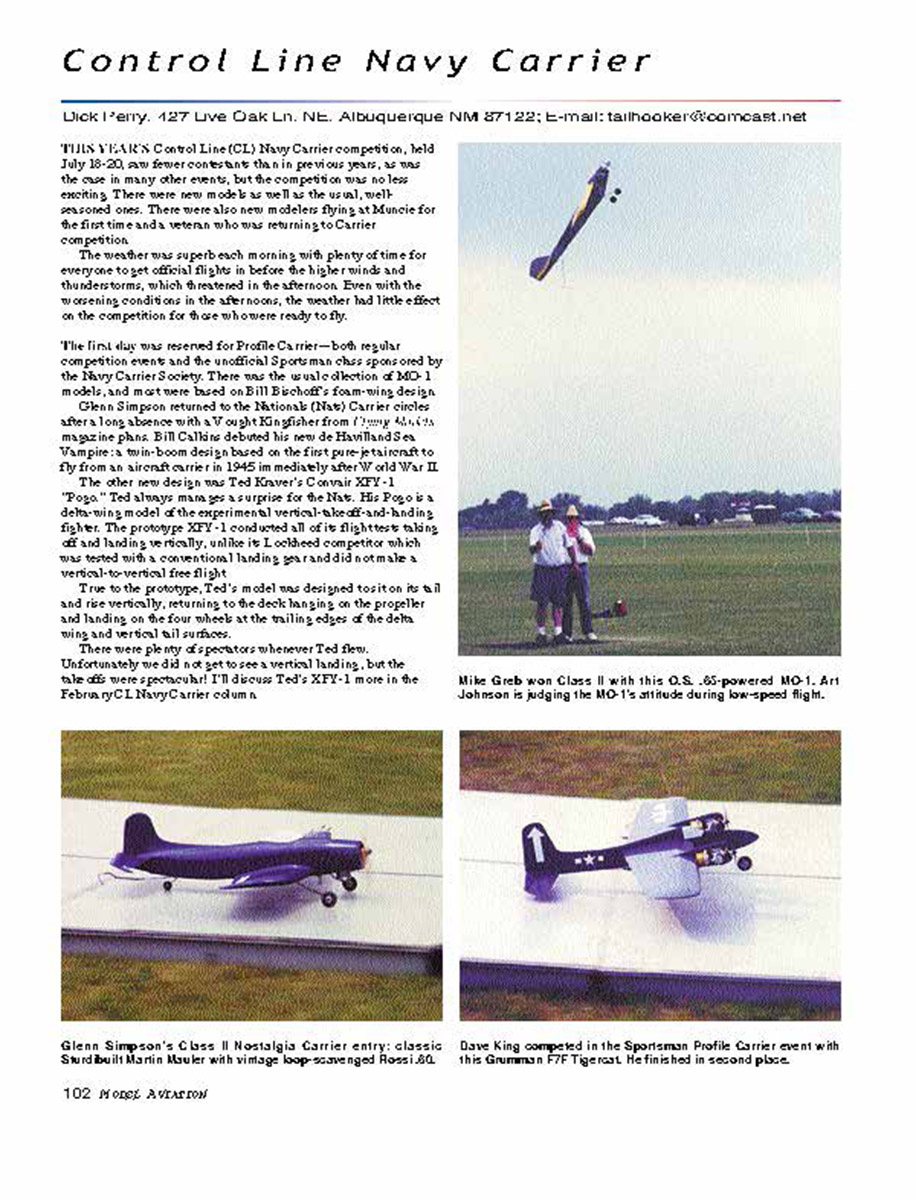
THIS YEAR'S Control Line (CL) Navy Carrier competition, held July 18-20, saw fewer contestants than in previous years, as was the case in many other events, but the competition was no less exciting. There were new models as well as the usual, well seasoned ones. There were also new modelers flying at Muncie for the first time and a veteran who was returning to Carrier competition.
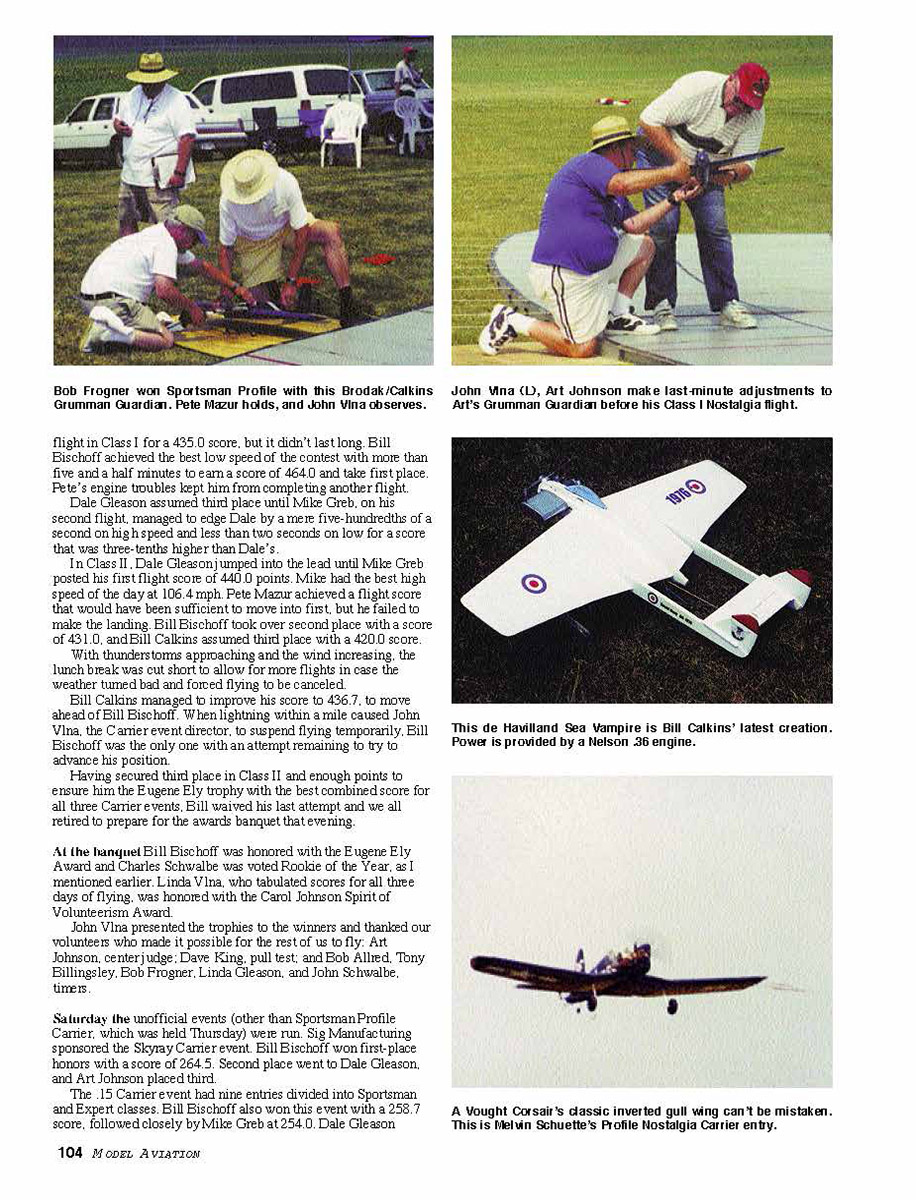
The weather was superb each morning with plenty of time for everyone to get official flights in before the higher winds and thunderstorms, which threatened in the afternoon. Even with the worsening conditions in the afternoons, the weather had little effect on the competition for those who were ready to fly.
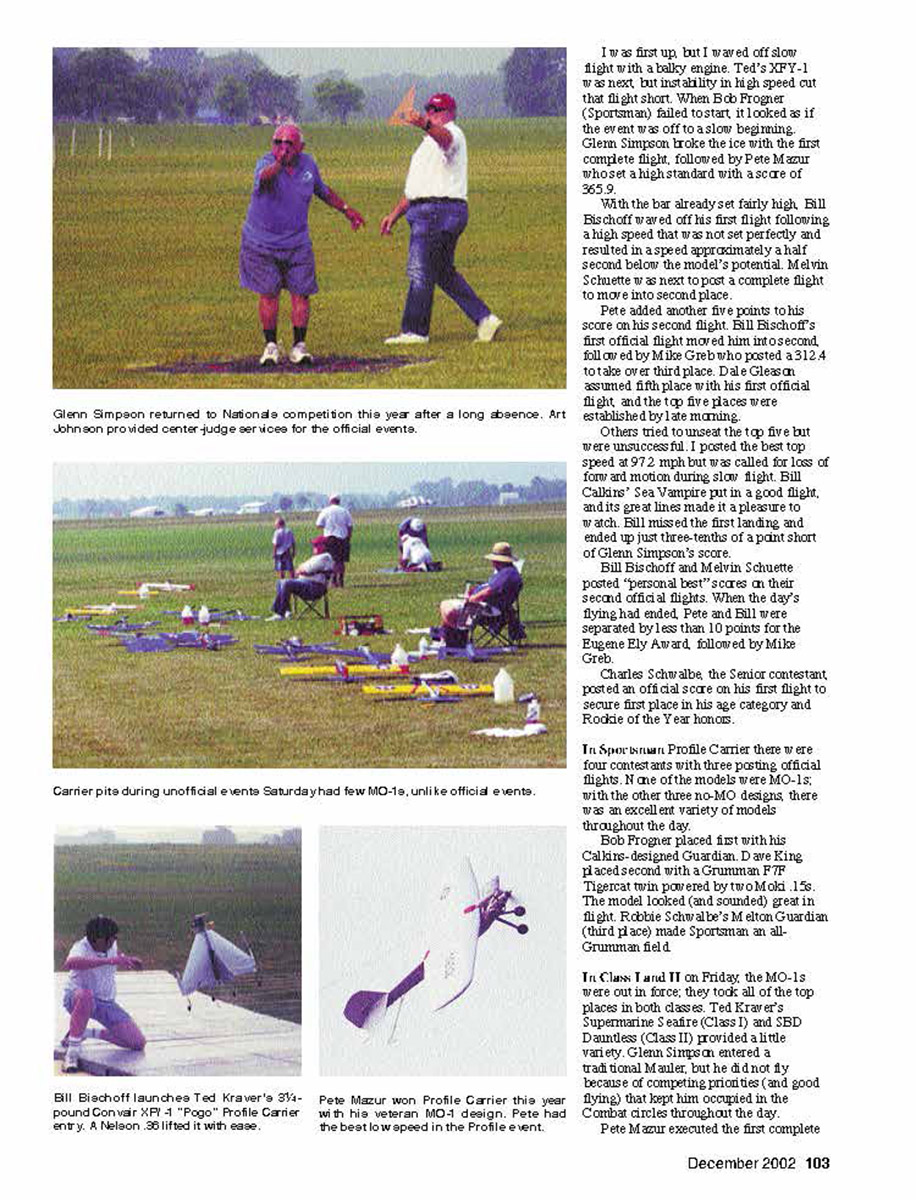
The first day was reserved for Profile Carrier—both regular competition events and the unofficial Sportsman class sponsored by the Navy Carrier Society. There was the usual selection of MD-1 models, and most were based on Bill Bischoff's foam-wing design. Glenn Simpson returned to the Nationals (Nats) Carrier circles after a long absence with a Vought Kingfisher from Young Aviators magazine plans. Bill Calkins debuted his new de Havilland Sea Vampire, a twin-boom design based on the first pure-jet aircraft to fly from an aircraft carrier in 1945 immediately after World War II.
The other new design was Ted Kaver's Convair XFY-1 "Pogo." Ted always manages a surprise for the Nats. His Pogo is a delta-wing model of the experimental vertical-takeoff-and-landing fighter. The prototype XFY-1 conducted all of its flights taking off and landing vertically, unlike the Lockheed competitor which was tested with a conventional landing gear and did not make a vertical-to-vertical free flight.
True to the prototype, Ted's model was designed to sit on its tail and rise vertically, returning to the deck hanging on the propeller and landing on the four wheels at the trailing edges of the delta wing and vertical tail surfaces.
There were plenty of spectators wherever Ted flew. Unfortunately we did not get to see a vertical landing, but the takeoffs were spectacular! I'll discuss Ted's XFY-1 more in the February CL Navy Carrier column.
I was first up, but I waved off slow flight with a balky engine. Ted's XFY-1 was next, but instability in high speed cut that flight short. When Bob Frogner (Sportsman) failed to start, it looked as if the event was off to a slow beginning. Glenn Simpson broke the ice with the first complete flight, followed by Pete Mazur, who set a high standard with a score of 365.9.
With the bar already set fairly high, Bill Bischoff waved off his first flight following a high speed that was not set perfectly and resulted in a speed approximately a half second below the model's potential. Melvin Schuette was next to post a complete flight to move into second place.
Pete added another five points to his score on his second flight. Bill Bischoff's first official flight moved him into second, followed by Mike Greb who posted a 312.4 to take over third place. Dale Gleason assumed fifth place with his first official flight, and the top five places were established by late morning.
Others tried to unseat the top five but were unsuccessful. I posted the best top speed at 372 mph but was called for loss of form and motion during slow flight. Bill Calkins' Sea Vampire put in a good flight, and its great lines made it a pleasure to watch. Bill missed the first landing and ended up just three-tenths of a point short of Glenn Simpson's score.
Bill Bischoff and Melvin Schuette posted "personal best" scores on their second official flights. When the day's flying had ended, Pete and Bill were separated by less than 10 points for the Eugene Ely Award, followed by Mike Greb.
Charles Schwalbe, the Senior contestant, posted an official score on his first flight to secure first place in his age category and Rookie of the Year honors.
In Sportsman Profile Carrier there were four contestants with three posting official flights. None of the models were MO-1s; with the other three no-MO designs there was an excellent variety of models throughout the day.
Bob Frogner placed first with his Calkins-designed Guardian. Dave King placed second with a Grumman F7F Tigercat twin powered by two Moki 1.5s. The model looked (and sounded) great in flight. Robbie Schwalbe's Melton Guardian (third place) made Sportsman an all-Grumman field.
In Class I and II on Friday, the MO-1s were out in force; they took all of the top places in both classes. Ted Kraver's Supermarine Seafire (Class I) and SBD Dauntless (Class II) provided a little variety. Glenn Simpson entered a traditional Mauler, but he did not fly because of competing priorities (and good flying) that kept him occupied in the Combat circles throughout the day.
Pete Mazur executed the first complete flight in Class I for a 435.0 score, but it didn't last long. Bill Bischoff achieved the best low speed of the contest with more than five and a half minutes to earn a score of 464.0 and take first place. Pete's engine troubles kept him from completing another flight.
Dale Gleason assumed third place until Mike Greb, on his second flight, managed to edge Dale by a mere five-hundredths of a second on high speed and less than two seconds on low for a score that was three-tenths higher than Dale's.
In Class II, Dale Gleason jumped into the lead until Mike Greb posted his first flight score of 440.0 points. Mike had the best high speed of the day at 106.4 mph. Pete Mazur achieved a flight score that would have been sufficient to move into first, but he failed to make the landing. Bill Bischoff took over second place with a score of 431.0, and Bill Calkins assumed third place with a 420.0 score.
With thunderstorms approaching and the wind increasing, the lunch break was cut short to allow for more flights in case the weather turned bad and forced flying to be canceled.
Bill Calkins managed to improve his score to 436.7 to move ahead of Bill Bischoff. When lightning within a mile caused John Vina, the Carrier event director, to suspend flying temporarily, Bill Bischoff was the only one with an attempt remaining to try to advance his position.
Having secured third place in Class II and enough points to ensure him the Eugene Ely trophy with the best combined score for all three Carrier events, Bill waived his last attempt and we all retired to prepare for the awards banquet that evening.
At the banquet Bill Bischoff was honored with the Eugene Ely Award and Charles Schwalbe was voted Rookie of the Year, as I mentioned earlier. Linda Vina, who tabulated scores for all three days of flying, was honored with the Carol Johnson Spirit of Volunteerism Award.
John Vina presented the trophies to the winners and thanked our volunteers who made it possible for the rest of us to fly: Art Johnson, contest director; Dave King, pull test; and Bob Allred, Tony Billingsley, Bob Frogner, Linda Gleason, and John Schwalbe.
Saturday the unofficial events (other than Sportsman Profile Carrier, which was held Thursday) were run. Sig Manufacturing sponsored the Skyway Carrier event. Bill Bischoff won first-place honors with a score of 264.5. Second place went to Dale Gleason, and Art Johnson placed third.
The .15 Carrier event had nine entries divided into Sportsman and Expert classes. Bill Bischoff also won this event with a 258.7 score, followed closely by Mike Greb at 254.0. Dale Gleason
CL Navy Carrier
placed third. All three were flying Bill's Sniper design. In the Sportsman Class, Dave King bested Art Johnson by less than a point and Bob Frogner placed third.
Nostalgia Carrier was flown in three classes this year for the first time. John Vina led the Profile class flying his Motth-designed XPC-1 Stunt with a SuperTiger ST35. His score was 300.99 points. Close behind was Melvin Schuett at 298.59 with a CS/Brockett Rex-pert pulled by a Fox Profile Carrier Special engine. In Class II it was Ted Knauer's diminutive Domi Guardian with a Fox .29 over Art Johnson's Bill Johnson on 33-inch Guardian. Ted scored 338.89 points. Ted also won Class III with a Sterling Guardian.
Other entries included Art Johnson's big train with a McCoy .60, one entered by Bill Johns on meter and glide, and Glenn Simpson's substitute Madsw with a Rossi .60. They really brought back more entries; it was great!
The officials and contestants selected John Vina and his XPC-1 as best representing the spirit of the Nostalgia Carrier events: the tough vintage model design and engine as well as performance. He received the Roland Bates Award commemorating Roland's contribution to the Carrier event through his active participation and prolific design.
It was a great three days of Carrier flying and camaraderie that is unique to the Nats experience.
See results in "Focus on Competition"
Transcribed from original scans by AI. Minor OCR errors may remain.

