
Rule changes for 2013
by Dick Perry [email protected]
The new competition rules for 2013 have been released by the AMA Competitions Department. You can see the Contest Board's voting results on the AMA website. There were three Navy Carrier proposals and one CL General proposal on the final ballot that affect our event, and all passed.
The CL General proposal, CLG-13-2, was the final version of a couple of proposals that would allow radio control of some functions on CL models. The change removes the decades-old prohibition of using radio control on CL models. Specifically, the new rule allows the following:
- Radio control may be used for controlling functions on CL models within certain parameters.
- Radios must be 2.4 GHz spread spectrum technology as allowed by the Federal Communication Commission (47 CFR Part 15).
- Radio may control only auxiliary functions on the model, not elevation.
- Elevation must be controlled via the lines, as in the past.
- All functions must be under control of the pilot; a second person may not operate any functions on the model.
- Radio may be used in competition events only as specifically allowed by the rules of the individual event, as determined by the appropriate Contest Board.
Specific Navy Carrier proposals went through modification as the process moved along, and some proposals under consideration were eliminated.
CLC-13-2 added 18 inches to the distance allowable for placing the model on the deck for takeoff; specifically, the "red line" was moved from 42 inches to 60 inches forward of the last arresting line.
This change allows more room for today's larger models. It makes it less likely that a model will be released forward of the line by an inattentive pit crew, causing a flight to be declared as an attempt with no score.
This rule also reduces the likelihood of an arrested takeoff, in which the tailhook, extending over the last arresting line in an effort to ensure that the nose of the model doesn't pass the red line, snags the arresting line when the model is released.
CLC-13-3 allows the use of radio control in the Navy Carrier events, as outlined in CLG-13-2.
CLC-13-6C establishes three provisional electric power Navy Carrier (E-Carrier) events: Profile, Class I, and Class II. These events will be added to the AMA Competitions Regulations.
The rules are based on the Navy Carrier Society's (NCS) unofficial E-Carrier rules. These events are separate from the original gas-powered Navy Carrier events.
Carrier Nationals
The 2013 Navy Carrier Nationals will be flown July 16-18. The schedule will be as in the past, with Profile Carrier events on Tuesday, Class I and II events on Wednesday, and unofficial Carrier events (Nostalgia, .15, Skyray) on Thursday. The annual NCS awards banquet will take place Wednesday evening.
The new provisional E-Carrier events will be flown on the same day as the corresponding gas Carrier events. Profile Carrier, E-Profile Carrier, and Sportsman Profile Carrier will be flown on Tuesday. The Scale Carrier classes (official and provisional) will all be flown on Wednesday.
At the 2013 Nats, Carrier processing can take place on any day, although it must occur no later than the day prior to the scheduled flying day. We will allow early processing for the events scheduled on Wednesday and Thursday.
Handle Options
The control handle is a critical part of the control system of a Navy Carrier model. The first commercially successful, three-line Flight Control handle was designed by J. Robert (Bob) Smurthwaite more than 60 years ago.
It was originally manufactured by J. Roberts Model Manufacturing, then Sturdi-Built Models. A stronger version of the handle and bellcranks was designed by Bob and produced by G-S Products International. Leroy Cordes took over manufacturing the handle; it is currently produced by Brodak Manufacturing.
The Smurthwaite handles were only available in one size, and the one size doesn't fit all hands. Modelers with smaller hands, in particular, have difficulty flying with one hand.
Using two hands is possible and many modelers fly that way, but it can be more awkward than using only one hand.
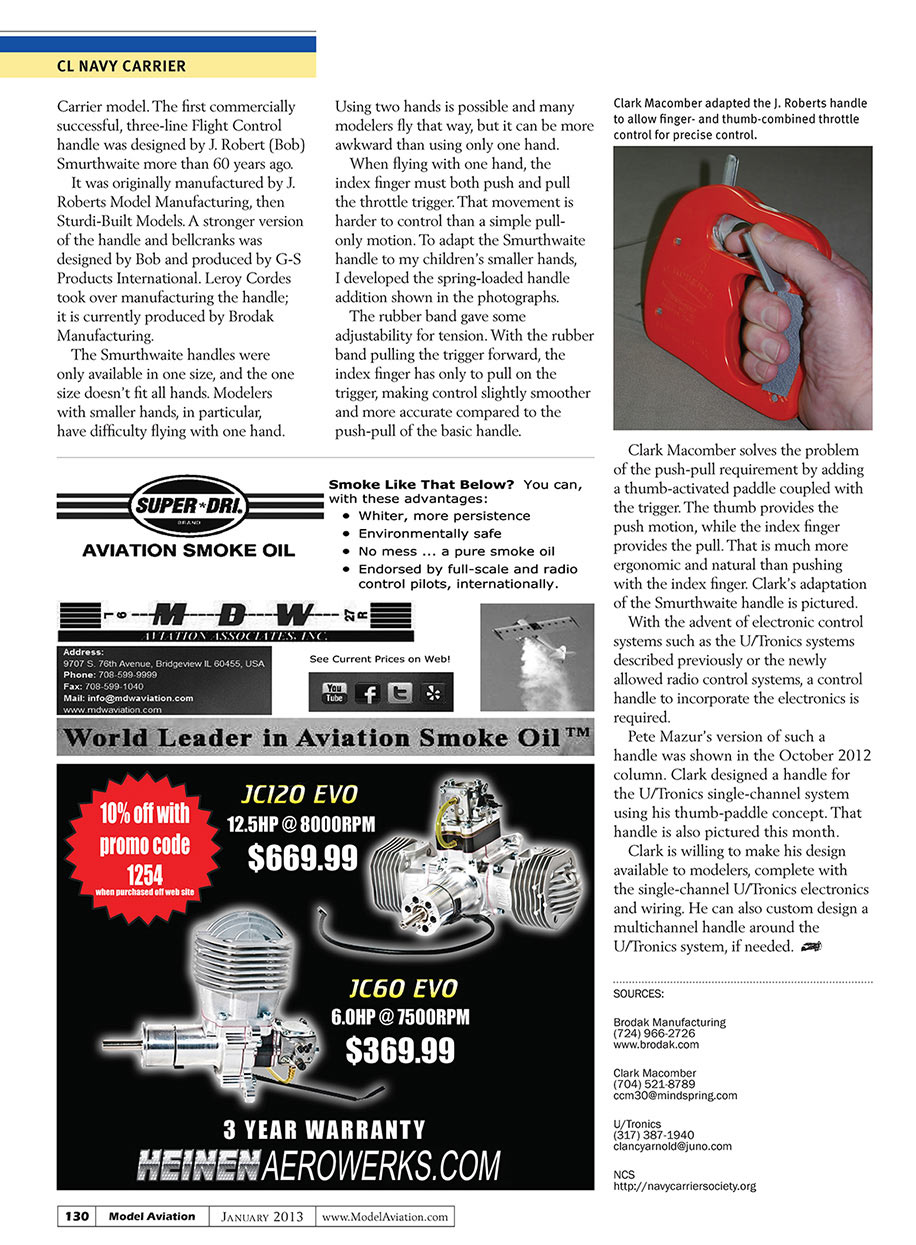
When flying with one hand, the index finger must both push and pull the throttle trigger. That movement is harder to control than a simple pull-only motion. To adapt the Smurthwaite handle to my children's smaller hands, I developed the spring-loaded handle addition shown in the photographs.
The rubber band gave some adjustability for tension. With the rubber band pulling the trigger forward, the index finger has only to pull on the trigger, making control slightly smoother and more accurate compared to the push-pull of the basic handle.
Clark Macomber adapted the J. Roberts handle to allow finger- and thumb-combined throttle control for precise control.
Clark Macomber solves the problem of the push-pull requirement by adding a thumb-activated paddle coupled with the trigger. The thumb provides the push motion, while the index finger provides the pull. That is much more ergonomic and natural than pushing with the index finger. Clark's adaptation of the Smurthwaite handle is pictured.
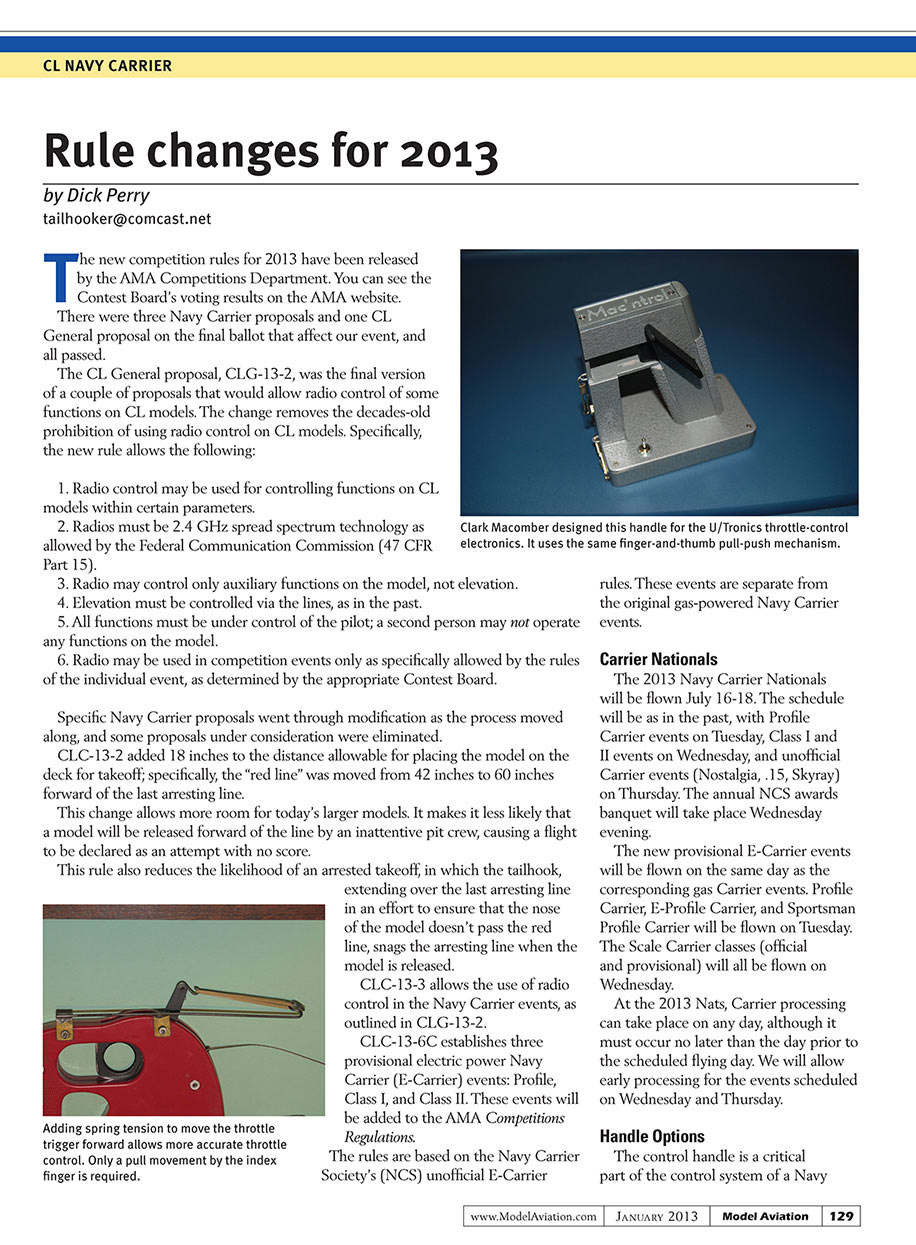
With the advent of electronic control systems such as the U/Tronics systems described previously or the newly allowed radio control systems, a control handle to incorporate the electronics is required.
Pete Mazur's version of such a handle was shown in the October 2012 column. Clark designed a handle for the U/Tronics single-channel system using his thumb-paddle concept. That handle is also pictured this month.
Clark is willing to make his design available to modelers, complete with the single-channel U/Tronics electronics and wiring. He can also custom design a multichannel handle around the U/Tronics system, if needed.
SOURCES:
Brodak Manufacturing (724) 966-2726 www.brodak.com
Clark Macomber (704) 521-8789 [email protected]
U/Tronics (317) 387-1940 [email protected]
NCS http://navycarriersociety.org
CL Navy Carrier
Dick Perry
Transcribed from original scans by AI. Minor OCR errors may remain.

