
CONTROL LINE NAVY CARRIER
Dick Perry, 427 Live Oak Ln. NE, Albuquerque NM 87122; E-mail: [email protected]
Correction
The Profile Guardian shown in the April column (photographed at the Nationals last summer) belonged to Bill Johnson — not Bill Calkins. The design was Bill Calkins', and is now in production by Brodak.
As this issue is mailed out, the Nationals Carrier events should be very near. I hope many of you enjoy a week of good competition, good weather, and camaraderie.
I'm sorry I will not be there this year, but work commitments are keeping me in Albuquerque. A steady paycheck is a necessity to maintain my model workshop.
Good luck to all who participate. Judging from what has already been achieved in 2000, there should be some spectacular scores if the weather is good.
Records
The Dallas Carrier fliers held a contest in February in near-perfect conditions, and the results showed it! There were three records, and nearly all contestants were inspired to personal-best performances.
- Andy Westerheim achieved a Profile Carrier Senior record of 341.1 points, which included a slow-flight time of 6½ minutes. His slow flight was the best of the day in any event or age category.
- Bill Bischoff had two record performances: he posted a 471.6 in Class I, and a 493.3 in Class II.
- Although it was not a record, Kelly Hite's 366.4 in Profile Carrier was an outstanding performance.
I'll try to have details of the models, engines, and other equipment in the October column. Congratulations to you all.
Rules
The initial voting on rules that will become effective in 2002 is complete. The voting results have already been published in Model Aviation.
The proposal to allow engines as large as .3661 cubic inches (6cc) in Profile Carrier was approved by a wide margin.
The change will allow the use of engines designed to the 6cc limit, which are imported from abroad. It will also allow the use of Fox Mark VII Combat Special engines, which were produced with slightly-oversize crankshafts.
Profile Carrier, Combat, and Slow Rat are the only events for which engine sizes have not been updated to correspond with standard metric sizes.
The upper limit for Class II Navy Carrier and Class D Speed remains .6500 cubic inches, but there are really no metric-equivalent engines in production. The engines produced are built to the US-displacement standard for the limited market in Carrier events.
The change for Profile Carrier was proposed to provide additional engine options—primarily, lower-priced imports—to make it easier for modelers to get into the event. The majority of those engines are relatively light and are equipped with throttles, making them easily adaptable to Profile Carrier.
Mystery Airplane
The Mystery Airplane from the June issue was the Breguet 960 Vultur.
This aircraft was configured similar to the Guardian, but with an Armstrong Siddeley Mamba turboprop in the nose, rather than the radial-piston engine of the Guardian.
As did the prototype Guardian, the Vultur included a turbojet in the tail to augment its performance. The jet was the Hispano-Suiza Nene.
The Vultur is a pretty airplane, as are many French aircraft. After printing the Aerocentre N.C. 1071 in the August 1998 issue, I felt compelled to include a French airplane that wasn't quite so weird.
The Vultur was similar in design to the Guardian, with a high-aspect-ratio wing and a crew of two. Its dimensions and weights were also similar to the Guardian. The mission was surface attack. Later variants of the Vultur were equipped with wingtip fuel tanks.
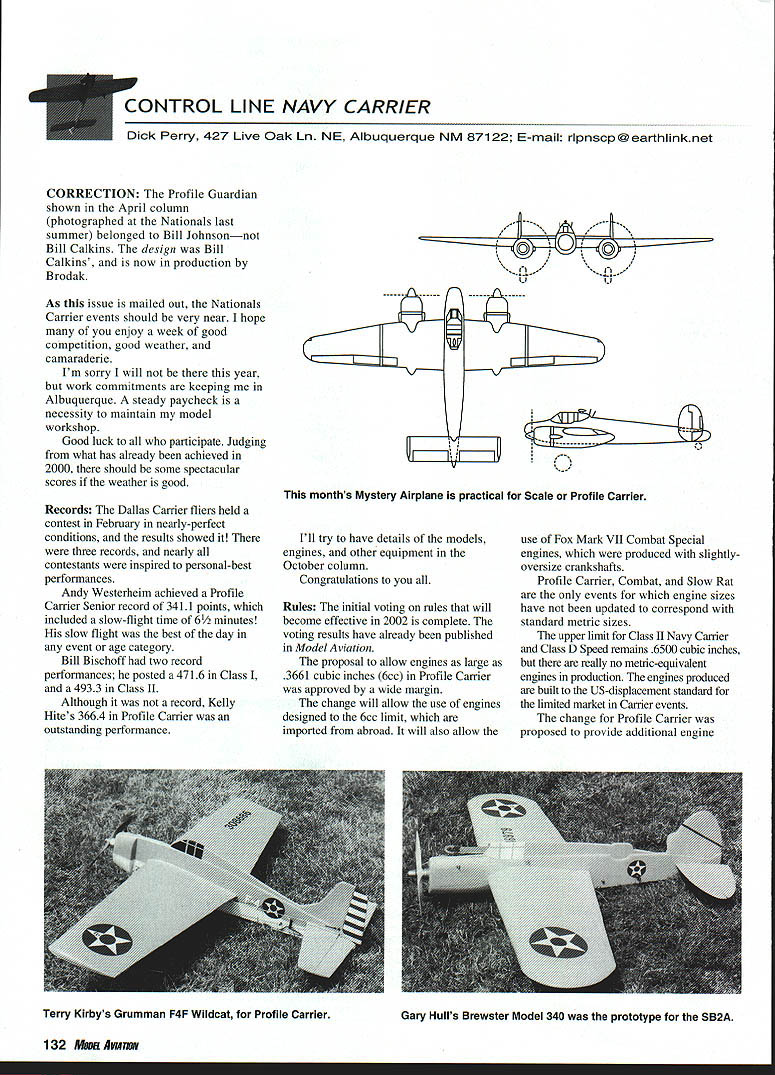
This month I'm going to continue the trend, with an aircraft that would make a practical model for Carrier events.
It isn't quite as pretty as some of the twin-engine propeller aircraft that have graced the carrier decks of the world, such as the Grumman Tigercat or the de Havilland Sea Hornet or Sea Mosquito; however, it should be readily adaptable to model form in Scale or Profile classes.
If you can identify this aircraft, send your entry to me at the USPS or E-mail address listed in the column header. I'll select a winner at random from those who correctly identify the aircraft, and he or she will be awarded a year's membership in the Navy Carrier Society.
Good luck!
Nostalgia
Some years ago, I acquired a copy of the Navy Carrier rules from 1955, when the event was run by the Navy as part of its recruiting program. The Navy was also providing its bases for the Nationals.
I believe Ron Duly found the old rules and lent them to me, but my memory is a little cloudy on that point.
Ted Kraver volunteered to convert the original document to electronic form, and I have it as a text file or a Microsoft® Word document. If you would like a copy, please contact me.
I'm still hoping to see photos of your winter building projects, so I can include them in the column.
This month's photos are older shots of nice Profile Carrier models from my archives. They share a trait that makes them very appealing to me: they aren't MO-1s.
MA
Transcribed from original scans by AI. Minor OCR errors may remain.

