
Control Line Precision Aerobatics
Frank McMillan, 12106 Gunter Grv., San Antonio TX 78231
There are points in time—"magic moments"—that stick in your mind as representative of an event or life.
During the Nationals (Nats) Top-20 flying, I was struck by the picture of the cloudless blue sky, the green grass, and all four circles on the L-pad filled with flashing, brightly colored models.
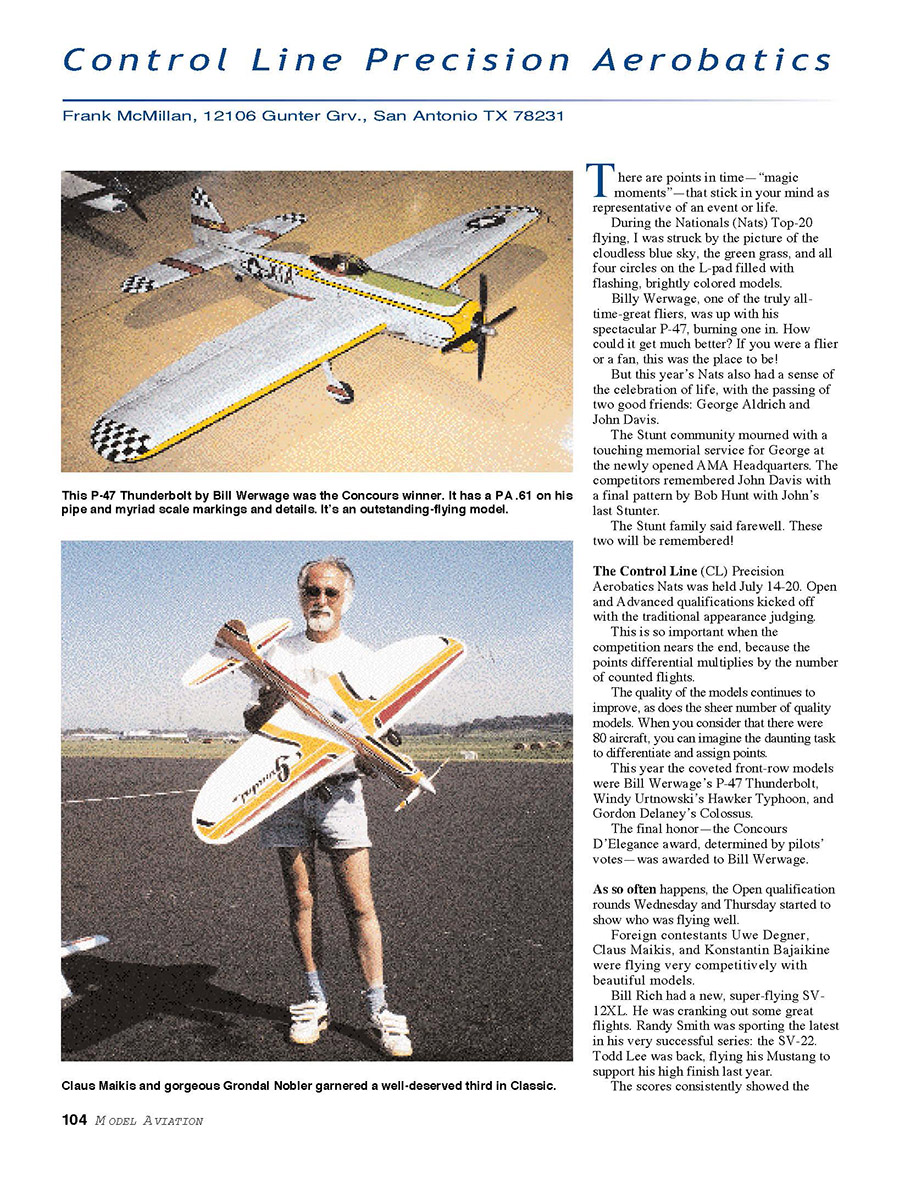
Billy Werwage, one of the truly all-time-great fliers, was up with his spectacular P-47, burning one in. How could it get much better? If you were a flier or a fan, this was the place to be!
But this year's Nats also had a sense of the celebration of life, with the passing of two good friends: George Aldrich and John Davis.
The Stunt community mourned with a touching memorial service for George at the newly opened AMA Headquarters. The competitors remembered John Davis with a final pattern by Bob Hunt with John's last Stunter.
The Stunt family said farewell. These two will be remembered!
The Control Line (CL) Precision Aerobatics Nats was held July 14-20. Open and Advanced qualifications kicked off with the traditional appearance judging.
This is so important when the competition nears the end, because the points differential multiplies by the number of counted flights.
The quality of the models continues to improve, as does the sheer number of quality models. When you consider that there were 80 aircraft, you can imagine the daunting task to differentiate and assign points.
This year the coveted front-row models were Bill Werwage's P-47 Thunderbolt, Windy Drunowski's Hawker Typhoon, and Gordon Delaney's Colossus.
The final honor—the Concours D'Elegance award, determined by pilots' votes—was awarded to Bill Werwage.
As so often happens, the Open qualification rounds Wednesday and Thursday started to show who was flying well.
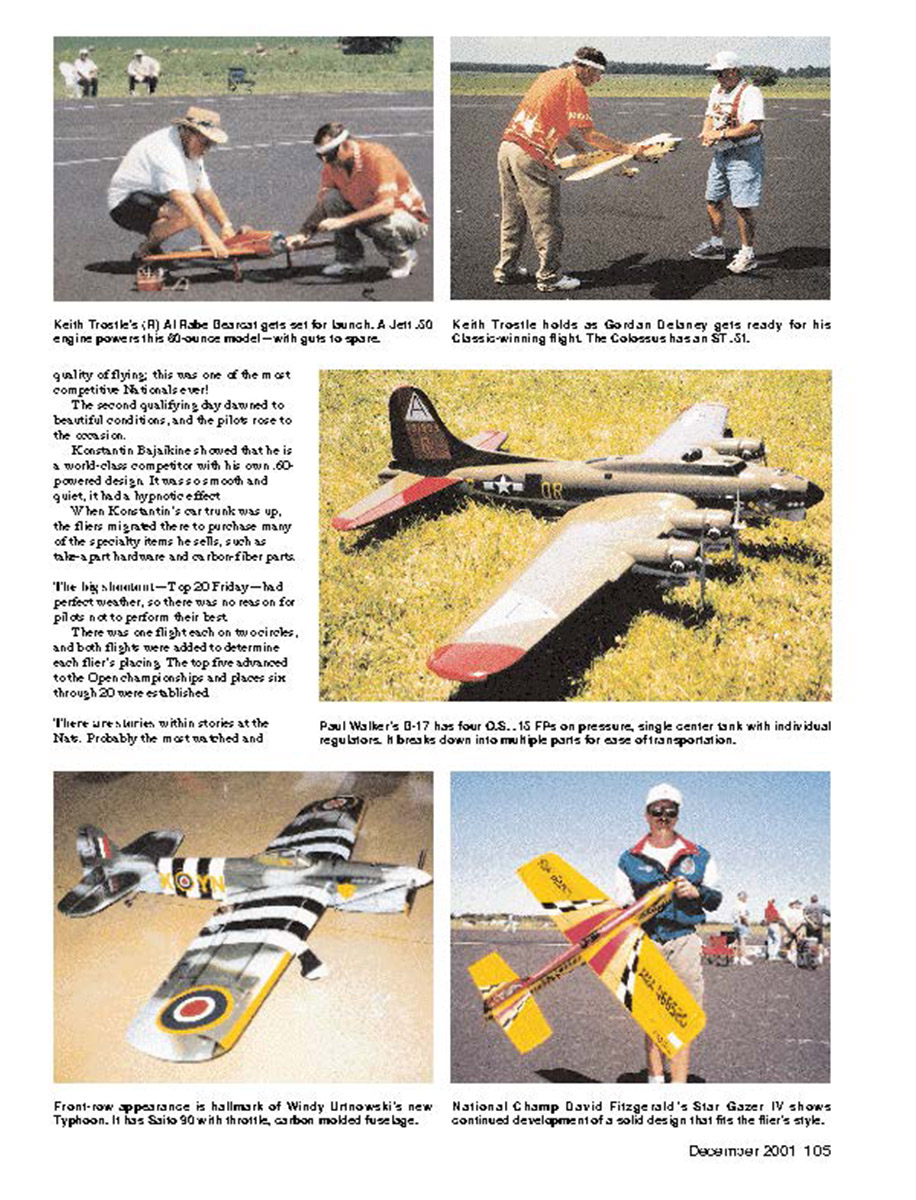
Foreign contestants Uwe Degner, Claus Maikis, and Konstantin Bajakinine were flying very competitively with beautiful models.
Bill Rich had a new, super-flying SV-12XL. He was cranking out some great flights. Randy Smith was sporting the latest in his very successful series: the SV-22. Todd Lee was back, flying his Mustang to support his high finish last year.
The scores consistently showed the quality of flying; this was one of the most competitive Nationals ever!
The second qualifying day dawned to beautiful conditions, and the pilots rose to the occasion.
Konstantin Bajakinine showed that he is a world-class competitor with his own .60-powered design. It was so smooth and quiet, it had a hypnotic effect.
When Konstantin's car trunk was up, the fliers migrated there to purchase many of the specialty items he sells, such as take-apart hardware and carbon-fiber parts.
The big shindig—Top 20 Friday—had perfect weather, so there was no reason for pilots not to perform their best.
There was one flight each on two circles, and both flights were added to determine each flier's placing. The top five advanced to the Open championship and places six through 20 were established.
There are sure to be stories within stories at the Nats. Probably the most watched and admired model was Paul Walker's Boeing B-17G, which was a team effort from the beginning.
Watching the starting procedure immediately conveyed the complexity of running multiple engines competitively. With Paul as the starter, Howard Rusch controlled the plug power from the ground power unit. Don McClave provided the remaining necessary support.
The level of the three friends' sustained effort to make this spectacular model fly had most in awe!
Congratulations to the B-17 crew, and thanks for the show. Paul finished in a very respectable sixth place!
Gordon Delaney was competing in his first Nats in many years and flew extremely well with his Colossus Classic-legal model, which was powered by a SuperTiger .51.
If it wasn't for a momentary distraction while practicing, which caused slight model damage, Gordon would have placed higher than 14th.
Bob Giesecke was flying perhaps his best-finished Bear. Sporting an Eather four-blade propeller, he had his PA .65 engine running with controlled authority. He finished 11th.
Todd Lee flew to a strong 10th. He would have finished much higher with a new model and associated higher appearance score.
In his first US Nats, German Uwe Degner flew his PA .61/piped, modified Cardinal Starlight to a well-deserved ninth place and captured the Rookie of the Year award for the highest first-time Nats qualifier.
Flying better than he has in several years, Bill Rich was just off the pace to finish eighth.
Backing up his third-place time from last year, Brett Buck had the same combination working to perfection to just miss the final five by six points.
In a touch of drama, the final contestant who had a chance to knock out the man on the bubble—Windy Drunowski—was last up in the final round. When Paul Walker's B-17 landed, the scoreboard in the pavilion was the place to be to watch the score come up.
The wait seemed longer than it really was. When the score was posted, it was learned that the B-17 had flown its last flight by three points. Paul has decided to retire the massive Fortress.
The final five had been there before. New this year was Windy Drunowski's Saito-90-powered Typhoon. The model featured take-apart construction and a carbon fuselage. This was the first serious thrust with the big four-stroke engines at the US Nats.
The model also featured an infrared, optically controlled throttle. Windy had the throttle fixed at several presets: take-off to cruise, high power, descent and land. After completing the pattern and the required two loops, he would throttle back, land, and taxi to the judges, then shut off.
The Typhoon was a very impressive package and represented a tremendous effort. It was a beautiful model that flew well and showcased the capabilities of the big four-stroke.
Concours winner Bill Werwage had a new version of the P-47. This one was loaded with scale detail, synthetic detail, insignia layout, and edge stains. It had a light gray overall base color with highlighted panel in silver—as if to portray newly repaired damage.
The P-47 had a much deeper and wider fuselage, presenting a near-scale look. With the well-proven PA.61 engine and pipe, it was a real "machine" throughout the week.
The other finalists were Ted Fancher, David Fitzgerald, and me; we all flew well-proven models powered by PA.61s on pipe.
The weather was beautiful for the Open championships, so those who watched were treated to the best flying.
Ted Fancher and David Fitzgerald were separated by a point at the end of the first two rounds, closely followed by Bill Werwage.
The last round saw a shift in the balance; Bill flew the high flight of the keeping with tradition from the early days of the Nats.
The Walker Cup was named in memory of one of the great pioneers of Control Line: Jim Walker.
It is impressive to see the Junior and Senior fliers put in competitive flights with everyone watching. Junior Robert Gruber flew a great flight to edge out Senior Kevin Stewart by three points.
Open champion David Fitzgerald was up to the test and emerged the winner and National Champion for the third time!
Classic Stunt has become as competitive as the other classes, including Open! Three-time winner Bob Whiteley had a new Billy Simmons S'boston, and it flew well for fourth place. Keith Tratch led his Al Williams Gulf Hawk Beech flying well.
The story was the close flying among last year's winner John Simpson with his Cavalier Aero Tiger .36, visitor Chris Makis with his Grondal Nocker, and Gordon Delaney with his Colossus super Tigre .51.
Gordon executed a spectacular flight to emerge the winner. John Simpson was four points behind, and Claus was another four points back. It was a great competition among the 22 contestants.
With the lower scores associated with Old-Time, the top fliers were bound to be close. This proved to be the case, with eight points separating the top five finishers.
Tom Luper had a great flight for first place with a Stunt Wagon 60 (pilot's choice model). Flying his Gyrotor, Keith Trostle edged out Bart Klapinski's Ringmaster for second place.
With 25 entrants, Old-Time continues to grow; more new designs are flown each year.
Beginner Stunt continues to see great participation, with Allen Brickhaus serving as event director — a labor of love. It's wonderful to see the older and younger beginners competing on the beautiful green grass underneath a cloudless, blue sky. It doesn't get much better.
Phil Sabal won the class with a Twister powered by an O.S. .40 FS engine. Vic Sinclair was second, and Warren Wagner was third with a Tower .40-powered Prowler.
Josh Condon won in the Junior/Senior category, followed by Dustin Gleesemyer, Zack Schoonover, and Jake Moon. It was a great time!
Rich Pasternak Jr. ran the Intermediate event on the grass pad.
Ricardo Martinez had a well-earned first, Roy Trantham flew his full-scale twin Cessna from Florida to win second, and Mark Boesen finished third.
Running the Nats is very much a labor of love for those involved. You wouldn't do it well and potentially subject yourself to grief without that love. I hope we never take our wonderful volunteers for granted.
To name a few of the volunteers, Warren Thirrs was event director, Gary McClellan was chief judge, Sharen Fancher was head tabulator, and Woody Midgley was pit boss.
To those people and all others who make our events so much a family happening, thanks on behalf of all those who benefit from your efforts.
'Til next year.
Transcribed from original scans by AI. Minor OCR errors may remain.

