
Control Line Precision Aerobatics
Curt Contrata, 8341 SW 28th St., Davie FL 33328; E-mail: [email protected]
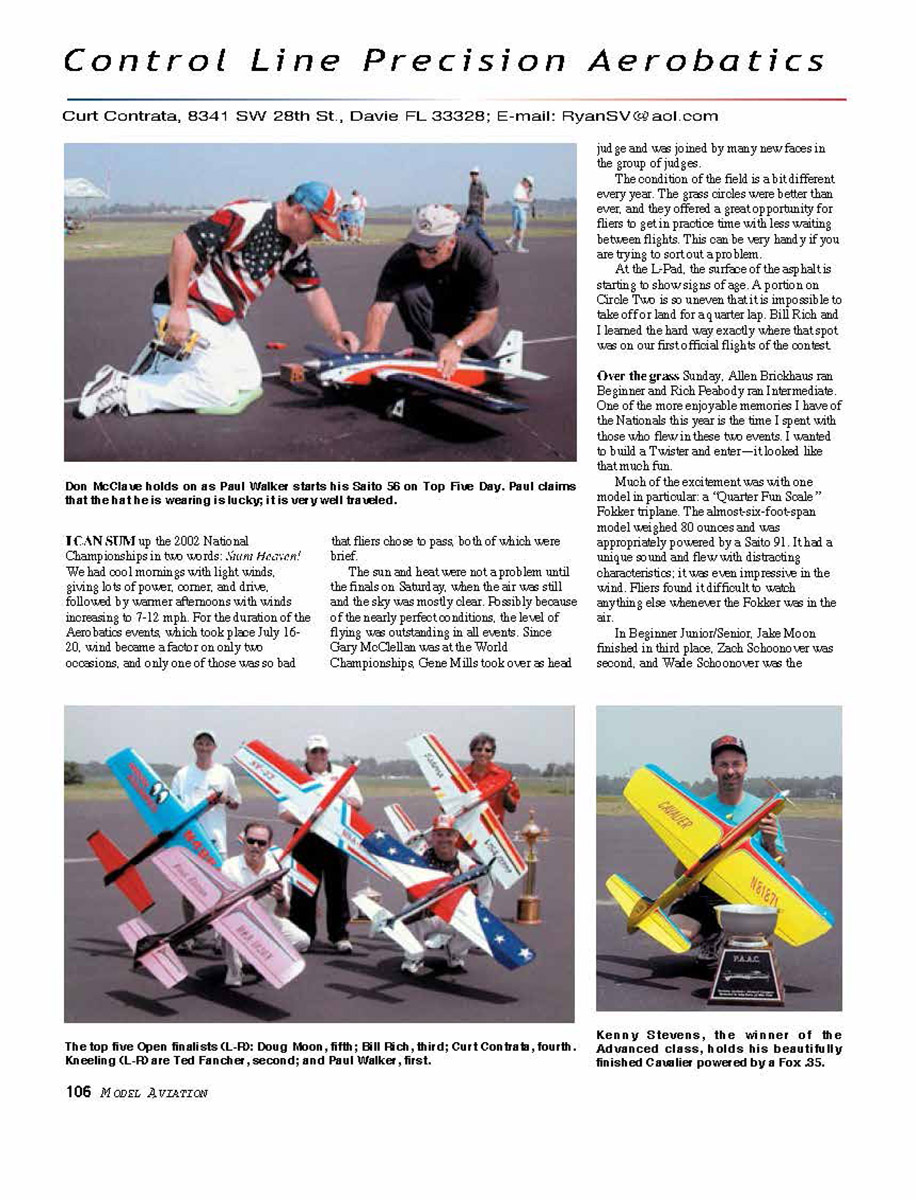
I CAN SUM up the 2002 National Championships in two words: Swan Heaven! We had cool mornings with light winds, giving lots of power, corner, and drive, followed by warmer afternoons with winds increasing to 7-12 mph. For the duration of the Aerobatics events, which took place July 16-20, wind became a factor on only two occasions, and only one of those was so bad that fliers chose to pass, both of which were brief.
The sun and heat were not a problem until the finals on Saturday, when the air was still and the sky was mostly clear. Possibly because of the nearly perfect conditions, the level of flying was outstanding in all events. Since Gary McClellan was at the World Championships, Gene Mills took over as head judge and was joined by many new faces in the group of judges.
The condition of the field is a bit different every year. The grass circles were better than ever, and they offered a great opportunity for fliers to get in practice time with less waiting between flights. This can be very handy if you are trying to sort out a problem.
At the L-Pad, the surface of the asphalt is starting to show signs of age. A portion on Circle Two is so uneven that it is impossible to take off or land for a quarter lap. Bill Rich and I learned the hard way exactly where that spot was on our first official flights of the contest.
Over the grass Sunday, Allen Brickhaus ran Beginner and Rich Peabody ran Intermediate. One of the more enjoyable memories I have of the Nationals this year is the time I spent with those who flew in these two events. I wanted to build a Tuster and enter—it looked like that much fun.
Much of the excitement was with one model in particular: a "Quarter Fun Scale" Fokker triplane. The almost-six-foot-span model weighed 80 ounces and was appropriately powered by a Saito 91. It had a unique sound and flew with distracting characteristics; it was even impressive in the air. Fliers found it difficult to watch anything else whenever the Fokker was in the air.
In Beginner/Junior/Senior, Jake Moon finished in third place, Zach Schoonover was second, and Wade Schoonover was the winner. In Beginner Open, Aaron Nottingham finished third, Curt Nixon was second, and Joe Owen earned first place.
In the Intermediate Class, Wes Eakin (the 1999 winner in Beginner) finished third, James Sumner and his Fokker triplane came in second, and Tom Polk took first place with a pretty S/W 40.
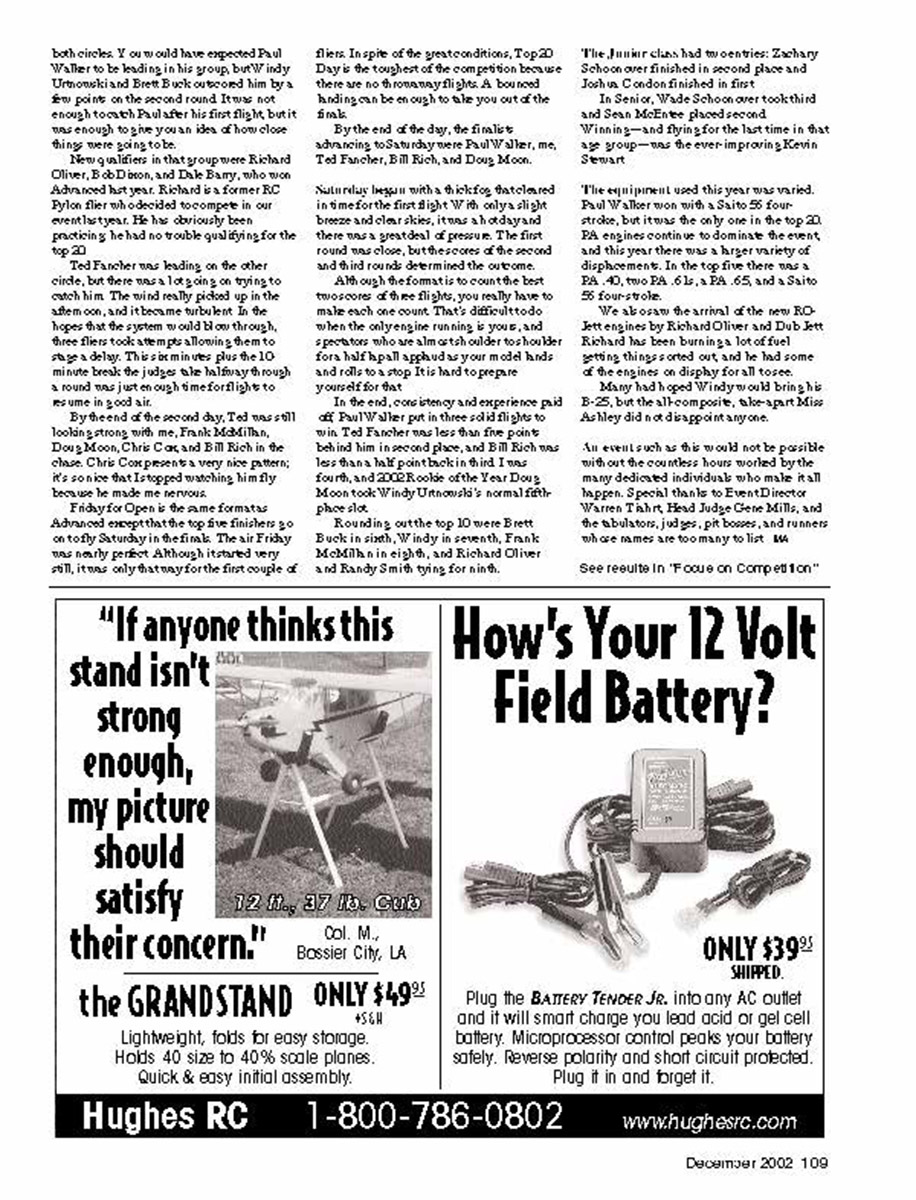
Old-Time was flown on Monday and there were some impressive models. Bart Klapinski had my favorite airplane of the group: a Fleet PT-6 biplane. It was as original as he could build and equip it, down to an original Tornado "Press Wood" 7x6 propeller. Bart took third place, Don Hutchinson finished second flying a very clean Yates Dragon, and Allen Brickhaus won the event with a Barnstormer. Allen does this once every 10 years.
Classic was flown on the adjacent circle, and it was quite a show. The first round had Ted Fancher leading, John Simpson in second, and Gordan Delaney tied with Kenny Stevens for third.
Then, in the middle of the second round, Gordan Delaney put up a great flight that posted a huge score. John Simpson had a bit of trouble in the wind and finished third with a new Cavalier. Ted Fancher earned second place flying a nice Tucker Special, and winning Classic for the second year in a row was Gordan Delaney with his 60-inch I-Beam Colossus.
Appearance judging for Advanced and Open was Tuesday, in a very small room. It was so small that contestants were let back into the room in small groups for review to avoid damage to the models in case of a mad rush for the door.
The front row this year had three 19-point aircraft: my Soton, Bob Lamprione's bright-green United IV, and Frank McMillan's special Caudron. Three models shared the second row with 18 points: Windy Urtnowski's shiny all-carbon Miss Ashley, a well-done Cavalier by Kenny Stevens, and Paul Walker's pretty—and ultimately Concours D' Elegance–winning—Miss America P-51.
The next two days were qualification rounds for Advanced and Open, with both events featuring the same format. The contestants of each skill class are broken into two groups. Of each group, 10 advance to the next round using the top scores of each day to get totals.
All indicators showed that this was going to be a real contest in both classes right from the start. Each year there are new names or a few much-improved fliers who show up ready to fly, and this year was no exception.
In Advanced, last year's winner Dale Barry moved up to Open, and Doug Moon, who was last year's second-place finisher in Advanced, decided to do the same. With both of them gone, there were new opportunities for the fliers who remained. Kenny Stevens and Steve Millet were expected to be in the mix, but quite a few other fliers were taking turns for the top five places. Among the fliers who had the leaders looking over their shoulders in the early rounds were Allen Goff, Kevin Stewart, and Bradley "Godzilla" Walker.
With the top 20 fliers advancing, the scores started back at zero on Friday and there was a new contest; the total score of two flights would be added for a final score. Both flights counted, and the pressure was on.
It was fairly close throughout the first round, with the same faces at the top along with a new one: Orestes Hernandez. At the end of the first round, six fliers were within 10 points of first place. With it so close, it was important for everyone to not blow the second flight. The battles in Advanced are always exciting to watch.
Moving up in the Advanced ranks were Alberto Haber finishing fifth and Steve Millet flying a clean Nova to a fourth-place finish. The much-improved Kent Tyzor took third with his familiar Strega, and Jose Modesto finished in second place (moving up from 19th last year) using a Pattern Master.
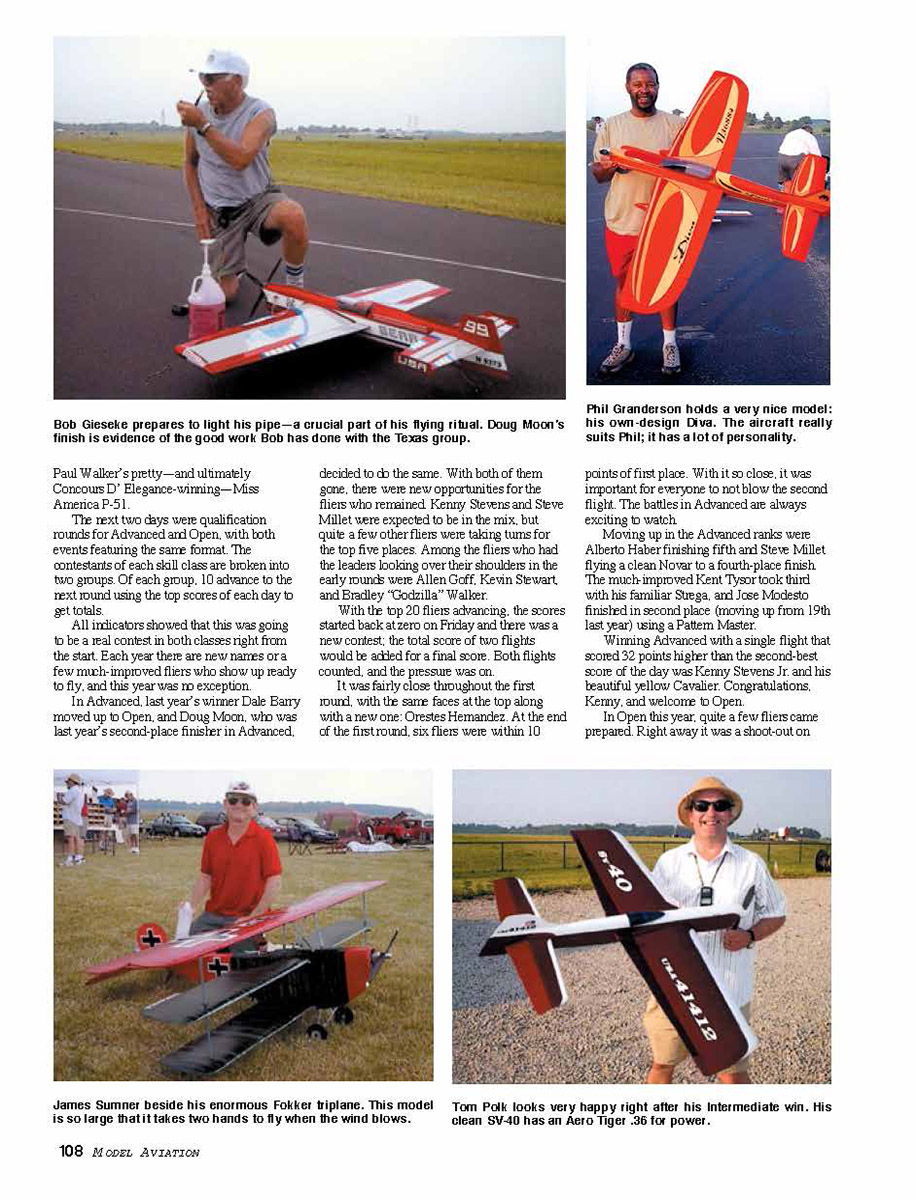
Winning Advanced with a single flight that scored 32 points higher than the second-best score of the day was Kenny Stevens Jr. and his beautiful yellow Cavalier. Congratulations, Kenny, and welcome to Open.
Both circles. You would have expected Paul Walker to be leading in his group, but Windy Utronowski and Bret Buck overtook him by a few points on the second round. It was not enough to catch Paul after his first flight, but it was enough to give you an idea of how close things were going to be.
New qualifiers in that group were Richard Oliver, Bob Dixon, and Dub Jett, who advanced. Richard is a former RC Pylon flier who decided to compete in our event last year. He has obviously been practicing; he had no trouble qualifying for the top 20.
Ted Fancher was leading on the other side, but there was a lot going on trying to catch him. The wind really picked up in the afternoon, and a sudden turbulence in the hopes that the system would blow through, three fliers took attempts at slowing them to stop a delay. This is only the first ten minute break the judges take halfway through a round was just enough time for flight to resume in good air.
By the end of the second day, Ted was still looking strong with me, Frank McMillin, Doug Moon, Chris Cox, and Bill Rich in the chase. Chris Cox presents a very nice pattern; it's so nice that I stopped watching him fly because he made me nervous.
Friday for Open is the same format as Advanced except that the top five finishers go on to fly Saturday in the finals. The air Friday was nearly perfect. Although it started very still, it was only that way for the first couple of fliers. In spite of the great conditions, Top 20 Day is the toughest of the competition because there are no throwaway flights. A bounced landing can be enough to take you out of the finals.
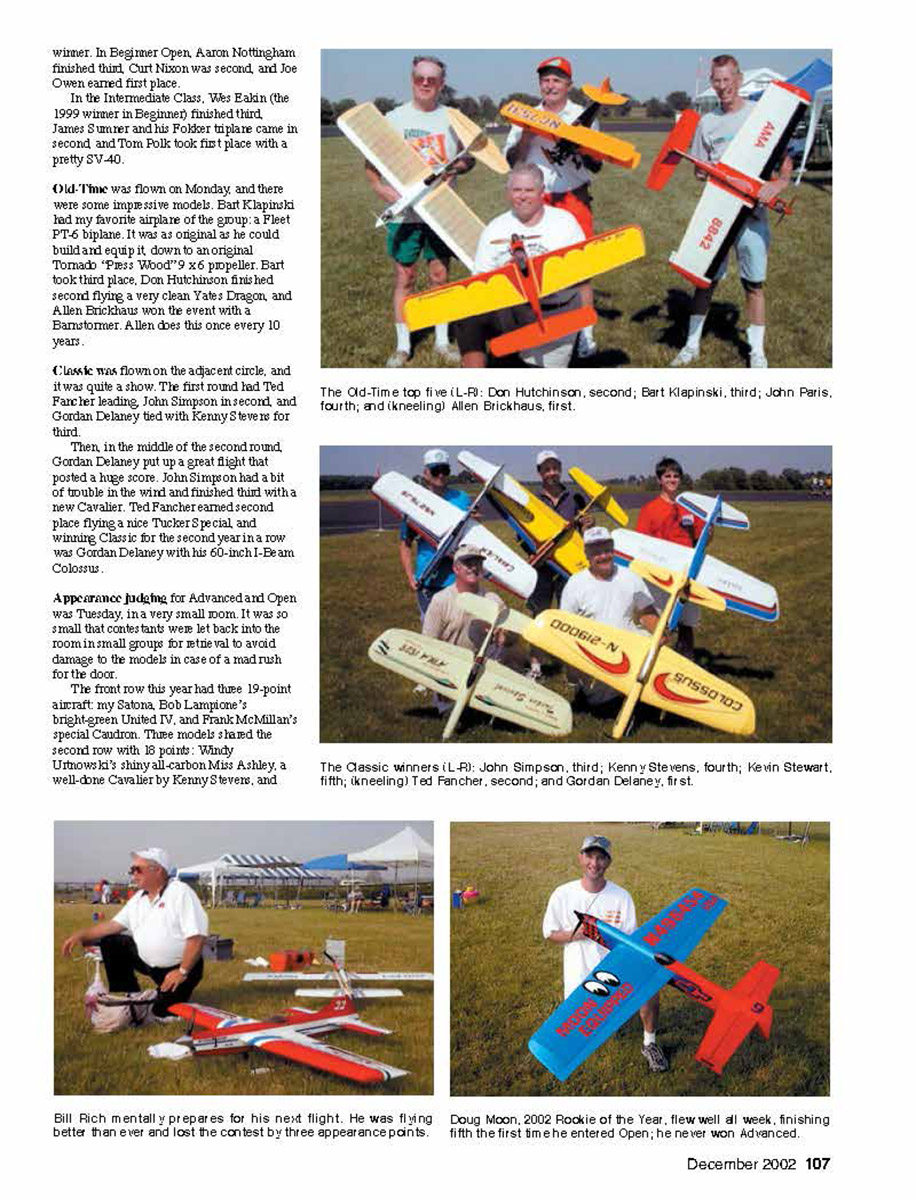
By the end of the day, the finalists advancing to Saturday were Paul Walker, me, Ted Fancher, Bill Rich, and Doug Moon.
Saturday began with a brisking that extended in time for the first flight. With only a light breeze and calm skies, it was a hot day and there was a great deal of pressure. The first round was close, but the scores of the second and third rounds determined the outcome.
Although the format is to count the best two scores of the five flights, you really have to make each one count. That's difficult to do when the oxygen is running in your lungs and spectators who are almost on shoulder to shoulder for a half lap applaud as your model hands and rolls to a stop. It is hard to prepare yourself for that.
In the end, consistency and experience paid off. Paul Walker put in three solid flights to win. Ted Fancher was less than five points behind him in second place, and Bill Rich was less than a half point back in third. I was fourth, and Dub Jett of the Navy, Doug Moon took sixth; Windy Utronowski's normal fifth-place finish was seventh.
Rounding out the top 10 were Brett Buck in sixth, Windy in seventh, Frank McMillin in eighth, and Richard Oliver and Randy Smith tying for ninth.
The Junior class had two entries: Zachary Schoonover finished in second place and Joshua Condon finished in first.
In Senior, Wade Schoonover took third and Sean McEntee placed second. Winning—and flying for the last time in that age group—was the ever-improving Kevin Stewart.
The equipment used this year was varied. Paul Walker won with a Saito 50 four-stroke, but it was the only one in the top 20. PA engines continue to dominate the event and this year there was a larger variety of displacements. In the top five there was a PA 40, two PA 61s, a PA 65, and a Saito 55 four-stroke.
We also saw the arrival of the new RO-Jett engines by Richard Oliver and Dub Jett. Richard has been burning a lot of fuel getting the things sorted out, and he had some of the engines on display for all to see.
Many had hoped Windy would bring his B-25, but the all-composite, take-apart Miss Ashley did not disappoint anyone.
An event such as this could not be possible without the countless hours worked by the many dedicated individuals who make it all happen. Special thanks to Event Director Warren Tabler, Field Judge Ken Mills, and the tabulators, judges, pit bosses, and runners who are too many to list.
See results in "Focus on Competition"
Transcribed from original scans by AI. Minor OCR errors may remain.

