
CL Racing
Dave McDonald, Box 384, Daleville IN 47334; E-mail: [email protected]
WITH THE LAST column basically dedicated to the "newcomers," I thought it appropriate to review the proper piloting procedures for Racing. This was discussed several years ago in the National Control Line Racing Association (NCLRA) newsletter, so why not use this column to reach more people and hopefully dispel some misconceived notions?
No amount of reading or writing will create a good pilot. It is imperative that you get out and practice until most of this is second nature. I will break Racing down into four areas: takeoff, level flight, landing, and practice.
Takeoff
This is the greatest source of grief in a race; lines go slack, airplanes crash, and propellers are broken. The cause of any one of these problems is usually a lack of understanding of two principles.
- You must be ahead of the airplane at all times. This means you must pull the airplane off the ground and into the air. Don't wait for it to take off by itself. If you do, you will probably see the name of the prop heading toward you.
- You must be ready. The pitman probably won't check to see if you are.
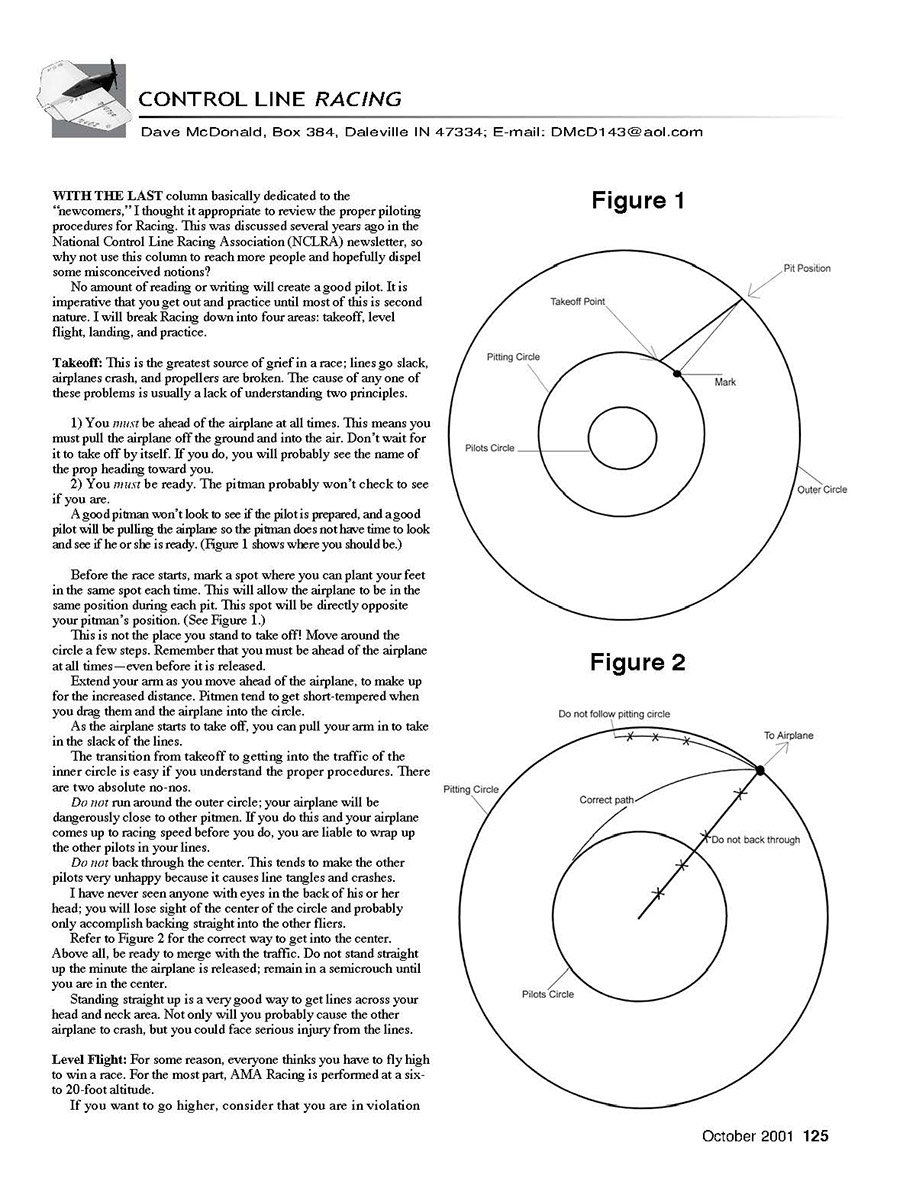
A good pitman won't look to see if the pilot is prepared, and a good pilot will be pulling the airplane so the pitman does not have time to look and see if he or she is ready. (Figure 1 shows where you should be.)
Before the race starts, mark a spot where you can plant your feet in the same spot each time. This will allow the airplane to be in the same position during each pit. This spot will be directly opposite your pitman's position. (See Figure 1.)
This is not the place you stand to take off! Move around the circle a few steps. Remember that you must be ahead of the airplane at all times—even before it is released.
Extend your arm as you move ahead of the airplane, to make up for the increased distance. Pitmen tend to get short-tempered when you drag them and the airplane into the circle.
As the airplane starts to take off, you can pull your arm in to take in the slack of the lines.
The transition from takeoff to getting into the traffic of the inner circle is easy if you understand the proper procedures. There are two absolute no-nos.
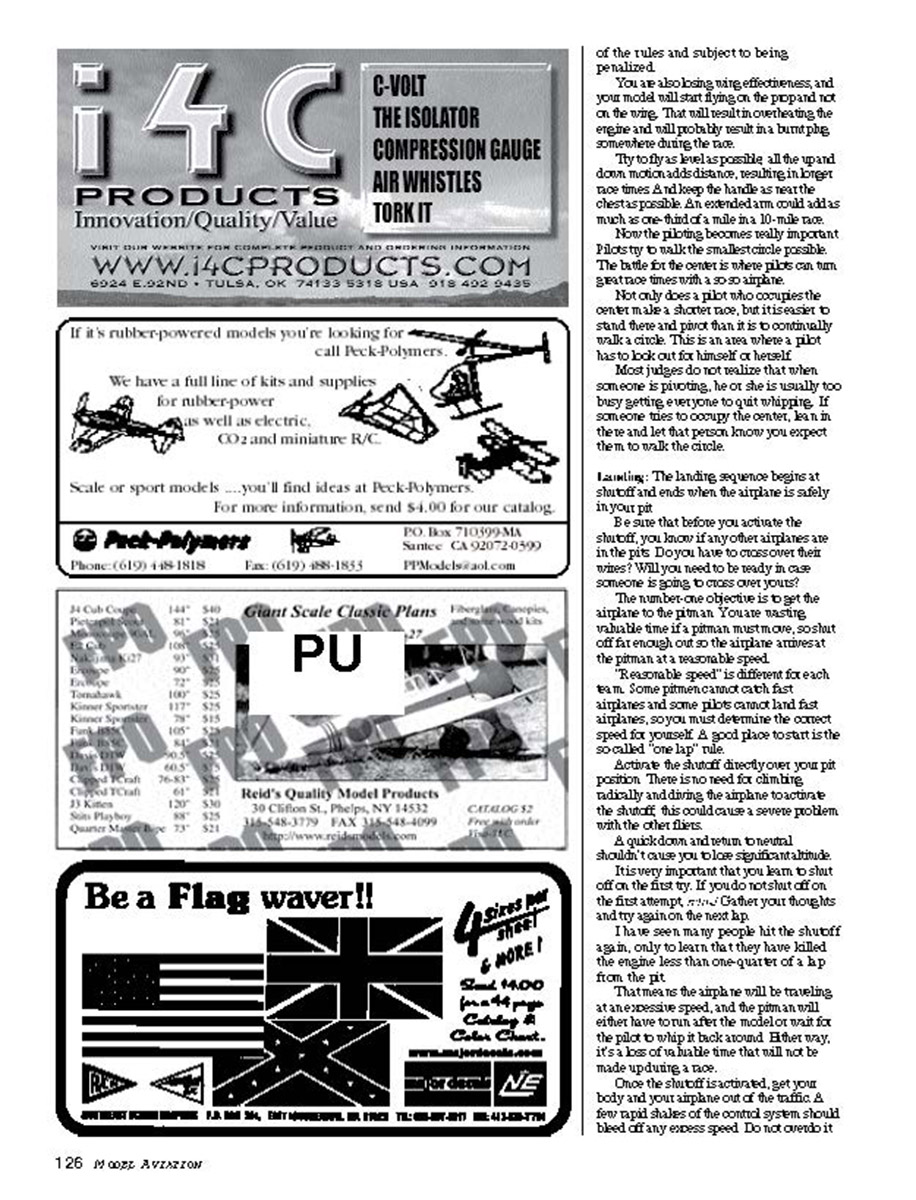
- Do not run around the outer circle; your airplane will be dangerously close to other pitmen. If you do this and your airplane comes up to racing speed before you do, you are liable to wrap up the other pilots in your lines.
- Do not back through the center. This tends to make the other pilots very unhappy because it causes line tangles and crashes. I have never seen anyone with eyes in the back of his or her head; you will lose sight of the center of the circle and probably only accomplish backing straight into the other fliers.
Refer to Figure 2 for the correct way to get into the center. Above all, be ready to merge with the traffic. Do not stand straight up the minute the airplane is released; remain in a semicrouch until you are in the center.
Standing straight up is a very good way to get lines across your head and neck area. Not only will you probably cause the other airplane to crash, but you could face serious injury from the lines.
Level Flight
For some reason, everyone thinks you have to fly high to win a race. For the most part, AMA Racing is performed at a six- to 20-foot altitude.
If you want to go higher, consider that you are in violation of the rules and subject to being penalized.
You are also losing wing effectiveness, and your model will start flying on the propwash or on the wire. That will result in overheating the engine and will probably result in a bumping somewhere during the race.
Try to fly as level as possible; all the up and down motions add distance, resulting in longer race times. Keep the handle as near the chest as possible. An extended arm could add as much as one-third of a mile in a 10-mile race.
Now the piloting becomes really important. Pilots try to walk the smallest circle possible. The bite for the center is where pilots can turn practice turns with a 30-30 airplane.
Not only does a pilot who occupies the center make a shorter race, but it is easier to stand there and pivot than it is to continually walk a circle. This is an area where a pilot has to look out for himself or herself.
Most judges do not realize that when someone is pivoting, he or she is usually too busy getting everyone to quit whipping. If someone tries to occupy the center, let it be in the area and let that person know you expect them to walk the circle.
Landing
The landing sequence begins at shutoff and ends when the airplane is safely in your pit.
Be sure that before you activate the shutoff, you know if any other airplanes are in the pits. Do you have to crossover their wires? Will you need to be ready in case someone is going to cross over yours?
The number-one objective is to get the airplane to the pitman. You are wasting valuable time if a pitman must move, so shut off far enough out so the airplane arrives at the pitman at a reasonable speed.
“Reasonable speed” is different for each team. Some pitmen cannot catch fast airplanes and some pilots cannot land fast airplanes, so you must determine the correct speed for yourself. A good place to start is the so-called “one lap” rule.
Activate the shutoff directly over your pit position. There is no need for climbing radically and driving the airplane to activate the shutoff; this could cause a severe problem with the other fliers.
A quick down and return to neutral shouldn’t cause you to lose significant altitude.
It is very important that you learn to shut off on the first try. If you do not shut off on the first attempt, gather your thoughts and try again on the next lap.
I have seen many people hit the shutoff again, only to learn that they have killed the engine less than one-quarter of a lap from the pit.
That means the airplane will be traveling at excessive speed, and the pitman will either have to run after the model or wait for the pilot to whip it back around. Either way, it’s a loss of valuable time that will not be made up during a race.
Once the shutoff is activated, set your body and your airplane out of the traffic. A few rapid shakes of the control system should bleed off any excess speed. Do not overdo it.
Transcribed from original scans by AI. Minor OCR errors may remain.

