

Control Line Racing
Dave McDonald, Box 381, Daleville IN 47334; E-mail: [email protected]
The 75th Academy of Model Aeronautics National Championships (Nats) for Control Line (CL) Racing, held July 8-13, will go down as one of the best in memory. The weather was hot and some competitions were close.
The people who helped run this year's event deserve top billing. Event Director Ray Gould was unable to attend at the last minute because of a medical condition. Dick Lambert stepped up and helped me run the events, a big "thank you" to Dick.
John McCollum helped run the Fédération Aéronautique Internationale (FAI) Team Race event. I thank John for pitching in. This gave him some practice before the US Team Trials and allowed the competitors to see what John likes and does not like in a Team Race heat.
Sunday is National Control Line Racing Association (NCLRA) Fox Racing day. Fox Manufacturing has supported the event since its inception and continues to support the event with the gracious donation of three Fox .35 engines for the Junior/Senior class.
This year's 21 Open entries made it the biggest Fox Racing day ever. Fox Racing provides close competition, as more and more competitors have figured out how to get every bit of power from a Fox .35.
Airframes have stabilized into some predictable types. Several competitors are using an old carrier design called the Vulture, while others are using the Mongoose/Fox Racer.
CL Racing
year, which could be attributed to the weather. Temperatures were in the 90s, with humidity of roughly 80%, making for extremely hot conditions.
Propellers varied from very thin-blade APCs to wide-blades.
Doug Short became a first-time champion in the Junior/Senior division by posting a very good time of 6:18.87. Doug's father Greg handled the pit duties.
Doug and his father have only been racing for a few years and have shown what dedication and practice can do.
Defending champion Scott Matson posted a 7:18.95 time after having difficulties during the race. Scott finished second using his second-generation Hooter Goose design.
Doug Mayer posted the quick time of 6:03.93 in the Open class. Pat Matson posted a 6:08.68 for second qualifying position, and Rich McIntyre turned a 6:21.82 to secure the third qualifying position.
Tim Stone, Dave Betz, and Wayne Trivin rounded out the positions for the final races.
Pat Matson showed what practicing an event can do and stepped up his performance in the final to post 6:02.03 and secure first place.
Tim Stone was second using a Mongoose. Doug Mayer's performance slipped during the final, and he posted 6:33.00 for third position.
Pat's winning airplane was the prototype of the Hooter Goose. He utilized an entirely different propeller strategy from that everyone else in the field. He uses a wider blade; although it doesn't turn the rpm that others do, Pat was able to turn seven lap times in the low-21-second bracket.
Monday is Slow Rat day. Several competitors had problems, and others took advantage of that to secure valuable positions.
Melvin Schuett had a catastrophic crash during test-flying when his controls caught in the down position during a shutoff. Jerry Meyer also had bad luck while trying to determine what airplanes to process; he lost three to various failures.
Nelson engines dominate the event from a power standpoint and are a must if you want to be competitive at a national level.
Mike Greb turned an outstanding time of 2:40.76 during the heat races to claim quick qualifying time. Doug Mayer was second qualifier at 2:41.12, and Bill Bischoff rounded out the top three qualifying spots at 2:44.20.
Only two other entries broke the 2:50 mark in qualifying: Larry Dziak at 2:46.92 and Todd Ryan's 2:47.73.
During the finals, only two entries ran lower than the six-minute mark. Bill Bischoff recorded a 5:40.92 for first place, Todd Ryan was second at 5:53.16, and third place went to Rich McIntyre at 6:00.29.
Tuesday means Scale Racing, and it was the hottest day of the week. Ambient temperature climbed into the middle 90s and the humidity rose to approximately the 90% level. Blacktop temperatures climbed to more than 140° during the afternoon.
When the weather gets this extreme, performance is sure to suffer. Many teams recognize this and compensate with propeller and/or glow-plug adjustments. Changes for the 70-lap race are not as critical as getting everything set for the 140-lap feature.
Open entries reaching 22 made this the largest official event of the week.
Scott Matson finished first in the Junior/Senior category. Doug Short experienced tank problems and took second.
The slow qualifying time in the Open category was 2:56.53. This showed several teams that they would need to work on engine performance or propeller selection.
Several good airplanes were left out of the finals. As a rule, any time exceeding three minutes will not qualify at the Nats.
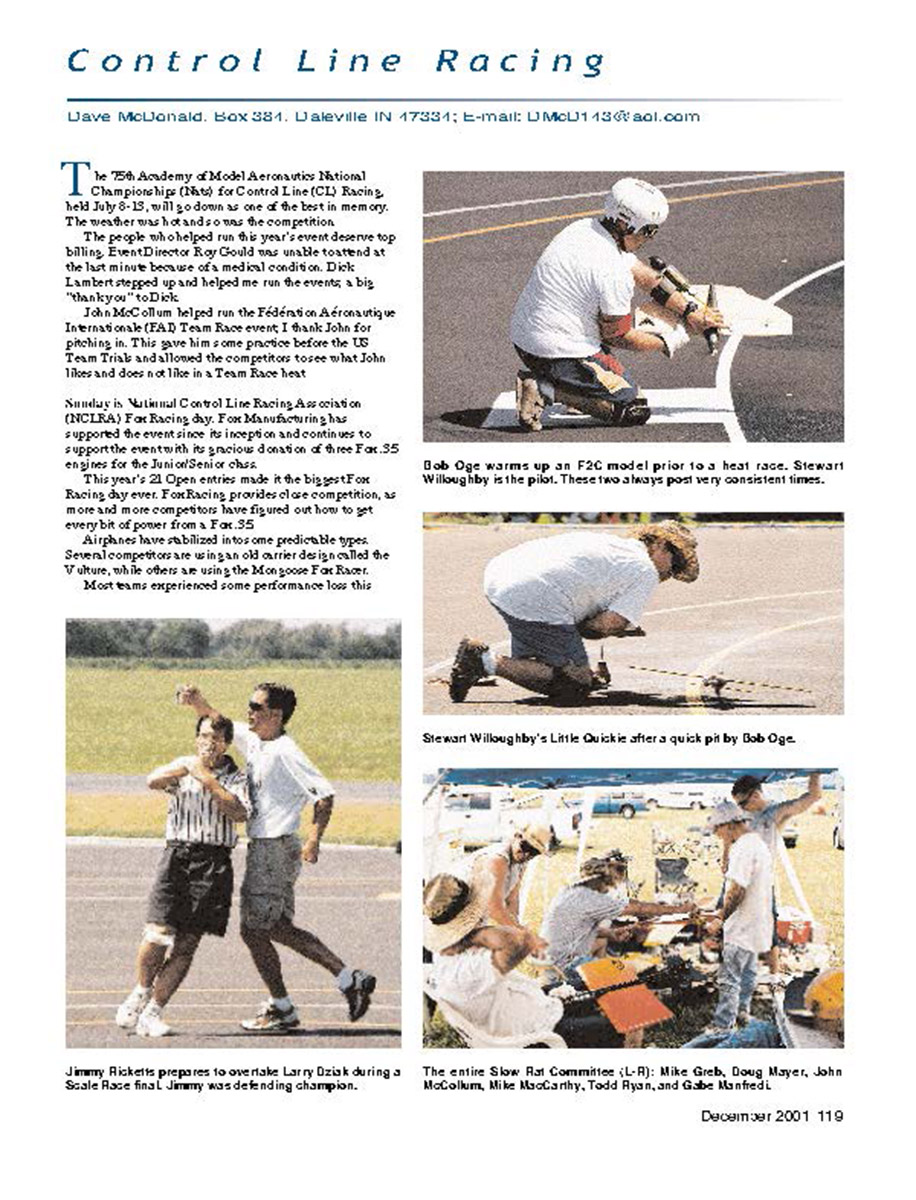
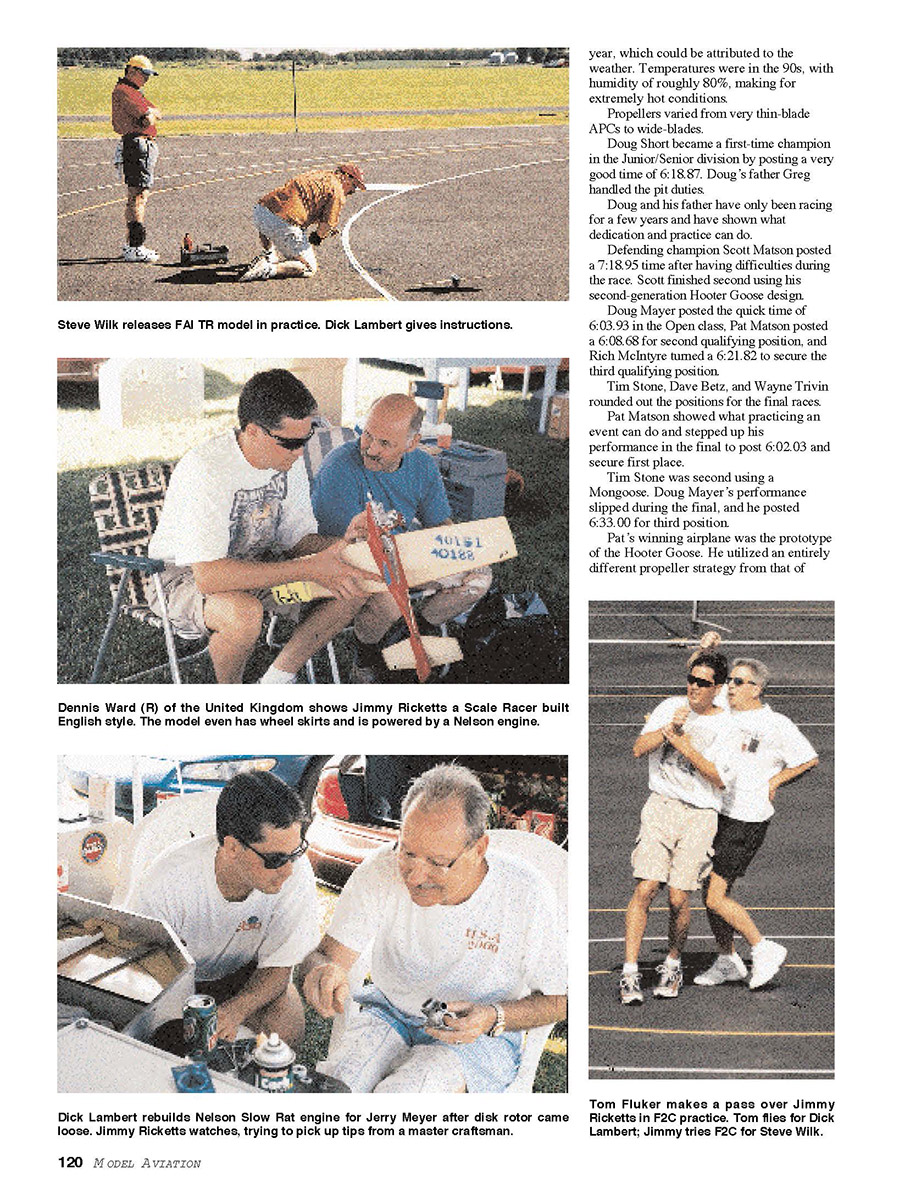
Stoo Willoughby turned quick time for the qualifying round at 2:42.51, and his partner Bob Oge was close behind at 2:44.98. Bob’s time was even more impressive since he didn’t get to start his first 70-lap race because of a broken crank in the warm-up period.
Bob changed the engine during the first heat and was ready for the second. With some minor needle-valve adjustments, he secured his time without practice.
Larry Dziak was third fastest at 2:50.47, and Jim Ricketts, Wayne Trivin, and Bill Lee rounded out the positions for the finals.
Although they were down on performance, the feature races made for some surprises. Stoo Willoughby and Bob Oge experienced plug problems that made them a nonfactor.
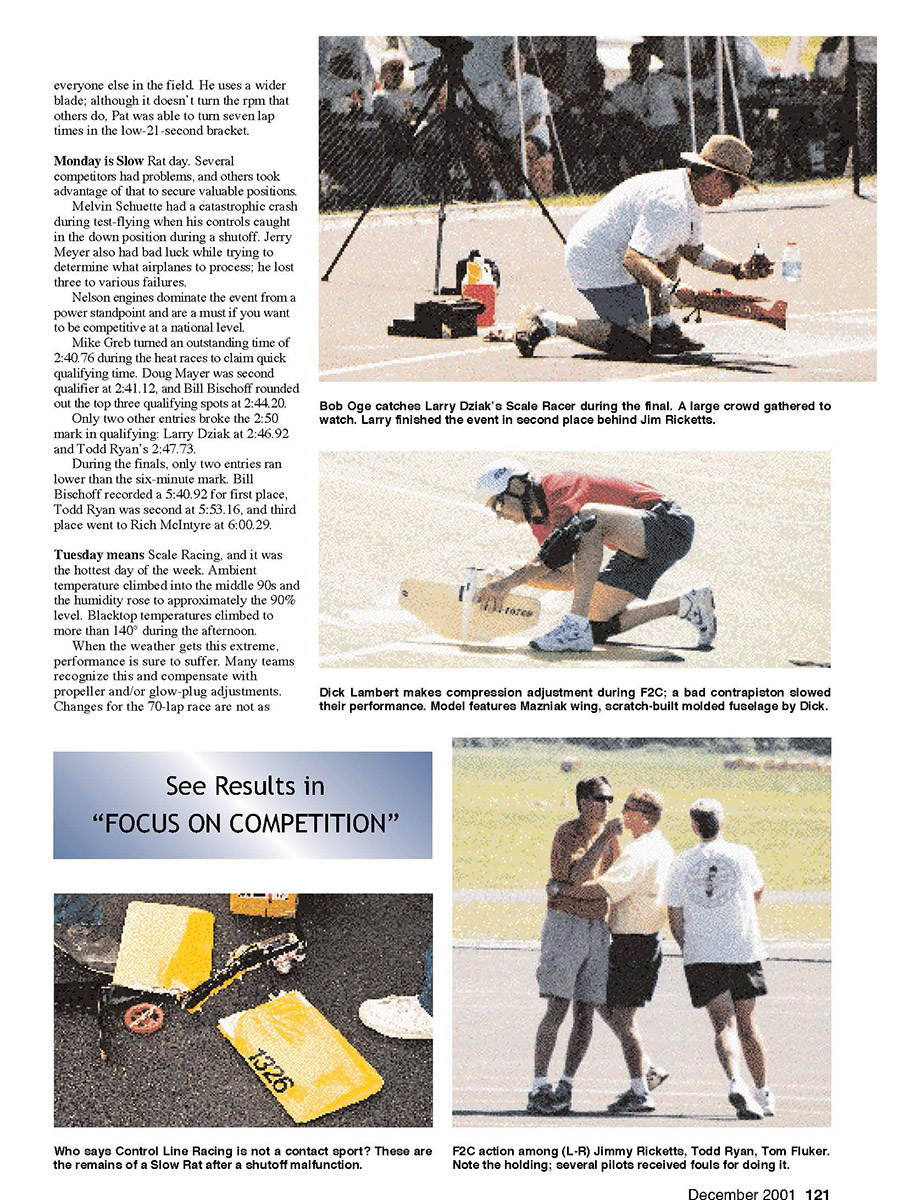
Jim Ricketts proved that consistency pays off; his time of 6:05.90 was enough to secure his first National Championship. Last year Jim’s son Jimmy claimed his first National Championship; this kept the Scale Racing title in the family.
Larry Dziak was second, and Scale Race rookie Wayne Trivin showed that he is going to be a factor for several years by taking third place. Bill Lee finished fourth, Stoo Willoughby was fifth, and Bob Oge was sixth.
Wednesday is F2C competition. In this event we see fast racing, nervous crews, $1,000 models, and action that puts aircraft as close together without touching as physically possible.
The extreme weather finally started to subside; the temperature was roughly the same, but the humidity decreased, making it easier on crews and equipment.
The 12 Open entries made for a nice amount of racing. Most teams brought out older or backup equipment, saving the top-performing airplanes and engines for the Team Trials.
Dick Lambert brought airplanes seven, eight, and nine, and I believe Jim Holland was using a Nelson-powered model. Others were using V or Oobior or Manzlik equipment.
For the first time in several years, we have seen some realignment of teams. Dick Lambert is teaming with Tom Fluker. Bill Lee has Jim Holland, a newcomer to the US Racing scene, as his pilot.
Dave Wallick is the Rookie this Year. Although his son is going to handle flying duties on a normal basis, Bill Bischoff jumped in to fly at the Nats.
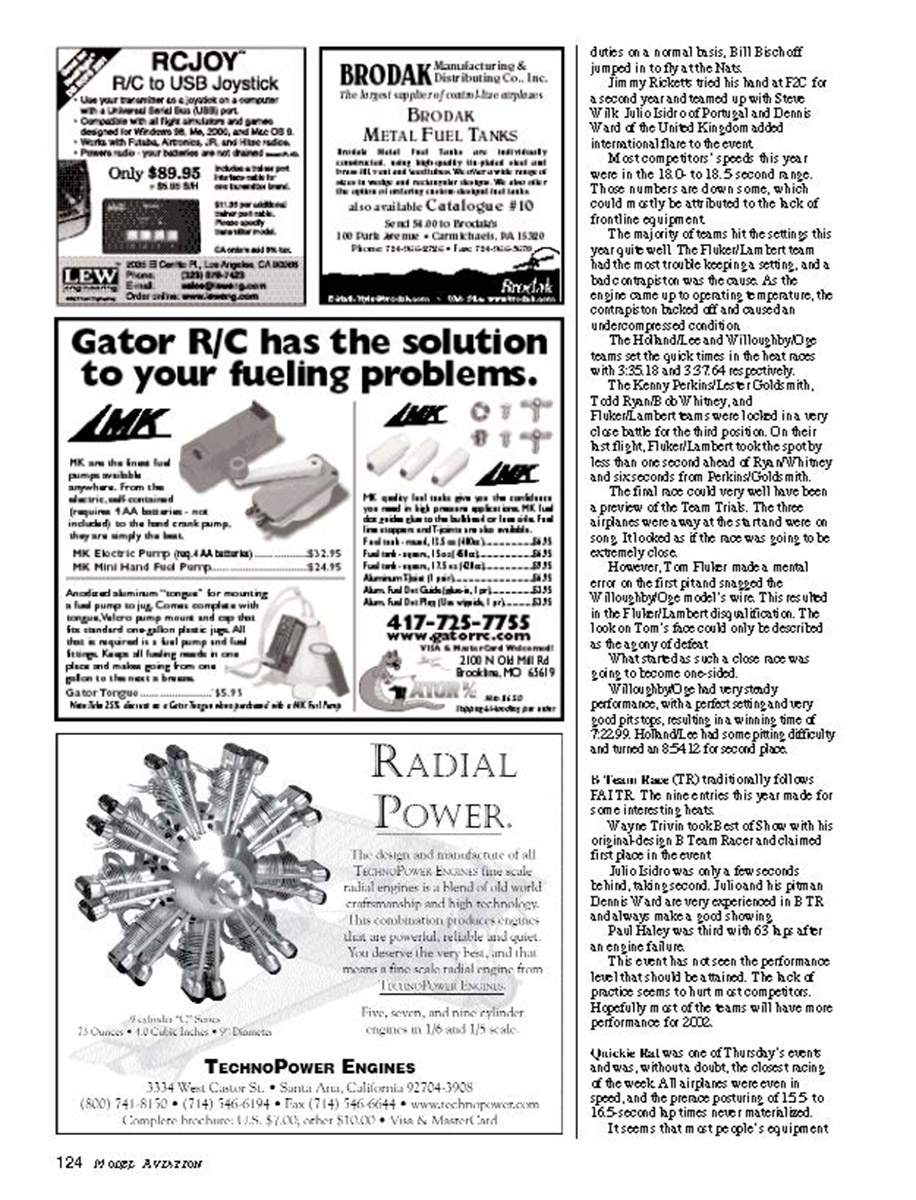
Jimpy Ricketts tried his hand at F2C for a second year and teamed up with Steve Wilk. Julio Isidro of Portugal and Dennis Ward of the United Kingdom added international flare to the event.
Most competitors’ speeds this year were in the 18.0 to 18.5 second range. Those numbers are down a second, which could mostly be attributed to the lack of frontline equipment.
The majority of teams hit the settings this year quite well. The Fluker/Lambert team had the most trouble keeping a setting, and a bad contraption was the cause. As the engine came up to operating temperature, the contraption bucked off and caused an undercompressed condition.
The Holland/Lee and Willoughby/Oge teams set the quick times in the heat races with 3:35.18 and 3:37.64 respectively.
The Kenny Perkins/Lester Goldsmith, Todd Ryan/Bob Whitney, and Fluker/Lambert cams were locked in a very close battle for the third position. On their last flight, Fluker/Lambert took the spot by less than one second ahead of Ryan/Whitney and six seconds from Perkins/Goldsmith.
The final race could very well have been a preview of the Team Trials. The three airplanes were away at the start and were on song. It looked as if the race was going to be extremely close.
However, Tom Fluker made a mental error on the first pylon and snapped the Willoughby/Oge model’s wire. This resulted in the Fluker/Lambert disqualification. The look on Tom’s face could only be described as the agony of defeat.
What started as such a close race was going to become one-sided.
Willoughby/Oge had very steady performance, with a perfect setting and very good pit stops, resulting in a winning time of 7:22.99. Holland/Lee had some pitting difficulty and turned an 8:54.12 for second place.
B Team Race (BT) traditionally follows FAI TR. The nine entries this year made for some interesting heats.
Wayne Trivin took Best of Show with his original-design B Team Racer and claimed first place in the event.
Julio Isidro was only a few seconds behind, taking second. Julio and his pitman Dennis Ward are very experienced in BTR and always make a good showing.
Paul Haley was third with 63 laps after an engine failure.
This event has not seen the performance level that should be attained. The lack of practice seems to hurt most competitors. Hopefully one of the teams will have more performance for 2002.
Quickie Rat was one of Thursday’s events and was, without a doubt, the closest racing of the week. All airplanes were even in speed, and the preace posturing of 155 to 165-second lap times never materialized.
It seems that most people’s equipment can't get any power under the new rules.
Most runs better at home than at the Nats. Most teams' lap times were in the 16.95 to 17.10-second range.
Three Junior/Senior competitors participated in Quickie Rat, and Steve Wilk of Eliminator Props, who sponsors the event, made sure these young men had awards. Thanks, Steve.
Scott Matson, who usually enters Open and flips the propeller, decided to fly in the Junior/Senior class this year. He turned a very respectable 3:04.22 in the heat races.
Zack Schoonover qualified second. Zack did a great job for his first time in the Nationals, and I expect to see more of him in years to come.
Doug Schothard had some difficulty during the final, when his model's elevator broke during a pit and put him out. Zack had a shutoff failure that resulted in an overrun. Scott Matson had a perfect four-flip race and a very good time of 6:20.20 to win the division.
Open races were extremely close and competitive. Todd Ryan was the quick qualifier at 3:01.12. The next eight qualifiers were separated by less than eight seconds.
Propellers ranged from APCs to carbon reproduction RevUp 8 x 8s. Several competitors experienced plug failures during the final; could it be attributed to lean settings or too many rpm?
At the conclusion of the final races and during the postrace inspection, the top three finishers were disqualified for venturi rule infractions. This resulted in the fourth- through sixth-place finishers moving up.
However, the fifth-place finisher was disqualified during the inspection because of an oversize venturi. That resulted in the seventh-place finisher taking third.
The final results were Wayne Trivin, first, Bill Cave, second, and Bill Lee, third. This shows the importance of making sure your equipment is correct — and not taking someone's word for it — so you don't have to learn at an inopportune time that it is not. I expect that all those who were disqualified will have the problems resolved for 2002.
Friday is Mouse I and Mouse II day, and, as expected, it was the windiest day of the week.
The talk at the beginning of the day was that there would not be a single Cox engine in the final, with all the home-built and converted Cyclon .049s in the field. The only problem with that talk was that the Cox engines were not quite ready to leave center stage.
Using a Paul Gilbert/Venom, Todd Ryan established a heat record of 2:14.35.
John McClintum surprised the field with a 19/16th reverse FAI-TR-type airplane that had a homemade engine, filler-system, and shutoff. He experienced difficulties in setting the engine up to speed and missed the final by a few seconds.
Wayne Trivin's bar-stock engines took two of the transfer spots, and Vic Garner's converted Cyclon claimed a transfer to the finals.
Wayne had problems getting the engine to start during the final, and he never did get it to start. Vic Garner damaged a reed in his engine and was forced to retire at 70 laps.
Todd Ryan was given a racer's dream; his two opponents retired after 79 laps, giving him a long period of solo time. Todd took advantage and posted a 4:30.31 to become Mouse II champion.
Bill Lee was second at 5:14.09, and Kenny Perkins was third at 5:17.26. The specialty Mouse engines were able to finish sixth, eighth, and ninth.
Mouse II was flown using the new rules. If you have been doubting the wisdom of changing the rules, you should have been there. The new pitting line and longer flight lines worked perfectly. Not one pilot had trouble getting to the correct spot, and the racing tempo was very reasonable.
The Cyclon is the dominant engine in this event; the engines are extremely well-made, and they develop great horsepower.
Doug Mayer posted the quickest time at 3:01.27. Todd Ryan was at 3:04.24, and Rich McIntyre took the third transfer spot at 3:06.88.
The favorites in this event were left out because of various engine problems—again underlying the need to have your equipment checked prior to the event.
During the final, on the last day of competition, Rich McIntyre scored his first win of the week. He dominated Mouse II with a time of 6:42.41. Doug Mayer was second at 7:14.49, and Todd Ryan posted a disappointing 8:27.39.
NCLRA Awards: Vic Garner and John McCollum were inducted into the NCLRA Hall of Fame this year. Congratulations to both.
The Larry Dziak Sportsmanship Award was presented to Marcia Mason. She is a tireless worker during the Nats, getting all the race times, posting the heats, and keeping the contestants informed.
Although Marcia is not a participant, she is extremely active so that others can participate. The NCLRA owes a big "thank you" to Marcia for her help this week.
Thanks to those I mentioned at the beginning of the article and to Bob Abernathy for his help in the pits, checking, lines and pull testing airplanes.
Also thanks to all the sponsors: Eliminator Props, Fox Manufacturing, Muncie Model and Hobby, and Sig Manufacturing.
Wayne Trivin became the first NCLRA Nats Racing Champion by just a few points ahead of Todd Ryan. Congratulations, Wayne.
The championship was determined the last day of competition. Future championships will be very exciting if the first year is any indication, so make your plans today to attend the 2002 Nats.
Transcribed from original scans by AI. Minor OCR errors may remain.

