
CL Racing
Dave McDonald, Box 384, Daleville IN 47334; E-mail: [email protected]
THE FLORIDA racers put on a good contest. As I write this, I am preparing for their year-end contest and reflecting on their October contest. This past October the Florida Racing Association held its annual Fall Brawl, with events such as Mouse I and II, Quickie Rat, and Fox Racing.
The home-built engines continue to have development problems in Mouse I and II. In Mouse I Gabe Manfredi was the winner using a stock Cox with a sluggish time of 5:44.26. In Mouse II Rick Osborn out-duelled Bob Whitney and Wayne Trivin to win the event. I believe it was Rick’s first win.
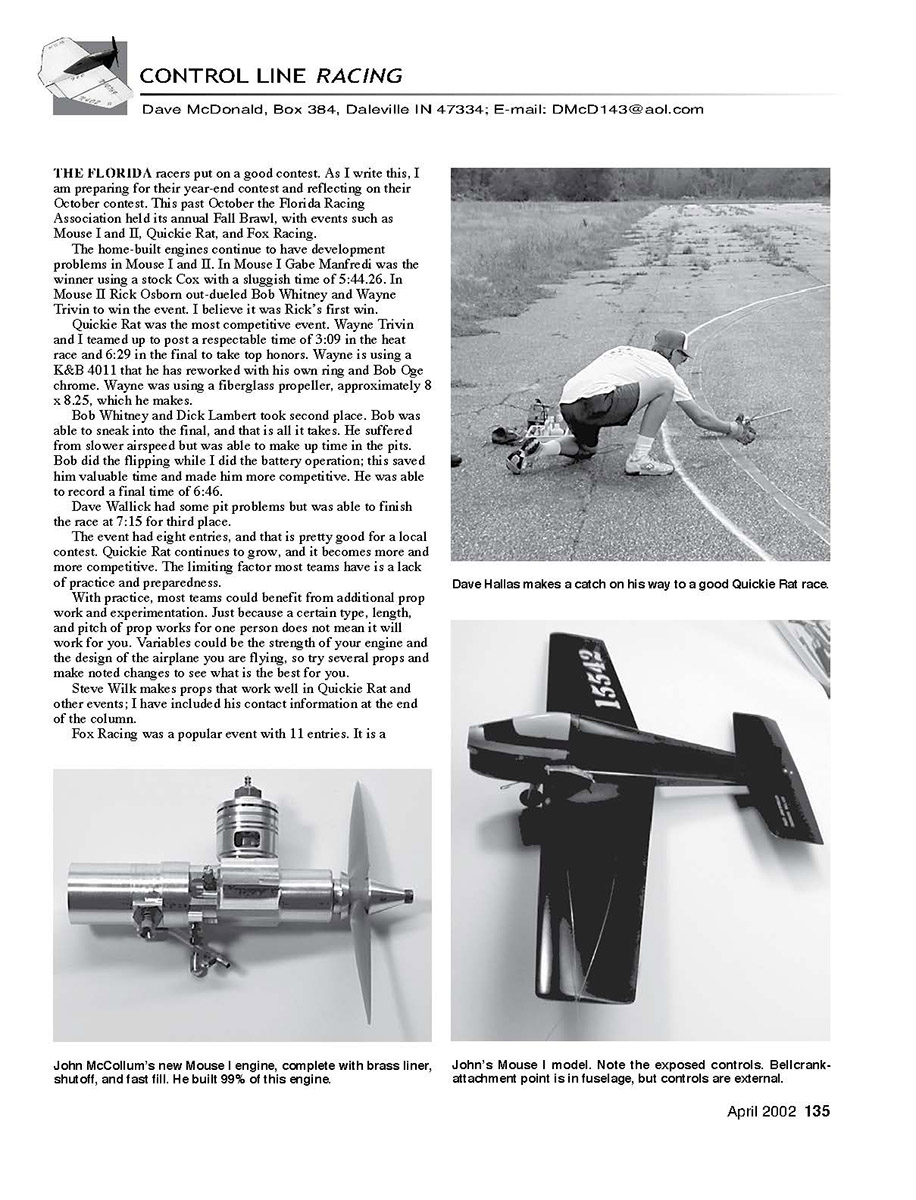
Quickie Rat was the most competitive event. Wayne Trivin and I teamed up to post a respectable time of 3:09 in the heat race and 6:29 in the final to take top honors. Wayne is using a K&B 4011 that he has reworked with his own ring and Bob Oge chrome. Wayne was using a fiberglass propeller, approximately 8 x 2.25, which he makes.
Bob Whitney and Dick Lambert took second place. Bob was able to sneak into the final, and that is all it takes. He suffered from slower airspeed but was able to make up time in the pits. Bob did the flipping while I did the battery operation; this saved him valuable time and made him more competitive. He was able to record a final time of 6:46.
Dave Wallick had some pit problems but was able to finish the race at 7:15 for third place.
The event had eight entries, and that is pretty good for a local contest. Quickie Rat continues to grow, and it becomes more and more competitive. The limiting factor most teams have is a lack of practice and preparedness.
With practice, most teams could benefit from additional prop work and experimentation. Just because a certain type, length, and pitch of prop works for one person does not mean it will work for you. Variables could be the strength of your engine and the design of the airplane you are flying, so try several props and make noted changes to see what is the best for you.
Steve Wilk makes props that work well in Quickie Rat and other events; I have included his contact information at the end of the column.
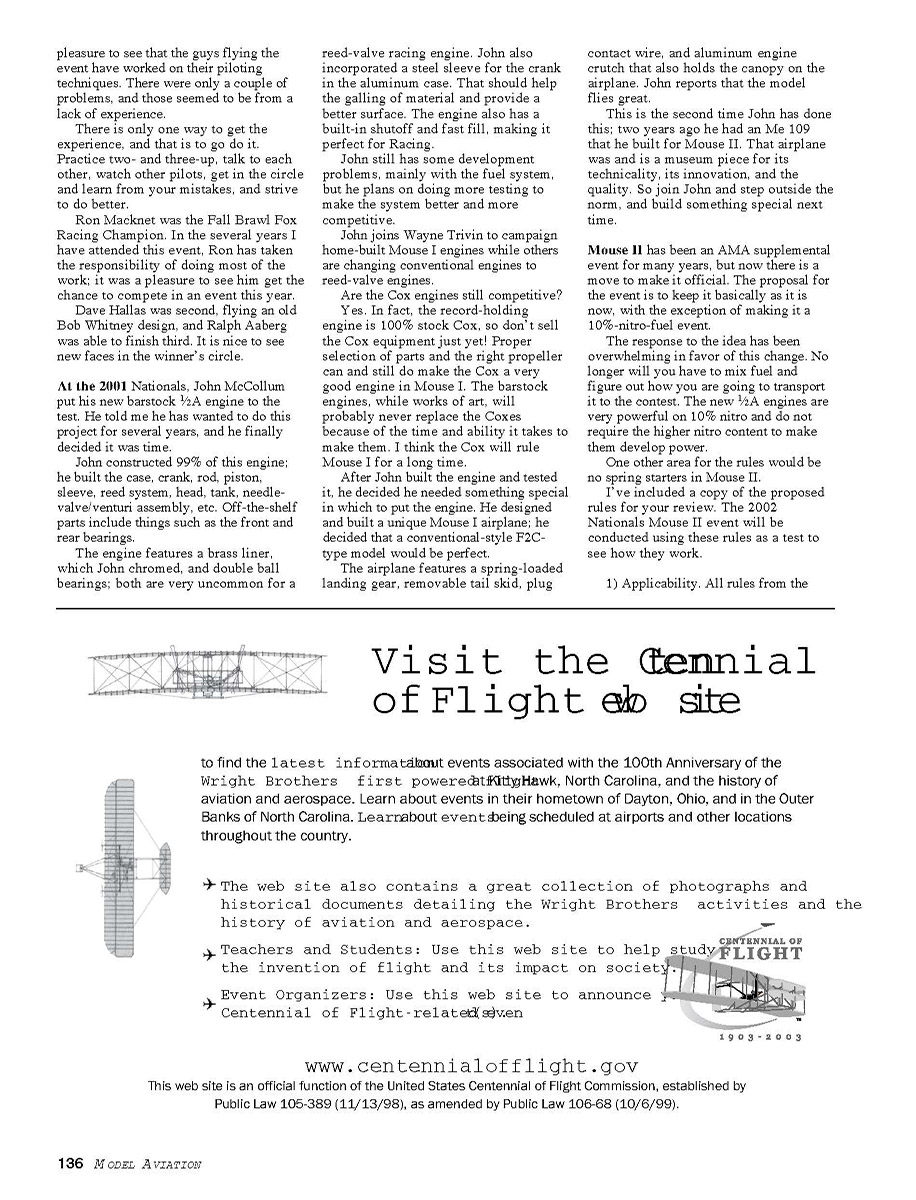
Fox Racing was a popular event with 11 entries. It is a reed-valve racing engine. John also incorporated a steel sleeve for the crank in the aluminum case. That should help the galling of material and provide a better surface. The engine also has a built-in shutoff and fast fill, making it perfect for Racing.
John still has some development problems, mainly with the fuel system, but he plans on doing more testing to make the system better and more competitive.
John joins Wayne Trivin to campaign home-built Mouse I engines while others are changing conventional engines to reed-valve engines.
Are the Cox engines still competitive? Yes, in fact, the record-holding engine is 100% stock Cox, so don't sell the Cox equipment just yet! Proper selection of parts and the right propeller can still do make the Cox a very good engine in Mouse I. The barstock engines, while works of art, will probably never replace the Coxes because of the time and ability it takes to make them. I think the Cox will rule Mouse I for a long time.
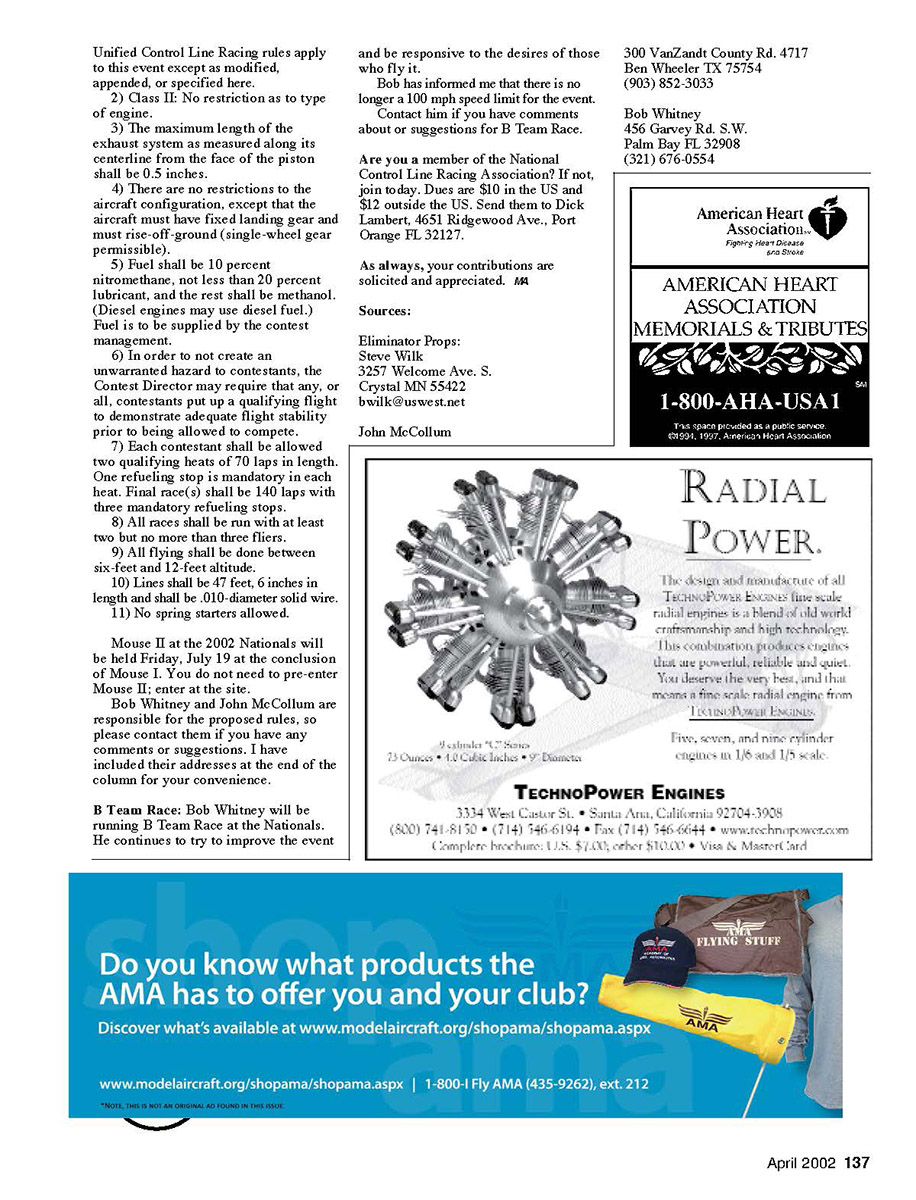
After John built the engine and tested it, he decided he needed something special in which to put the engine. He designed and built a unique Mouse I airplane; he decided that a conventional-style F2C-type model would be perfect.
The airplane features a spring-loaded landing gear, removable tail skid, plug contact wire, and aluminum engine crutch that also holds the canopy on the airplane. John reports that the model flies great.
This is the second time John has done this; two years ago he had an Me 109 that he built for Mouse II. That airplane was and is a museum piece for its technicality, its innovation, and its quality. So join John and step outside the norm, and build something special next time.
Mouse II has been an AMA supplemental event for many years, but now there is a move to make it official. The proposal for the event is to keep it basically as it is now, with the exception of making it a 10%-nitro-fuel event.
The response to the idea has been overwhelming in favor of this change. No longer will you have to mix fuel and figure out how you are going to transport it to the contest. The new .12 engines are very powerful on 10% nitro and do not require the higher nitro content to make them develop power.
One other area for the rules would be no spring starters in Mouse II.
I've included a copy of the proposed rules for your review. The 2002 Nationals Mouse II event will be conducted using these rules as a test to see how they work.
- Applicability. All rules from the Unified Control Line Racing rules apply to this event except as modified, appended, or specified here.
- Class II: No restriction as to type of engine.
- The maximum length of the exhaust system as measured along its centerline from the face of the piston shall be 0.5 inches.
- There are no restrictions to the aircraft configuration, except that the aircraft must have fixed landing gear and must rise-off-ground (single-wheel gear permissible).
- Fuel shall be 10 percent nitromethane, not less than 20 percent lubricant, and the rest shall be methanol. (Diesel engines may use diesel fuel.) Fuel is to be supplied by the contest management.
- In order to not create an unwarranted hazard to contestants, the Contest Director may require that any, or all, contestants put up a qualifying flight to demonstrate adequate flight stability prior to being allowed to compete.
- Each contestant shall be allowed two qualifying heats of 70 laps in length. One refueling stop is mandatory in each heat. Final race(s) shall be 140 laps with three mandatory refueling stops.
- All races shall be run with at least two but no more than three fliers.
- All flying shall be done between six-feet and 12-feet altitude.
- Lines shall be 47 feet, 6 inches in length and shall be .010-diameter solid wire.
- No spring starters allowed.
Mouse II at the 2002 Nationals will be held Friday, July 19 at the conclusion of Mouse II; you do not need to pre-enter Mouse II; enter at the site.
Bob Whitney and John McCollum are responsible for the proposed rules, so please contact them if you have any comments or suggestions. I have included their addresses at the end of the column for your convenience.
B Team Race: Bob Whitney will be running B Team Race at the Nationals. He continues to try to improve the event and be responsive to the desires of those who fly it.
Bob has informed me that there is no longer a 100 mph speed limit for the event. Contact him if you have comments about or suggestions for B Team Race.
Are you a member of the National Control Line Racing Association? If not, join today. Dues are $10 in the US and $12 outside the US. Send them to Dick Lambert, 4651 Ridgewood Ave., Port Orange FL 32127.
As always, your contributions are solicited and appreciated.
Sources:
- Eliminator Props:
Steve Wilk 3257 Welcome Ave. S. Crystal MN 55422 [email protected]
- John McCollum
300 VanZandt County Rd. 4717 Ben Wheeler TX 75754 (903) 852-3033
- Bob Whitney
456 Garvey Rd. S.W. Palm Bay FL 32908 (321) 676-0554
Transcribed from original scans by AI. Minor OCR errors may remain.

