
CL Racing
Dave McDonald, Box 384, Daleville IN 47334; E-mail: [email protected]
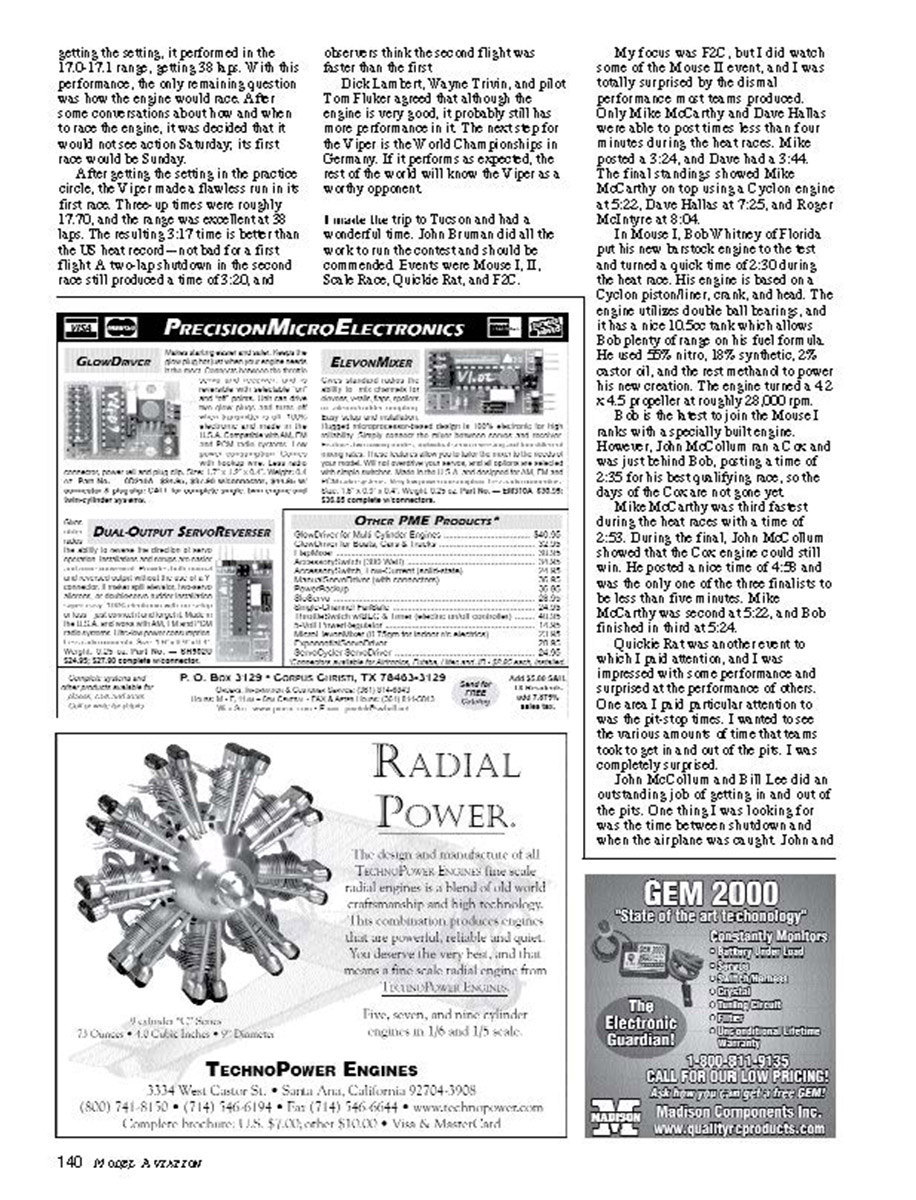
THE USA VIPER F2C engine was introduced at the Tucson AZ contest Easter weekend. The Viper F2C is a barstock 2.5cc engine, which is the collaboration between Dick Lambert and Wayne Trivin.
This two-year project has been a very well-kept secret; I was fortunate enough to know about it, but I was unable to make reference to it in my column. Since the engine has had its race debut and subsequent postings on the World Wide Web, now I can let the rest of the modeling community know of its existence.
Wayne Trivin is a master machinist and an accomplished modeler. He did the design work and the machining. Dick Lambert, a technical and detail-oriented competitor who knows what it takes to make an F2C engine run, provided the technical guidance for what was needed internally for a competitive engine. The Viper utilizes Mazniak parts such as piston/liner, crank, and head. The drum rotor has a modification, as does the rear bearing.
Two goals behind making the Viper were to strengthen the rear bearing area and to stiffen the front end of the engine. Although both are easy to do, engine weight becomes an issue — especially with a barstock engine.
Wayne overcame the weight issue and accomplished the goals. He used computer-aided design (CAD) to lay out the case, and he used Computer Numeric Controlled (CNC) machining to complete the engine. The use of CAD and CNC technology allowed the product to maintain a respectable weight of 151 grams, which is acceptable for a Team Race engine.
The Viper also features Electronic Discharge Machining (EDM) porting in the case; this allowed Wayne the freedom to make the porting exactly like he and Dick wanted it. A major problem with barstock engines is putting the porting in the case; EDM allows you to overcome these machining obstacles.
The prototype engine was tried on December 31, 2001. Although it performed well, some minor changes were needed to get the leap in performance that was hoped for. With the knowledge of the first F2C engine, work began on a second version, and in a short time two formidable engines were produced and ready for testing.
Dick Lambert took the new engine to Tucson for further testing and evaluation. Dick and his pilot, Tom Fluker, used the contest as a test session to work on different scenarios. The Fluker/Lambert team wanted to be slow during the races Saturday. Yes, slow.
Too many teams can only fly if they are the fast pair. What happens to the equipment, pilot, settings, etc. if they are the slow team? Most teams have no idea what to do; consequently, they burn up equipment and throw away times. This idea of practicing being slow is unique; most teams could benefit from it.
After arriving in Tucson on a Friday and getting to the field, it was time to test the latest Viper. Testing showed that it was producing the expected results. After setting the engine, it performed in the 170-171 range, getting 38 laps. With this performance, the only remaining question was how the engine would race. After some conversations about how and when to race the engine, it was decided that it would not race action Saturday; its first race would be Sunday.
After getting the setting in the practice circle, the Viper made a flawless run in its first race. Three-up times were roughly 17.70, and the race was excellent at 38 laps. The resulting 3:17 time is better than the US heat record—not bad for a first flight. A two-lap shut down in the second race still produced a time of 3:20, and observers think the second flight was faster than the first.
Dick Lambert, Wayne Trivin, and pilot Tom Fluker agreed that although the engine is very good, it probably still has more performance in it. The next step for the Viper is the World Championships in Germany. If it performs as expected, the rest of the world will know the Viper as a worthy opponent.
I made the trip to Tucson and had a wonderful time. John Bruman did all the work to run the contest and should be commended. Events were Mouse I, II, Solex Race, Quickie Rat, and F2C.
My focus was F2C, but I did watch some of the Mouse II event, and I was totally surprised by the dismal performance on the team gas produced. Only Mike McCarthy and Dave Halls were able to post times less than four minutes during the heat races. Mike posted a 3:24, and Dave had a 3:44. The final standings showed Mike McCarthy on top using a Cyclon engine at 5:22, Dave Halls at 7:25, and Roger McIntyre at 8:04.
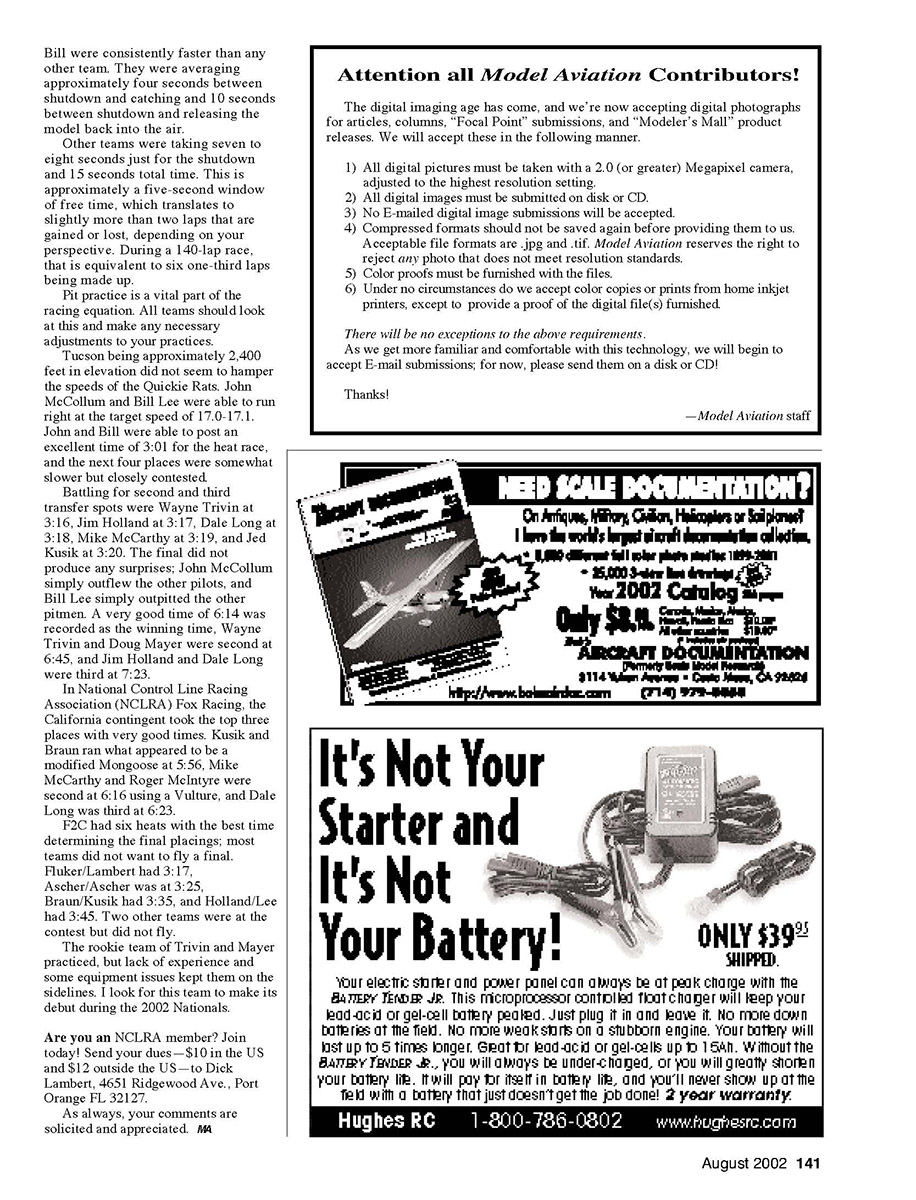
In Mouse I, Bob Whitney of Florida put his new Bratstock engine to the test and turned a quick time of 2:30 during the heat race. His engine is based on a Cyclon piston/liner, crank, and head. The engine utilizes double ball bearings, and it has a nice 10.5oz tank which allows Bob plenty of range on his fuel formula. He used 52% nitro, 18% synthetic, 27% castor oil, and the rest methanol to power his new creation. The engine turned a 42 x 4.5 p propeller at roughly 28,000 rpm.
Bob is the first to join the Mouse I ranks with a specially built engine. However, John McCollum ran a Cox and was just behind Bob, posting a time of 2:35 for his best qualifying race, so the days of the Cox are not gone yet.
Mike McCarthy was third fastest during the heat races with a time of 2:53. During the final, John McCollum showed that the Cox engine could still win. He posted a nice time of 4:58 and was the only one of the three finalists to be less than five minutes. Mike McCarthy was second at 5:22, and Bob finished in third at 5:24.
Quickie Rat was another event to which I paid attention, and I was impressed with some performance and surprised at the performance of others. One area I paid particular attention to was the pit-stop times. I was not used to the various amounts of time that teams took to get in and out of the pits. I was completely surprised.
John McCollum and Bill Lee did an outstanding job of getting in and out of the pits. One thing I was looking for was the time between shutdown and when the airplane was caught. John and Bill were consistently faster than any other team. They were averaging approximately four seconds between shutdown and catching and 10 seconds between shutdown and releasing the model back into the air.
Other teams were taking seven to eight seconds just for the shutdown and 15 seconds total time. This is approximately a five-second window of free time, which translates to slightly more than two laps that are gained or lost, depending on your perspective. During a 140-lap race, that is equivalent to six one-third laps being made up.
Pit practice is a vital part of the racing equation. All teams should look at this and make any necessary adjustments to your practices.
Tucson being approximately 2,400 feet in elevation did not seem to hamper the speeds of the Quickie Rats. John McCollum and Bill Lee were able to run right at the target speed of 17.0–17.1. John and Bill were able to post an excellent time of 3:01 for the heat race, and the next four places were somewhat slower but closely contested.
Battling for second and third transfer spots were Wayne Trivin at 3:16, Jim Holland at 3:17, Dale Long at 3:18, Mike McCarthy at 3:19, and Jed Kusik at 3:20. The final did not produce any surprises; John McCollum simply outflew the other pilots, and Bill Lee simply outpitted the other pitmen. A very good time of 6:14 was recorded as the winning time. Wayne Trivin and Doug Mayer were second at 6:45, and Jim Holland and Dale Long were third at 7:23.
In National Control Line Racing Association (NCLRA) Fox Racing, the California contingent took the top three places with very good times. Kusik/Braun ran what appeared to be a modified Mongoose at 5:56, Mike McCarthy and Roger McIntyre were second at 6:16 using a Vulture, and Dale Long was third at 6:23.
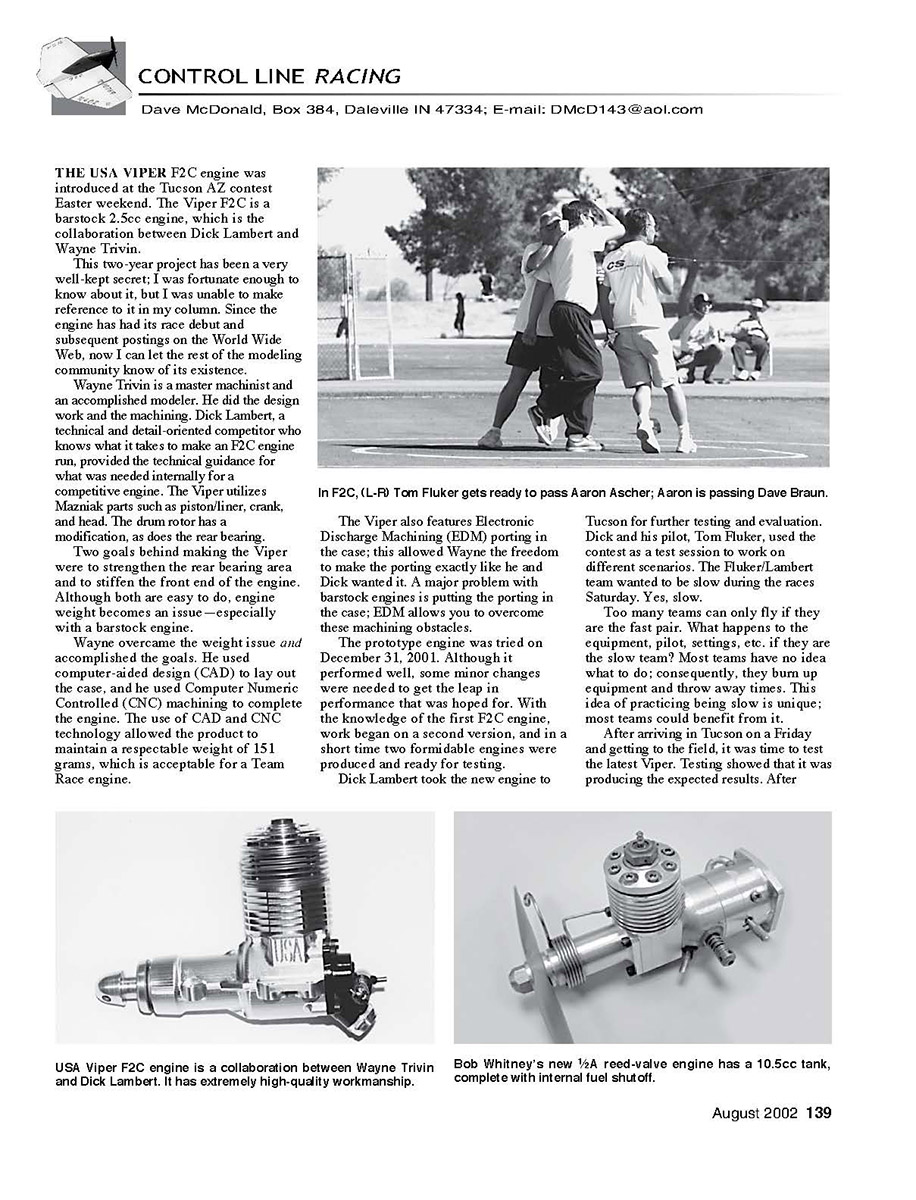
F2C had six heats with the best time determining the final placings; most teams did not want to fly a final. Fluker/Lambert had 3:17, Ascher/Ascher was at 3:25, Braun/Kusik had 3:35, and Holland/Lee had 3:45. Two other teams were at the contest but did not fly.
The rookie team of Trivin and Mayer practiced, but lack of experience and some equipment issues kept them on the sidelines. I look for this team to make its debut during the 2002 Nationals.
Are you an NCLRA member? Join today! Send your dues—$10 in the US and $12 outside the US—to Dick Lambert, 4651 Ridgewood Ave., Port Orange FL 32127.
As always, your comments are solicited and appreciated. MA
Transcribed from original scans by AI. Minor OCR errors may remain.

