
Control Line Racing
Dave McDonald, Box 384, Daleville IN 47334; E-mail: [email protected]
AN ENJOYABLE National Championships, good weather, and good flying—what could be better? This year's Control Line Racing Nationals (Nats), held July 14-19, was not as well attended as in the past, but the competition was as close as ever. Some new faces emerged as victors, and some old faces made reappearances in the circle.
Before I get to the events, it is imperative that I thank all those who make it easier for all of us to enjoy our hobby. Fox Manufacturing provided the fuel for the official Nats event. In the years that Fox has done this, I can't think of a single engine failure caused by a fuel problem. The company continues to provide a first-class product.
Fox Manufacturing sponsored the NCLRA (National Control Line Racing Association) Fox Racing event, as it has in the past, and provided engines for the Junior/Senior class. It is good to see the kids out competing with the youth; there will be a future.
Steve Wilk of Eliminator Prop provided a spare ship for .21 Rat and Quickie Rat. His dedication to the hobby is overwhelming. Steve is always ready to step in and help where needed.
A big thanks to Marcia Matson, who ran timing all week and generally kept the timers and counters on the ball. John McCollum helped me officiate the event; his guidance was appreciated very much. Bob Abernathy helped make sure lines were pull-tested, and Bob Whitney built a freestanding pull plate; this made the job of pulling lines easier and more efficient. Thanks to you all!
Sunday is traditionally Fox Racing day. This year there were 16 Open entries and two in the Junior/Senior age group. Both Junior/Senior entries put on a good race. Scott Matson and his steady Hooter Goose design took quick 52.8 QP, and Doug Shortt took second place with 17:20. What is unique is that Scott and Doug turned times faster than any Open entrant. I know both of these young men practice, and it shows.
In the Open category, only 10 of the 16 participants managed to post times in the heat races. Rookie Darnett Walker proved that Fox Racing is not just a man's event. Competing in her first Nats, she posted a time of 7:27.00 in the heat races. That was much better than many experienced participants did. Good job, Darnett.
Several competitors' inability to post times was due to lack of preparedness. You can't take any event for granted, and I think some participants failed to remember this. The slow time in the finals this year was 7:16.00; this is extremely slow for Fox Racing and would not have made the final in many years.
The finals provided closer action; the top three places were only three seconds apart. Mike McCarthy was first at 6:20.75, Julio Bedrows second at 6:22.86, and Brian Silversmith was third at 6:23.96.
At the conclusion of the finals, the two Junior/Senior entries and the top three Open contestants had their airplanes impounded and the engines removed for inspection. All were found to be legal. The inspection process seems to be one of the best parts of the event; every participant is around the area to look over the inspectors' shoulders.
Monday is the heavy lifting day for pilots; Slow Rat has become a true horsepower event, with only four to six pilots in the country who can adequately handle these airplanes. This year it took a heat time of 25.196 or faster to advance to the final; this made it one of the fastest fields in memory. All the top airplanes were running in the 13.8-14.1 range. These are honest times, and not the one-up, let's-see-how-much-I-can-impress-the-crowd types.
Jerry Meyer secured the last transfer spot with his 25.96, and Doug Mayer was quick qualifier at 24.250. Bill Bischoff and Mike Greb were the most consistent between their two heat times, with only one and two seconds difference.
During the five-minute warm-up for the final, Jerry Meyer suffered the worst luck of anyone. Upon landing, Jerry's battery man Bob Whitney failed to get out of the way and hit the airplane with his leg, causing a snapped fuselage. This failure with three minutes to go before race time resulted in Jerry being unable to start the race, which resulted in an automatic fourth-place finish.
Fast qualifier Doug Mayer had some pit trouble and could only muster a 6:26.47 in his final pass, resulting in a third-place finish. Bill Bischoff and Mike Greb continued their methodical approaches to racing, and both recorded excellent times—5:40.61 and 5:50.46—to claim first and second places.
If you plan on flying Slow Rat, I suggest a couple things: a good, strong pilot and a lot of practice. There appears to be no sign of Bill and Mike slowing down.
Tuesday is Scale Racing, and the Nelson-versus-Rossi battle continued. This year the Nelson engine once again came out on top. These engines are becoming more and more evenly matched, with the difference being the airplane and propeller. The best engine in the world will not win if it's attached to a heavy, dirty airplane or turning a poorly worked propeller.
Scott Mathis won the Junior/Senior division. He had some strong competition from Doug Short until an up-line he broke, causing Doug's airplane to have an untimely impact with the flying surface.
Five of the eight Open finalists turned heat times of roughly 2:50.00, with Wayne Trivin posting the fast time of 2:50.07 using a Nelson engine. The final transfer spot went to Rick McIntyre at 3:02.70. Most airplanes were the Little Quickie design, and Wayne Trivin used a Gilmore Shootstring.
The finals saw last year's champion James Ricketts turn a 6:08.55 for third place. James (Jim) and his son Jimmy utilized the consistency approach again; they have won or finished in the top five for the last several years. That is a good record, and it does not come easy.
Finishing second was James Holland using an old Bob Fogg airplane and a Rossi engine. Mr. Holland posted a time of 6:07.57, and first-time Nationals winner Bob Christ used Mr. Holland's backup airplane to post a 6:06.46.
Wednesday is F2C day. This year the total range of experience was seen at the site. The wide range of experience dictated that the event would not have a final, but that the total of the two best times of three rounds would determine the winners.
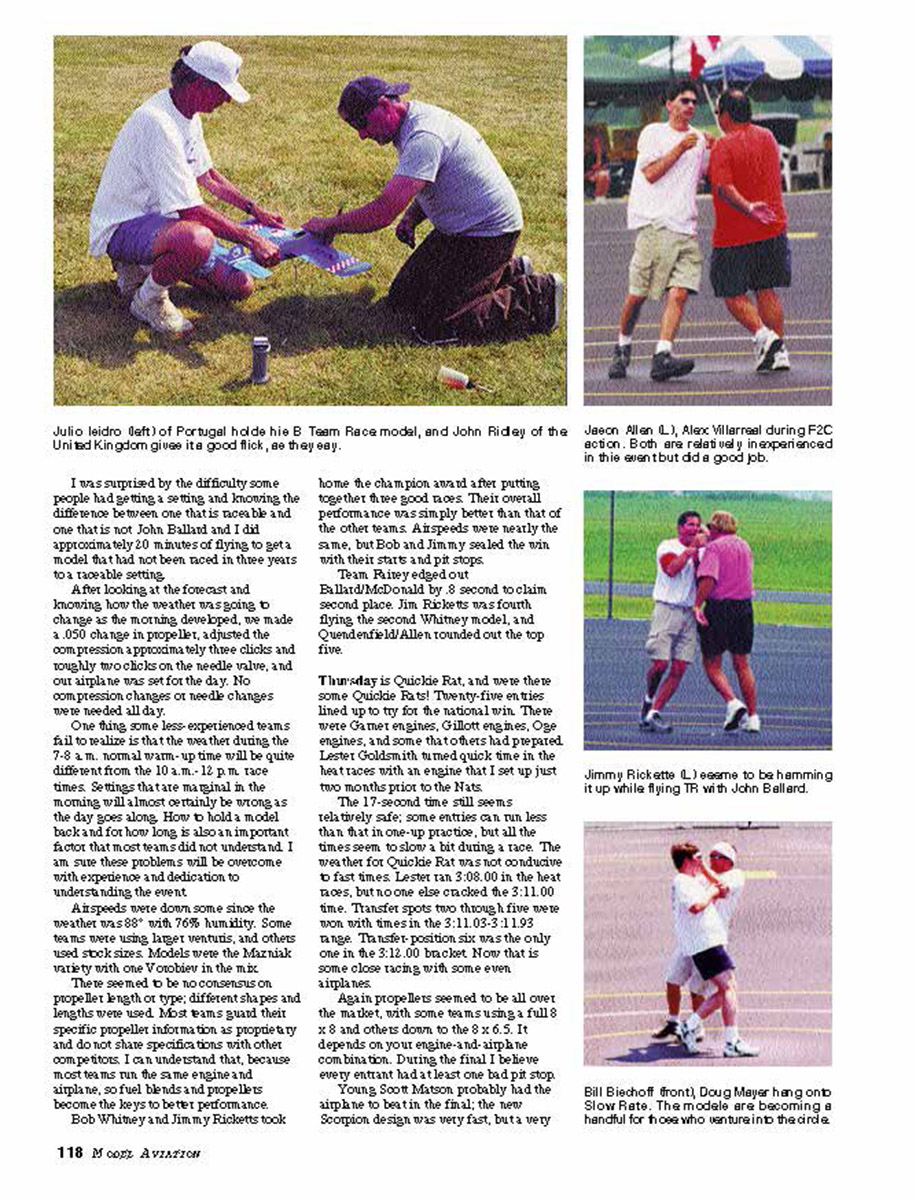
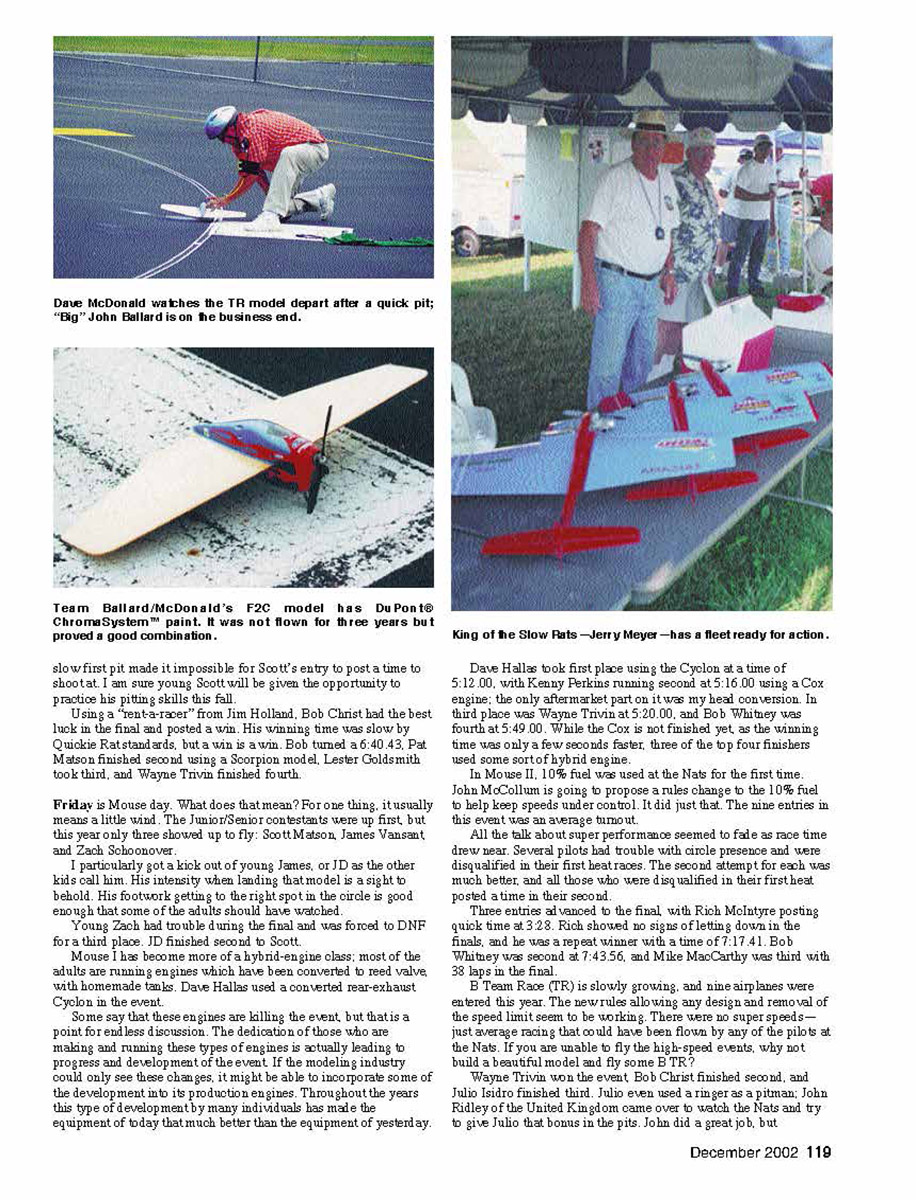
I teamed up with longtime US team member John Ballard, and we pulled a model off the wall that was last raced in 1999 to give it a go. Another unusual combination was Fred Quendenfield and Jason Allen. Fred reappeared after being out of the event for several years, and he posted some of his personal best times after tuning it with Bob Whitney. Wayne Trivin and Doug Mayer gave F2C a go for the first time at the Nats. Although their performance was below par, I am sure they learned a lot and will be better prepared next time.
The Canadian team of Fairley/Fairley came down to battle one last time. Brian is hanging up the models after many years of flying this US Nats. He will certainly be missed because he was a colorful figure at the circle.
Dave Wallick was in attendance with his new pilot Alex Villarreal. They had the hard luck of the Nats; they had a refly in each of their first two heats because their lines were snagged by other models. Mr. Wallick learned a valuable lesson during Team Race in his last heat race on the hotpit; his fuel can was out of fuel. This provided a big roar from the crowd but a valuable lesson for those involved.
Steve Wilk picked up "rent-a-pilot" Jimmy Ricketts but had model problems and was unable to post a time. Bob Whitney also utilized the "rent-a-pilot" program and used Jimmy for two entries—one for each of them. Bob, the wizened veteran, showed that just because he is getting older does not mean he is getting slower. Bob provided excellent pit work and put together some good times.
I was surprised by the difficulty some people had getting a setting and knowing the difference between one that is raceable and one that is not. John Ballard and I did approximately 20 minutes of flying to get a model that had not been raced in three years to a raceable setting.
After looking at the forecast and knowing how the weather was going to change as the morning developed, we made a .050 change in propeller, adjusted the compression approximately three clicks and roughly two clicks on the needle valve, as our airplane was set for the day. No compression changes or needle changes were needed all day.
One thing some less-experienced teams fail to realize is that the wear during the 7-8 a.m. to noon warm-up time will be quite different from the 10 a.m.-12 p.m. race times. Settings that are marginal in the morning will almost certainly be wrong as the day goes along. How to hold a model back and for how long is also an important factor that most teams did not understand. I am sure these problems will be overcome with experience and a little dedication to understanding the event.
Airspeeds were down some since the weather was 88° with 76% humidity. Some teams were using larger venturis, and others used stock sizes. Models were the Manzak variety with one Vortabow in the mix.
There seemed to be two consensus on propeller length or type; different shapes and lengths were used. Most teams guard their specific propeller information as proprietary and do not share specifics with other competitors. I can understand that, because most teams run the same airplane, so fuel blends and propellers become the keys to better performance.
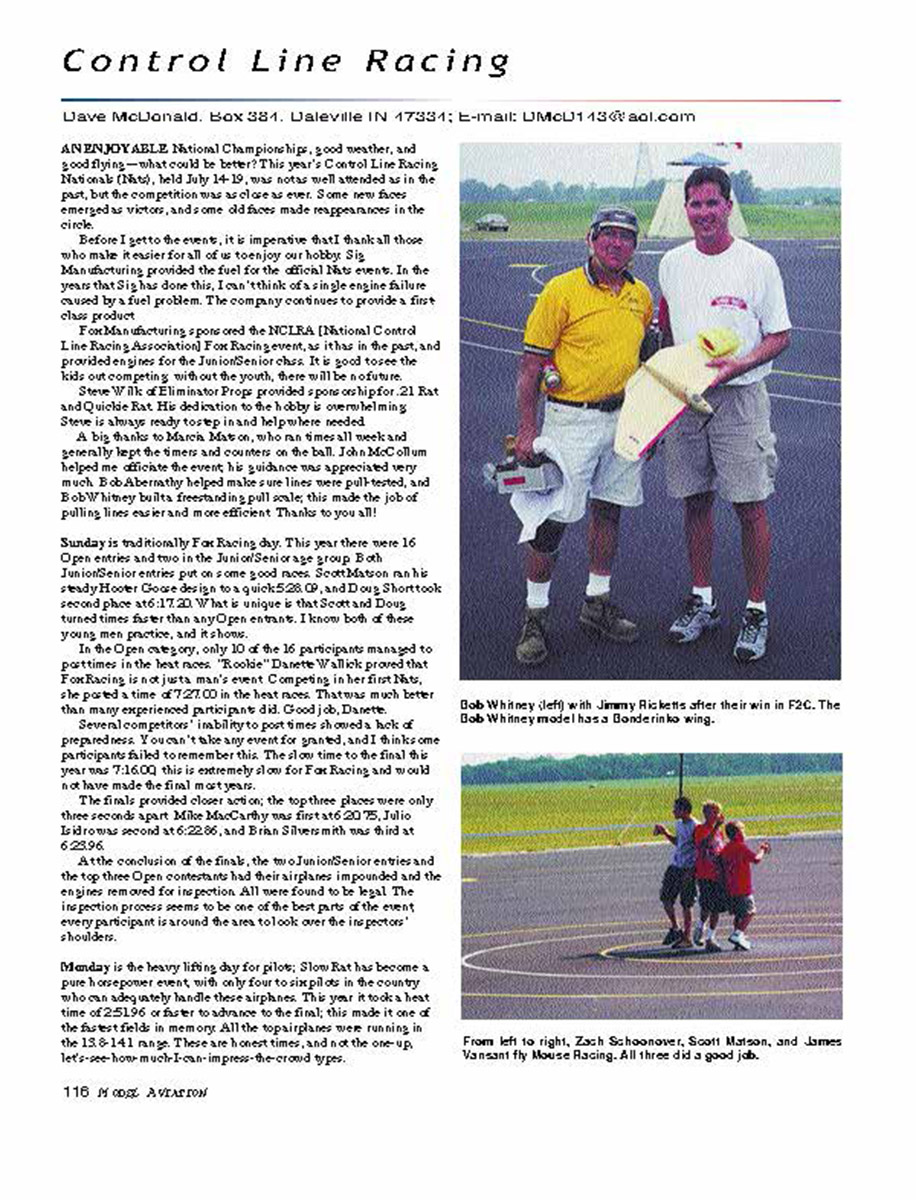
Bob Whitney and Jimmy Ricketts took home the champion award after putting together three good races. Their overall performance was simply better than that of the other teams. Airspeeds were nearly the same, but Bob and Jimmy sealed the win with their starts and pit stops.
Team Raley edged out Ballard/McDonald by 8 seconds to claim second place. Jim Ricketts was fourth flying the second Whitney model, and Quendenfeld/Allen rounded out the top five.
Thursday is Quickie Rat, and were there some Quickie Rats! Twenty-five entries lined up to try for the national win. There were Gantz engines, Gillott engines, Ogee engines, and some that others had prepared. Lester Goldsmith turned quick time in the heat races with an engine that I set up just two months prior to the Nats.
The 17-second time still seems relatively safe; some entries can run less than that in one-up practice, but all the times seem to slow a bit during a race. The weather for Quickie Rat was not conducive to fast times. Lester ran a 3:08.00 in the heat races, but no one else cracked the 3:11.00 time. Transfer spots two through five were won with times in the 3:11.03-3:11.93 range. Transfer position six was the only one in the 3:12.00 bracket. Now that is some close racing with some even airplanes.
Again propellers seemed to be all over the market, with some teams using a full 8 x 8 and others down to the 8 x 6.5. It depends on your engine-and-airplane combination. During the final I believe every entrant had at least one bad pit stop.
Young Scott Mason probably had the airplane to beat in the final; the new Scorpion design was very fast, but a very home-made prop killed his chances. Scott ended up with a DNF.
I am not certain of all the placings, but Lester Goldsmith took first followed by Bob Whitney and Jimmy Ricketts in second, and Raley/McDonald third.
It was a great week of racing with some new teams showing up and some veterans still at the top of their game. A slow first pit made it impossible for Scott's entry to post a time to shoot at. I am sure young Scott will be given the opportunity to practice his pitting skills this fall.
Using a "rent-a-racer" from Jim Holland, Bob Christ had the best luck in the final and posted a win. His winning time was slow by Quickie Rat standards, but a win is a win. Bob turned a 6:40.43. Pat Matson finished second using a Scorpion model, Lester Goldsmith took third, and Wayne Trivin finished fourth.
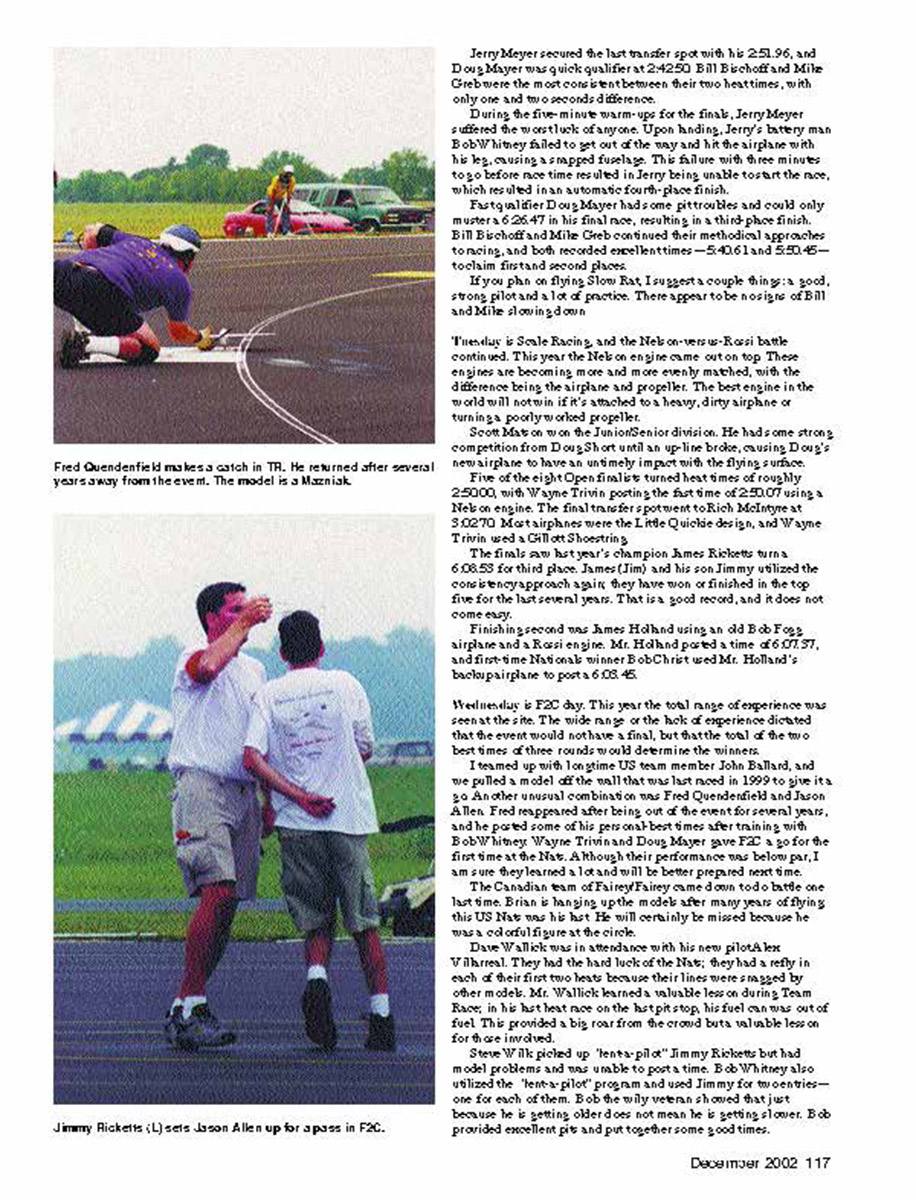
Friday is Mouse day. What does that mean? For one thing, it usually means a little wind. The Junior/Senior contestants were up first, but this year only three showed up to fly: Scott Matson, James Vansant and Zach Schoonover.
I particularly got a kick out of young James, or JD as the other kids call him. His intensity when landing that model is a sight to behold. His footwork getting to the right spot in the circle is good enough that some of the adults should have watched.
Young Zach had trouble during the final and was forced to DNF for a third place. JD finished second to Scott.
Mouse I has become more of a hybrid-engine class; most of the adults are running engines which have been converted to reed valve, with homemade tanks. Dave Hallas used a converted rear-exhaust Cyclon in the event.
Some say that these engines are killing the event, but that is a point for endless discussion. The dedication of those who are making and running these types of engines is actually leading to progress and development of the event. If the modeling industry could only see these changes, it might be able to incorporate some of the development into its production engines. Throughout the years this type of development by many individuals has made the equipment of today that much better than the equipment of yesterday.
Dave Hallas took first place using the Cyclon at a time of 5:12.00, with Kenny Perkins running second at 5:16.00 using a Cox engine; the only aftermarket part on it was my head conversion. In third place was Wayne Trivin at 5:20.00, and Bob Whitney was fourth at 5:49.00. While the Cox is not finished yet, the winning time was only a few seconds faster, than the top four finishers used some sort of hybrid engine.
In Mouse II, 10% fuel was used at the Nats for the first time. John McCollum is going to propose a rules change to the 10% fuel help keeps speeds under control. It did just that. The nine entries in this event was an average turnout.
All the talk about super performance seemed to fade as race time drew near. Several pilots had trouble with circle presence and were disqualified in their first heat races. The second attempt for each was much better, and all those who were disqualified in their first heat posted a time in their second.
Three entries advanced to the final, with Rich McIntyre posting quick time at 3:28. Rich showed no signs of letting down in the finals, and he was a repeat winner with a time of 7:14.01. Bob Whitney was second at 7:43.56, and Mike MacCarthy was third with 38 laps in the final.
B Team Race (TR) is slowly growing, and nine airplanes were entered this year. The new rules allowing any design and removal of the speed limit seem to be working. There were no super speeds—just average racing that could have been flown by any of the pilots at the Nats. If you are unable to fly the high-speed events, why not build a beautiful model and fly some B TR?
Wayne Trivin won the event; Bob Christ finished second, and Julio Isidro finished third. Julio even used a ringer as a pitman; John Ridley of the United Kingdom came over to watch the Nats and try to give Julio that bonus in the pits. John did a great job, but unfortunately Julio said he was running a turtle in a race with a Ferrari.
At the NCLRA banquet, Steve Wilk was awarded the Larry Dziak Sportsmanship Award. Steve is a great recipient because he has always been there to help those who need assistance, provide equipment, sponsor events, and whatever else it takes to make the hobby more enjoyable for those participating. Steve's father Tom, along with his wife Becky and daughter Ashley, were at the Nats this year, and all were a pleasure to be with.
Hall of Fame inductees could not have been two better ambassadors for modeling and Control Line Racing. John Kisdonk, who recently passed away, was instrumental in developing some of the equipment that is still used today. His contributions to the equipment side of modeling will long be remembered.
Inductee John Balch won his first "Rat Racers" trophy in 1957 and has won almost every event at one time or another. He has probably flown more staffplanes than any two people combined. John wrote the Racing column in Model Aviation for years, he holds the final time record in F2C with Dick Lambert, and he has been a US team member several times. John's knowledge in getting the most out of an airplane is legendary. He is very deserving of this induction.
Pat Matson received the special Fireman of the Year Award; he was trying to start a Fox racer when his winning fire was observed. Doug Short received the Broken Prop Award for the best crash of the week: a total wipeout of a new Scale racer. I'll bet his mother was happy to see him drag that into the house.
Bob Christ was the second winner of the NCLRA Nationals Points Champion Award. Congratulations to all the winners. To everyone who was present, thank you and hope to see you next year.
As always, your comments are appreciated and solicited. MA
See results in "Focus on Competition"
Transcribed from original scans by AI. Minor OCR errors may remain.

