
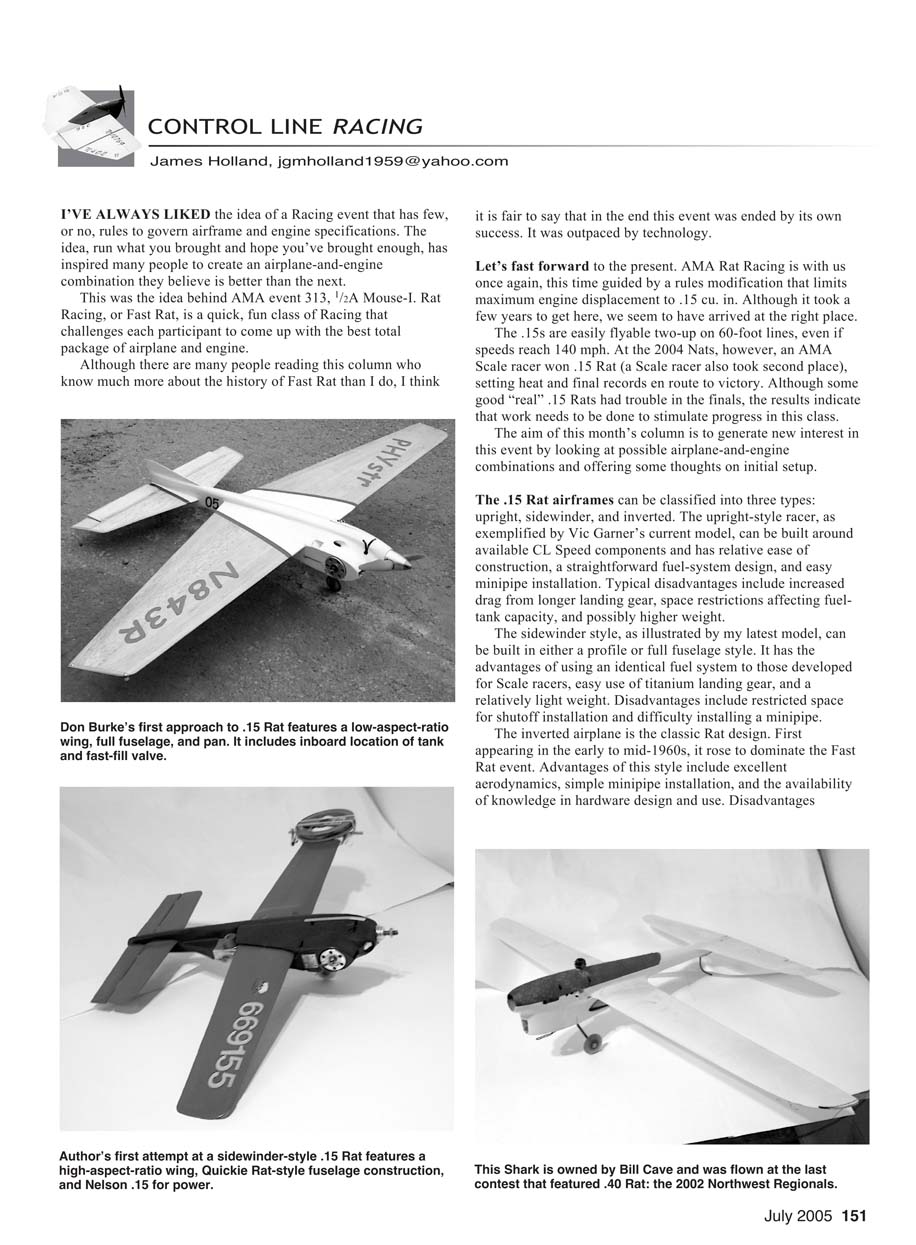
CL Racing
James Holland, [email protected]
I'VE ALWAYS LIKED the idea of a Racing event that has few, or no, rules to govern airframe and engine specifications. The idea, run what you brought and hope you've brought enough, has inspired many people to create an airplane-and-engine combination they believe is better than the next.
This was the idea behind AMA event 313, 1/2A Mouse-I. Rat Racing, or Fast Rat, is a quick, fun class of Racing that challenges each participant to come up with the best total package of airplane and engine.
Although there are many people reading this column who know much more about the history of Fast Rat than I do, I think it is fair to say that in the end this event was ended by its own success. It was outpaced by technology.
Let's fast forward to the present. AMA Rat Racing is with us once again, this time guided by a rules modification that limits maximum engine displacement to .15 cu. in. Although it took a few years to get here, we seem to have arrived at the right place.
The .15s are easily flyable two-up on 60-foot lines, even if speeds reach 140 mph. At the 2004 Nats, however, an AMA Scale racer won .15 Rat (a Scale racer also took second place), setting heat and final records en route to victory. Although some good "real" .15 Rats had trouble in the finals, the results indicate that work needs to be done to stimulate progress in this class.
The aim of this month's column is to generate new interest in this event by looking at possible airplane-and-engine combinations and offering some thoughts on initial setup.
The .15 Rat airframes can be classified into three types: upright, sidewinder, and inverted. The upright-style racer, as exemplified by Vic Garner's current model, can be built around available CL Speed components and has relative ease of construction, a straightforward fuel-system design, and easy minipipe installation. Typical disadvantages include increased drag from longer landing gear, space restrictions affecting fuel-tank capacity, and possibly higher weight.
The sidewinder style, as illustrated by my latest model, can be built in either a profile or full fuselage style. It has the advantages of using an identical fuel system to those developed for Scale racers, easy use of titanium landing gear, and a relatively light weight. Disadvantages include restricted space for shutoff installation and difficulty installing a minipipe.
The inverted airplane is the classic Rat design. First appearing in the early to mid-1960s, it rose to dominate the Fast Rat event. Advantages of this style include excellent aerodynamics, simple minipipe installation, and the availability of knowledge in hardware design and use. Disadvantages
CL Racing
and move the intake out of the way of incoming grit. These convenience factors are in direct contrast to the modern front-intake .15 that powers most .15 Rats.
Other than the diesel engines made for F2C, I cannot think of a single modern, rear-rotor .15 that is commercially available and likely to be competitive out of the box. This may completely change the .15 Rat design envelope.
Unless someone owns a stack of Rossi .15 rear-rotor parts and wants to build a new backplate assembly or owns a similar number of SuperTigre X .15 parts and is able to machine the case to use a Mark III Rossi liner (along with a custom head), it is unlikely that we will see any competitive rear-intake engines in this event.
If you agree with this point, it looks like the .15 Rat field will be dominated by modern front-intake .15s—probably those produced by Henry Nelson or Rossis modified by Tim Gillott. What airframes will work with these engines? Experience and results indicate that any of the three styles has potential for success.
My favorite is the sidewinder. This style of airframe has a relatively low-drag design that works well with a front-intake engine. It has potential for development beyond my first effort.
Future areas for investigation include the use of highly asymmetric wing designs to increase line coverage, the use of carbon-fiber fuselages and wings, and experimentation with wing location to produce the optimum minipipe alignment.
Let's move on to the actual operation of these devices. It is currently possible to be competitive without the use of a minipipe, but I believe this will change within the next couple years. Based on my field observations, as a pilot and holding a stopwatch, the minimum usable minipipe diameter appears to be .50 inch, with some evidence supporting the use of pipe diameters in excess of .70 inch.
Optimum pipe diameter and length can be found through repeated runs on the test bench. If you find that the engine is making more torque than expected (such as running faster on a larger-diameter propeller), it may be worthwhile to increase pipe diameter to improve top-end breathing.
Propellers are one of my favorite subjects, and I offer the following observations for the .15 Rat. Although .15 Rats are aerodynamically cleaner than Scale racers, this will not necessarily allow them to turn propellers with much more pitch. Wayne Trivin and I discussed this issue a couple years ago, and the point that emerged was that a 5-inch pitch prop would probably be enough for these models. The engine simply won't make enough rpm to get into its power band on a very high-pitch prop.
Transcribed from original scans by AI. Minor OCR errors may remain.

