
CL Racing
THE F2C TEAM trials were held in Muncie, Indiana during Labor Day weekend.
Thanks go to the Muncie Controliners, who hosted the event; to Pat Matson, Contest Director; to Doc Jackson, Walt Perkins, and Steve Wilk, for being the Jury; and to Tom Wilk, for making an excellent video of the event.
Weather for the contest could not have been better—very light wind, and hot temperatures. However, many of the teams experienced difficulties getting their equipment to perform to its potential because of the conditions, and pilots experienced some discomfort; blacktop temperature reached a sweltering 140 degrees!
The team trials are run with a total of six heats flown during two days, with the best three times of each team determining its final position. First is as good as third in this competition, but bragging rights are a big part of the final standings.
The first heat of the contest pitted the teams of Stewart Willoughby/Bob Oge, John Ballard/Dick Lambert, and John McCollum/Glenn Lee. This grouping has provided some of the more exciting racing action during the past several years.
At the start of the first race, it seemed that nothing would change from past performances. Soon after takeoff, it was apparent that something was amiss with the McCollum/Lee model; it was able to run only at a greatly reduced speed, and the team had to retire after 10 laps. Later analysis showed a problem with the fuel-delivery system—probably a small amount of dirt.
That left the remaining two teams a perfect opportunity to turn good times with an easy two-up race.
For Ballard/Lambert, a compression setting and short laps prevented them from taking advantage of this two-up opportunity.
After two cycles from making the team, Sto Willoughby and Bob Oge came with their "A" game, and showed it from the start. They turned a 3:29.69, putting up a respectable time in the first heat.
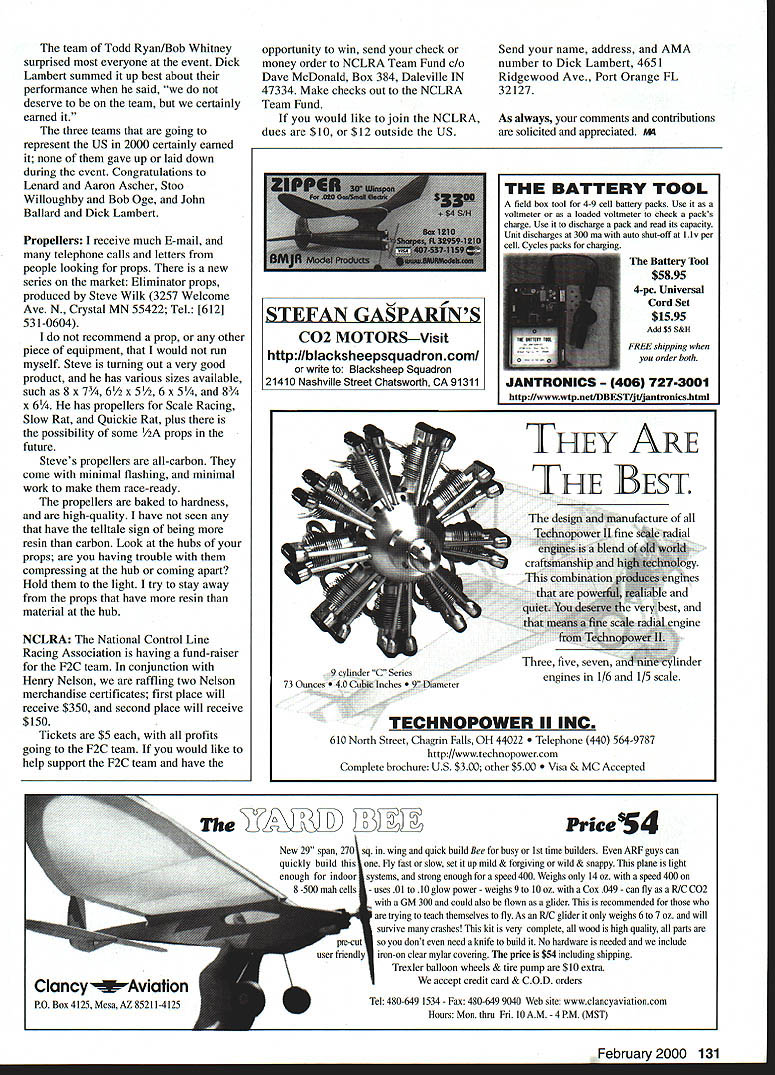
The second race had its misfortune—and adventure—with Aaron Ascher/Lenard Ascher, Todd Ryan/Bob Whitney, and Kenny Perkins/myself in competition.
All three models were away at the start, with fairly equal speed. The team of Ryan/Whitney occupied the middle pit, and as Aaron Ascher brought his team's model in, he snagged the wire of the Ryan/Whitney model.
After some deliberation, it was determined that it was a racing incident, and the three teams were granted a refly. This type of incident marked the rest of the weekend. A combination of heat, speed, and the lack of competition-flying resulted in several teams not performing up to the standards I have seen in the past.
However, most teams' pit stops did run in the 3- to 4-second range. The average pit stop in F2C is 3.5 seconds; that is, catching the model, refueling, starting, and launching. The pits are very busy places for a short period of time.
The first incident involving the loss of equipment happened when Kenny Perkins was in the circle with John Ballard and Sto Willoughby.
Kenny was being passed, and he moved out of the center of the circle. That caused him to lose sight of his model, which proved disastrous. As John Ballard passed, his model was hit from the bottom up by the Perkins model, resulting in a total loss of the Perkins aircraft. Miraculously, the Ballard/Lambert model came down very lightly, resulting only in cosmetic damage.
The first day was a total loss for the Ballard/Lambert team, with inconsistent runs and poor settings. After careful analysis and swapping parts, engines, tanks, and airplanes, it was determined that the team had rear-bearing problems. A bearing with too-little clearance was causing their engines to run abnormally hot, making for inconsistent settings, and causing the team to lose laps.
With some after-hours work Saturday evening, Ballard/Lambert was prepared to do battle on Sunday for a spot on the team.
In contrast, the team of Willoughby/Oge had three good races on Saturday, recording two 3:28s and one 3:29. Clearly, they were a pair to contend with if you wanted to be on the US team.
Team Ascher also put up two good times on the board Saturday, running 3:28.84 and 3:26.65 on their first two flights.
Sunday proved almost a mirror image of Saturday. A slight cooling in temperature resulted in the blacktop reaching only 136 degrees. As the day began, the mood of most competitors was turning extremely serious. Most teams had their backs to the wall, and had only that day to make the team.
In one of the early races, the McCollum/Lee team experienced trouble. With the rotational speeds of these airplanes—and not as fast in the US as some of the European models—it is only a matter of time before you crash a model, and Sunday was McCollum/Lee's day.
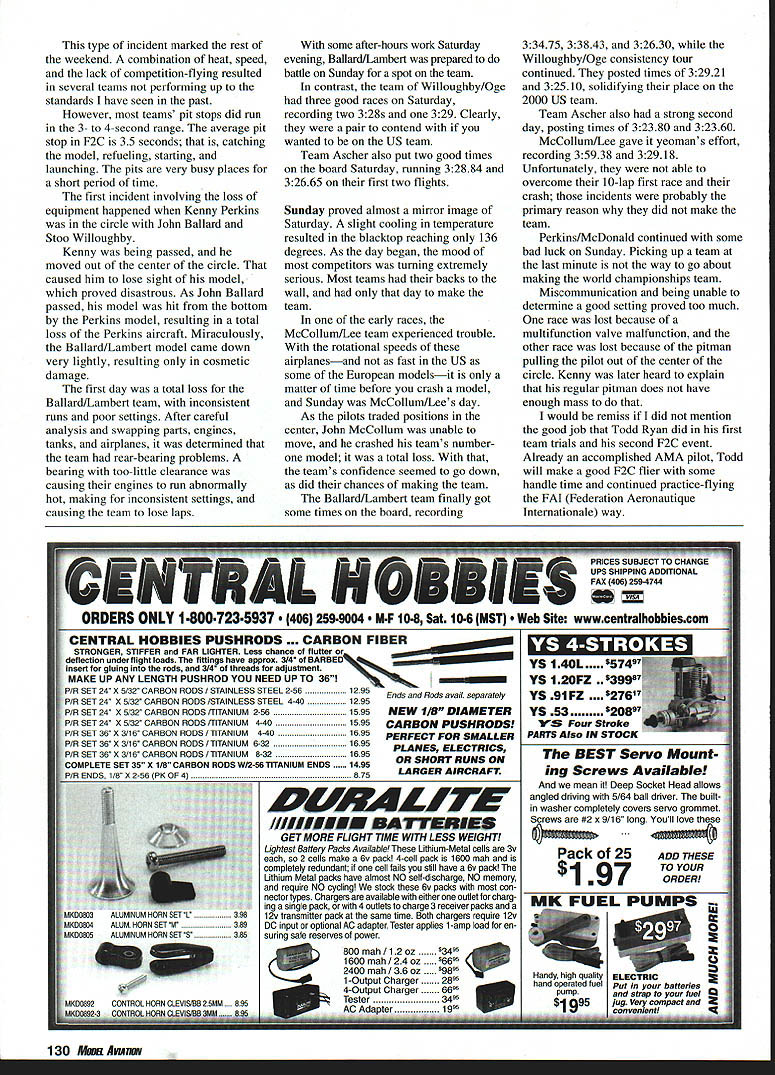
As the pilots traded positions in the center, John McCollum was unable to move, and he crashed his team's number-one model; it was a total loss. With that, the team's confidence seemed to go down, as did their chances of making the team.
The Ballard/Lambert team finally got some times on the board, recording 3:34.75, 3:38.43, and 3:26.30, while the Willoughby/Oge consistency tour continued. They posted times of 3:29.21 and 3:25.10, solidifying their place on the 2000 US team.
Team Ascher also had a strong second day, posting times of 3:23.80 and 3:23.60.
McCollum/Lee gave it yeoman's effort, recording 3:59.38 and 3:29.18.
Unfortunately, they were not able to overcome their 10-lap first race and their crash; those incidents were probably the primary reason why they did not make the team.
Perkins/McDonald continued with some bad luck on Sunday. Picking up a team at the last minute is not the way to go about making the world championships team. Miscommunication and being unable to determine a good setting proved too much. One race was lost because of a mufflertion valve malfunction, and the other race was lost because of the pitman pulling the pilot out of the center of the circle. Kenny was later heard to explain that his regular pitman does not have enough mass to do that.
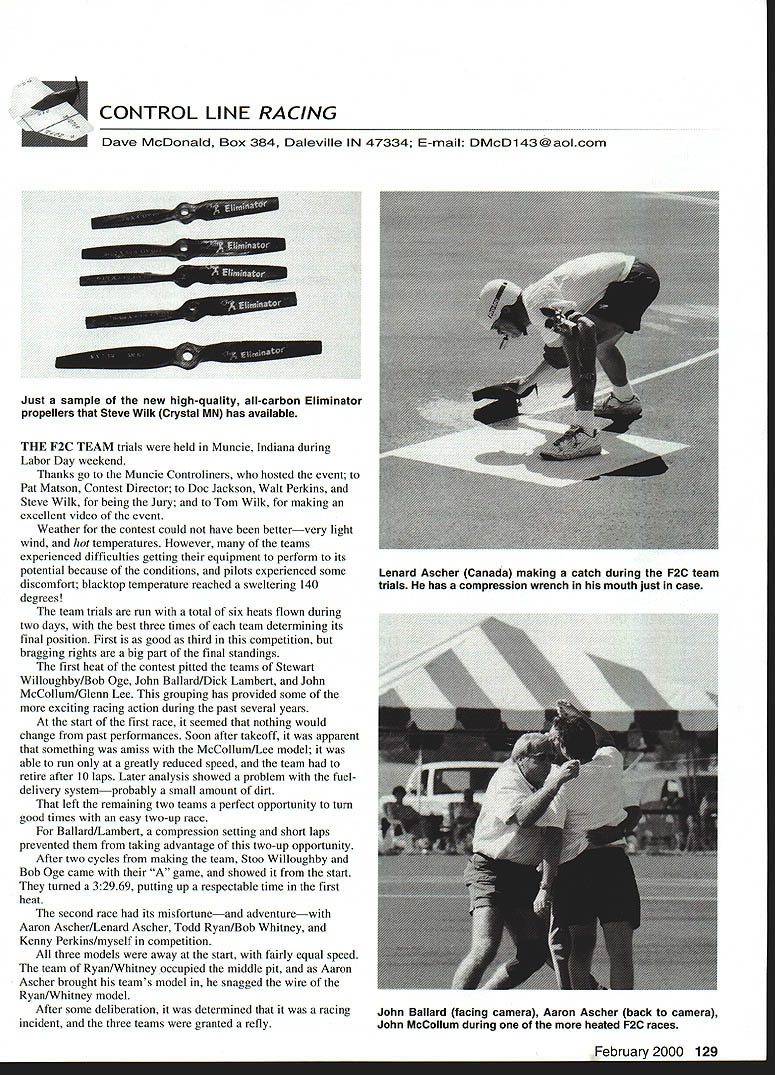
I would be remiss if I did not mention the good job that Todd Ryan did in his first team trials and his second F2C event. Already an accomplished AMA pilot, Todd will make a good F2C flier with some handle time and continued practice—flying the FAI (Federation Aeronautique Internationale) way. Propellers: I receive much E-mail, and many telephone calls, and letters from people looking for props. There is a new series on the market: Eliminator props, produced by Steve Wilk (3257 Welcome Ave. N., Crystal MN 55422; Tel.: (612) 531-0604).
I do not recommend a prop, or any other piece of equipment, that I would not run myself. Steve is turning out a very good product, and he has various sizes available, such as 8 x 7¼, 6½ x 5½, 6 x 5¼, and 8¾ x 6¼. He has propellers for Scale Racing, Slow Rat, and Quickie Rat, plus there is the possibility of some ½A props in the future.
Steve's propellers are all-carbon. They come with minimal flashing, and minimal work to make them race-ready.
The propellers are baked to hardness, and are high-quality. I have not seen any that have the telltale sign of being more resin than carbon. Look at the hubs of your props; are you having trouble with them compressing at the hub or coming apart? Hold them to the light. I try to stay away from the props that have more resin than material at the hub.
NCLRA: The National Control Line Racing Association is having a fund-raiser for the F2C team. In conjunction with Henry Nelson, we are raffling two Nelson merchandise certificates; first place will receive $350, and second place will receive $150.
Tickets are $5 each, with all profits going to the F2C team. If you would like to help support the F2C team and have the opportunity to win, send your check or money order to NCLRA Team Fund c/o Dave McDonald, Box 384, Daleville IN 47334. Make checks out to the NCLRA Team Fund.
If you would like to join the NCLRA, dues are $10, or $12 outside the US.
Send your name, address, and AMA number to Dick Lambert, 4651 Ridgewood Ave., Port Orange FL 32127.
As always, your comments and contributions are solicited and appreciated. MA
Transcribed from original scans by AI. Minor OCR errors may remain.

