
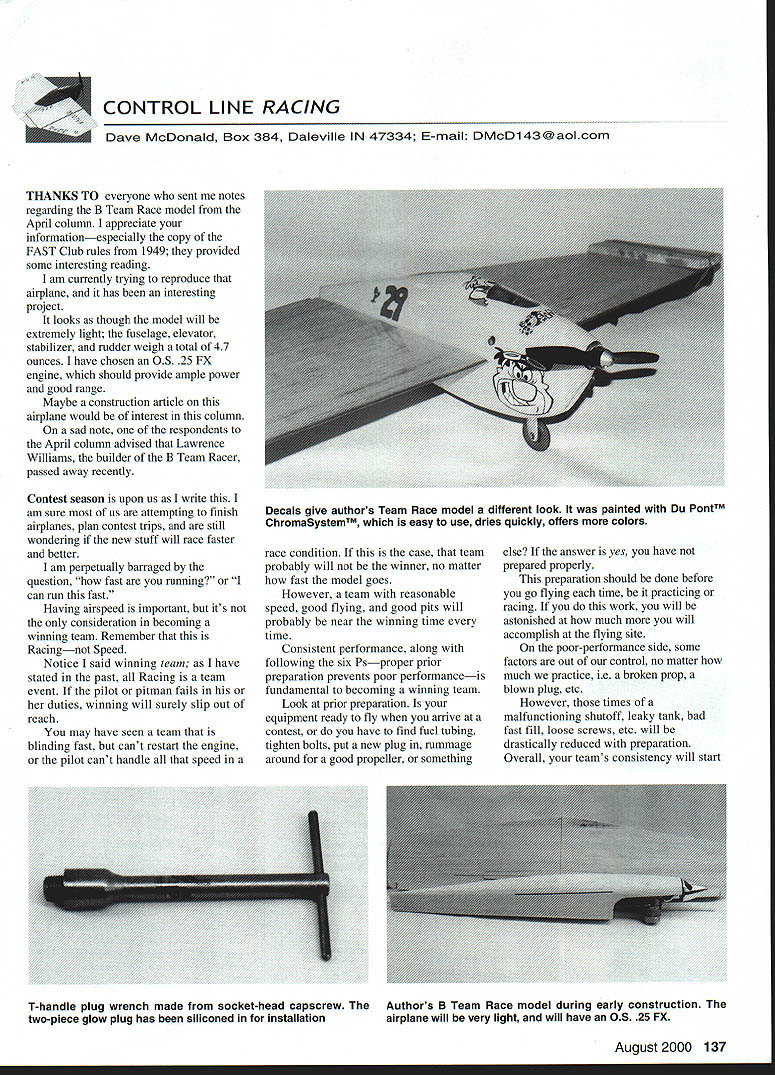
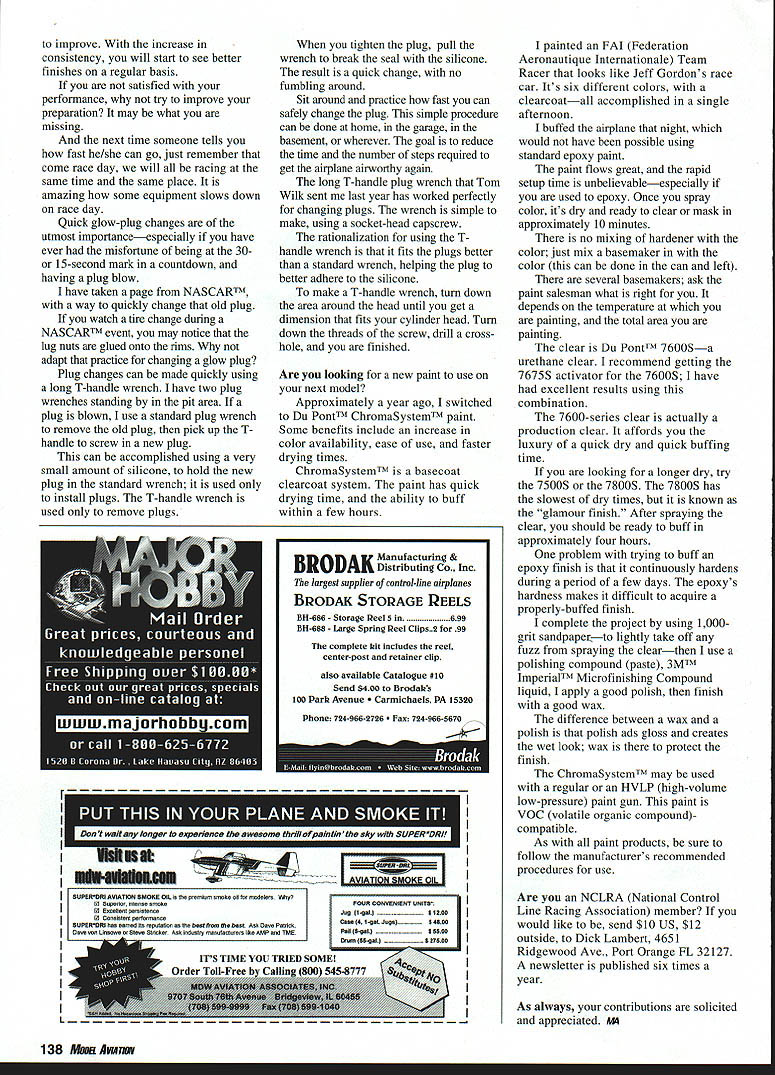
CL Racing
Dave McDonald, Box 384, Daleville IN 47334; E-mail: [email protected]
About the project
Thanks to everyone who sent me notes regarding the B Team Race model from the April column. I appreciate your information—especially the copy of the FAST Club rules from 1949; they provided some interesting reading.
I am currently trying to reproduce that airplane, and it has been an interesting project. It looks as though the model will be extremely light; the fuselage, elevator, stabilizer, and rudder weigh a total of 4.7 ounces. I have chosen an O.S. .25 FX engine, which should provide ample power and good range.
Maybe a construction article on this airplane would be of interest in this column.
On a sad note, one of the respondents to the April column advised that Lawrence Williams, the builder of the B Team Racer, passed away recently.
Contest season and racing perspective
Contest season is upon us as I write this. I am sure most of us are attempting to finish airplanes, plan contest trips, and are still wondering if the new stuff will race faster and better.
I am perpetually barraged by the question, "How fast are you running?" or "I can run this fast."
Having airspeed is important, but it's not the only consideration in becoming a winning team. Remember that this is racing—not speed.
Notice I said winning team; as I have stated in the past, all racing is a team event. If the pilot or pitman fails in his or her duties, winning will surely slip out of reach.
You may have seen a team that is blinding fast, but can't restart the engine, or the pilot can't handle all that speed in race conditions. If this is the case, that team probably will not be the winner, no matter how fast the model goes.
However, a team with reasonable speed, good flying, and good pits will probably be near the winning time every time.
Consistent performance, along with following the six Ps—proper prior preparation prevents poor performance—is fundamental to becoming a winning team.
Look at prior preparation. Is your equipment ready to fly when you arrive at a contest, or do you have to find fuel tubing, tighten bolts, put a new plug in, rummage around for a good propeller, or something else? If the answer is yes, you have not prepared properly.
This preparation should be done before you fly each time, be it practice or racing. If you do this work, you will be astonished at how much more you will accomplish at the flying site.
On the poor-performance side, some factors are out of our control, no matter how much we practice, i.e., a broken prop, a blown plug, etc.
However, those times of a malfunctioning shutoff, leaky tank, bad fast-fill, loose screws, etc., will be drastically reduced with preparation. Overall, your team's consistency will start to improve. With the increase in consistency, you will start to see better finishes on a regular basis.
If you are not satisfied with your performance, why not try to improve your preparation? It may be what you are missing.
And the next time someone tells you how fast he/she can go, just remember that come race day, we will all be racing at the same time and the same place. It is amazing how some equipment slows down on race day.
Quick glow-plug changes
Quick glow-plug changes are of the utmost importance—especially if you have ever had the misfortune of being at the 30- or 15-second mark in a countdown and having a plug blow.
I have taken a page from NASCAR, with a way to quickly change that old plug. If you watch a tire change during a NASCAR event, you may notice that the lug nuts are glued onto the rims. Why not adapt that practice for changing a glow plug?
Plug changes can be made quickly using a long T-handle wrench. I have two plug wrenches standing by in the pit area. If a plug is blown, I use a standard plug wrench to remove the old plug, then pick up the T-handle to screw in a new plug.
This can be accomplished using a very small amount of silicone to hold the new plug in the standard wrench; it is used only to install plugs. The T-handle wrench is used only to remove plugs.
When you tighten the plug, pull the wrench to break the seal with the silicone. The result is a quick change, with no fumbling around.
Sit around and practice how fast you can safely change the plug. This simple procedure can be done at home, in the garage, in the basement, or wherever. The goal is to reduce the time and the number of steps required to get the airplane airworthy again.
T-handle plug wrench
The long T-handle plug wrench that Tom Wilk sent me last year has worked perfectly for changing plugs. The wrench is simple to make, using a socket-head cap-screw.
The rationalization for using the T-handle wrench is that it fits the plugs better than a standard wrench, helping the plug to better adhere to the silicone.
To make a T-handle wrench:
- Turn down the area around the head until you get a dimension that fits your cylinder head.
- Turn down the threads of the screw.
- Drill a cross-hole.
- You are finished.
Paint: Du Pont ChromaSystem
Are you looking for a new paint to use on your next model?
Approximately a year ago, I switched to Du Pont ChromaSystem paint. Some benefits include an increase in color availability, ease of use, and faster drying times.
ChromaSystem is a basecoat/clearcoat system. The paint has quick drying time, and the ability to buff within a few hours.
I painted an FAI (Federation Aeronautique Internationale) Team Racer that looks like Jeff Gordon’s race car. It’s six different colors, with a clearcoat—all accomplished in a single afternoon. I buffed the airplane that night, which would not have been possible using standard epoxy paint.
The paint flows great, and the rapid setup time is unbelievable—especially if you are used to epoxy. Once you spray color, it’s dry and ready to clear or mask in approximately 10 minutes.
There is no mixing of hardener with the color; just mix a base-maker in with the color (this can be done in the can and left).
There are several base-makers; ask the paint salesman what is right for you. It depends on the temperature at which you are painting, and the total area you are painting.
The clear is Du Pont 7600S—a urethane clear. I recommend getting the 7657S activator for the 7600S; I have had excellent results using this combination.
The 7600-series clear is actually a production clear. It affords you the luxury of a quick dry and quick buffing time.
If you are looking for a longer dry, try the 7500S or the 7800S. The 7800S has the slowest dry time, but it is known as the "glamour finish." After spraying the clear, you should be ready to buff in approximately four hours.
One problem with trying to buff an epoxy finish is that it continuously hardens over a period of a few days. The epoxy’s hardness makes it difficult to acquire a properly buffed finish.
I complete the project by using 1,000-grit sandpaper—to lightly take off any fuzz from spraying the clear—then I use a polishing compound (paste), 3M Imperial Microfinishing Compound liquid; I apply a good polish, then finish with a good wax.
The difference between a wax and a polish is that polish adds gloss and creates the wet look; wax is there to protect the finish.
The ChromaSystem may be used with a regular or an HVLP (high-volume low-pressure) paint gun. This paint is VOC (volatile organic compound)-compatible.
As with all paint products, be sure to follow the manufacturer’s recommendations for safety.
NCLRA membership
Are you an NCLRA (National Control Line Racing Association) member? If you would like to be, send $10 U.S., $12 outside, to Dick Lambert, 4651 Ridgewood Ave., Port Orange FL 32127. A newsletter is published six times a year.
As always, your contributions are solicited and appreciated.
MA
Transcribed from original scans by AI. Minor OCR errors may remain.

