


CL Racing
Dave McDonald, Box 384, Daleville IN 47334; E-mail: [email protected]
The 2000 Control Line (CL) Racing Nationals (Nats) is history — a great accomplishment for some, a disappointment for others. However, most contestants had a great time.
The Nats is more than competition; it is a time to renew friendships, make new friends, and enjoy our hobby.
As in previous years, we were fortunate to have Roy Gould as event director. Roy does a good job, and he should be congratulated for his dedication and hard work.
NCLRA Fox Racing (Sunday, July 9)
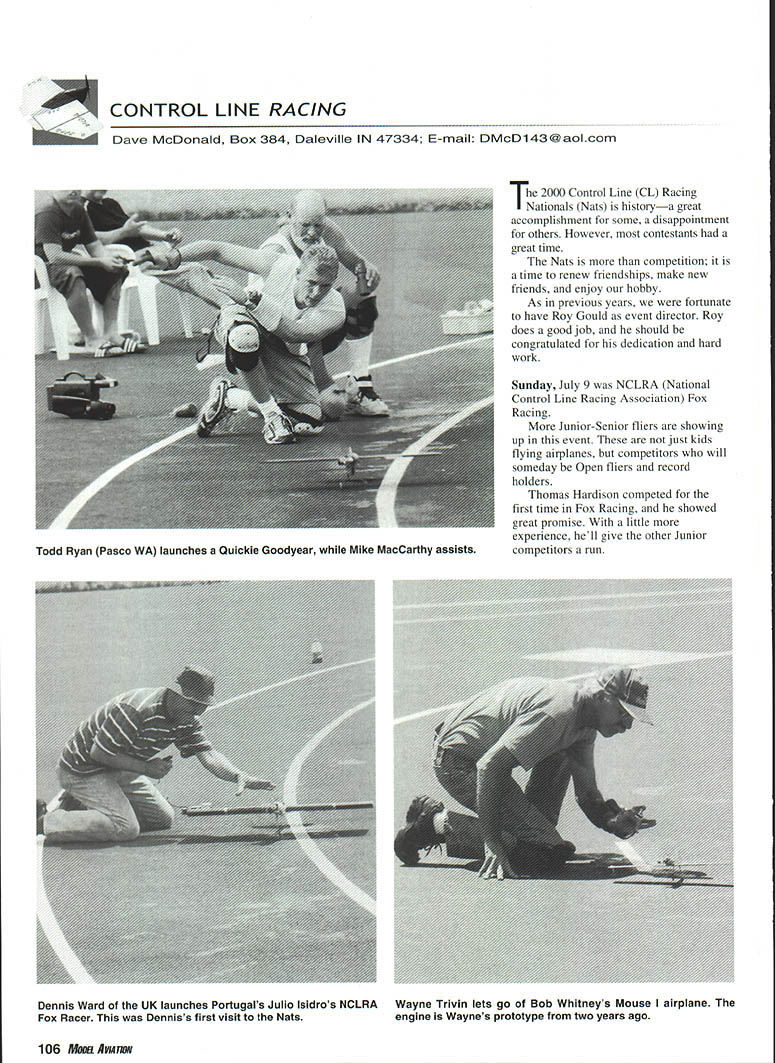
Sunday, July 9 was NCLRA (National Control Line Racing Association) Fox Racing.
More Junior-Senior fliers are showing up in this event. These are not just kids flying airplanes, but competitors who will someday be Open fliers and record holders.
Thomas Hardison competed for the first time in Fox Racing, and he showed great promise. With a little more experience, he'll give the other Junior competitors a run.
Doug Short of Muncie was the third-place finisher. He had good airspeed, but some longish stops kept him from a better time in the final.
Chris Bates of Arizona—a first-time Nationals entrant—is a very competent flier. His flying reflects many hours of practice and dedication to the hobby. Chris scored a second-place finish, and he should be very proud.
Scott Matson of Muncie unveiled his new Hooter Goose Fox Racer. He had great airspeed and consistent races for first place.
Scott is a four-time Junior-class winner. He spends many hours at the circle with his father Pat, and he flies more with Open competitors than he does with Junior competitors. This shows in Scott's ability to handle the airplanes and in his keen circle awareness.
The Open Fox Racing competitors are close each year. Defending winner Pat Matson and I did not enter this Nats.
After many flights, the top three qualifiers in Fox Racing were Bob Whitney at 6:01.43, Mike MacCarthy at 6:00.50, and Doug Mayer at 5:57.56. The three airplanes were run in the final, and the race was determined mainly in the pits.
Mike MacCarthy finished third at 7:24.75; Bob Whitney was second at 6:20.65, and Doug Mayer was a first-time winner at 6:08.27.
As always, all three airplanes were impounded, and the engines were torn down for inspection.
Slow Rat (Monday)
Monday is Slow Rat day; with that comes big engines, heavy fuel consumption, and tremendous horsepower.
Scott Matson established a 140-lap record for the Junior class with a time of 6:47.37. He used a modified Mongoose Fox Racer, powered by a K&B engine he acquired from John Ballard. Scott turned lap times of 15.8, which is extremely good for a Junior competitor.
In the Open category, it took a great time of 2:46.33 to make the finals. Jerry Meyer secured the fourth transfer spot with that time, and Todd Ryan was third-fastest at 2:41.75. Bill Bischoff was second-fastest at 2:39.38, and fast time went to Mike Greb at 2:38.38.
Three of the four fast airplanes had Nelson .36s, and the other model utilized a SuperTigre.
Everyone's model ran strong in the final. Todd Ryan's airplane had great airspeed, but burnt plugs kept him from winning; he finished fourth.
Third place went to Jerry Meyer with 6:06.05; second went to Bill Bischoff with 5:40.07, and Mike Greb claimed first at 5:37.73.
More competitors are using composite material to make these big airplanes stronger and lighter. The strength aids performance, and the lighter airframe helps the pilots and helps the airplane accelerate and decelerate. This improves the proto time during those mandatory pit stops.
CL Scale Racing (Tuesday)
Tuesday at the Nationals is CL Scale Racing.
This year's competition was delayed until afternoon because of rain. AMA Nationals Headquarters put out a weather update at approximately 11 a.m., saying "when it quits raining, the rain is over." I'll give them credit—when it quit raining, the rain was finished!
The circle was opened at noon for an hour of practice. The Junior-Senior competition started at 1:00, pitting Scott Matson against Doug Short.
Both young men flew the Quickie airplane. Scott utilized a Gillott Rossi Mk.III engine, and Doug used a Nelson. Both had good airspeed, and they put on the best race of the day. Scott won the final, but both received a round of applause at the end.
The Open class had some competitors who were greatly disappointed, and others who were pleased with their accomplishments.
Todd Ryan, Doug Mayer, Mike MacCarthy, and Steve Wilk had good airspeed in the heat races, taking them to the final. Unfortunately, not being able to keep plugs in their engines proved fatal in the flyoffs.
This emphasizes the need to practice 140-lap races; setups you can get away with in a 70-lap race may not work in the longer final.
Jim and Jimmy Ricketts had outstanding airspeed, and were the class of the field. Both had new Gillott Rossi engines that were delivered just days before the event. After initial flight testing and raising the heads on both engines, the speed increased, as did the longevity of the plugs.
Jimmy Ricketts became a first-time Nationals champion, beating his father Jim by a mere .04 second. Todd Ryan was third. Doug Mayer was fourth, Steve Wilk was fifth, and sixth place went to Mike MacCarthy.
The Quickie airplane was the dominant design.
Henry Nelson's new .15 made its first Nationals appearance. The engine showed good airspeed, and it should be great—especially after competitors learn which propeller to use with it.
F2C and B Team Race (Wednesday)
F2C and B Team Race were on the schedule Wednesday. With the Control Line World Championships going on at the same time, the usual hot teams were not at the Nationals.
However, that did not keep others from providing heated competition.
Julio Isidro of Portugal and Dennis Ward of the United Kingdom teamed up to give the Nats that international flavor. It would be nice if more teams from outside the US started participating.
With the format at the Nationals, most teams have two entries. This presents difficulty in the pairings, but it gives competitors more opportunity to fly.
A change was made this year in determining the winners. At the conclusion of three rounds, each team's two best times were added to establish the champion. This puts more emphasis on consistent performance, and eliminates the go-for-broke strategy.
Jimmy Ricketts took the handle for the first time at 7:30 a.m., and he quickly learned the difficulties of F2C. You can't learn to control the setting and learn what to do and what not to do in an hour, but Jimmy did a great job. With more practice, he will make an excellent F2C pilot.
The team of Kenny Perkins/Lester Goldsmith, otherwise known as the "Team Race Terrorists," turned the hot time of the Nationals in a 3:26.62. However, consistency was not their forte, and they recorded a third-place finish.
Team Bob Whitney/Todd Ryan had entries under both names. They had great consistency, and were able to take first and second places respectively.
Bob used Mazniak equipment, as did most competitors; many fliers are going to this.
The equipment is available and it runs consistently. Tanks and multifunction valves are of good quality, and they require little or no adjustments.
Speeds were close, with most teams running approximately 18.5 seconds; the difference between winning and losing was who got the better setting, made quicker pits, and had better luck.
Everyone should watch F2C at least once. You will be impressed by the close action.
B Team Race was held for the second time at the Nats. Bob Whitney is responsible for the event. He modified the rules from last year, and the changes were greeted with acceptance from all who attended.
An interesting change was the mandatory stop-and-go penalty for those caught exceeding the target speed of the event. Only one contestant was clocked going faster than the target speed; he was unable to attain the ideal speed, and retired from the event.
Although still in its infancy, B Team Race is showing signs of growth. More competitors are talking about the event, and it will return in 2001.
After several heat races, the contestants with the top three times advanced to the final.
Julio Isidro was the fast qualifier, but could only muster a third-place finish because of engine failure. Dave Betz finished second, and Bob Whitney was the champion.
Mouse I and II (Thursday)
Mouse I and II shared the circle Thursday.
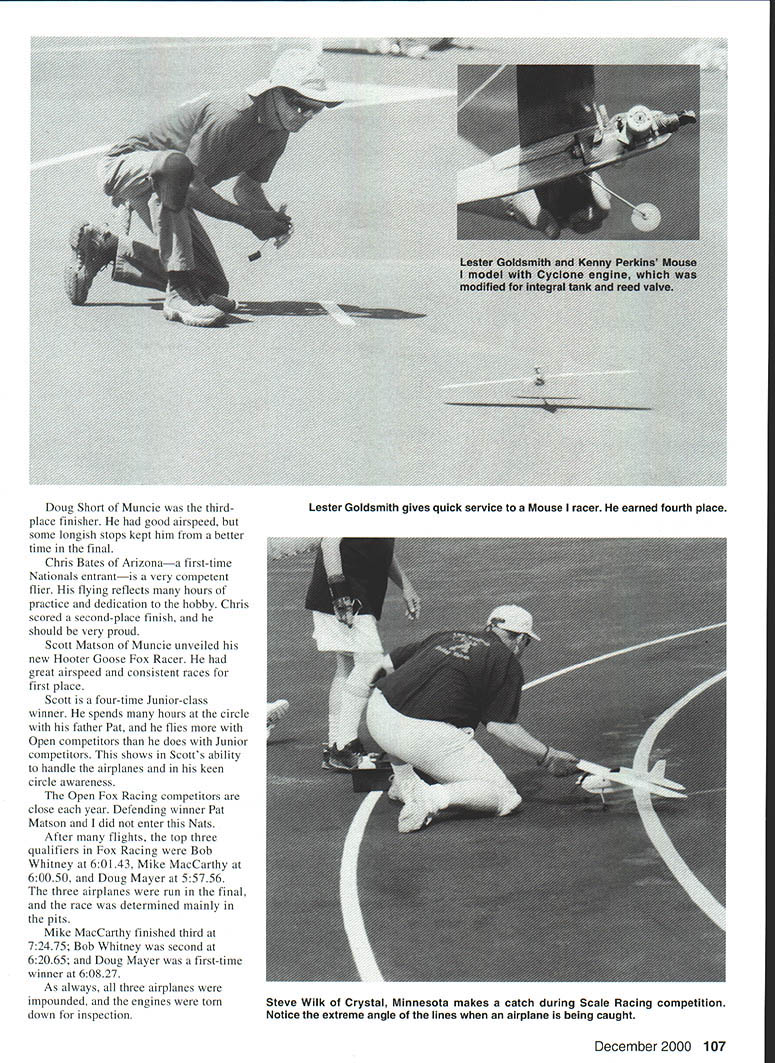
In Mouse I, Wayne Trivin had his homemade reed-valve engine, and he turned the quick time of the day with a 2:18.25. Bob Whitney, who was running the prototype engine from Wayne, was second-fastest at 2:28.23. Melvin Schuette earned third place in the event.
Lester Goldsmith and Kenny Perkins converted their Cyclone .049 to a reed valve with an integral tank, and they turned fourth- and fifth-place times at 2:32.48 and 2:35.42.
Mouse II is transitioning from a Cox reed-valve contest to a more-sophisticated event; whether or not that is good is being debated.
These competitors have produced works of art. The time, planning, and workmanship that goes into them is unbelievable.
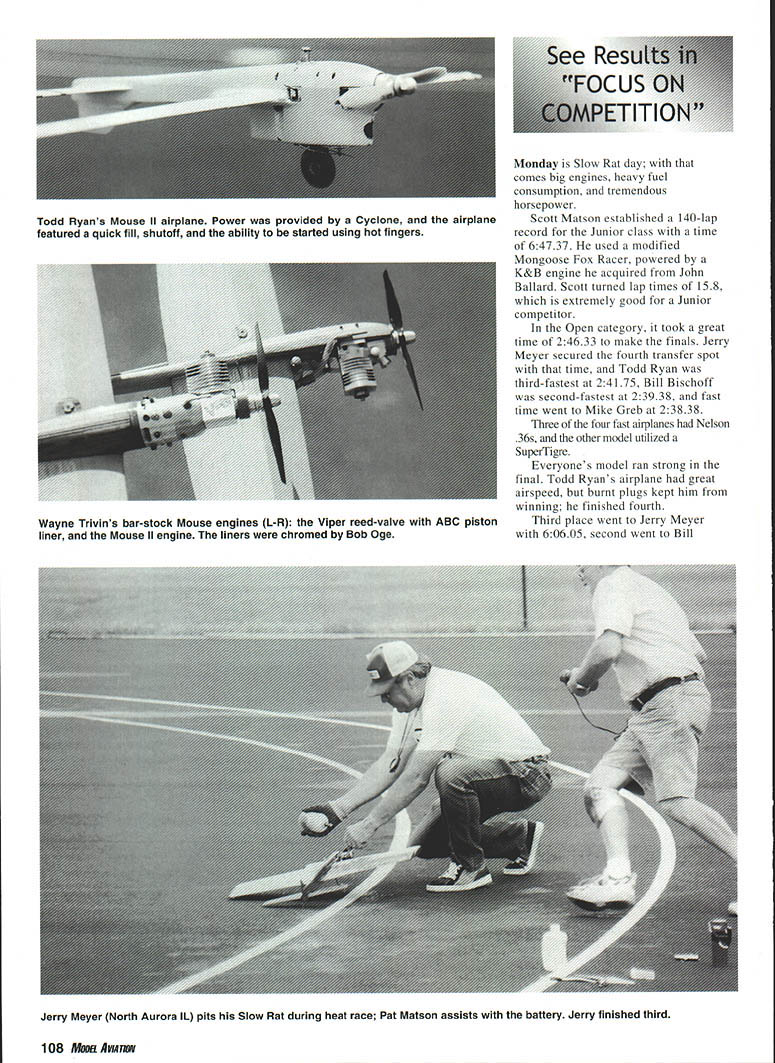
Mouse II has transitioned from Cox Tee Dee to Cyclone, VA, CS, and homebuilt engines. The Cyclone and Wayne Trivin's bar-stock engines were the class of the field.
With the increase in speed, Mouse II piloting—especially in the 200-lap final—was like watching an F2C final. There were no mishaps, but it was close several times.
Most airplanes featured quick fills, shutoffs, and could be started using hot fingers.
The rotational speed may be getting close to the breaking point; at the conclusion of the final, all the pilots had to sit down in the center and rest.
Discussion from those who flew in Mouse II centered on the need for longer runs.
Todd Ryan flew one of the most interesting airplanes—an inverted-type Rat design. It was extremely clean, but it suffered from heating problems. Todd chose a Cyclone for power, and proved to have extreme speed.
Most competitors stepped up their performances from 1999, and I expect an additional increase in 2001.
Quickie Rat (Friday, July 14)
Quickie Rat on Friday, July 14 was the concluding event of the 2000 CL Racing Nats, and it was an outstanding success.
Before the event, many claims of 15-second Quickie Rats floated around. However, they never materialized. Clocking various airplanes during races showed no one running faster than 16.69. The biggest percentage of airplanes were in the 17.0–17.5 range. As in most events, the guy who can race the airplane usually finishes well. Engine troubles surfaced for the first time in the event; Todd Ryan suffered engine failure during the final, because of a broken crank.
A rather slow 3:23 was good enough to make the final, and 3:04 was the fast time of the day. Taking six contestants to the final provided two good three-up races. The three-up racing format is the event's biggest draw.
Wayne Trivin walked away with the win. Scott Matson got his first taste as a pitman; he decided to start his entry and have me fly it. This combination gave him a second-place finish.
Bob Heywood finished third.
NCLRA Banquet and Officers
The annual NCLRA banquet was held during the Nationals. There was an election of officers, and I was re-elected as president. Jimmy Ricketts was chosen for vice president, and Dick Lambert was re-elected as secretary/treasurer.
Jerry Meyer presented the Larry Dziak Sportsmanship Award to Jimmy Ricketts.
If you would like to become an NCLRA member, send $10 U.S., $12 outside to Dick Lambert, 4651 Ridgewood Ave., Port Orange FL 32127.
Marcia Matson and Bob Abernathy were instrumental to the CL Racing Nationals. Without them, the running of times and pulling of lines would have taken longer. Each competitor should be thanked; a new system was instituted this year, whereby each contestant took time out to count laps and time races.
Sponsors and Thanks
Sponsors are a big part of Nats CL Racing's success.
- Sig Manufacturing provided fuel for the events.
- Fox Manufacturing sponsored NCLRA Fox Racing, provided fuel for the event, and donated three engines for the Junior-Senior Fox Racing category.
- Muncie Model and Hobby sponsored the Team Race.
- Dave Platt provided a $100 award to the B Team Race Best of Show winner for the best-looking model.
- Eliminator propellers sponsored Mouse II and Quickie Rat.
- Nelson Competition Engines supported the CL Racing events with the F2C Raffle.
We are eternally grateful for the support of these manufacturers.
I certainly hope to see everyone at the 2001 Nationals. MA
Transcribed from original scans by AI. Minor OCR errors may remain.

