
CONTROL LINE SCALE
Bill Boss 77-06 269th St., New Hyde Park NY 11040
Detailing Your Model
While reading an old copy of Probable Cause, the newsletter of the Rocky Mountain Aeromodellers, I found the following tip:
If you have a very good three-view of your scale subject and want an easy way to position the panel lines, rivet and screw patterns, access panel locations, and other details, you might do what Rocky Mountain club member Lynn Boss has done.
During the construction of a Corsair, Lynn had the set of three-views for his model blown up commercially to the full size of the model. This seemed to be a much simpler approach to getting full-size details for his model than using a camera to photograph the three-views for slides, or making opaque projector transparencies for blowing up the three-views.
It also seems that the one-step process of having a good three-view blown up commercially is much easier, and probably more accurate, than the multiple-step process.
I spoke with Lynn about where he had the blowups made, and the cost. The enlargements were made at a Kinko's® printing shop; the cost was approximately $1 per square foot of printed material.
The machine used for the printing is capable of making enlargements of 200 percent, it uses rolls of print material three feet wide, and it allows prints to be made several feet long.
The final cost would depend on the size of the original three-view and the size and number of enlargements required to obtain full-size details of the model.
Lynn noted that he spent roughly $50 for the Corsair enlargements, and he considered that a reasonable price to pay for getting the full-size details of his model.
Contest Activity
The Pacific Northwest Control Line (CL) clubs, the Eugene Pop Spinners and Umpqua Valley Modelers, will hold the 29th AAA Paul Ageret Northwest Control Line Regionals at the Roseburg Regional Airport and the Douglas County Fairgrounds in Roseburg, OR during Memorial Day weekend.
- The contest will offer 43 CL events, including Precision, Sport, and Profile Scale. There will also be Junior-only events.
- Awards of trophies and merchandise will be presented in all events, and will include three Grand Championship trophies.
- Camping, recreational vehicle space, restrooms, food concessions, and an on-site hobby shop will be available. Motels and restaurants are nearby.
Information and contest flyers are available from Craig Bartlett, 205 N.E. Cedar Ln., Corvallis OR 97330; Tel.: (541) 745-2025. Copies of the event rules are available from John Thompson, 2456 Quince St., Eugene OR 97404.
The Indy Sportliners club will hold the Al Pitts Memorial Contest for Scale and Stunt events on Sunday, June 4 at the AMA International Aeromodeling Center, Muncie, IN.
Scale events include Sport, Profile, and Fun. The Stunt events include four classes of Precision Aerobatic Model Pilots Association (PAMPA), Old Time, and Classic.
Contact Contest Director (CD) George F. Kite, 109 N. Denny St., Indianapolis IN 46201, for full contest details.
The Circlemasters of Wisconsin will hold the annual Stunt and Scale CL contest June 18. The contest will be held in the Germantown High School parking lot, where there is sufficient room for two flying circles on a blacktop surface. Sport and Profile Scale events will be offered.
For specific contest details, please contact Art Weber, 17560 Windemere, Brookfield WI 53045-2646.
If you're in the area of any of these contests, I'm sure they would like to have you as a contestant or even as a spectator to show your support of this great hobby of aeromodeling.
Rocky Mountain Aeromodelers Report
The Rocky Mountain Aeromodelers held the 17th Annual CL Championships September 4–5, 1999 in the parking lot of the Denver (CO) Coliseum.
Club Vice President Rusty Brown reported that Saturday was a cool, breezy day, and although Sunday was warmer and very calm, there was thermal activity and variable draft at the circles. I'm happy to report that there were no major mishaps.
Scale events flown at the contest were Precision, Sport, and Profile.
- The Precision event was won by Grant Hiestand (Glendale, CA), who flew a Spacewalker. Lynn Boss (Aurora, CO) placed second with his new P-47 (a photo of the P-47 is in the January 2000 column).
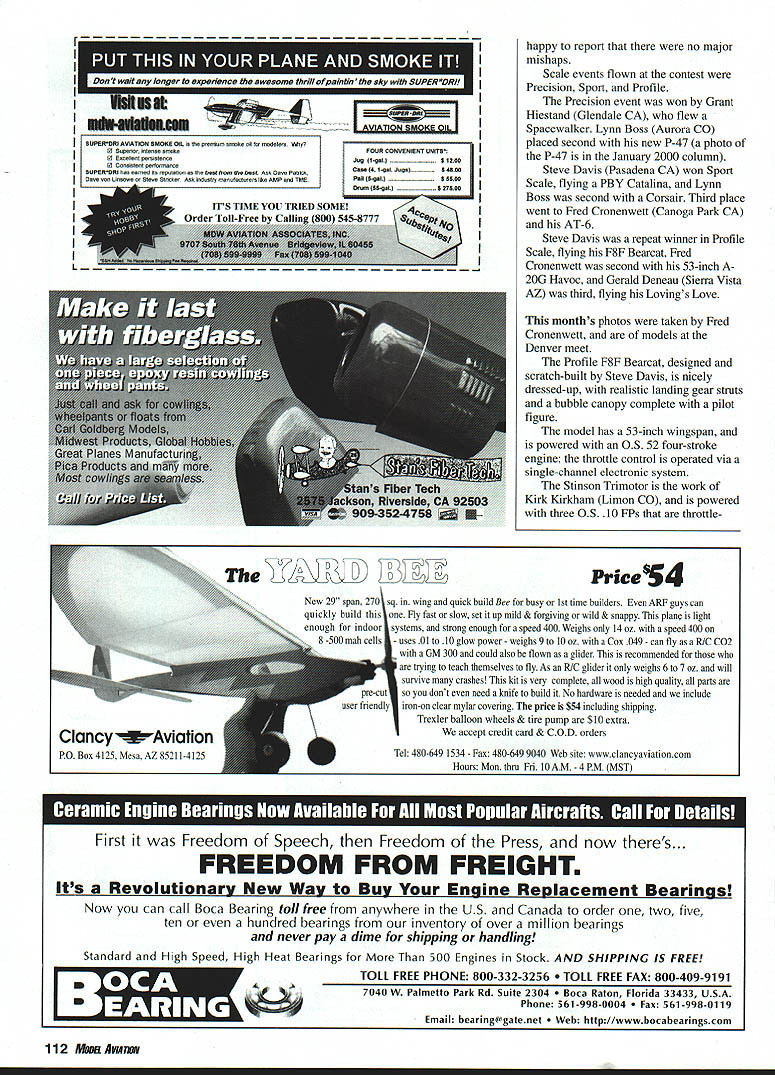
- Steve Davis (Pasadena, CA) won Sport Scale, flying a PBY Catalina, and Lynn Boss was second with a Corsair. Third place went to Fred Cronenwett (Canoga Park, CA) and his AT-6.
- Steve Davis was a repeat winner in Profile Scale, flying his F8F Bearcat. Fred Cronenwett was second with his 53-inch A-20 Havoc, and Gerald Deneau (Sierra Vista, AZ) was third, flying his Loving's Love.
This month's photos were taken by Fred Cronenwett, and are of models at the Denver meet.
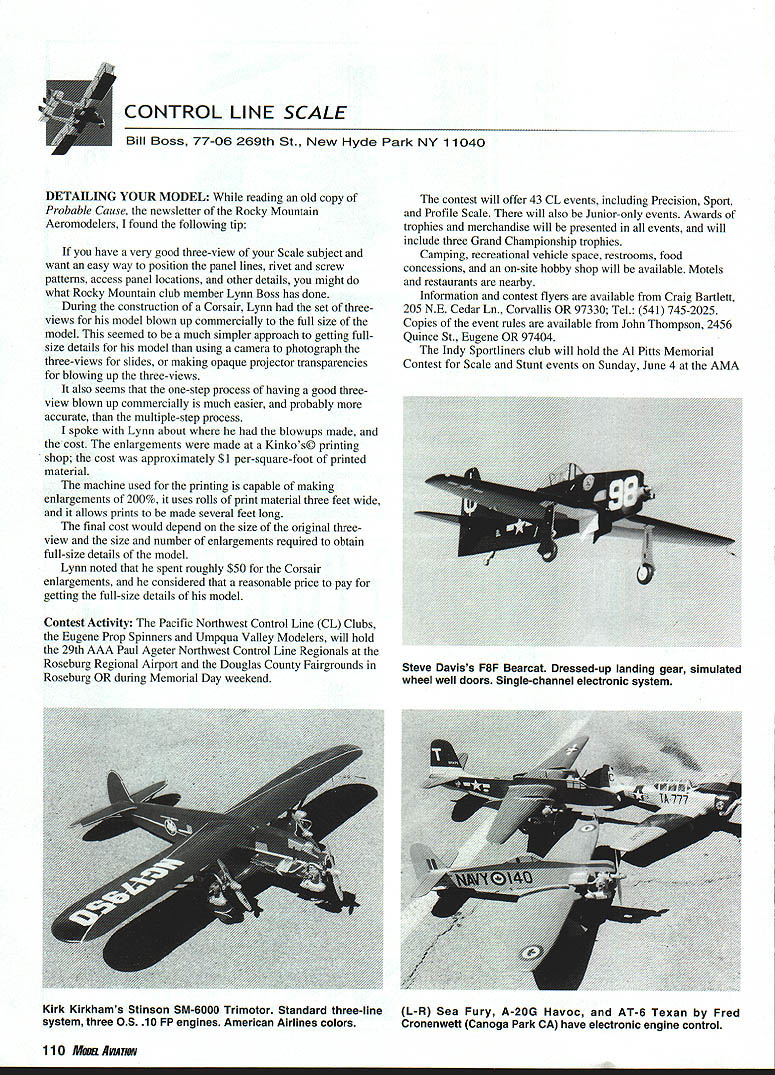
The Profile F8F Bearcat, designed and scratch-built by Steve Davis, is nicely dressed up, with realistic landing gear struts and a bubble canopy complete with a pilot figure. The model has a 53-inch wingspan, and is powered with an O.S. .52 four-stroke engine; the throttle control is operated via a single-channel electronic system.
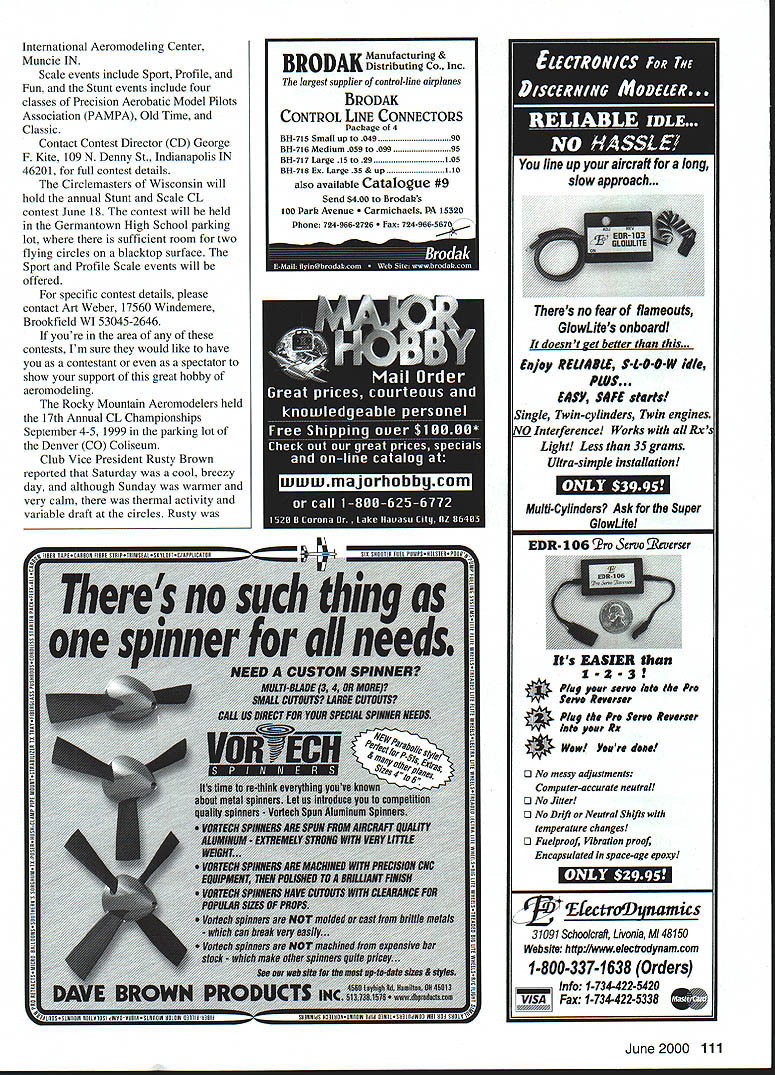
The Stinson Trimotor is the work of Kirk Kirkham (Limon, CO), and is powered with three O.S. .10 FPs that are throttle-controlled with a standard three-line bellcrank system. The model's color scheme is one used by American Airlines.
Stinson Trimotor — Brief History
The Stinson Aircraft Corporation introduced the Stinson Trimotor SM-6000 in July 1930. The airplane was powered with three 160-kilowatt (kW), 215-horsepower Lycoming R-680 engines, and was designed to carry a pilot and 10 passengers. One engine was mounted in the nose of the airplane; the other two were strut-mounted over the landing-gear assemblies.
The upgraded Model U was produced in 1932, and had a lower stub wing on which the lower engines, now increased to 240 horsepower, were mounted. Approximately 80 Model U airplanes were produced.
Another Viewpoint
In the February 2000 column, there was a workshop hint about engines and the idea that oil in model fuels carries away heat.
Ian McQueen of St. John, New Brunswick, Canada points out that while the oil carries engine heat away, other constituents in the exhaust gas are at the same temperature as the oil, and should be considered.
Water formed by combustion proportionally carries away much more heat than other constituents because of the higher heat capacity. The oil happens to be there because it is required in two-stroke engines as a lubricant.
Ian says to remember that there is no oil in the exhaust of even the highest-output Grand Prix, or other automotive racing engines, and they get by fine. The heat is carried out of automotive racing engines (as it is in model-airplane engines) each time the exhaust valve (port) opens and all of the hot gases rush out.
What oil in the fuel does (in addition to providing lubrication) is lower the combustion-chamber temperature of the air/fuel mixture, as any other inert material would. It does cause the engine to run at a lower temperature, but it also reduces the maximum power output that the engine could develop if the engine was otherwise adequately and properly cooled and lubricated.
Workshop Hint
Bob Furr, a member of the Orbiting Eagles of Omaha, has a suggestion for your workshop:
"Have you ever tried to use C-clamps on balsa, or even Lite Ply, and found they crushed the wood?" Bob asks. "I have used scraps of wood under the clamps, but they almost always slip. Try using those plastic caps from milk jugs. They don't slip away and seem to spread out the clamping force enough to minimize problems with crushing."
Please send ideas, notice of upcoming CL Scale events, contest reports, and photos of CL Scale activity to me at the address at the top of this column. MA
Transcribed from original scans by AI. Minor OCR errors may remain.

