
CL Scale
Bill Boss, 77-06 269th St., New Hyde Park NY 11040
Electronics and questions about their place and use in Control Line (CL) Scale keep popping up.
Dennis Slater, Chicago IL, wonders why I don't publish "Do-It-Yourself" information about the use of an encoder and decoder for controlling the various operational features of CL Scale aircraft. Dennis suggested obtaining parts from a local electronics store such as Radio Shack®, to give the "Do-It-Yourselfers" a shot at making their own multichannel systems for a fraction of the cost of commercially available units.
Although I would be more than happy to present do-it-yourself projects (especially projects started from scratch) relating to the use of electronics for Scale model control, there is a major problem. You have to have someone who is well-versed in electronics and able to design a system that would be fairly easy to build, would work well, and would be reasonable in cost. It's quite a tall order.
It would be a great mistake to publish something only to learn that it doesn't work well and money has been wasted. Even if you could make the encoder and decoder, you still have the cost of the miscellaneous materials, such as switches or other controls, something to mount all the parts in, a charging unit, and batteries for operating the encoder, decoder, and servos. These parts can be costly.
A visit to my local Radio Shack® store and talks with the sales people indicated that most Radio Shack® stores do not carry many of the electronic kits or individual parts specific to building an encoder/decoder system. Although local stores may not carry kits and program chips, there are many listed in Radio Shack®'s commercial catalog and on its Web site at www.radioshack.com.
The trick is to be knowledgeable enough in electronics to know what program chip can be used, and to select the other components (resistors and capacitors) required to build a good, reliable system.
When it was in business and a provider of parts, Ace R/C sold separately the encoder and decoder assemblies that were used in the Commander Series of radios. Unfortunately, those encoder/decoder boards that allowed you to construct systems with up to five channels are no longer available. A system using Ace R/C parts was presented in a three-part series in the January 1991, February 1991, and March 1991 issues of Model Aviation.
Tom Runge (formerly of Ace R/C) tells me that those parts are no longer manufactured, and that the newer Radio Control (RC) units are more complex in their makeup, and that more functions are grouped together in common board arrangements, making the separation of the encoder and decoder sections for CL use more difficult.
Alternatives
However, there are alternatives:
- Many old frequency modulation (FM) and amplitude modulation (AM) RC systems can be modified to provide you with multichannel systems. You might be able to pick up older radios at swap shops associated with model expos, such as the Toledo or WRAM shows. You might even know a fellow modeler who flies RC and has upgraded his or her equipment and would be willing to part with the old system for a few dollars.
- Older radio systems can be sent to Calvin Wollitz, 8896 Barco Ln., Jacksonville FL 32222; Tel.: (904) 771-4284, and he will modify the transmitter and receiver so that signals can be sent through insulated flying lines. The cost of this modification is approximately $60. If you want to engage Calvin's services, it might be wise to call and find out about shipping the system.
- Another alternative, although it might seem expensive, is to buy a new RC system that has the built-in DSC (Direct Servo Connection) feature, such as JR's XF421EX RC System. The unit consists of a five-channel transmitter, a six-channel receiver, four servos, a flight battery pack, and a dual charger—for less than $200. The DSC feature allows the user to make a connection between the transmitter and the airplane to facilitate testing the servos and operating features of the model without transmitting a radio signal. The DSC feature allows you to operate the model's servos with a pair of insulated lines. I know of several CL Scale modelers who are using this system, and they are well satisfied with its operation and reliability.
- Another option that I explored in the March 2000 column was the four-channel electronic control handle developed by Bill Young, Flagstaff AZ. The advantage of this handle is that the electronics and its controls are in front of you as you're flying your model. Unless you're a dyed-in-the-wool experimenter with electronics, the purchase of a new system with a DSC feature, or the electronic handle by Bill Young would be a wiser way to get into electronic control.
Fred Cronenwett has assembled and provided me with considerable information on the use of electronics in CL models. Anyone wanting copies of this material can obtain it by writing to Fred at 21320 Parthenia St. #101, Canoga Park CA 91304, or to me at the address at the top of this column. Include $2 to cover the cost of copying and postage.
This Month's Photos
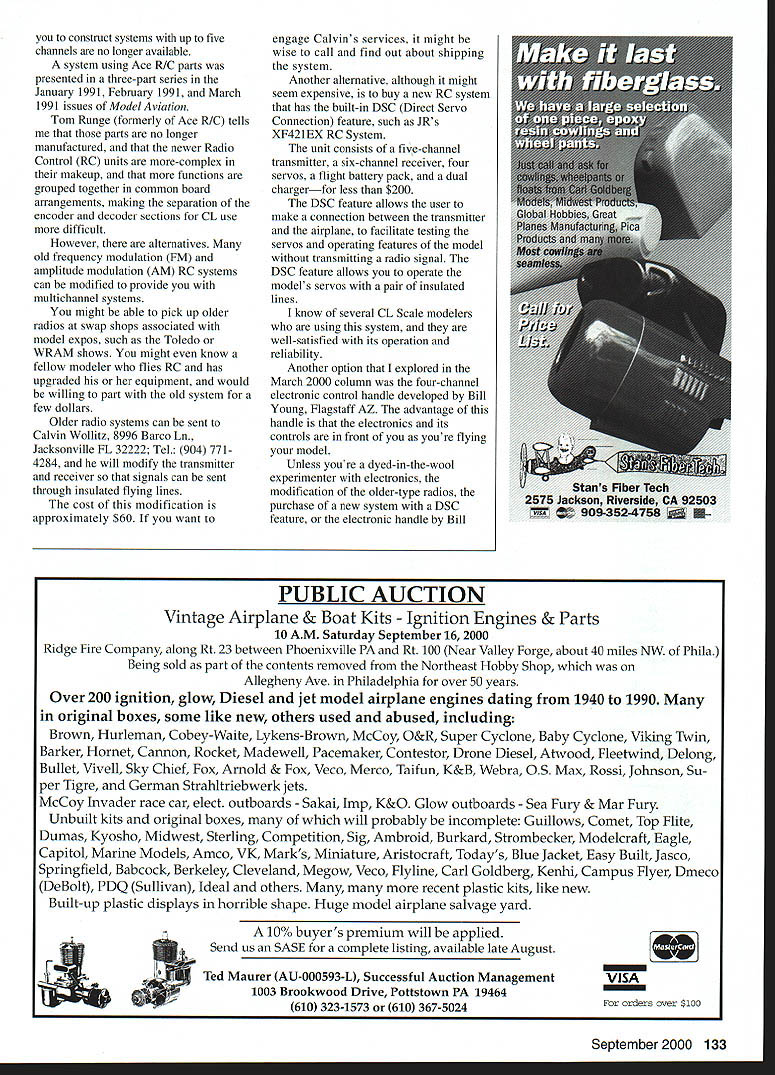
The fine-looking Consolidated B-24D Liberator is the work of Bob Mangan, Willowick OH. The model was built from a Jack Stafford kit. Bob noted that although construction was straightforward, it is a project for a beginner.
The model has a span of 90 inches and is powered with four O.S. Max .25s, with the throttle controlled via a standard three-line bellcrank system. A separate two-line bellcrank system is used for controlling a Robart pneumatic landing-gear retract system.
The model's finish consists of covering with GM-grade (mediumweight) Silksapan, three coats of Coverite/21st Century military-colored spray paint, and three coats of clear AeroGloss.
While reading about the Consolidated B-24 Liberator in Rand McNally's Encyclopedia of Military Aircraft, I found the following:
- The B-24 was produced in the greatest quantity of any bomber aircraft by the United States. More than 18,000 came off the production lines of Consolidated, Douglas, Ford, and North American.
- The B-24 had many model designations, starting with the initial B-24 and followed by the C, D, E, G, H, J, L, and M models. The Liberator was used in almost all theaters of operation of World War II, not only in its primary role as a United States Air Force bomber, but for naval reconnaissance, antisubmarine warfare, and general transport duty.
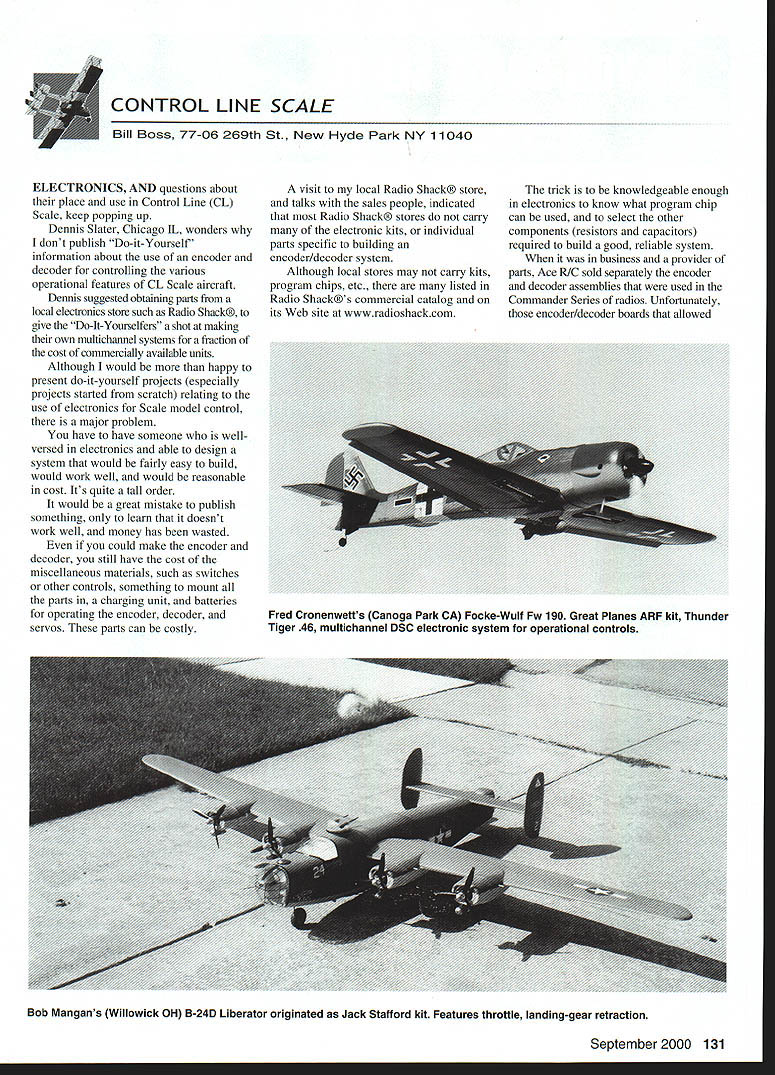
The Focke-Wulf Fw 190 by Fred Cronenwett was constructed from a Great Planes® Almost Ready to Fly (ARF) kit and is powered with a Thunder Tiger .46 engine. The airplane is controlled with a multichannel DSC electronic system for throttle, retractable landing gear, bomb drop, and flaps. Fred noted that the airplane was built very quickly and is great for practicing his flying skills and using the various operating features for when he flies his better Scale models.
Contest Activity
- The Rocky Mountain Control Line Championships will be held during the Labor Day weekend, September 2–3, at the Denver (CO) Coliseum. The contest will feature Profile, Sport, and Precision Scale events, as well as Carrier, Speed, Racing, and Stunt. Scale models will be static-judged Saturday, and flight will be judged Sunday. Leroy Fuehrer will be the Scale Event Director, and Dave Rolley will be the Contest Director (CD). For full details about this competition, contact Court Hughes, club newsletter editor, at 4672 S. Kittredge Way, Aurora CO 80015; E-mail: [email protected].
- The Indy Sportliners will be holding its Octoberfest contest at the AMA International Aeromodeling Center, Muncie IN, Sunday, October 8. This Stunt/Scale contest will include Sport, Profile, and Fun Scale events. For full contest details, contact CD George Kite, 109 N. Denny St., Indianapolis IN 46201; Tel.: (317) 356-4777.
I urge all Scale buffs in the surrounding areas of these contests to support the great efforts.
Please send ideas, notice of upcoming CL Scale events, contest reports, and photos of CL Scale activities to me at the address at the top of this column.
Transcribed from original scans by AI. Minor OCR errors may remain.

