
CL Scale
Bill Boss, <REDACTED>
Past and Present
Reuben MacBride (Clifton, NJ), a 37-year member of the Garden State Circle Burners (GSCB) Control Line (CL) club, is still going strong. This month's column features two of his models—one from the past, and one currently being flown.
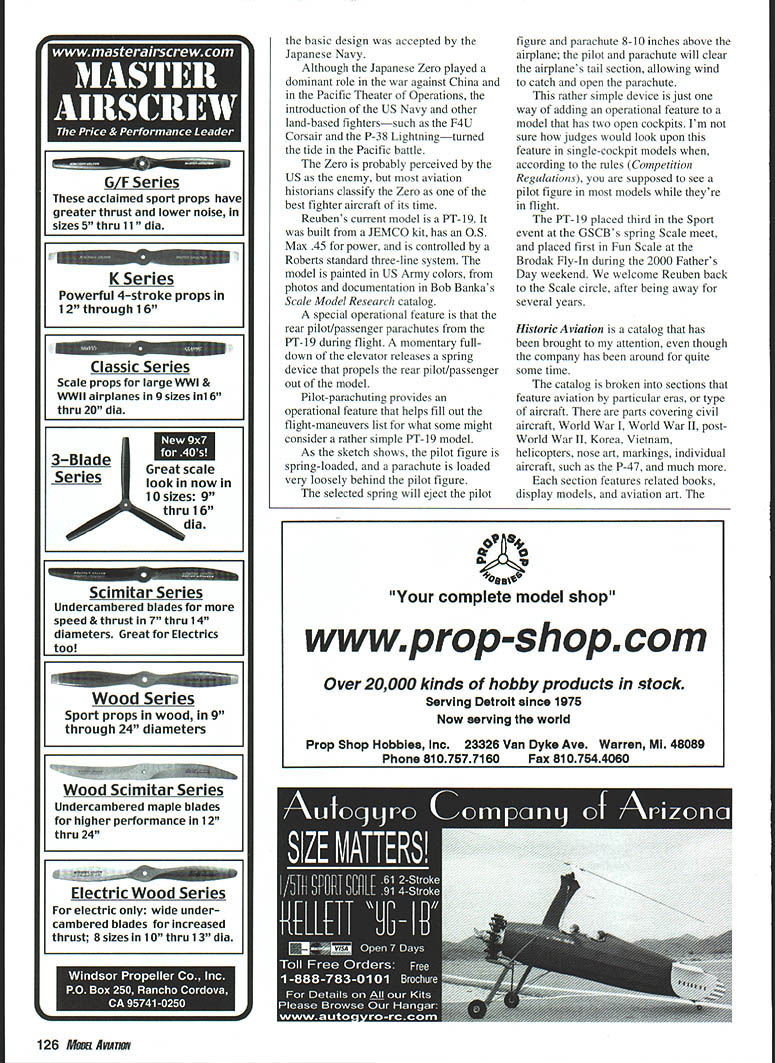
The first model is the Japanese Zero 32 A6M3 that Reuben flew in the 1983 and 1985 National Championships at Chicopee, Massachusetts. The 60-inch-wingspan model was made from a Royal kit and is powered with a SuperTigre .60. Throttle is controlled via a standard Roberts three-line bellcrank system. The color scheme is of a carrier-based Zero, painted with Sig paints and given a coat of Sig Flat-Coat to subdue the gloss of the regular paint.
The years (15 since it was last flown) have taken their toll on the model's finish; it now has the weathered and aged appearance that all of us would like to have when our models are first finished.
The Japanese Zero was one of the most significant fighter aircraft of World War II. Manufactured by Mitsubishi, the aircraft started as the 12-Shi A6M1 in 1939, went through many modifications and upgrades, and became the Zero Type 63 A6M7 in late 1944 or early 1945.
The Zero was powered with a Nakajima Sakae engine that ranged in horsepower from 940 to 1,130. It had a span of 36 feet, a length of approximately 30 feet, and a maximum speed of 300 mph. Firepower included two Type 99 Model 2 Mk4 20mm cannons.
Have you ever wondered what the Zero aircraft name, letter, and number designations stood for? According to Robert C. Mikesh's book Zero/Combat & Development History of Japan's Legendary Mitsubishi A6M Zero Fighter (Motorbooks International Warbird History), two systems of identification were used: the "Name" designation and the "Letter" system.
Reuben's Zero model is known as the A6M3 in the Letter system. The letter "A" designates the aircraft for a naval mission; the "6" tells us that it was the sixth basic design in the carrier fighter series; the "M" stands for Mitsubishi (the company that designed the aircraft); and the "3" represents the modification number of the aircraft after it was accepted by the Japanese Navy.
In the Name designation, Reuben's model is called the Zero 32—expressed not as a two-digit number, but as "Zero Three-Two." The first number (three) relates to the basic airframe and subsequent changes that are numbered consecutively. The second number (two) identifies the engine-type changes that took place after the basic design was accepted by the Japanese Navy.
Although the Japanese Zero played a dominant role in the war against China and in the Pacific Theater of Operations, the introduction of US Navy and other land-based fighters—such as the F4U Corsair and the P-38 Lightning—turned the tide in the Pacific battle. The Zero is probably perceived by the US as the enemy, but most aviation historians classify the Zero as one of the best fighter aircraft of its time.
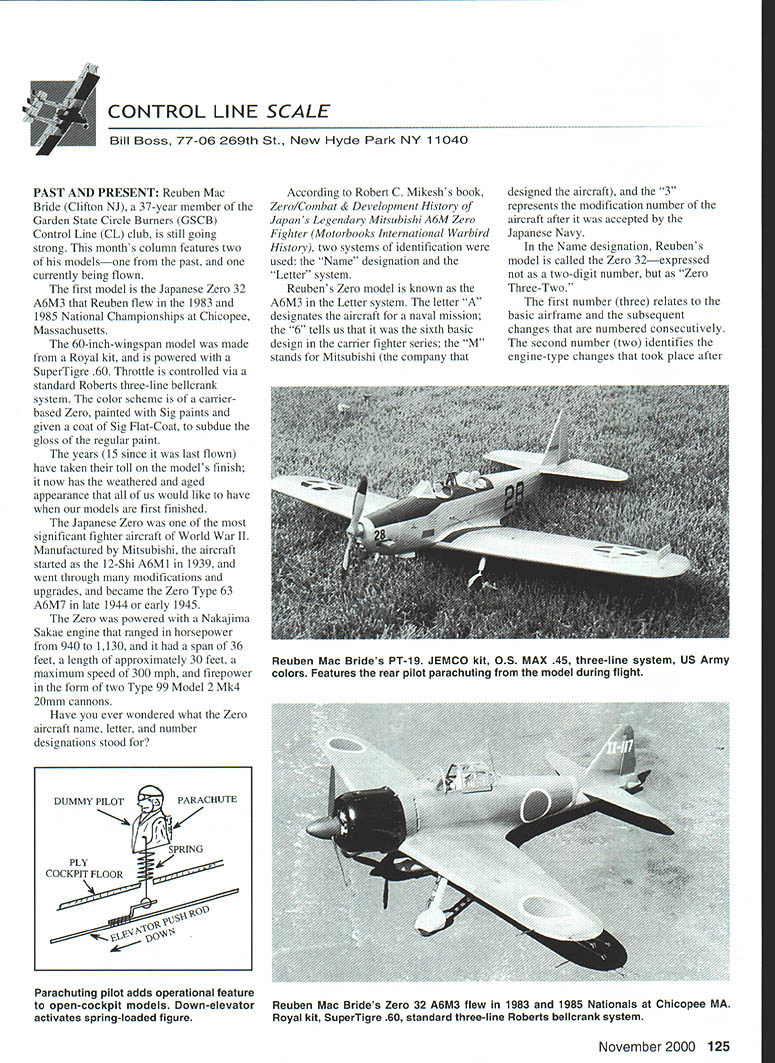
Reuben's current model is a PT-19. It was built from a JEMCO kit, has an O.S. Max .45 for power, and is controlled by the Roberts standard three-line system. The model is painted in US Army colors, based on photos and documentation in Bob Banka's Scale Model Research catalog.
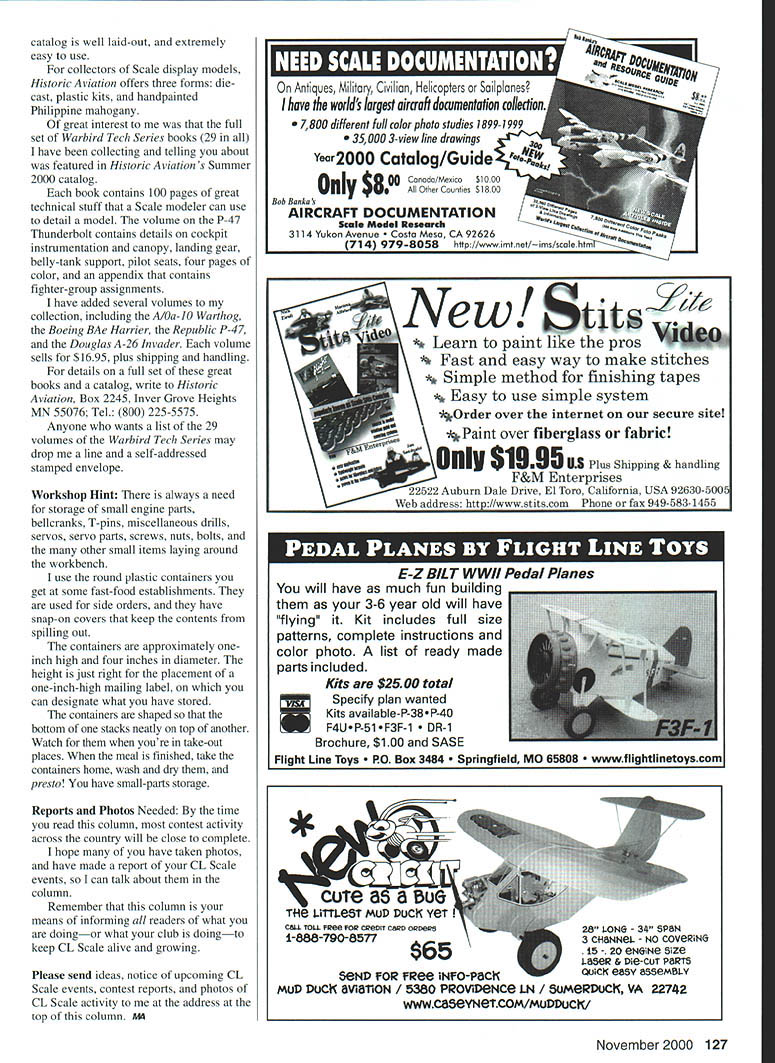
A special operational feature is that the rear pilot/passenger parachutes from the PT-19 during flight. A momentary full-down of the elevator releases a spring device that propels the rear pilot/passenger out of the model. Pilot-parachuting provides an operational feature that helps fill out the flight-maneuvers list for what some might consider a rather simple PT-19 model.
As the sketch shows, the pilot figure is spring-loaded, and a parachute is loaded very loosely behind the pilot figure. The selected spring will eject the pilot figure and parachute 8–10 inches above the airplane; the pilot and parachute will clear the airplane's tail section, allowing wind to catch and open the parachute.
This rather simple device is just one way of adding an operational feature to a scaled model that has two cockpits. I'm not sure how judges would look upon this feature in single-cockpit models when, according to the rules (Competition Regulations), you are supposed to see a pilot figure in most models while they're in flight.
The PT-19 placed third in the Sport event at the GSBC's spring Scale meet, and placed first in Fun Scale at the Brodak Fly-In during the 2000 Father's Day weekend. We welcome Reuben back to the Scale circle after being away for several years.
Historic Aviation Catalog
Historic Aviation is a catalog that has been brought to my attention, even though the company has been around for quite some time. The catalog is broken into sections that feature aviation by particular eras or type of aircraft. There are parts covering:
- Civil aircraft
- World War I
- World War II
- Post-World War II
- Korea
- Vietnam
- Helicopters
- Nose art and markings
- Individual aircraft, such as the P-47
- And much more
Each section features related books, display models, and aviation art. The catalog is well laid-out and extremely easy to use.
For collectors of scale display models, Historic Aviation offers three forms:
- Die-cast
- Plastic kits
- Handpainted Philippine mahogany
Of great interest to me was that the full set of Warbird Tech Series books (29 in all) I have been collecting and telling you about was featured in Historic Aviation's Summer 2000 catalog. Each book contains 100 pages of technical material useful for detailing a model. For example, the volume on the P-47 Thunderbolt contains details on cockpit instrumentation and canopy, landing gear, belly-tank support, pilot seats, four pages of color, and an appendix that contains fighter-group assignments.
I have added several volumes to my collection, including the A/0a-10 Warthog, the Boeing BAE Harrier, the Republic P-47, and the Douglas A-26 Invader. Each volume sells for $16.95, plus shipping and handling. For details on a full set of these books and a catalog, write to Historic Aviation, Box 2245, Inver Grove Heights, MN 55076; Tel: (800) 225-5575.
Anyone who wants a list of the 29 volumes of the Warbird Tech Series may drop me a line with a self-addressed stamped envelope.
Workshop Hint
There is always a need for storage of small engine parts, bellcranks, T-pins, miscellaneous drills, servos, servo parts, screws, nuts, bolts, and the many other small items laying around the workbench.
I use the round plastic containers you get at fast-food establishments. They are used for side orders and have snap-on covers that keep the contents from spilling out. The containers are approximately one inch high and four inches in diameter. The height is just right for the placement of a one-inch-high mailing label on which you can designate what you have stored. The containers are shaped so that the bottom of one stacks neatly on top of the next. Watch for them when you're in take-out places. When the meal is finished, take the containers home, wash and dry them, and presto—you have small-parts storage.
Reports and Photos Needed
By the time you read this column, most contest activity across the country will be close to complete. I hope many of you have taken photographs and have made a report of your CL Scale events so I can talk about them in the column.
Remember that this column is your means of informing all readers of what you are doing—or what your club is doing—to keep CL Scale alive and growing.
Please send ideas, notice of upcoming CL Scale events, contest reports, and photos of CL Scale activity to me at the address at the top of this column. MA
Transcribed from original scans by AI. Minor OCR errors may remain.

