
CONTROL LINE SCALE
Bill Boss 77-06 269th St., New Hyde Park NY 11040
In the February 2001 column, I wrote about the need for better presentation documentation that you provide for static judging of Scale models. I mentioned that the "4.6 Declaration" of parts not made by the contestant was eliminated from the Sport Scale rules.
Keith Trostle (Fountain Valley CA) sent me a note indicating that my wording might be taken to mean that the need for a declaration of parts not made by the contestant was eliminated from all Control Line (CL) Scale events.
There is still the need for such a declaration for the CL Precision Scale event, as noted in paragraph 4.4 of the Unified Scale Judging Regulations for CL Precision Scale and FF (Free Flight) Outdoor Gas Scale, on page 130 of the 1999–2001 Competition Regulations.
Paragraph 4.4 states, "The contestant will provide a signed declaration for the judges, listing the major components of the model he did not make himself."
The paragraph also lists examples, such as molded canopies, cowlings, wheel pants, fuselages, wheels, cockpit instrumentation, etc., and states, "Only that part of the workmanship actually done by the contestant in completing or finishing the parts he did not make will be considered for workmanship points."
Although the declaration was eliminated for Sport Scale and the Profile Scale event that uses the Sport Scale rules, there is still a need for the Precision Scale modeler to provide a declaration of parts not made by him or her.
Book Review: Warbird Legends
Are you looking for a great addition to your aviation library? Consider a book by John M. Dibbs, titled Warbird Legends.
The book contains 180 color pictures and more than 80 black-and-white photos covering 20 of the greatest fighters and bombers of World War II, as well as commentary by persons who were engaged in flying or maintenance of the airplanes featured.
These spectacular photos are mostly of the airplanes in the air, and have been taken so that they show structural detail and the color-and-markings employed during the war years.
Airplanes featured in the book include:
- Hawker Hurricane
- Spitfire
- Bristol Blenheim
- P-40
- F4F Wildcat
- Westland Lysander
- B-25
- P-51
- Mosquito
- B-17
- A6M Zero
- SBD Dauntless
- P-47
- Messerschmitt Bf 109G
- F6F Hellcat
- F4U Corsair
- P-38
- TBM Avenger
- Avro Lancaster
- P-63 Kingcobra
This book might also be useful to the Scale modeler as a beginning point for the color scheme of a future project.
The 2000 edition of Warbird Legends (ISBN 0-7603-0967-1) is published by MBI Publishing Company (Zenith Books), Box 1, Osceola WI 54020-0001; the price is $24.95.
Letters and Requests
I recently received a couple of letters; one asked for help with making operational controls without the use of servos and the other wanted to locate a kit for a C-130.
Randall Schwartz (Cornell IL) is a CL Scale newcomer who has embarked on building his first Scale model.
"I am using just the standard three-line system for my first attempt. I do, however, plan on stretching my wings, so to say, for future models. I have been doing research in advance and have read information on various electronic systems.
"However nice these systems look, I would like to stay with multiple line systems. This is primarily due to cost."
Randall has not seen much detailed information on multiline systems or how to make some of a model's operational features work without the use of servos. He asked if there were any sources he could draw detail from, such as Web sites, books, or fellow modelers.
I am not aware of a specific source, other than what might have appeared in R/C, CL or other modeling magazines; most Scale modelers engineer an airplane's operational features to suit that particular model's structure.
I also thought this might be an opportunity to ask readers for input not only to help Randall, but for the benefit of other CL Scale newcomers who could use information on dropping bombs, fuel tanks, throttle control, independent operation of flaps, gear retraction, pilot parachutes, bomb bay doors, etc.—all without servos.
Although this approach to operational features on a Scale model may seem a step backward after the promotion of electronic systems and servo operation, the Scale newcomer might want to take one step at a time before getting into—and spending the money on—more sophisticated electronics.
The challenge is there; there must be some of you who can dig into the archives and come up with some information to pass on. I'll be glad to hear from you.
Contact Randall at:
- 2797 N. 1000 East Rd., Cornell IL 61519
- E-mail: [email protected]
Harry Watson (651 La Grivota, Pismo Beach CA 93449) is requesting information about where he might obtain an ARF (Almost Ready to Fly) or ARC (Almost Ready to Cover) model of a C-130 Hercules—either glow engine or electric-powered.
I didn't find one for such a kit, but maybe someone out there can help Harry. He can be reached at the address above or by telephone on evenings or weekends at (805) 773-8844.
This Month's Photos
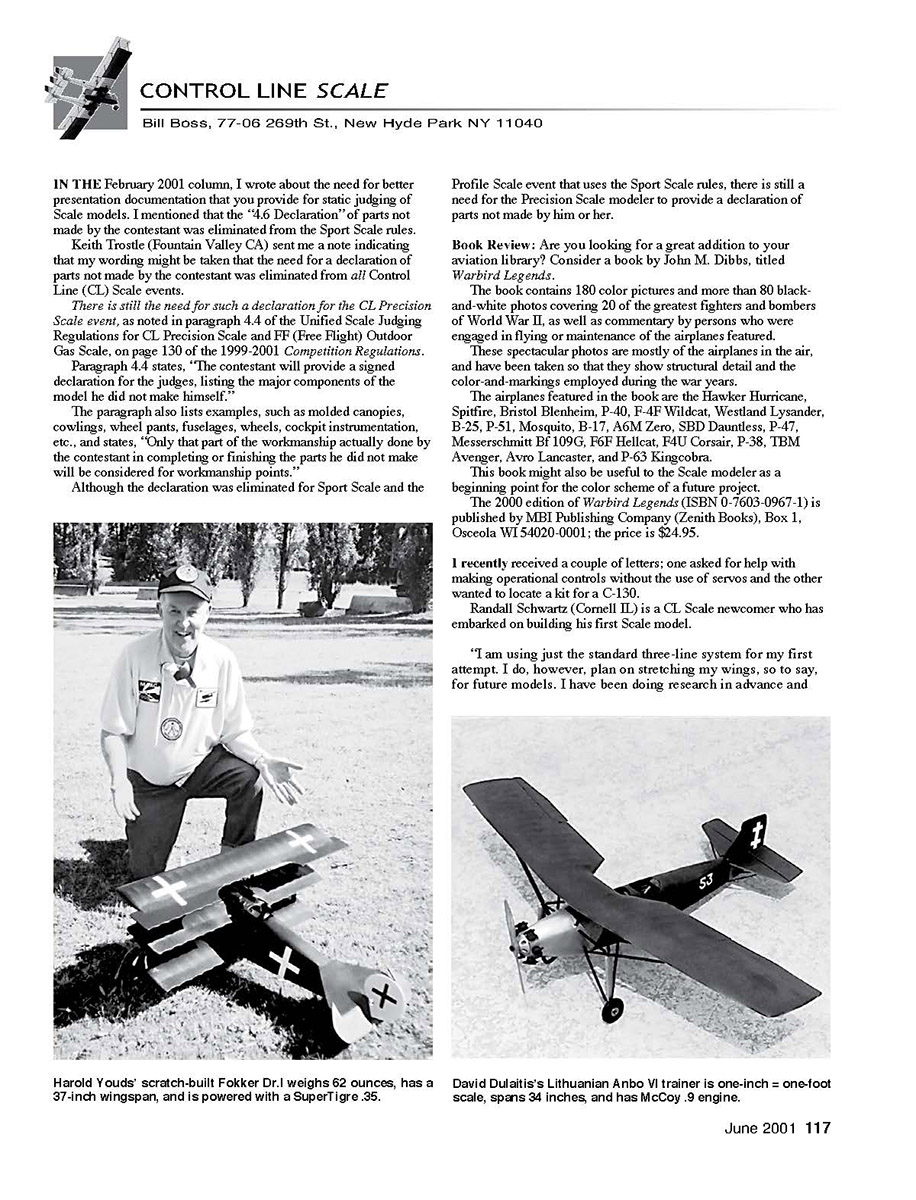
Harold Woods (Vancouver, British Columbia, Canada) built his Fokker Dr.I triplane with pick-up and scale trim on a 1952 Jr. kit; a 3/4-size -5/8 scale-controlled engine provides the power for this model. The color scheme of flat black and white was found in the book Fokker Dr.I by William Green and Gordon Swanborough, and was used by Lieutenant Josef Kuhnlein of Jasta 76, who was said to be the ninth-ranked German ace of World War I.
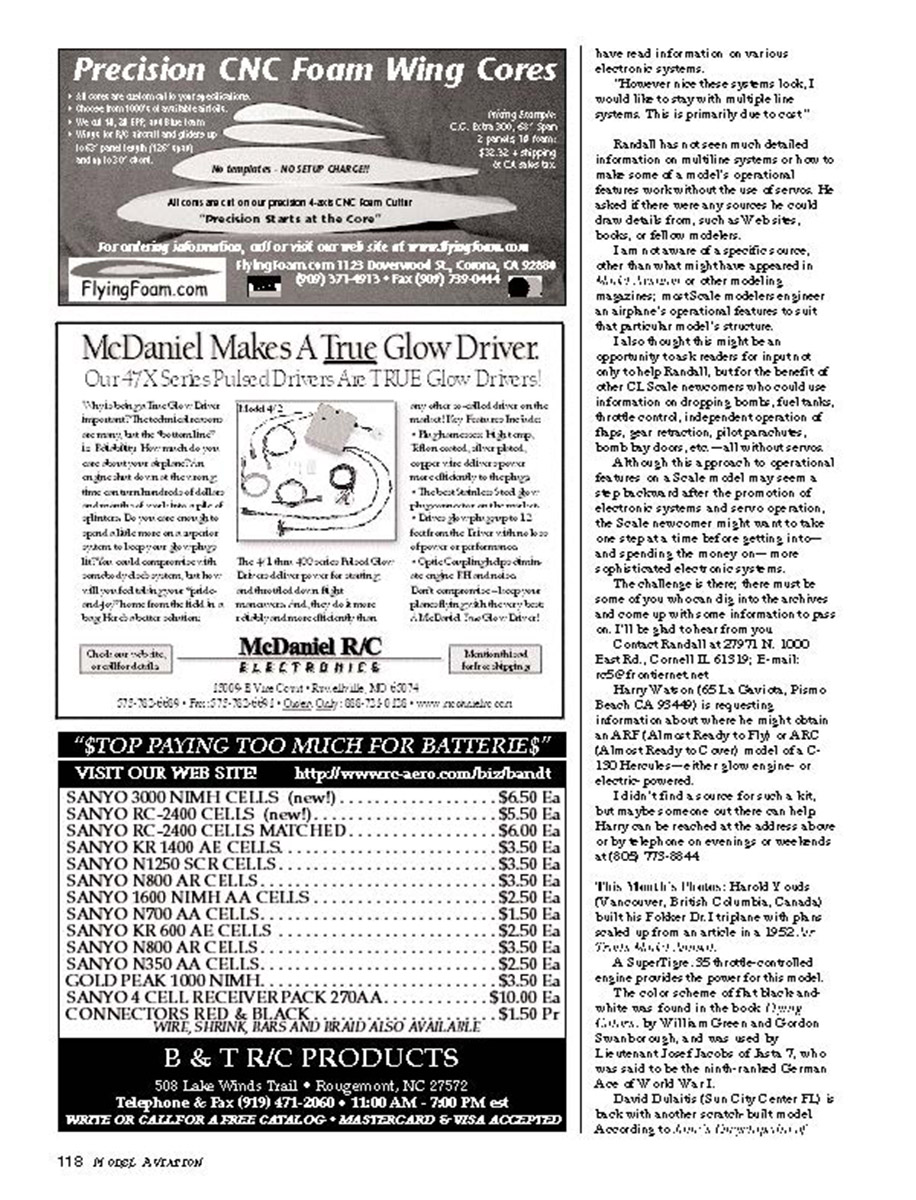
David Dunlop (Sun City Center FL) is back with another scratch-built model. According to Dave, "a reproduction of
[Text incomplete in the provided scan; remaining content not available.]
Transcribed from original scans by AI. Minor OCR errors may remain.

