

CL Scale
THE BOEING B-17 Flying Fortress had a construction span of approximately 10 years: 1935 to the end of World War II. The bomber went through several models, ending with the most-used, heavily armed B-17G, of which more than 8,600 were produced.
The B-17G was powered with four nine-cylinder radial air-cooled engines that developed 1,200 horsepower each. The airplane had a wingspan of 103 feet, nine inches; a length of 74 feet, nine inches; a speed of 287 mph at 25,000 feet; an ultimate ceiling of 35,600 feet; and a range of 3,400 miles.
Armament was 13 machine guns and it could carry 17,600 pounds of bombs, requiring a crew of 10 for all operations. Even after WWII, the B-17 was used by the military for general officer transport and as drones. As late as the 1980s, the B-17 was used to deliver thousands of gallons of fire retardant for forest fires.
The B-17G model featured in this month's column is the work of Dennis Slater (Chicago IL). The model is scratch-built from a half-size reduction of a set of Giant Scale RC (Radio Control) plans by Don Smith. Even at half size, the model has a wingspan of 71 inches and a length of 50 inches, producing a model approximately 1/17 the size of the real thing.
The color scheme and markings are fashioned after an airplane known as "Man O War II" of the 322nd Bomb Squadron, 91st Bomb Group in England in 1944.
The model engines are throttle controlled via the standard three-line bellcrank system while all other operational functions are controlled via an Airtronics six-channel radio system converted by Calvin Wollitz (FL) to an electronic encoder/decoder system.
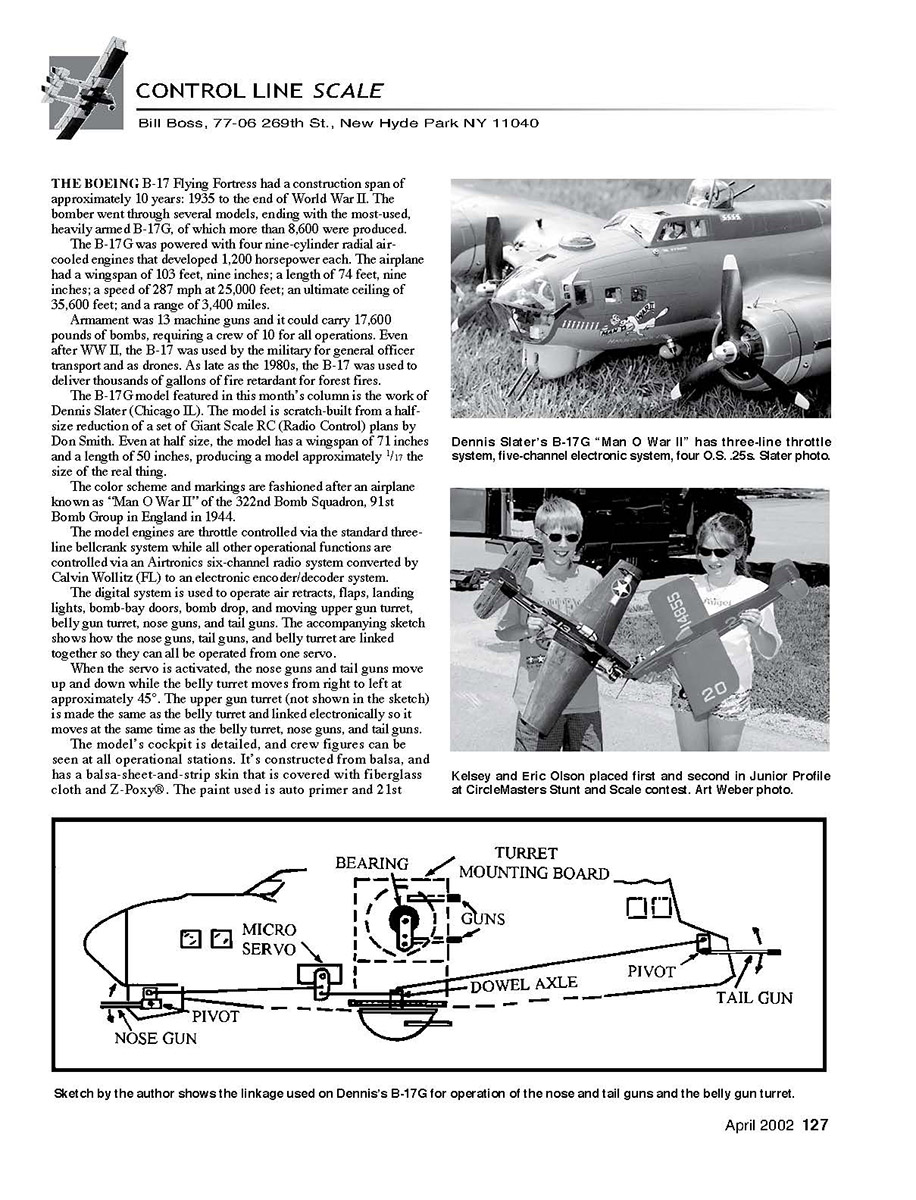
The digital system is used to operate air retracts, flaps, landing lights, bomb-bay doors, bomb drop, and moving upper gun turret, belly gun turret, nose guns, and tail guns. The accompanying sketch shows how the nose guns, tail guns, and belly turret are linked together so they can all be operated from one servo.
When the servo is activated, the nose guns and tail guns move up and down while the belly turret moves from right to left at approximately 45°. The upper gun turret (not shown in the sketch) is made the same as the belly turret and linked electronically so it moves at the same time as the belly turret, nose guns, and tail guns.
The model's cockpit is detailed, and crew figures can be seen at all operational stations. It's constructed from balsa, and has a balsa-sheet-and-strip skin that is covered with fiberglass cloth and Z-Poxy®. The paint used is auto primer and 21st Century®, top‑coated with LustreKote™ flat clear.
The surface is fully panel‑lined, and the nose art is hand painted. Power is provided by four O.S. .25s, making this 13½‑pound model a fine flying machine.
General information about the Boeing B‑17 Flying Fortress was taken from Volume Seven of the Warbird Profiles series by Frederick E. Johnson. This book covers the history of the Flying Fortress and has many sketches and photos showing major construction and cockpit details.
It can be obtained from Zenith Books (Classic Motorbooks LLC), 729 Prospect Ave., Osceola WI 54020.
Contest Activity: Art Weber of the CircleMasters Flying Club of Wisconsin reported that the club had good weather, no wind to speak of, and a fine day of flying at its June 17, 2001 Stunt and Scale contest.
The contest was held at Germantown High School, where pilots fly on two blacktop circles. Good weather and a fine flying site made for a great day of model flying. Scale events included Stand‑Off, Open Profile, and Junior Profile.
John Klima and Don Adriano judged Scale static while Dan Teft and Scott Jones were flight judges. They all have to be complimented on doing a fine job on and off the circles.
Charlie Bauer was present with two of his latest and extraordinary Profile creations. One of the models was a 72‑inch Lockheed Super Constellation, powered with four .25 engines, done in the color scheme of Trans‑World Airlines. The other model was a 60‑inch version of Burt Rutan’s Boomerang. It was powered with two .40 Wankel engines.
Another of the large Profile models was Art Weber’s B‑24 Liberator, which had a wingspan of 81 inches.
In Junior Profile, Brice and Kelsey Olsen (sister and brother) flew Profiles of the Hellcat and Goodyear Racer, respectively. Kelsey’s Goodyear Racer was .15‑powered with a 30‑inch wingspan, and she placed first in the event. Brice’s Hellcat was also .15‑powered with a 30‑inch wingspan, and he placed second.
In the Stand‑Off Scale event, Art placed first with a P‑40 Warhawk, Charlie Bauer was second with the Constellation, and third went to Jeff Jensen flying an F4U Corsair.
The Profile event was won by Charlie’s Boomerang. Art was second with his Liberator, and Jeff Jensen placed third with his PBF Beechcraft.
Art said that the CircleMasters’ 2002 Stunt and Scale contest will be held on Father’s Day, June 16. He invites all modelers who will be in the area to come out and celebrate the day with the family and take part in a great day of model flying. It will again be held at the Germantown High School grounds.
Watch the Contest Calendar in Model Aviation for further details. contact Art Weber: 17500 Windermere Rd., Brookfield WI 53045-2646.
Engine Field Test: After you've built that beautiful scale airplane and you bring it out to the field to try for the first time, you don't need or want an extra-running engine. A simple pinch-test of the fuel line might be the thing you need to do before taking the new model to the air.
After you have the engine running at what you could consider a good needle-valve setting, pinch the fuel line at a point before its attachment to the engine carburetor. If you can't safely pinch the tubing with your fingers, use long-nose pliers. You don't need any propeller-nicked hands or fingers.
If the engine speeds up, the needle valve is set on the rich side of the adjustment. How much it speeds up shows how close you are to a good adjustment. If it speeds up a lot, you have the fuel adjustment set rich. If it speeds up a little before starting to die, it's set almost right. If it doesn't speed up at all and starts to die immediately, you are well on the lean side of the setting. Adjust the needle-valve setting accordingly.
A little extra time getting the right engine setting can be the difference between a good flying session and disaster.
This item was found in the Orange County RC Club newsletter but had its origin in the Bay Area Model Airplane Club (BAMAC) newsletter. (Tim Mihalski is the editor.)
Safety at the flying field and keeping yourself from injury is always a good practice. This tip concerns the use of electric engine starters. The item says that modelers who start their engines by jamming a spinning starter against a spinner or propeller hub are acting in an unnecessary and hazardous manner. The starter could slip and go into your hand, break the propeller and needle valves, or tear up your model's fuselage.
The best way to use the starter is to place it firmly against the engine spinner or propeller hub and turn it on. This will save a lot of broken equipment, and it will create enough torque to turn your engine over effectively.
This item was found in the Indy Sportliners newsletter.
Notice to All Clubs: Do you want the results of your club's Scale contests events noted in this column? It's a simple process. Just have someone take a few pictures, record the event results, and provide a few words on how the event went.
In addition, I am always in need of building tips and ideas.
Do you want your upcoming contest noted in the column? I'll need the information approximately four months in advance of the event.
Send your information, ideas, and photos of any CL Scale activity to me at the address at the top of this column.
Transcribed from original scans by AI. Minor OCR errors may remain.

