
CL Scale
Bill Boss, 77-06 269th St., New Hyde Park NY 11040
RADIO CONTROL in Control Line (CL)? During the past few months I have had discussions with several modelers concerning the use of radio-control and infrared technology in CL modeling. One of the reasons given for using new systems is that we shouldn't be confined to the mechanical (bellcrank) and electrical-pulse (over our control lines) systems that have been used for years.
Although there is nothing wrong with wanting to adopt new systems and give the CL fliers more choices for how they can control their models, we should develop and use any new system in a manner that does not interfere with other types of model flying.
Some of the thinking behind the use of the radio for controlling a CL model comes from the proliferation and use of radio control in all sorts of toys (boats, airplanes, robots, cars, etc.) that can be bought in almost any toy store. These toys can be used by anyone without the need for control such as we have within the Academy of Model Aeronautics for radio-control operations.
The thought is, if we can use these toys in our back yards, pools, and in our streets and not have to worry about interfering with other radio-control operations, why can't we use similar radio systems as a means of controlling our CL models when confined to a CL flying site. I wrote "similar radio systems" because transmitter and receiver parts are readily available for making systems instead of using Federal Communications Commission (FCC)-approved toy radio systems which I understand would not be legal.
There is also the thought that our present rules, and in particular paragraph 2 of the "Control Line, General" rules on page 28 of the 2001 Competition Regulations, deal strictly with the manipulation of "control surfaces" through mechanical means and electrical impulses sent up the lines.
However, we in CL Scale have been using mechanical means and electrical pulses or a combination of the two for performing all the operational functions of a model. Those who believe that our present rule pertains only to the manipulation of control surfaces (such as the elevator) believe that the rule does not prohibit the use of radio or other systems for the other operational features, such as retracting landing gear, bomb drop, etc.
It is my understanding, and that of AMA Headquarters, that in accordance with our present competition rules, the use of radio in any form for CL model is not authorized. The primary reason is that there shouldn't be any conflict between AMA's standard approved FCC radio operations and any radio that might be used for CL. This is especially important where Radio-Controlled CL contests are being held at the same time and place, such as regional or national competitions. Also, there are no FCC-approved frequencies for use with tethered transmitters.
Another system that is being experimented with uses infrared technology. Based on information from those who are experimenting with, or building, the infrared systems, it is my understanding that there is no conflict with radio-frequency transmissions. Therefore, I don't see how there would be any objection to its use for controlling an operational feature of a CL model, regardless of the event in which it might be employed.
Although the infrared system was used with some success at last year's Nationals, further experimentation and development are needed before it can be considered 100% usable. One of the difficulties with infrared use might be interference from bright sunlight. You might also have the problem of possible interference between one or more than one system being active at a given time. Those who are experimenting with the system will work out any bugs in time.
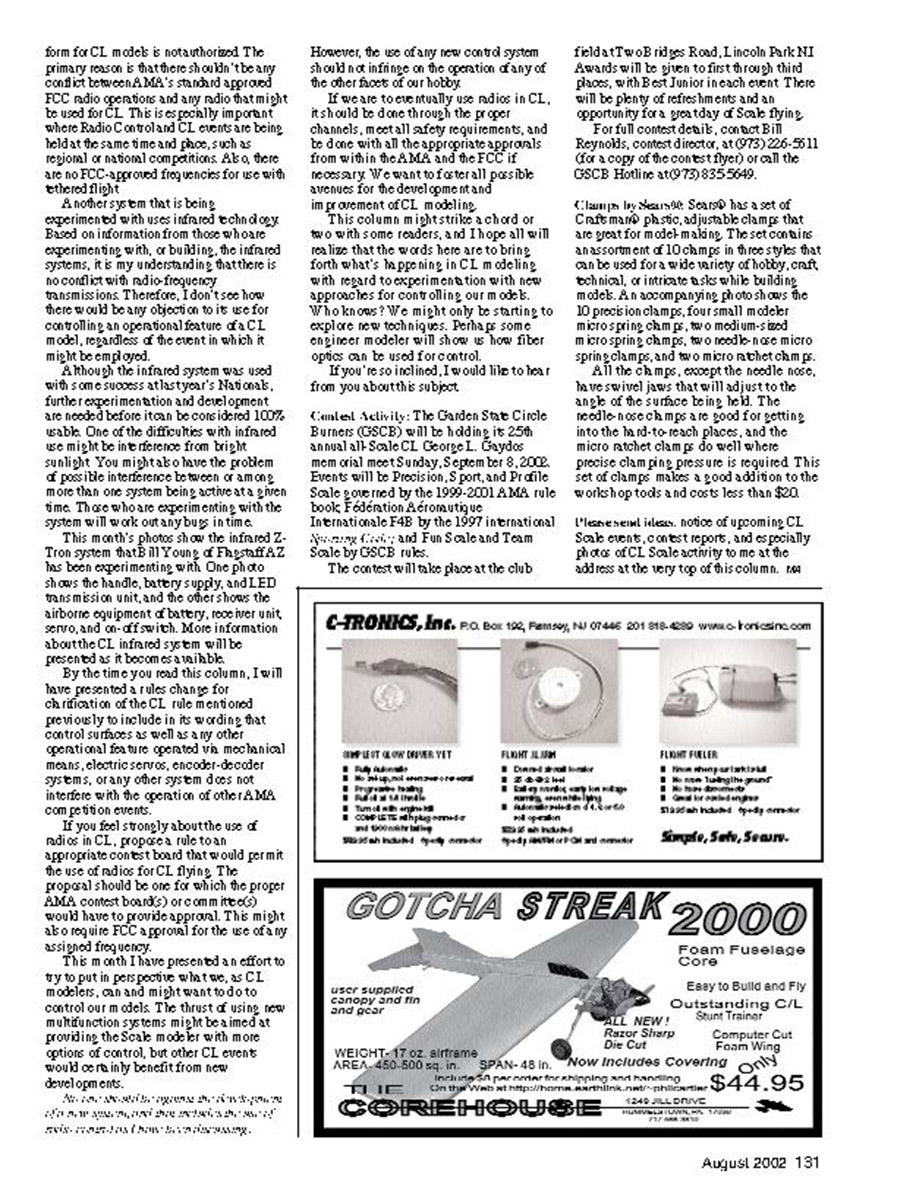
This month's photos show the infrared Z-Tron system that Bill Young of Fightin' A/2 has been experimenting with. One photo shows the handle, battery supply, and LED transmission unit, and the other shows the airborne equipment of battery, receiver unit, servo, and on-off switch. More information about the CL infrared system will be presented as it becomes available.
By the time you read this column, I will have presented a rules change for clarification of the CL rule mentioned previously to include in its wording that control surfaces as well as any other operational feature operated via mechanical means, electric sensors, encoder-decoder systems, or any other system does not interfere with the operation of other AMA competition events.
If you feel strongly about the use of radios in CL, propose a rule to an appropriate contest board that would permit the use of radios for CL flying. The proposal should be one for which the proper AMA contest board(s) or committee(s) would have to provide approval. This might also require FCC approval for the use of any assigned frequency.
This month I have presented an effort to try to put in perspective what we, as CL modelers, can and might want to do to control our models. The thrust of using new multifunction systems might be aimed at providing the Scale modeler with more options of control, but other CL events would certainly benefit from new developments.
However, the use of any new control system should not infringe on the operation of any of the other facets of our hobby.
If we are to eventually use radios in CL, it should be done through the proper channels, meet all safety requirements, and be done with all the appropriate approvals from within the AMA and the FCC if necessary. We want to foster all possible avenues for the development and improvement of CL modeling.
This column might strike a chord or two with some readers, and I hope all will realize that the words here are to bring forth what's happening in CL modeling with regard to experimentation with new approaches for controlling our models. Who knows? We might only be starting to explore new techniques. Perhaps some newer modeler will show us how fiber optics can be used for control.
If you're so inclined, I would like to hear from you about this subject.
Current activity: The Garden State Circle Burners (GSCB) will be holding its 25th annual Fall Scale CL George L. Gaydos memorial meet Sunday, September 8, 2002. Events will be Precision, Sport, and Profile Scale governed by the 1999-2001 AMA rule book Fédération Aéronautique Internationale F4B by the 1997 international air-racing, and Fun Scale and Team Scale by GSCB rules.
The contest will take place at the club field at Two Bridges Road, Lincoln Park NJ. Awards will be given to first through third places, with Best Junior in each event. There will be plenty of refreshments and an opportunity for a great day of Scale flying.
For full contest details, contact Bill Reynolds, contest director, at (973) 226-5111 (for a copy of the contest flyer) or call the GSCB Hotline at (973) 835-5649.
Classifieds by Nesbitt
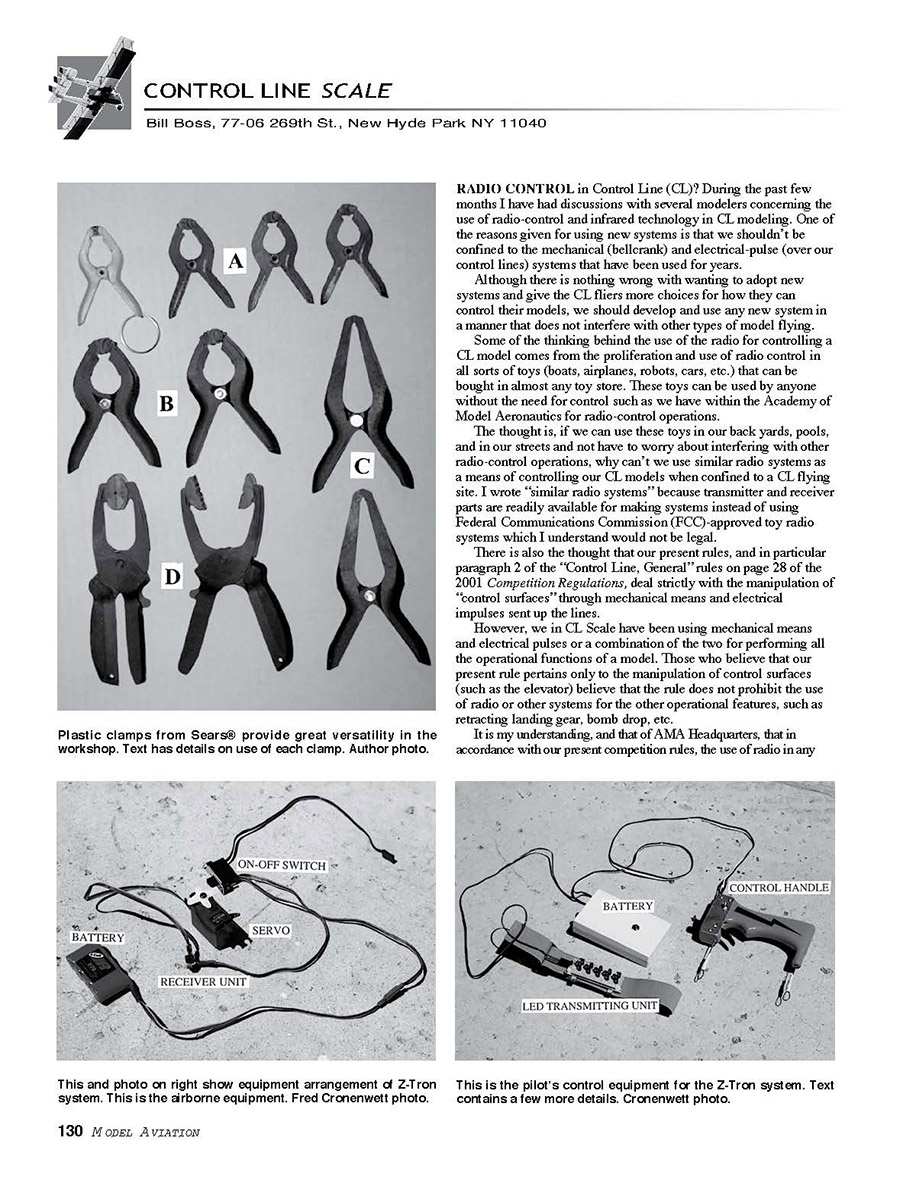
Nesbitt has a set of Craftsman micro adjustable clamps that are great for model making. The set contains an assortment of 10 clamps in three sizes that can be used for a wide variety of hobby, craft, technical, or intricate tasks while building models. An accompanying photo shows the 10 precision clamps, four small modeler micro spring clamps, two medium-sized micro spring clamps, two needle-nose micro spring clamps, and two micro ratchet clamps.
All the clamps, except the needle-nose, have swivel jaws that will adjust to the angle of the surface being held. The needle-nose clamps are good for getting into the hard-to-reach places, and the micro ratchet clamp is a good addition to the precise clamp pin, pressure is required. This set of clamps makes a good addition to any workshop tools and costs less than $20.
Please send ideas, notice of upcoming CL Scale events, contest reports, and especially photos of CL Scale activity to me at the address at the very top of this column. RA
Transcribed from original scans by AI. Minor OCR errors may remain.

