
CONTROL LINE SCALE
Bill Boss, 77-06 269th St., New Hyde Park NY 11040
RULES CHANGES for Control Line (CL) Scale published in the 2002-2004 Competition Regulations are few but important. The first is the addition of Designer Scale, which is listed as event 524.
The models entered must be contestants' original designs — not built from kits or commercially available plans. Modifications of kits, plans, or commercial plans are not eligible. Proof that the models entered are original designs from the beginning to the end is the burden of the contestants.
The rules for judging Designer Scale models are identical to those of CL Sport Scale for static and flight except for the following.
- Craftsmanship will be judged at zero distance.
- The models' cockpit or interior details will be considered under Item 9 (Color and Markings) of the CL Sport Scale Worksheet on page 160 of the new regulations book — not Item 10 as shown in paragraph 3 of the new rules.
Although the rule does not state how much of Item 9 should be applied to the cockpit/interior, the amount of points should be set by the judges prior to scoring any models. Five to seven points of the 20 for the cockpit/interior might be appropriate.
The purposes of Designer Scale are to give CL modelers an event in which they can demonstrate design and building skills and upgrade the status of CL Scale. Perhaps one day we should create the ultimate CL Scale event by combining the new Designer event with the Precision event.
The second change in the rule book is in Sport Scale paragraph 4.2. This relates to the accuracy of the three-view drawing, in that it must be obtained from a reliable source.
This change also notes that corrected three-views, homemade or unpublished drawings, and plans of nonflying or flying models are unacceptable unless the plans or changes have been submitted to and approved by the AMA technical director.
All Scale modelers should carefully read and become familiar with this change to avoid any misunderstanding when presenting your documentation for judging purposes.
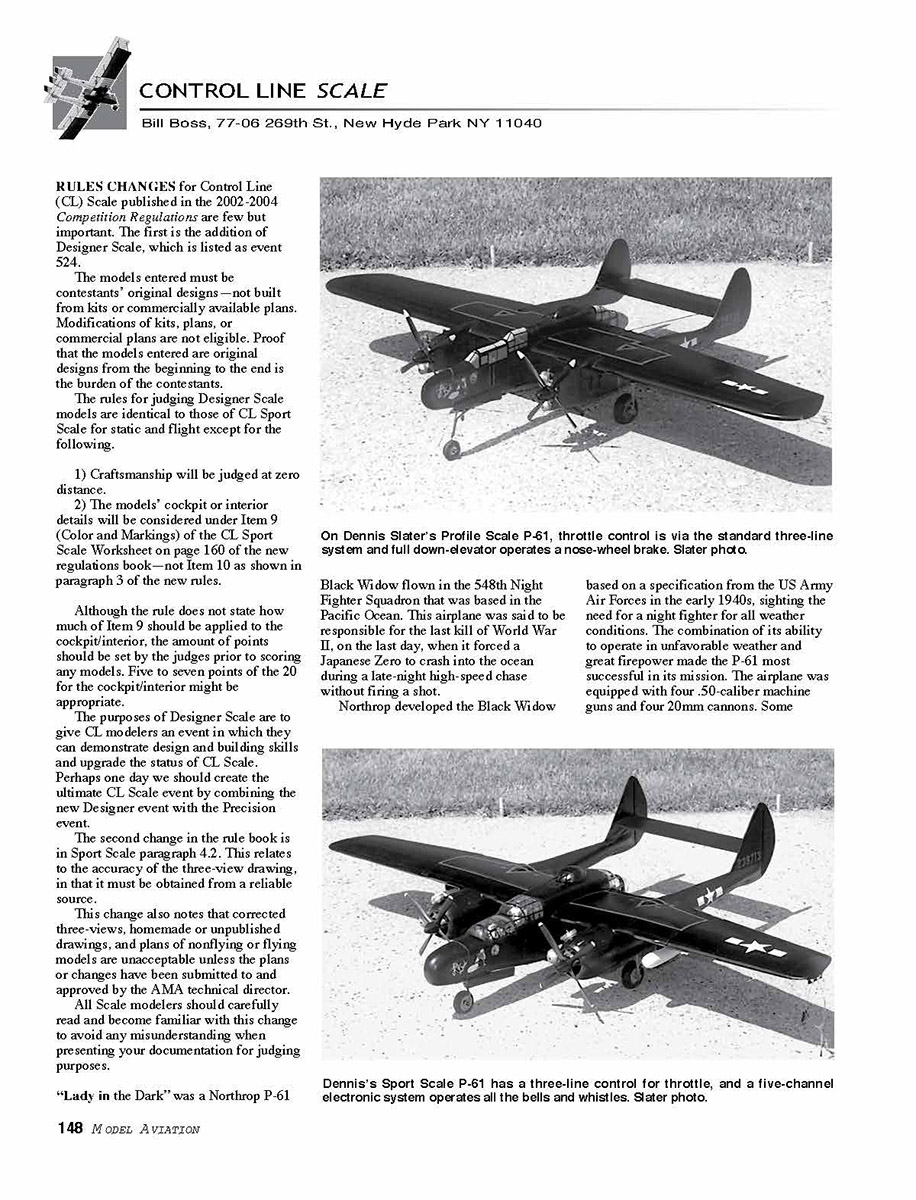
"Lady in the Dark" was a Northrop P-61 Black Widow flown in the 548th Night Fighter Squadron that was based in the Pacific Ocean. This airplane was said to be responsible for the last kill of World War II, on the last day, when it forced a Japanese Zero to crash into the ocean during a late-night high-speed chase without firing a shot.
Northrop developed the Black Widow based on a specification from the US Army Air Forces in the early 1940s, sighting the need for a night fighter for all weather conditions. The combination of its ability to operate in unfavorable weather and great firepower made the P-61 most successful in its mission. The airplane was equipped with four .50-caliber machine guns and four 20mm cannons.
CL Scale
versions were equipped with 310-gallon fuel tanks.
As successful as the Black Widow was, its life span was only approximately five years and it was taken out of service just prior to the Korean War. It was replaced for a short time by the F-82 Twin Mustang.
Recently, Jan Six's volume 15, from which the preceding information was taken, has a photo of the "Lady in the Dark" taken in 1948 at Clark Air Base's (in the Philippines) boneyard.
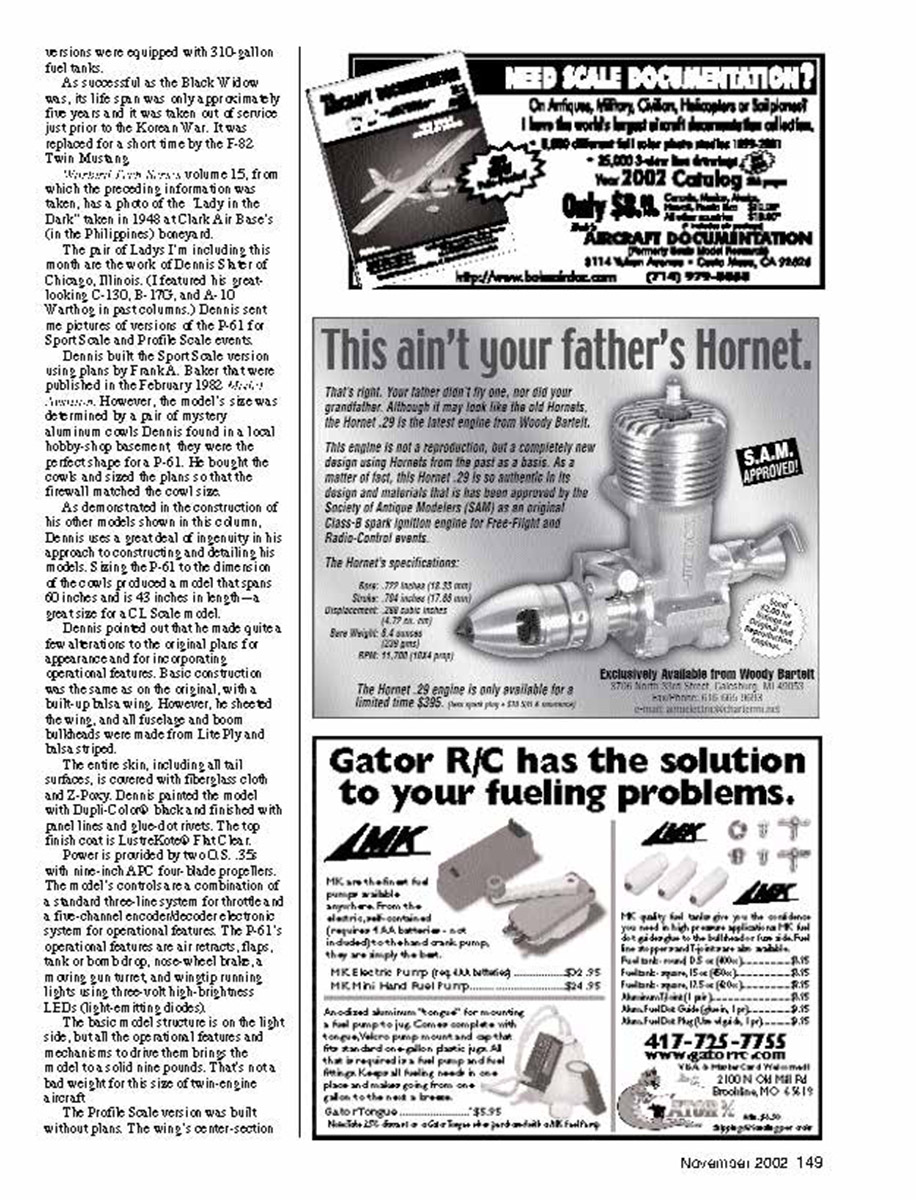
The pair of Ladys I'm including this month are the work of Dennis Sher of Chicago, Illinois. (I featured his great-looking C-130, B-17G, and A-10 Warthog in past columns.) Dennis sent me pictures of versions of the P-61 for Sport Scale and Profile Scale events.
Dennis built the Sport Scale version using plans by Frank A. Baker that were published in the February 1982 issue. However, the model's size was determined by a pair of mystery aluminum cowls Dennis found in a local hobby-shop basement; they were the perfect shape for a P-61. He bought the cowl and sized the plans so that the firewall matched the cowl size.
As demonstrated in the construction of his other models shown in this column, Dennis uses a great deal of ingenuity in his approach to constructing and detailing his models. Sizing the P-61 to the dimension of the cowls produced a model that spans 60 inches and is 43 inches in length — a great size for a CL Scale model.
Dennis pointed out that he made quite a few alterations to the original plans for appearance and for incorporating operational features. Basic construction was the same as on the original, with a built-up slab wing. However, he sheathed the wing, and all fuselage and boom buildups were made from LitePly and balsa striped.
The entire skin, including all tail surfaces, is covered with fiberglass cloth and Z-Poxy. Dennis painted the model with Dupli-Color® black and finished with panel lines and glue-dot rivets. The top finish coat is LustreKote® Flat Clear.
Power is provided by two O.S. .35s with nine-inch APC four-blade propellers. The model's controls are a combination of a standard three-line system for throttle and a five-channel encoder/decoder electronic system for operational features. The P-61's operational features are its retracts, flaps, tank or bomb drop, nose-wheel brake, a revolving gun turret and wingtip running lights (using three 0.06" high-brightness LEDs (light-emitting diodes).
The basic model structure is on the light side, but all the operational features and mechanisms to drive them brings the model to a solid nine pounds. That's not a bad weight for this size of twin-engine aircraft.
The Profile Scale version was built without plans. The wing's center-section construction is based on the use of the Ringmaster center rib duplicated 11 times. After completion of the center-section, the standard Ringmaster wing halves were attached outboard of the center-section. The balsa-sheathed wing spans 54 inches. Then, using a large-size copy machine, the profile patterns were sized to proportion from the line drawings and three-views in the Squadron/Signal publication.
Fiberglass cloth and Z-Poxy were used on the wing surface for added strength. Dupli-Color® black was painted on, with panel striping added, then a coat of LustreKote® Flat Clear for fuel-proofing was applied.
Power is two vintage O.S. Max .30s with eight-inch APC four-blade propellers. Control is via the standard three-line system for throttle and full down-elevator for activating the nose-wheel brake. The model weighs in at a fairly light 5½ pounds.
Plans Service: As a result of seeing the picture of the Curtiss C-46 Commando in the June column, Jerry Bates of Jerry Bates Plans responded with a letter and a copy of his C-46 plans for my review.
The full-size plans are excellent. They are black line on white paper, complete with all the detail and instruction needed for easy construction. The plans contain full-size templates for all wing and tail assembly ribs and fuselage formers.
By profession, Jerry is a designer for a consulting firm, and he uses his designer experience for developing Radio Control (RC) Scale models. Most of his plans are sized for large RC airplanes, but several would be suitable for conversion to CL use. The plans listing includes a 67-inch Dewoitine D.520 French World War II fighter, 42- and 63-inch Brewster F2A Buffalos, a Russian Yak-3 World War II fighter, and a 54½-inch de Havilland D.H.94 Moth Minor.
Also available are fiberglass and plastic accessories, custom-designed retracts, and wood kits for many of the airplanes. A number of the plans are for models spanning roughly 80 inches and weighing 18-24 pounds, making them questionable candidates for CL use. Remember the maximum weight for a CL scale model is 20 pounds.
For a listing and the cost of Jerry Bates' plans, visit the Web site at www.scaleaero.com/jerrybates.htm or write to him at 102 Glenwood St., Mobile AL 36606.
Please send ideas, notices of upcoming CL Scale events, contest reports, and especially photos of CL Scale activity to me at the address at the very top of this column. #44
Transcribed from original scans by AI. Minor OCR errors may remain.

