
Control Line Scale
Steve Ashby, 4771 Cinnamon Pl., Indianapolis IN 46237; E-mail: [email protected]
WHAT MOTIVATES modelers to spend vacation time and hard-earned money to journey sometimes thousands of miles in an effort to pit their building and piloting skills against other competitors? The answer to that age-old question was pondered at the Academy of Model Aeronautics International Aeromodeling Center—the site of the 76th National Championships for Control Line (CL) Scale model aircraft.
The Scale competition, held July 7-9, was sponsored by the National Association of Scale Aeromodelers (NASA), marking the Special Interest Group's 25th anniversary. Bob Underwood met with an assemblage of dedicated Scale modelers at the 1977 Nationals, and NASA was organized. NASA's members have been involved in the operation of the Scale Nationals since the organization began.
The competition opened Sunday at the spacious Horizon Convention Center in downtown Muncie, as the static portion of the competition began. Each model was processed, weighed, and placed in its respective category: Designer Scale, Sport Scale, Profile Scale, Team Scale, or F4B.
F4B is an international event which involves uniform rules on a world-wide basis. A set of three static judges carefully considers each model using the basic criteria for each category: outline, craftsmanship, and color. These areas are compared to photos and drawings of the model's prototype, or "big brother," as supplied by the competitor. Although the manner of judging may vary between categories, the static score makes up one-half of the points available for each competitor's total score, regardless of the category.
Performing the daunting task of serving as static judges in the various categories were Jack Sheeks, Australia Graves, Mike Getz, Mike Welshans, Chris Brownhill, Bill Logan, and Chuck Snyder.
There was a change in the flying venue this year. Because of the concern for safety with the Radio Control Scale aircraft overflying the L-Pad, the site of past events, the competition was relocated to the caged CL Speed circles. This area offered enough space to operate the two-circle system, which is necessary to efficiently accommodate two rounds of flying for each of the two days of competition.
Each competitor was assigned to a circle, and the flight judges moved to the opposite circle after the first two rounds, thus giving the competitors the opportunity to fly in front of two different sets of judges.
The first two rounds were flown on
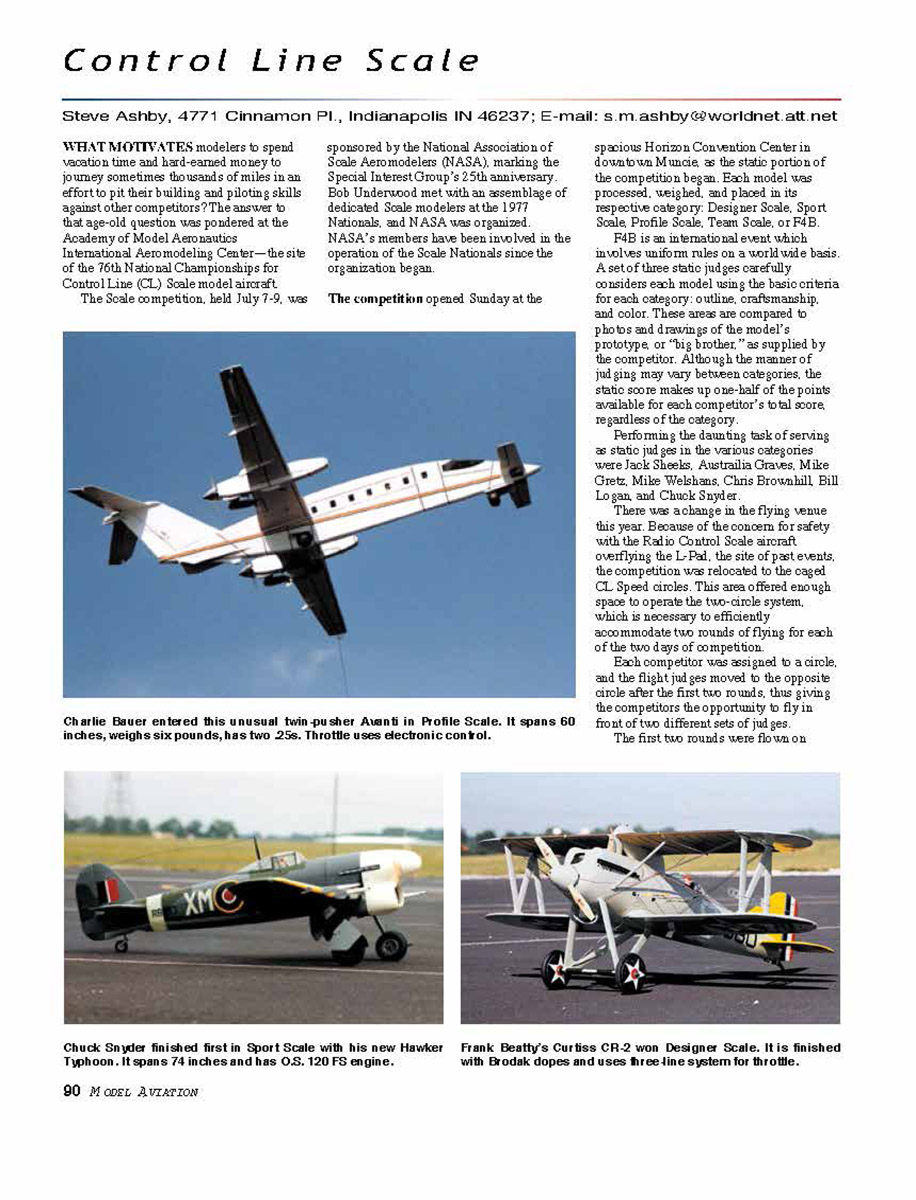
Canadian Bill Logan's 13.8-pound D.H.10—his F4B entry—spans 103 inches. Thunder Tiger .40s power this smooth‑flying bomber. It's finished with Pactra paint.
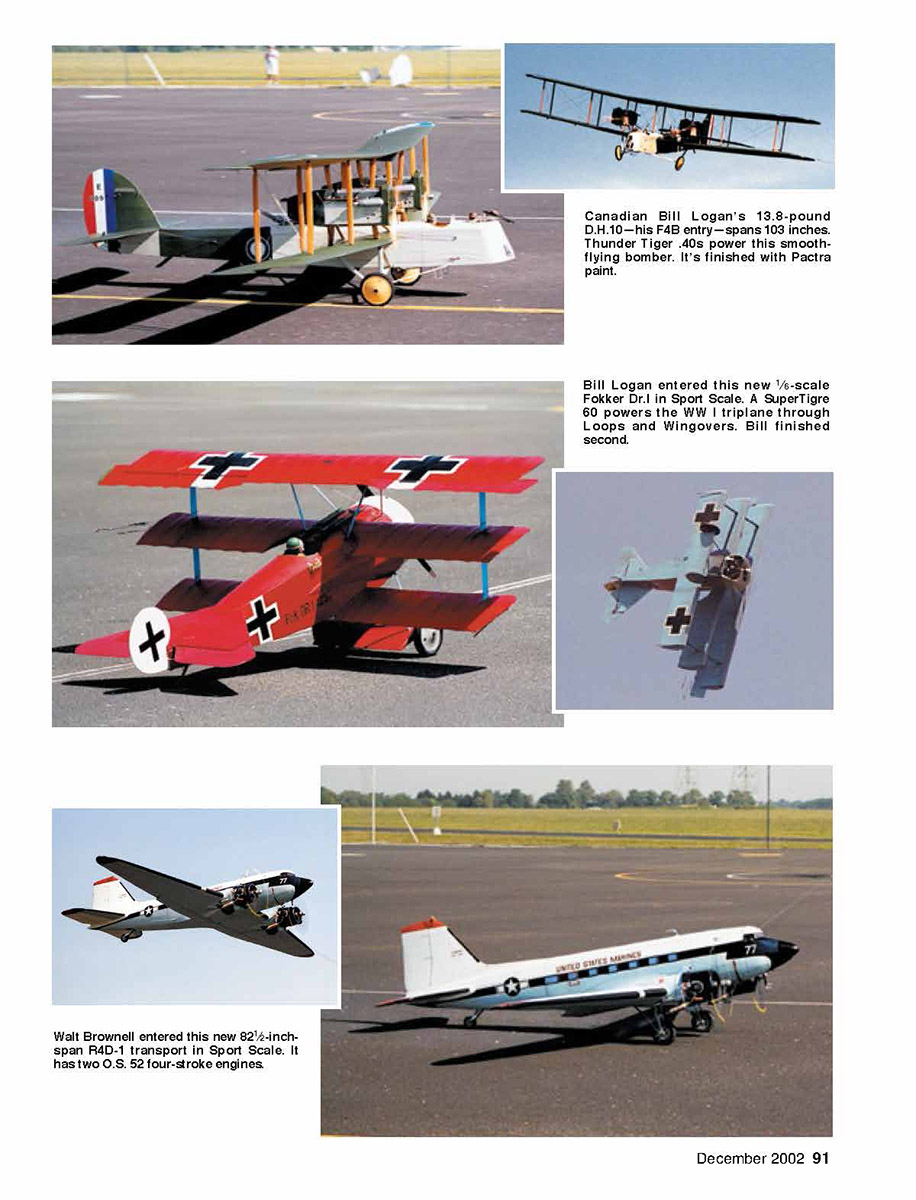
Bill Logan entered this new 7/16-scale Fokker D.r.I in Sport Scale. A SuperTiger 60 powers the WWI triplane through loops and wingovers. Bill finished second.
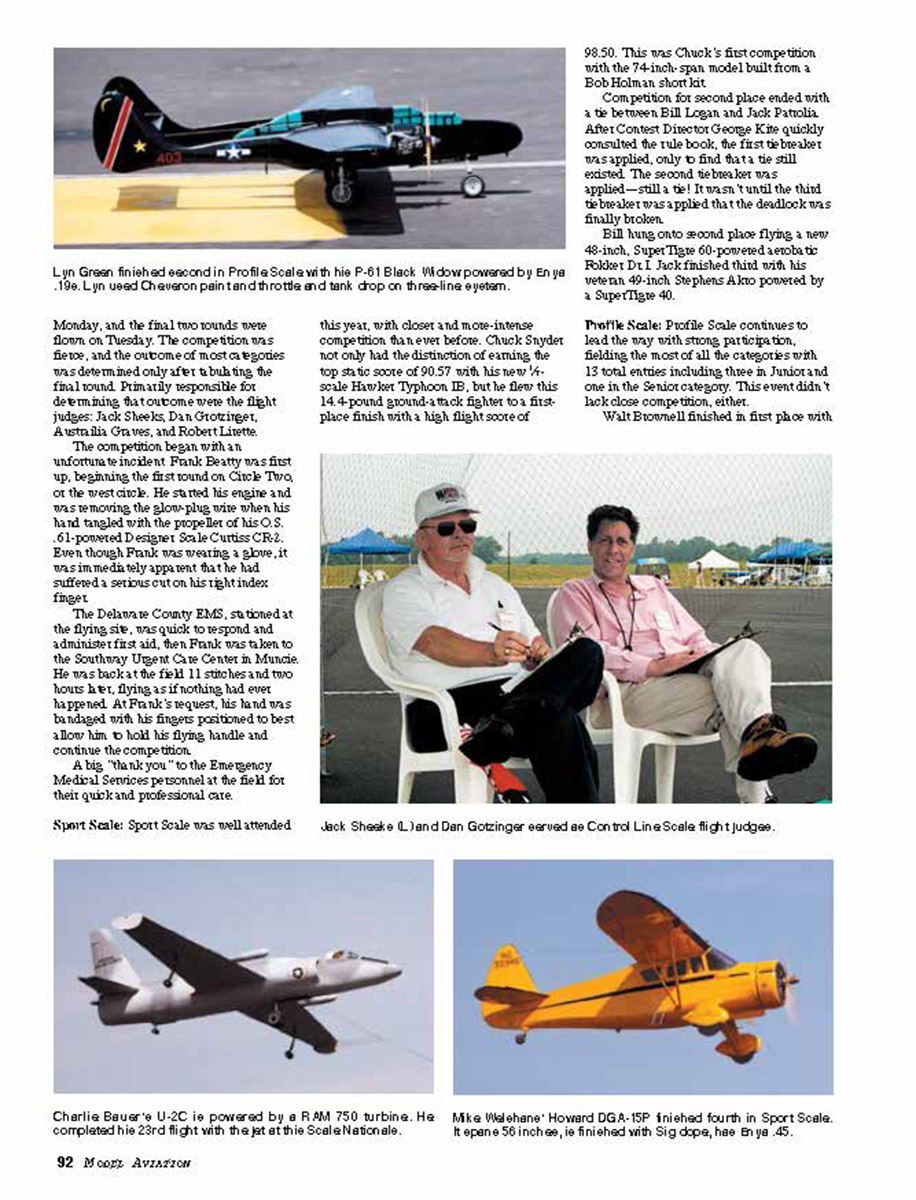
Walt Brownell entered this new 82½-inch-span R4D-1 transport in Sport Scale. It has two O.S. 52 four-stroke engines.
Transcribed from original scans by AI. Minor OCR errors may remain.

