
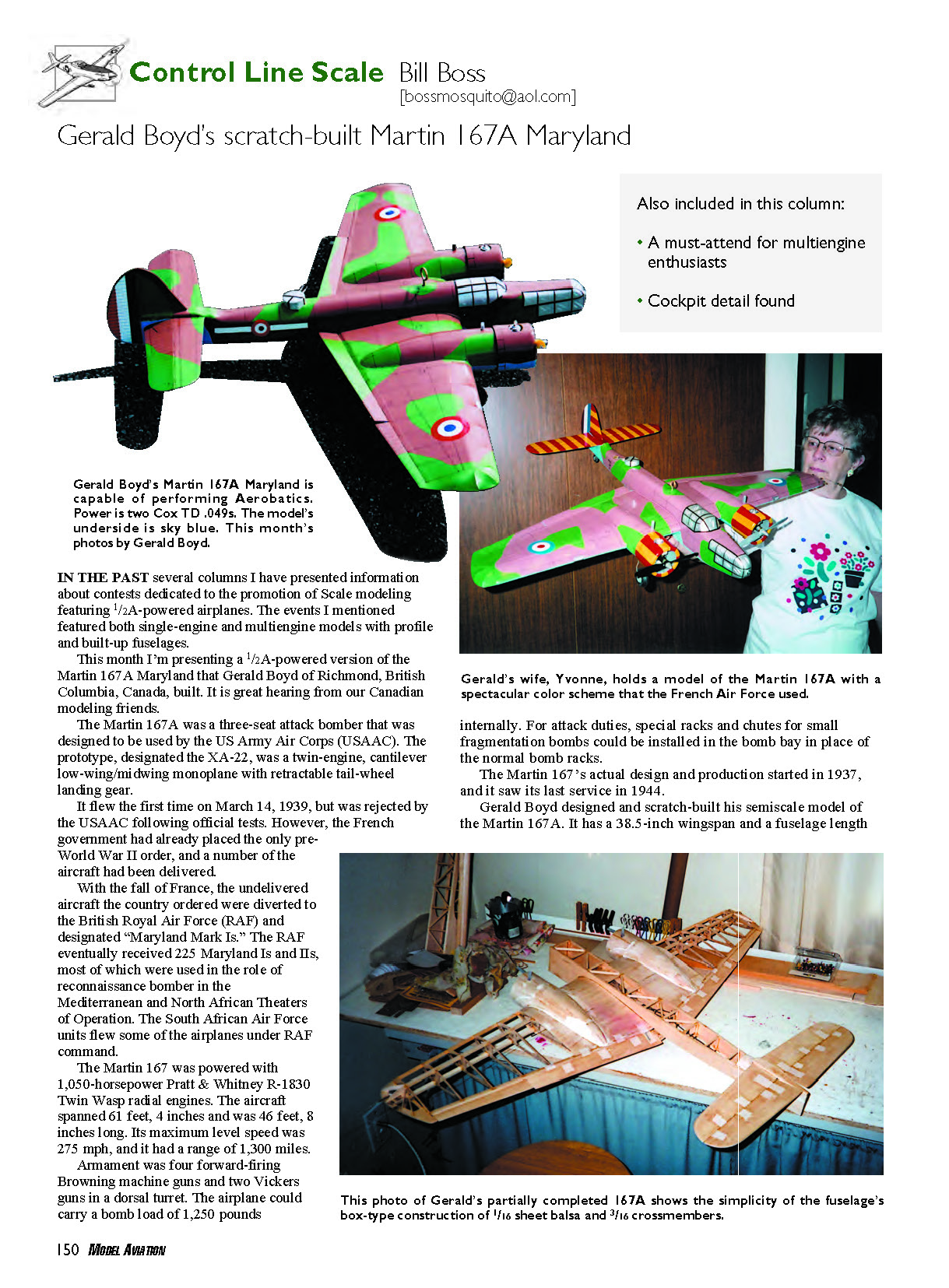
Control Line Scale
Bill Boss [[email protected]]
Gerald Boyd's scratch-built Martin 167A Maryland
IN THE PAST several columns I have presented information about contests dedicated to the promotion of Scale modeling featuring 1/2A-powered airplanes. The events I mentioned featured both single-engine and multiengine models with profile and built-up fuselages.
This month I'm presenting a 1/2A-powered version of the Martin 167A Maryland that Gerald Boyd of Richmond, British Columbia, Canada, built. It is great hearing from our Canadian modeling friends.
The Martin 167A was a three-seat attack bomber that was designed to be used by the US Army Air Corps (USAAC). The prototype, designated the XA-22, was a twin-engine, cantilever low-wing/midwing monoplane with retractable tail-wheel landing gear.
It flew the first time on March 14, 1939, but was rejected by the USAAC following official tests. However, the French government had already placed the only pre-World War II order, and a number of the aircraft had been delivered.
With the fall of France, the undelivered aircraft the country ordered were diverted to the British Royal Air Force (RAF) and designated "Maryland Mark Is." The RAF eventually received 225 Marylands and IIIs, most of which were used in the role of reconnaissance bomber in the Mediterranean and North African Theaters of Operation. The South African Air Force units flew some of the airplanes under RAF command.
The Martin 167 was powered with 1,050-horsepower Pratt & Whitney R-1830 Twin Wasp radial engines. The aircraft spanned 61 feet, 4 inches and was 46 feet, 8 inches long. Its maximum level speed was 275 mph, and it had a range of 1,300 miles.
Armament was four forward-firing Browning machine guns and two Vickers guns in a dorsal turret. The airplane could carry a bomb load of 1,250 pounds internally. For attack duties, special racks and chutes for small fragmentation bombs could be installed in the bomb bay in place of the normal bomb racks.
The Martin 167's actual design and production started in 1937, and it saw its last service in 1944.
Gerald Boyd designed and scratch-built his semiscale model of the Martin 167A. It has a 38.5-inch wingspan and a fuselage length of approximately 31 inches.
The photos show two 167As, in different color schemes, that Gerald made. One has what might be considered a standard brown-and-green camouflage scheme, with a sky-blue underside. Gerald obtained that color scheme from the book Aircraft of WWII by Kenneth Munson.
The spectacular-looking color scheme on the model that Gerald’s wife, Yvonne, is holding was taken from the airplanes flown by the French Air Force; aka, Armée de l’Air.
Balsa and light plywood is used throughout the 167A’s construction. Gerald claims that because of the small engines used to power the model (Cox TD .049s), the wood’s weight and selection is important in keeping its weight down. He chose 4- to 6-pound balsa and made sure it was straight.
As you can see in the photo of the partially completed 167A, the fuselage is a basic box configuration. The sides are 1/16 sheet balsa joined with 3/16 square balsa cross, vertical, and diagonal supports, making a rigid and strong structure. The top of the fuselage is completed with formers and hollowed-out balsa blocks. The tail surfaces are made from 1/8 sheet balsa.
Rather than cover the formers with strip balsa, Gerald soaked 1/16 balsa sheet and wrapped it around a 2-inch mailing tube. When the wood was dry, he applied the formed sheeting over the fuselage formers, providing a better surface for finishing.
As you can also see in the photo, the wing structure and tail surfaces are not too complicated. Gerald started the wing’s construction as many of us do, by pinning the bottom wing spar to a board. Care must be taken when adding the ribs, top spar, LE, and TE.
According to Gerald, the wing’s construction requires great attention to provide accuracy of alignment, especially when installing the engine pods, to prevent warps. Wing construction and alignment would be much easier if you had a building fixture system.
The model is controlled via a standard two-line bellcrank system that actuates flaps for performing maneuvers. A small amount of rudder offset keeps the model taut on the 45-foot flying lines that Gerald uses.
He noted that he starts the outboard engine first and runs it at slightly fewer rpm so that the outboard engine stops first during flight. He uses a tachometer and sets the outboard engine roughly 300 rpm less than the inboard engine.
Gerald’s 167As are capable of CL Precision Aerobatics, and the one in French colors is a great attraction and crowd pleaser whenever it is flown. The models are covered with lightweight silkspan, while all other surfaces are filled, sanded, doped, and painted. He did not suggest any particular type of finishing material; that is left up to the builder.
I am unable to provide more detail about the models’ construction, but I asked Gerald if the plans he had drawn could be made available to anyone who is interested in building the model. He is willing to provide the two-page full-size plans and three pages of construction detail. The cost is a reasonable $5 plus the price of mailing. (See the source list for contact information.)
Contest Reminder: Mike Keville wanted me to remind you that October 11-12, 2008, the Cholla Choppers of Tucson, Arizona, will host the second annual Multi-Engine Profile Scale Contest at Christopher Columbus Park in Tucson. Two classes of models will be flown: Limited and Unlimited.
Limited is for airplanes that have neither throttle control nor functions that are controlled by timers, electronics, etc. The Unlimited category is for throttle-equipped models that have any number of functional ground or flight features that the full-scale aircraft performs.
Awards will be provided through third place. It will be a great weekend of fun and flying. You can get contest rules from Event Director Mike Keville. (See the sources.)
Cockpits: Have you ever wondered what full-scale cockpits look like? Code One magazine’s Web site has photos of 32 of the most impressive-looking cockpits of old and modern aircraft. (See the source list for the complete address.) All you have to do is click on any of the pictures to see that airplane’s cockpit.
In addition, there is a short history detailing the type of aircraft and for what it was used. Also listed is the manufacturer, the number of airplanes built, its first date of service, and something notable about the aircraft. You will also find the name of the photographers who took the pictures and where they were taken.
If you are going to build a model of one of these subjects, you might find the cockpit photo helpful. If you have a color printer, a copy of the picture would come in handy for the scale documentation.
Please send ideas, notice of upcoming CL Scale events, contest reports, shop hints, and current projects to my E-mail address at the top of the column or by regular mail. Photos from 35mm film are okay. If you send pictures from a digital camera, please submit them on disc.
Now that some of you have attended contests during the summer months, I’d like to hear about the results. And of course receive photos with model details. MA
Sources:
Martin 167A Maryland information: The Complete Encyclopedia of World Aircraft Barnes & Noble www.bn.com Jane’s Encyclopedia of Aviation Crescent Books
Gerald Boyd 102-7700 Francis Rd Richmond British Columbia, Canada V6Y 1A2 [email protected]
Mike Keville (520) 307-1523 [email protected]
Code One magazine cockpit photos (817) 777-5542 www.codeonemagazine.com/test/archives/2007/articles/jan_07/cockpits/cock...
Bill Boss 77-06 269th St. New Hyde Park NY 11040
Transcribed from original scans by AI. Minor OCR errors may remain.

