
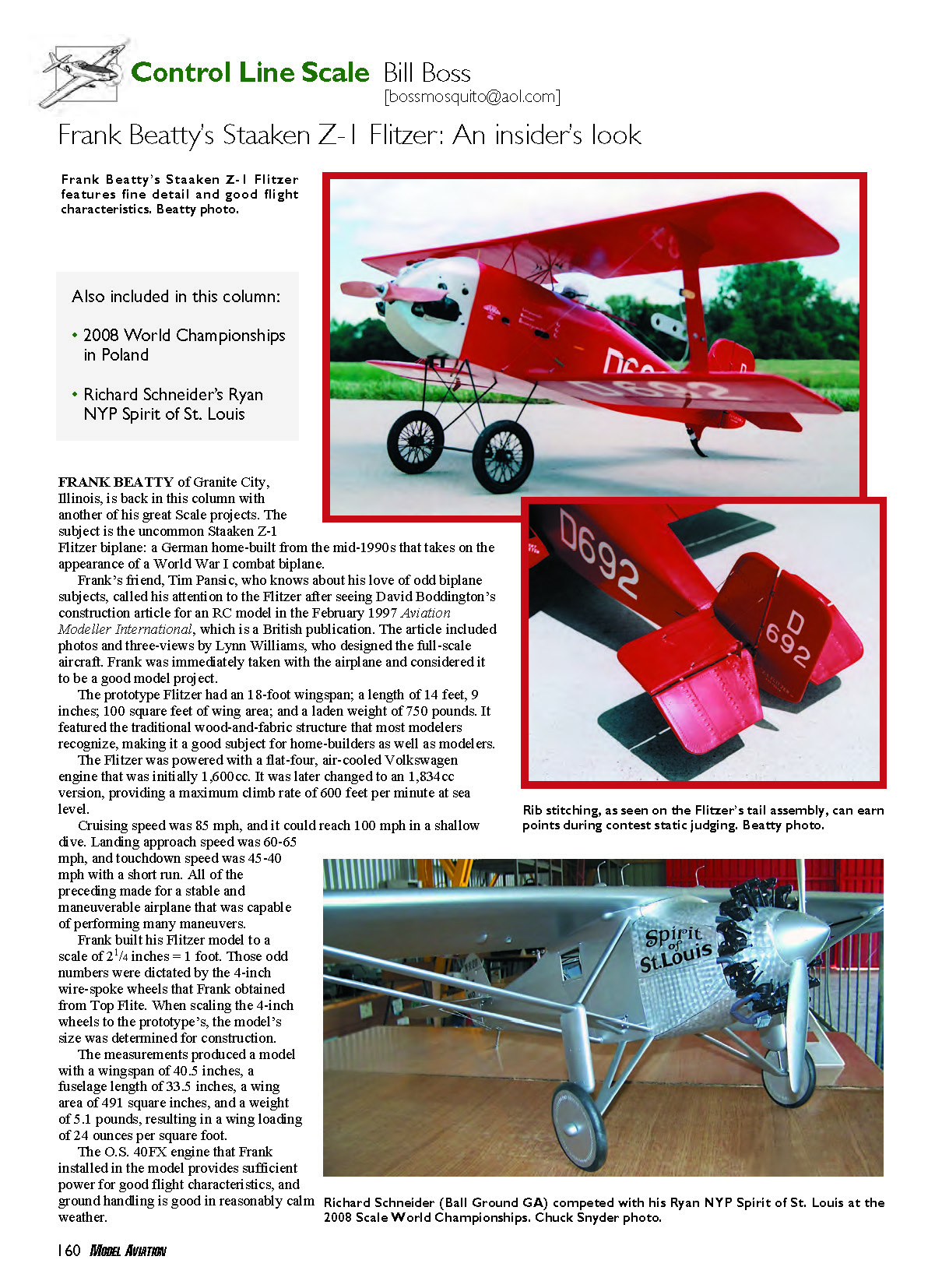
Frank Beatty's Staaken Z-1 Flitzer: An insider's look
FRANK BEATTY of Granite City, Illinois, is back in this column with another of his great Scale projects. The subject is the uncommon Staaken Z-1 Flitzer biplane, a German home-built from the mid-1990s that takes on the appearance of a World War I combat biplane.
Frank's friend, Tim Pansic, who knows about his love of odd biplane subjects, called his attention to the Flitzer after seeing David Boddington's construction article for an RC model in the February 1997 Aviation Modeller International, a British publication. The article included photos and three-views by Lynn Williams, who designed the full-scale aircraft. Frank was immediately taken with the airplane and considered it to be a good model project.
Prototype specifications
The prototype Flitzer had:
- Wingspan: 18 feet
- Length: 14 feet 9 inches
- Wing area: 100 square feet
- Laden weight: 750 pounds
It featured the traditional wood-and-fabric structure that most modelers recognize, making it a good subject for home-builders as well as modelers.
The Flitzer was powered with a flat-four, air-cooled Volkswagen engine that was initially 1,600 cc. It was later changed to an 1,834 cc version, providing a maximum climb rate of 600 feet per minute at sea level.
Performance:
- Cruising speed: 85 mph
- Maximum in shallow dive: 100 mph
- Landing approach speed: 60–65 mph
- Touchdown speed: 40–45 mph
All of the preceding made for a stable and maneuverable airplane that was capable of performing many maneuvers.
Model scale and dimensions
Frank built his Flitzer model to a scale of 2 1/4 inches = 1 foot. Those odd numbers were dictated by the 4-inch diameter wheels that Frank obtained from Top Flite. When scaling the 4-inch wheels to the prototype's, the model's size was determined for construction.
The scaled measurements produced a model with:
- Wingspan: 40.5 inches
- Fuselage length: 33.5 inches
- Wing area: 491 square inches
- Weight: 5.1 pounds
- Wing loading: 24 ounces per square foot
The O.S. .40FX engine that Frank installed in the model provides sufficient power for good flight characteristics, and ground handling is good in reasonably calm weather. However, if there is some wind, it takes some doing on the upwind side of the circle to keep the model from tipping. Wind affects most biplanes in the same manner.
Construction features
Construction features that make this model outstanding are the simulated Volkswagen engine and the application of rib stitching. Frank found the information he used in creating the model’s dummy engine from service manuals and photos in various publications. A total of 56 parts form the cylinders, cooling fins, valve covers, and exhaust stacks.
Materials used:
- Cylinders and cooling fins: 1/16 and 1/64 plywood
- Exhaust manifold and valve assembly covers: 3/8 basswood and 5/16 balsa
- Dummy exhaust piping: 1/4 basswood, sanded round
BrodaK B-2S Silver paint was used on the engine and cowling. According to Frank, the paint was the best he has used to give the appearance of real metal.
Rib stitching
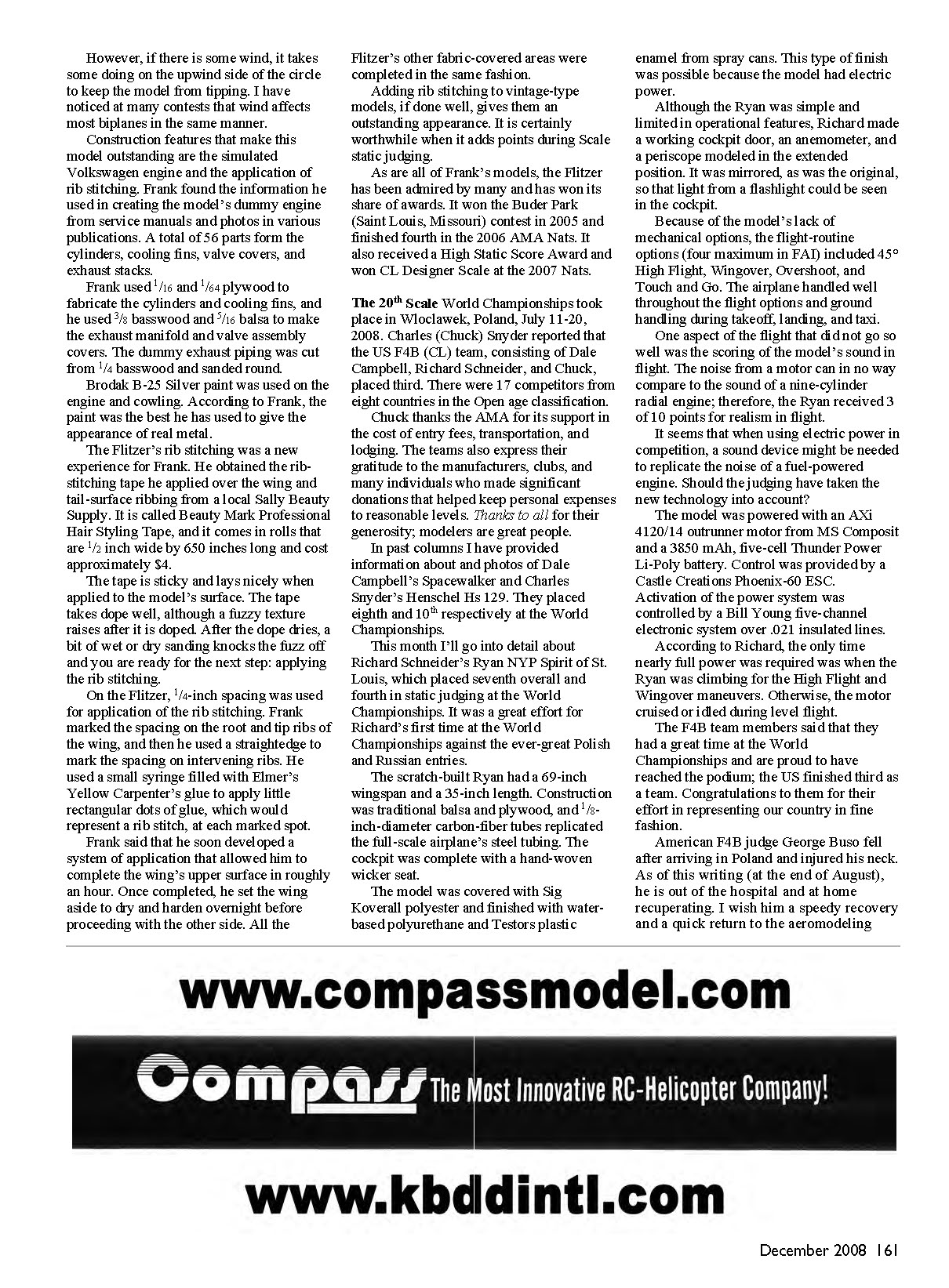
The Flitzer’s rib stitching was a new experience for Frank. He obtained the rib-stitching tape from a local Sally Beauty Supply. It is called Beauty Mark Professional Hair Styling Tape; it comes in rolls that are 1/2 inch wide by 650 inches long and costs approximately $4.
The tape is sticky and lays nicely when applied to the model’s surface. The tape takes dope well, although a fuzzy texture raises after it is doped. After the dope dries, a bit of wet or dry sanding knocks the fuzz off and you are ready for the next step: applying the rib stitching.
On the Flitzer, 1/4-inch spacing was used for rib stitching. Frank:
- Marked the spacing on the root and tip ribs of the wing.
- Used a straightedge to mark spacing on intervening ribs.
- Used a small syringe filled with Elmer’s Yellow Carpenter’s glue to apply little rectangular dots of glue (representing rib stitches) at each marked spot.
Frank said he soon developed a system of application that allowed him to complete the wing’s upper surface in roughly an hour. Once completed, he set the wing aside to dry and harden overnight before proceeding with the other side. All the Flitzer’s other fabric-covered areas were completed in the same fashion.
Adding rib stitching to vintage-type models, if done well, gives them an outstanding appearance. It is certainly worthwhile when it adds points during Scale static judging.
Awards and recognition
As are all of Frank’s models, the Flitzer has been admired by many and has won its share of awards. It won the Buder Park (Saint Louis, Missouri) contest in 2005 and finished fourth in the 2006 AMA Nats. It also received a High Static Score Award and won CL Designer Scale at the 2007 Nats.
20th Scale World Championships — Wloclawek, Poland (July 11–20, 2008)
Charles (Chuck) Snyder reported that the US F4B (CL) team, consisting of Dale Campbell, Richard Schneider, and Chuck, placed third. There were 17 competitors from eight countries in the Open age classification.
Chuck thanks the AMA for its support in the cost of entry fees, transportation, and lodging. The teams also express their gratitude to the manufacturers, clubs, and many individuals who made significant donations that helped keep personal expenses to reasonable levels. Thanks to all for their generosity; modelers are great people.
In past columns the author provided information about and photos of Dale Campbell’s Spacewalker and Charles Snyder’s Henschel Hs 129. They placed eighth and 10th respectively at the World Championships.
This month we go into detail about Richard Schneider’s Ryan NYP Spirit of St. Louis, which placed seventh overall and fourth in static judging at the World Championships. It was a great effort for Richard’s first time at the World Championships against strong Polish and Russian entries.
Richard Schneider’s Ryan NYP Spirit of St. Louis
The scratch-built Ryan had:
- Wingspan: 69 inches
- Length: 35 inches
Construction was traditional balsa and plywood, and 1/8-inch-diameter carbon-fiber tubes replicated the full-scale airplane’s steel tubing. The cockpit was completed with a hand-woven wicker seat.
The model was covered with Sig Koverall polyester and finished with water-based polyurethane and Testors plastic enamel from spray cans. This type of finish was possible because the model had electric power.
Although the Ryan was simple and limited in operational features, Richard made:
- A working cockpit door
- An anemometer
- A periscope modeled in the extended position (mirrored as on the original so that light from a flashlight could be seen in the cockpit)
Because of the model’s lack of mechanical options, the flight-routine options (four maximum in FAI) included:
- 45° High Flight
- Wingover
- Overshoot
- Touch and Go
The airplane handled well throughout the flight options and ground handling during takeoff, landing, and taxi.
One aspect of the flight that did not go so well was the scoring of the model’s sound in flight. The noise from a motor can in no way compare to the sound of a nine-cylinder radial engine; therefore, the Ryan received 3 of 10 points for realism in flight.
It seems that when using electric power in competition, a sound device might be needed to replicate the noise of a fuel-powered engine. Should the judging have taken the new technology into account?
Power system and control
The model was powered with:
- Motor: AXi 4120/14 outrunner motor from MS Composit
- Battery: 3850 mAh, five-cell Thunder Power Li-Poly
- ESC: Castle Creations Phoenix-60
Activation of the power system was controlled by a Bill Young five-channel electronic system over .021 insulated lines.
According to Richard, the only time nearly full power was required was when the Ryan was climbing for the High Flight and Wingover maneuvers. Otherwise, the motor cruised or idled during level flight.
The F4B team members said that they had a great time at the World Championships and are proud to have reached the podium; the US finished third as a team. Congratulations to them for their effort in representing our country in fine fashion.
American F4B judge George Buso fell after arriving in Poland and injured his neck. As of this writing (at the end of August), he is out of the hospital and at home recuperating. We wish him a speedy recovery and a quick return to the aeromodelling community.
Transcribed from original scans by AI. Minor OCR errors may remain.

