
CONTROL LINE SPEED
Glenn Lee, 819 Mandrake Dr., Batavia IL 60510
Perky Speed Contest
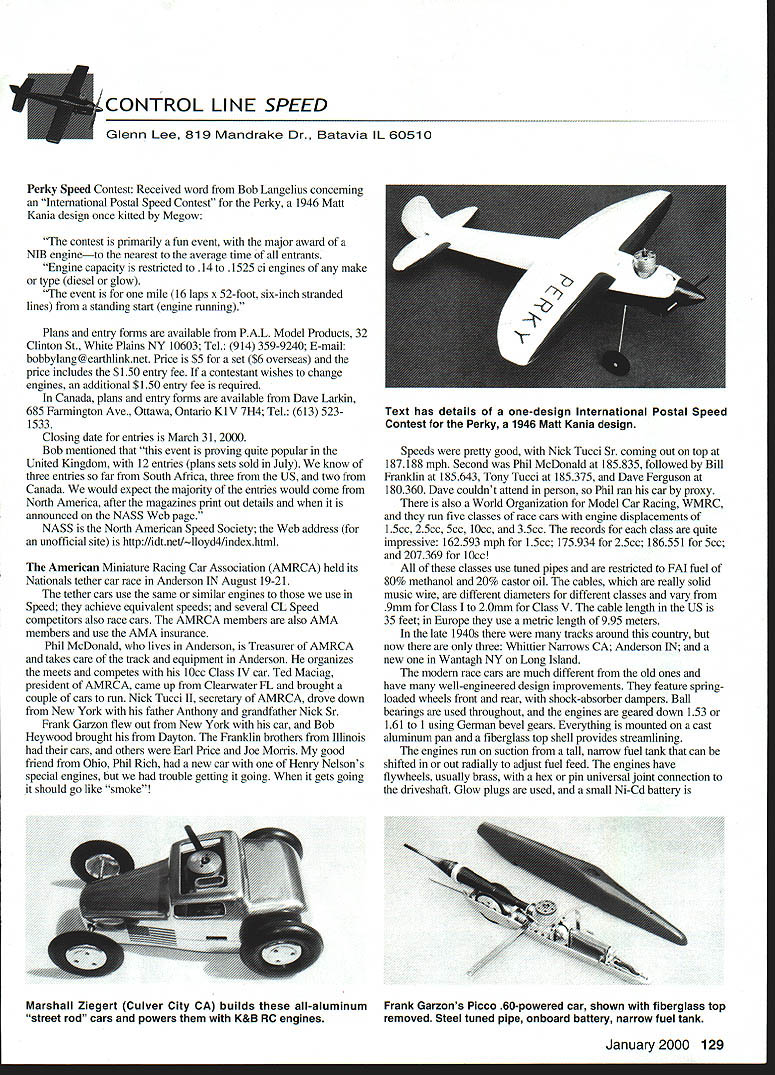
Received word from Bob Langelus concerning an "International Postal Speed Contest" for the Perky, a 1946 Matt Kania design once kitted by Megow.
"The contest is primarily a fun event, with the major award of a NIB engine—to the nearest to the average time of all entrants.
"Engine capacity is restricted to .14 to .1525 ci engines of any make or type (diesel or glow).
"The event is for one mile (16 laps x 52-foot, six-inch stranded lines) from a standing start (engine running)."
Plans and entry forms are available from P.A.L. Model Products:
- 32 Clinton St., White Plains NY 10603
- Tel.: (914) 359-9240
- E-mail: [email protected]
Price is $5 for a set ($6 overseas) and the price includes the $1.50 entry fee. If a contestant wishes to change engines, an additional $1.50 entry fee is required.
In Canada, plans and entry forms are available from:
- Dave Larkin, 685 Farmington Ave., Ottawa, Ontario K1V 7H4
- Tel.: (613) 523-1533
Closing date for entries is March 31, 2000.
Bob mentioned that "this event is proving quite popular in the United Kingdom, with 12 entries (plans sets sold in July). We know of three entries so far from South Africa, three from the US, and two from Canada. We would expect the majority of the entries would come from North America, after the magazines print our details and when it is announced on the NASS web page."
NASS is the North American Speed Society; the Web address (for an unofficial site) is http://dir.tnet/lloyd/andex.html.
AMRCA Nationals Tether Car Race
The American Miniature Race Car Association (AMRCA) held its Nationals tether car race in Anderson IN August 19–21.
- The tether cars use the same or similar engines to those used in CL Speed; they achieve equivalent speeds, and several CL Speed competitors also race cars.
- AMRCA members are also AMA members and use the AMA insurance.
Key people and participants:
- Phil McDonald (Anderson) — treasurer of AMRCA; takes care of the track and equipment in Anderson; organizes the meets; competes with his 10cc Class IV car.
- Ted Maciag (president of AMRCA) — came up from Clearwater FL and brought a couple of cars to run.
- Nick Tucci II (secretary of AMRCA) — drove down from New York with his father Anthony and grandfather Nick Sr.
- Frank Garzon — flew out from New York with his car.
- Bob Heywood — brought his car from Dayton.
- The Franklin brothers from Illinois — brought their cars.
- Others present included Earl Price and Joe Morris.
- Phil Rich (Ohio) — had a new car with one of Henry Nelson's special engines; it had trouble getting going but, when running, is expected to be very fast.
Speeds at the meet:
- Nick Tucci Sr. — 187.188 mph
- Phil McDonald — 185.835 mph
- Bill Franklin — 185.643 mph
- Tony Tucci — 185.375 mph
- Dave Ferguson — 180.360 mph (Dave couldn't attend; Phil ran his car by proxy)
World Organization for Model Car Racing (WCMC) and Class Records
WCMC runs five classes of race cars with engine displacements of:
- 1.5 cc
- 2.5 cc
- 5 cc
- 10 cc
- 3.5 cc
Recorded speeds for classes:
- 1.5 cc — 162.593 mph
- 2.5 cc — 175.934 mph
- 5 cc — 186.551 mph
- 10 cc — 207.369 mph
Notes on equipment and rules:
- All classes use tuned pipes and are restricted to FAI fuel of 80% methanol and 20% castor oil.
- Cable diameters vary by class and range from 0.9 mm for Class I to 2.0 mm for Class V.
- Cable length in the US is 35 feet; in Europe they use a metric length of 9.95 meters.
Tracks and Car Design
- In the late 1940s there were many tracks around the country; now there are only three: Whitney Narrows CA; Anderson IN; and a new one in Wantagh NY on Long Island.
- Modern race cars are much different from the old ones and have many well-engineered design improvements:
- Spring-loaded wheels front and rear with shock-absorber dampers
- Ball bearings used throughout
- Engines geared down 1.53:1 or 1.61:1 using German bevel gears
- Everything mounted on a cast aluminum pan with a fiberglass top shell for streamlining
- Engines run on suction from a tail, narrow fuel tank that can be shifted radially to adjust fuel feed
- Engines have flywheels (usually brass) with a hex or pin universal joint connection to the driveshaft
- Glow plugs are used and a small Ni-Cd battery is [text incomplete in source]
Transcribed from original scans by AI. Minor OCR errors may remain.

