
CL Speed
Scott Newkirk 4840 N. Glendale, Bel Aire KS 67220
Editor's note
This is the first of a three-column trial for Scott as the new Speed columnist. Reader reaction will determine the column's future.
Introduction
Hi! I'm Scott Newkirk. I've been flying aeromodels since I was eight.
I started out flying Free Flight and Indoor airplanes; I flew mostly hand-launched gliders and rubber models. My first Speed model was scratch-built; I flew it as a senior at my first Nationals (Nats) in 1973.
That first Nats was a real eye-opener for me; I met many very nice and helpful people who gave me a considerable amount of advice and assistance. Many of those people became good friends in the ensuing years.
As I look back on the history of Speed, I'm dismayed at the lack of junior and senior fliers. I've wanted the opportunity to help others get into Speed flying, and to enjoy the hobby as I have.
In the coming months, I hope to give information and develop a forum that will help Speed fliers, as a group, increase their ranks and make it easier for new fliers of any age to build, fly, and enjoy the experience.
One of the biggest factors in building and flying a Speed model is having the resources and the help to do so.
Resources and organizations
The first and most highly recommended resource is the North American Speed Society (NASS)—the AMA's Special Interest Group for Speed flying. Become a member.
- The newsletter has a parts-finder listing for those custom-made or hard-to-find parts.
- There is a yearly listing of NASS members that can help you find fliers with similar interests in your area.
- There are technical articles and competition results to help you with your ventures and to see how you, your friends, and your heroes have done.
The Internet has become a useful resource for competition and sport aeromodellers.
- The AMA has a large website with considerable information for aeromodellers: www.modelaircraft.org.
- The website www.delphi.com has Control Line (CL) Speed and Racing user groups. This is a great forum for help, questions, and contacts for buying or selling equipment.
- At www.egroups.com there are e-mail lists for Speed, Racing, and Combat models.
- An unofficial website for NASS, http://idt.net/~lloyd4/index.html, has contest results, a contest calendar, general Speed info, etc.
There are also sites with information on engine design, propeller design, tuned-pipe design, model and engine drawings, and model-engineering programs of all types.
I will try to have several links to sites of interest relating to the various topics of each column.
Mentoring and the competitive scene
Drawing new modelers into Speed flying takes effort. The top fliers I see at competitions are excellent sources of information; I see many of these experienced pilots doling out a lot of information, tips, and help.
I hear complaints about too many secrets being held by experienced fliers, but I've only seen a few things that were "Speed secrets"—and they didn't stay secret for long.
The experienced fliers aren't going fast because of secret methods; they are going fast because they practice, practice, practice, and continue to try new things. Reliability and familiarity with equipment wins more contests than anything else does.
Proposal: change classification system
It is time for one major change. The Junior, Senior, and Open classifications are out-of-date; a system of Beginner, Intermediate, and Advanced classes, similar to those in CL Stunt and Radio Control Aerobatics, is in order.
A novice Speed flier shouldn't have to fly against the Open record holder in an event just because he or she is 30 years old. My initial proposal:
- Beginner events would have mini pees and/or mufflers only, and two lines only. (I'm thinking about proposing requiring shutoffs to help save wear-and-tear on engines.)
- Make .40 the maximum engine size for C, with no B for Beginners.
- Three contest wins at 90% or more of the national Beginner record would bump you up to the next level.
Intermediate would have the same rules as Advanced, but without the experts to compete against.
- Three contest wins at 90% or more of the national Intermediate record would bump you up to Advanced.
If a beginning flier wants to use a .65 engine, let them—but fly them against the Intermediate or Advanced fliers. If they want to fly monoline, the same applies: they should fly against Intermediate or Advanced fliers.
Leveling the field for new Speed modelers should help with the intimidation factor. When a pilot gets better at flying, he or she advances to the next level.
By automatic progression, we eliminate—for three contests at least—the modeler trying to take undue advantage of the system and getting wins "at any price."
By putting a minimum speed on contest wins for progression, we prevent modelers from being moved up prematurely when they are the only contestants, or when they are one of a couple entries.
Engines and recent developments
New engines are available for several Speed classes.
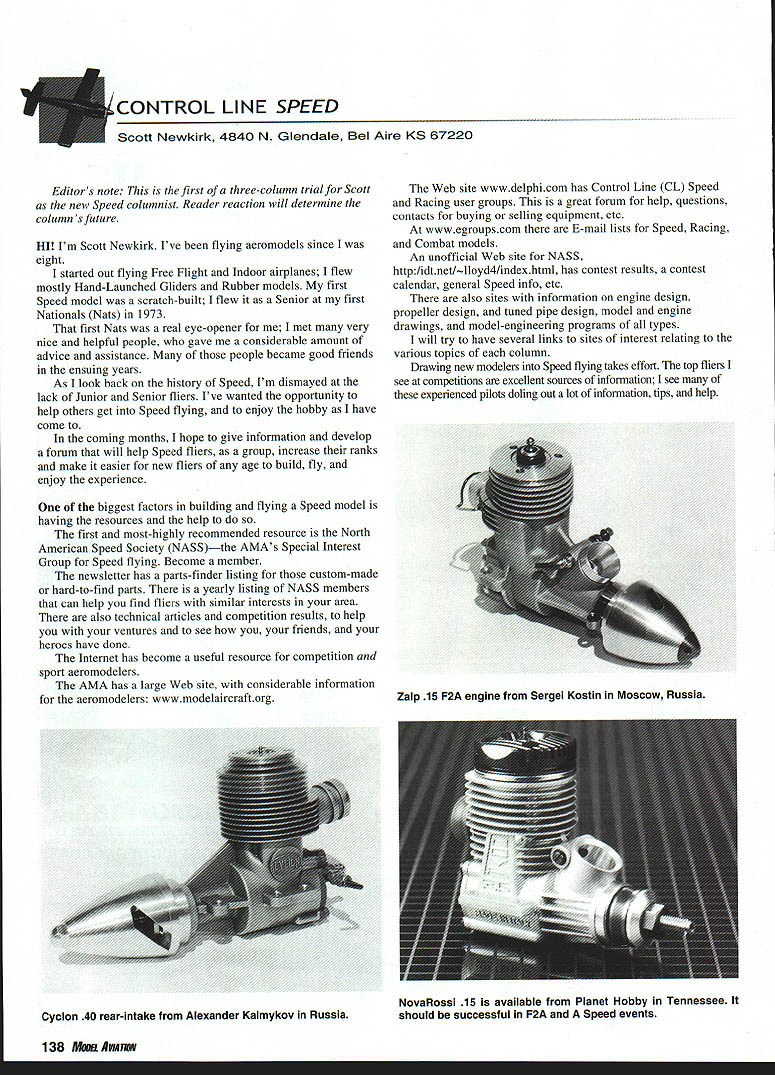
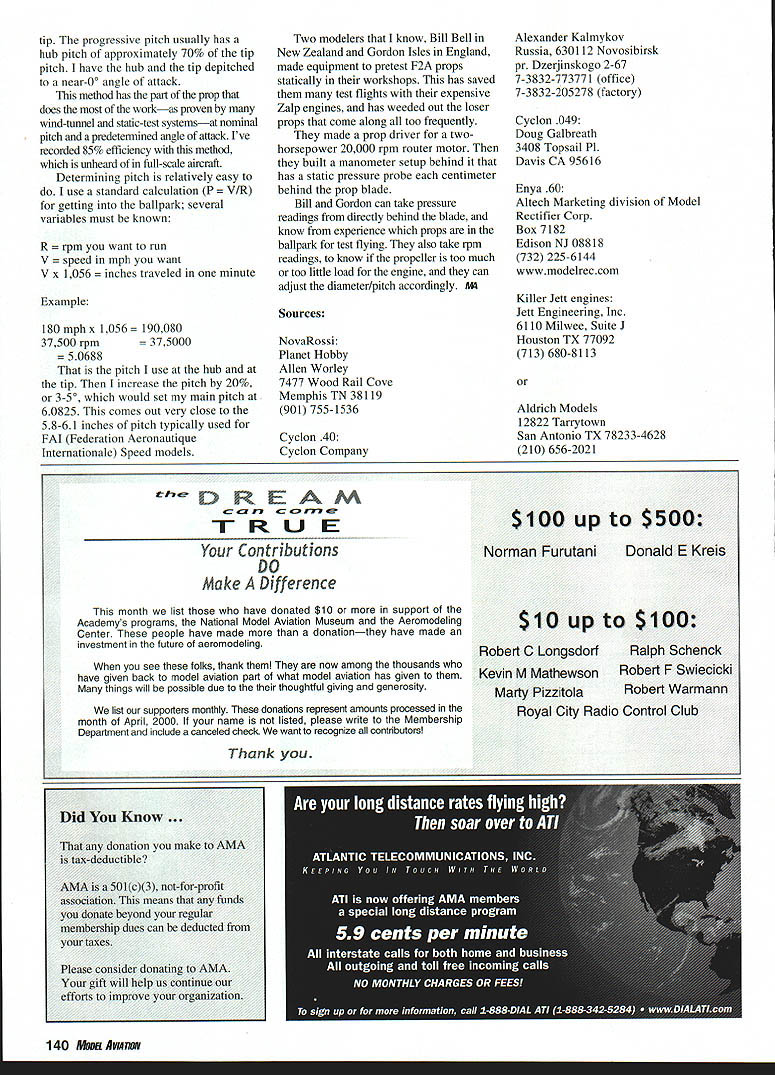
- The NovaRossi .15 looks promising. It is a scaled-down version of the popular and powerful .21. It has a 13mm turbo crankshaft, turbo plug head, multiport liner, etc. It should make waves in the F2A and A Speed circles.
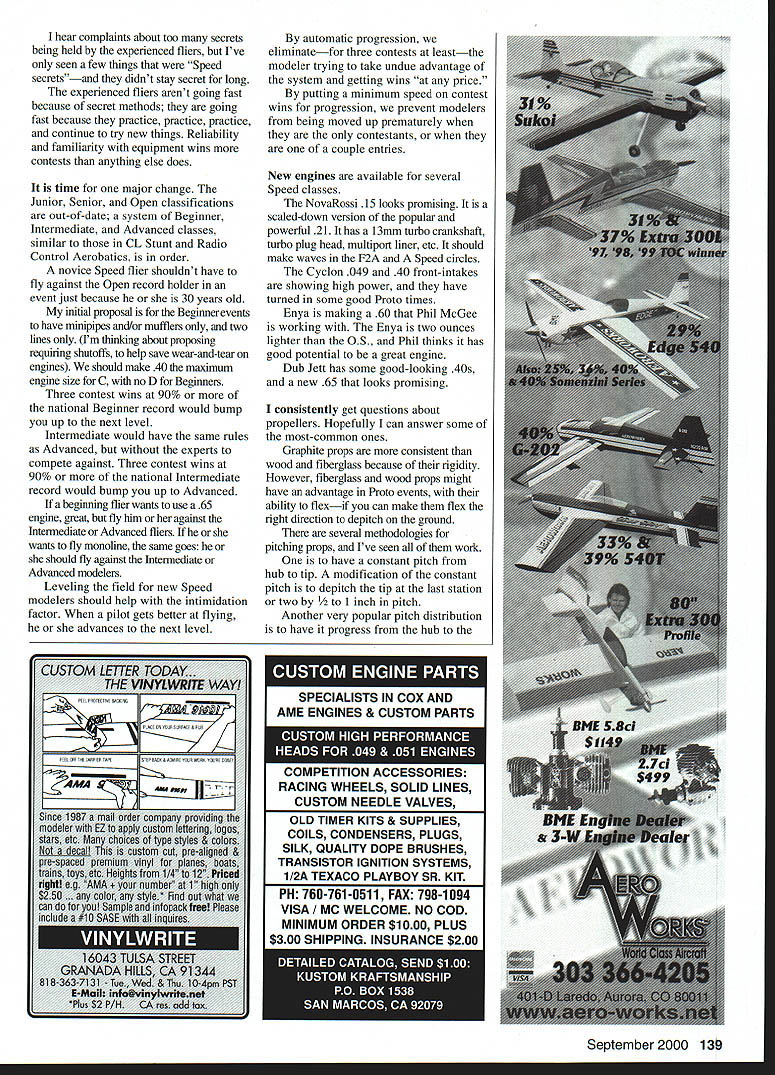
- The Cyclon .049 and .40 front-intakes are showing high power, and they have turned in some good Proto times.
- Enya is making a .60 that Phil McGee is working with. The Enya is two ounces lighter than the O.S., and Phil thinks it has good potential.
- Dub Jett has some good-looking .40s, and a new .65 that looks promising.
Propellers: materials and pitch
I consistently get questions about propellers. Hopefully I can answer some of the most common ones.
- Graphite props are more consistent than wood and fiberglass because of their rigidity. However, fiberglass and wood props might have an advantage in Proto events, with their ability to flex—if you can make them flex the right direction to depitch on the ground.
- There are several methodologies for pitching props, and I've seen all of them work.
- Constant pitch from hub to tip. A modification is to depitch the tip at the last station or two by 1/2 to 1 inch in pitch.
- A popular distribution is to have pitch progress from the hub to the tip so that the root has less pitch than the tip; this gives more bite at the tip to load the motor better and can give slightly higher top speed.
If your pitch is inconsistent from prop to prop, check the hub thickness and the way you're flexing the hub when sanding. A hub that is too thin or weak will change the effective pitch when the prop is spinning, screwing up balance and performance.
If you shape the hub correctly and sand the pitch true, your finished prop will do the same lap times, with only a few hundredths difference between props of the same design.
I will cover prop balancing, hub shaping, and some fabrication hints in the next column.
Static prop testing
Two modelers I know, Bill Bell in New Zealand and Gordon Isles in England, made equipment to pretest F2A props statically in their workshops. This has saved them many test flights with their expensive Zalp engines, and has weeded out the loser props that come along all too frequently.
- They made a prop driver for a two-horsepower 20,000 rpm router motor.
- Then they built a manometer setup behind it that has a static pressure probe each centimeter behind the prop blade.
- Bill and Gordon can take pressure readings from directly behind the blade, and know from experience which props are in the ballpark for test flying. They also take rpm readings to know if the propeller is too much or too little load for the engine, and they can adjust diameter/pitch accordingly.
Sources
- NovaRossi:
Planet Hobby Allen Worley 7477 Woodl Rail Cove Memphis TN 38119 (901) 755-1536
- Cyclon .40:
Cyclon Company Alexander Kalmykov Russia, 630112 Novosibirsk pr. Dzerjinskogo 2-67 7-3832-737771 (office) 7-3832-205278 (factory)
- Cyclon .049:
Doug Galbreath 3408 Topsail Pl. Davis CA 95616
- Enya .60:
Altech Marketing division of Model Rectifier Corp. Box 7182 Edison NJ 08818 (732) 225-6144 www.modelrec.com
- Killer Jett engines:
Jett Engineering, Inc. 6110 Milwee, Suite J Houston TX 77092 (713) 680-8113
- Aldrich Models:
12822 Tarrytown San Antonio TX 78233-4628 (210) 656-2021
Transcribed from original scans by AI. Minor OCR errors may remain.

