
CONTROL LINE SPEED
Dave McDonald, Box 384, Daleville IN 47334; E-mail: [email protected]
Yes, there's a different name at the top of the column. New Control Line (CL) Speed columnist Scott Newkirk was unable to attend the Nationals (Nats) this year, and I was asked to step in and provide coverage. Please bear with me; I hope I didn't leave anything out.
If an award was given to the contestant who traveled the farthest to attend the Nats, it would go to Mervyn Bell of Australia. Mervyn flew in .21 Sport Speed, and he posted a respectable time of 144.05.
Air-density readings throughout the week were roughly 97, so slow air was the norm. Combining that with humidity and off-and-on rain meant that records were hard to achieve.
Monday, July 10 — 1/2A and 1/2A Profile Proto
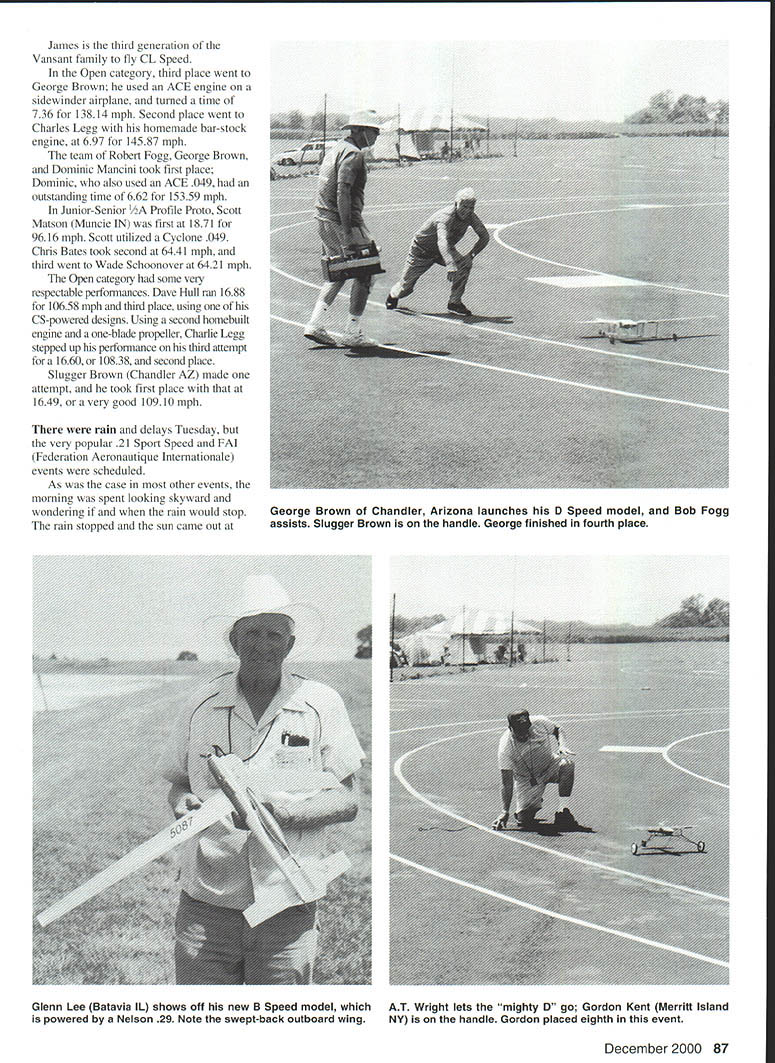
Young James Vansant (Langhorne PA), a crowd favorite, recorded a nice time of 16.28 for 62.45 mph in 1/2A. It looked as if he was having the time of his life. James is the third generation of the Vansant family to fly CL Speed.
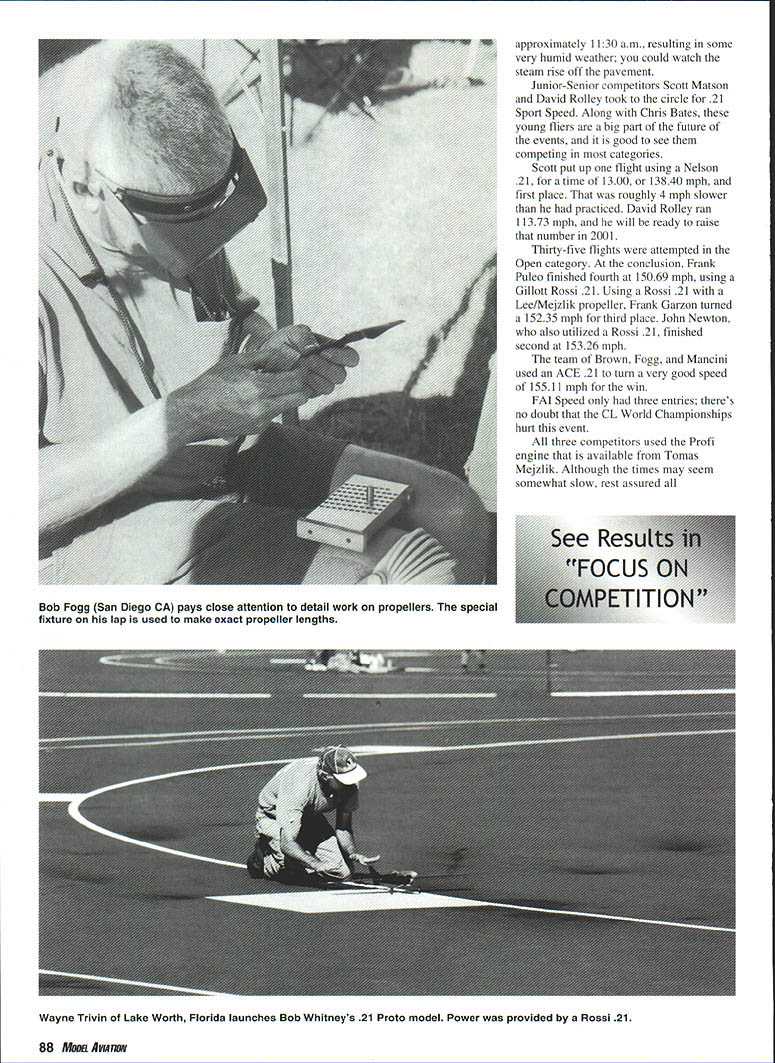
In the Open category, third place went to George Brown; he used an ACE engine on a sidewinder airplane, and turned a time of 7.36 for 138.14 mph. Second place went to Charles Legg with his homemade bar-stock engine, at 6.97 for 145.87 mph.
The team of Robert Fogg, George Brown, and Dominic Mancini took first place; Dominic, who also used an ACE .049, had an outstanding time of 6.62 for 153.59 mph.
In Junior-Senior 1/2A Profile Proto, Scott Matson (Muncie IN) was first at 18.71 for 96.16 mph. Scott, using a Cyclone .049, Chris Bates took second at 64.41 mph, and third went to Wade Schoonover at 64.21 mph.
The Open category had some very respectable performances. Dave Hull ran 16.88 for 106.58 mph and took third place, using one of his CS-powered designs. Using a second homebuilt engine and a one-blade propeller, Charlie Legg stepped up his performance on his third attempt for a 16.60, or 108.38, and second place.
Slugger Brown (Chandler AZ) made one attempt, and he took first place with that at 16.49, or a very good 109.10 mph.
Tuesday — .21 Sport Speed and FAI
There were rain and delays Tuesday, but the very popular .21 Sport Speed and FAI (Federation Aeronautique Internationale) events were scheduled.
As was the case in most other events, the morning was spent looking skyward and wondering if and when the rain would stop. The rain stopped and the sun came out at approximately 11:30 a.m., resulting in some very humid weather; you could watch the steam rise off the pavement.
Junior-Senior competitors Scott Matson and David Rolley took to the circle for .21 Sport Speed. Along with Chris Bates, these young fliers are a big part of the future of the events, and it is good to see them competing in most categories.
Scott put up one flight using a Nelson .21, for a time of 13.00, or 138.40 mph, and first place. That was roughly 4 mph slower than he had practiced. David Rolley ran 13.73, and he will be ready to raise that number in 2001.
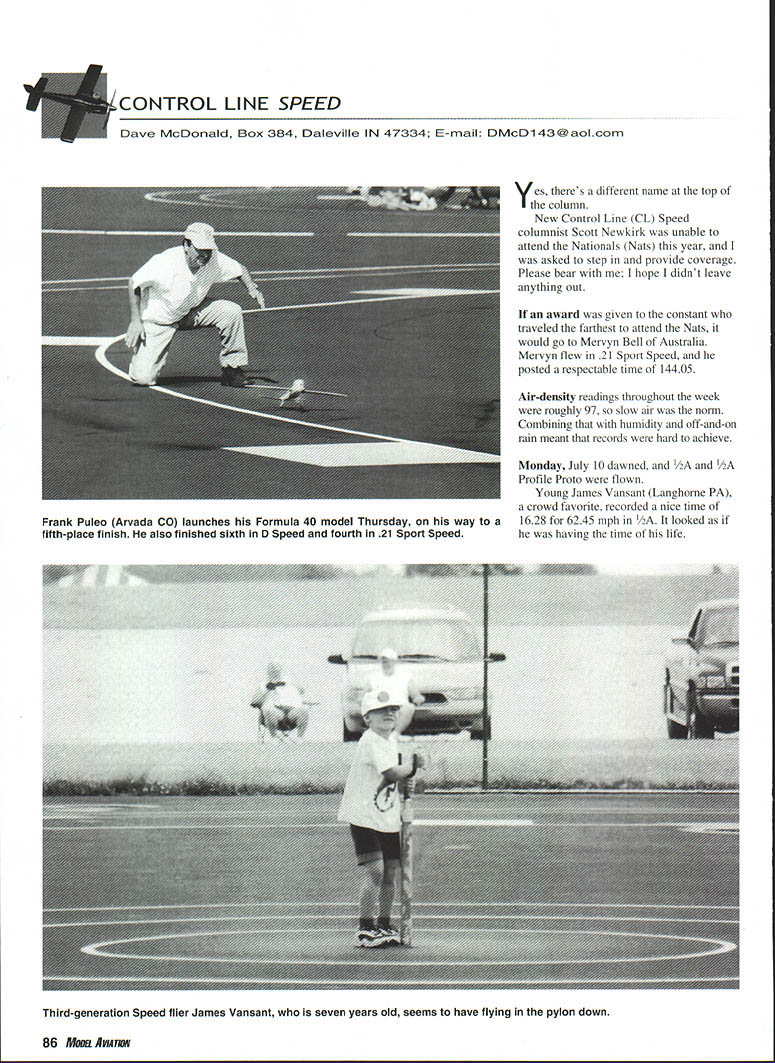
Thirty-five flights were attempted in the Open category. At the conclusion, Frank Puleo finished fourth at 150.69 mph, using a Gillott Rossi .21. Using a Rossi .21 with a Lee/Mejzlik propeller, Frank Garzon turned a 152.35 mph for third place. John Newton, who also utilized a Rossi .21, finished second at 153.26 mph.
The team of Brown, Fogg, and Mancini used an ACE .21 to turn a very good speed of 155.11 mph for the win.
FAI Speed only had three entries; there's no doubt that the CL World Championships hurt this event.
All three competitors used the Profi engine that is available from Tomas Mejzlik. Although the times may seem somewhat slow, rest assured all competitors worked very hard to get the equipment up to speed.
Glen Vansant was third at 144.83 mph; Dave Hull was second at 160.75 mph; and J.H. Rhoades (Salt Lake City UT) was the champion at 166.12 mph.
A Speed
A Speed is almost completely run with the asymmetrical design, but the two Juniors in the event used more-conventional airplanes.
James D. Vansant finished second at 88.07 mph, and he looked like a natural after some coaching from dad and grandpa.
Scott Matson won at 121.24 mph—slower than he had practiced. He used a Gillott Rossi Mk.III.
Five pilots made attempts in the Open category, and all five posted times.
A.T. Wright posted a 147.36 mph for third, with Gordon Kent at the controls. These guys do a tremendous amount of flying in the Titusville, Florida area.
Glen Vansant brought the speed up to 185.87 mph using a Profi, which secured second place.
George Brown (Staten Island NY), who is a big part of the Brown, Fogg, and Mancini team, moved into first place at almost 190 mph, with an official time of 189.59 mph. This airplane looked good in the air, and it was extremely fast and consistent.
B Speed
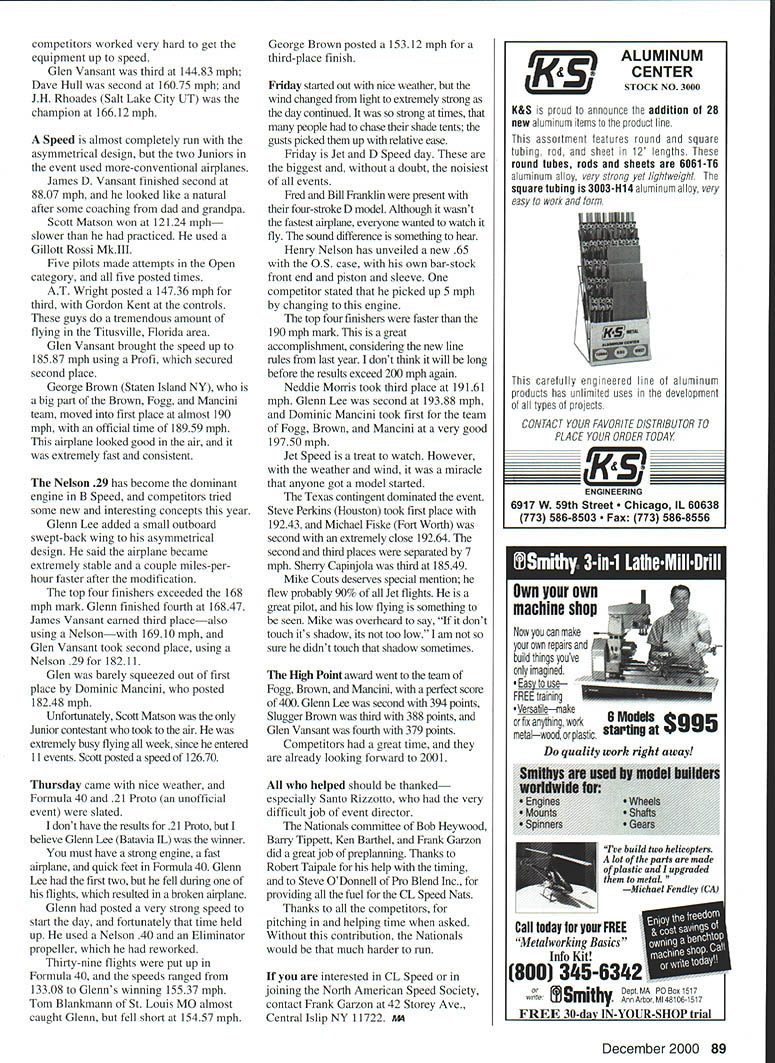
The Nelson .29 has become the dominant engine in B Speed, and competitors tried some new and interesting concepts this year.
Glenn Lee added a small outboard swept-back wing to his asymmetrical design. He said the airplane became extremely stable and a couple miles-per-hour faster after the modification.
The top four finishers exceeded the 168 mph mark. Glenn finished fourth at 168.47. James Vansant earned third place—also using a Nelson—with 169.10 mph, and Glen Vansant took second place, using a Nelson .29 for 182.11.
Glen was barely squeezed out of first place by Dominic Mancini, who posted 182.48 mph.
Unfortunately, Scott Matson was the only Junior contestant who took to the air. He was extremely busy flying all week, since he entered 11 events. Scott posted a speed of 126.70.
Thursday — Formula 40 and .21 Proto (unofficial)
Thursday came with nice weather, and Formula 40 and .21 Proto (an unofficial event) were slated.
I don’t have the results for .21 Proto, but I believe Glenn Lee (Batavia IL) was the winner. You must have a strong engine, a fast airplane, and quick feet in Formula 40. Glenn led the first two, but he fell during one of his flights, which resulted in a broken prop and scratches. Glenn had posted a very strong speed to start the day, and fortunately that time held up. He used a Nelson .40 and an Eliminator propeller, which he had reworked.
Thirty-nine flights were attempted in Formula .40, and the speeds ranged from 133.08 to Glenn’s winning 155.37 mph. Tom Blankmann of St. Louis MO almost caught Glenn, but fell short at 154.57 mph.
George Brown posted a 153.12 mph for a third-place finish.
Friday — Jet and D Speed
Friday started out with nice weather, but the wind changed from light to extremely strong as the day continued. It was so strong at times, that many people had to chase their shade tents; the gusts picked them up with relative ease.
Friday is Jet and D Speed day. These are the biggest, and without a doubt, the noisiest of all events.
Fred and Bill Franklin were present with their four-stroke D model. Although it wasn’t the fastest airplane, everyone wanted to watch it fly. The sound difference is something to hear.
Henry Nelson has unveiled a new .65 with the O.S. case, with his own bar-stock front end and piston and sleeve. One competitor stated that he picked up 5 mph by changing to this engine.
The top four finishers were faster than the 190 mph mark. This is a great accomplishment, considering the new line items from last year. I don’t think it will be long before the results exceed 200 mph again.
Neddie Morris took third place at 191.61 mph. Glenn Lee was second at 193.88 mph, and Dominic Mancini took first for the team of Fogg, Brown, and Mancini at a very good 197.50 mph.
Jet Speed is a treat to watch. However, with the weather and wind, it was a miracle that anyone got a model started.
The Texas contingent dominated the event. Steve Kerins (Houston) took first place with 192.43, and Michael Fiske (Fort Worth) was second with an extremely close 192.64. The second and third places were separated by 7 mph. Sherry Capiola was third at 185.49.
Mike Couts deserves special mention; he flew probably 90% of all jet flights. He is a real pilot, and his low flying is something to be seen. Mike was overheard to say, “If I don’t touch it’s shadow, it’s not too low.” I am not so sure he didn’t touch that shadow sometimes.
High Point and thanks
The High Point award went to the team of Fogg, Brown, and Mancini, with a perfect score of 400. Glenn Lee was second with 394 points, Slugger Brown was third with 388 points, and Glen Vansant was fourth with 379 points.
Competitors had a great time, and they are already looking forward to 2001.
All who helped should be thanked—especially Santo Rizzuto, who had the very difficult job of event director.
Thanks to the Nationals committee of Bob Heywood, Barry Trenor, Ken Barthel, and Frank Garzon for the great job of preplanning. Thanks also to Steve O’Donnell of Pro Filer Inc. for providing the timing gear for the CL Speed Nats.
Thanks to all the competitors, for pitching in and helping where asked. Without the contribution, the Nationals would be that much harder to run.
If you are interested in CL Speed or in joining the North American Speed Society, contact Frank Garzon at 42 Storey Ave., Central Islip NY 11722.
Transcribed from original scans by AI. Minor OCR errors may remain.

