
CL Speed
BY THE TIME this issue is published, the flying season will be dwindling, and building season will be upon us once again. I hope you have all had a good year in aeromodelling.
In the last month as I write this, we have lost two of Speed flying's greatest supporters.
George Aldrich passed away in the early part of July from bone-marrow cancer. His contributions to the aeromodelling community as a whole and to Speed are innumerable. He will be greatly missed.
I am sure that there will be many write-ups on his contributions, so I am limiting mine, but suffice it to say that Speed flying wouldn't be what it is today if it wasn't for some of the greats such as George.
We also lost Bud Hughes, who was Bill Hughes' father. He passed away in late June after a brief illness.
Bud was one of those men I greatly admired. He was always there supporting the US F2A teams, and he was the greatest supporter of, and championed, his son. I remember so many of the stories Bud would tell of Bill and his exploits; he was very proud of his son.
Bud always had something good to say about people. He is a great loss to all of us Speed fliers.
Better News: Bill Hughes is the new North American Speed Society (NASS) president. I have high hopes for him in this position. He is an avid flier and one of the nicest guys you could meet.
Bill is also importing the G&Z line of engines. The company is well known for the .049—an updated version of the CS .049—which is being manufactured by Gao Go Jun in Shanghai, China.
The .049 is still the powerhouse engine to have for 1/2A Speed and Proto. Other engines have come and gone, but this is the one to have if you want to win competitions.
Glen Dye has been helping Randy Linsalata at RLL in California. Randy purchased K&B recently, and he is up to speed and manufacturing the K&B line as well as introducing new engines.
Those who know about Glen's skill as an engine builder know that this is a potent combination to carry the K&B banner.
Engine Work Continued: One of the most important aspects for engine performance is the head. Unfortunately, there are hundreds of head designs, and they will all work for some things.
The major difference I've observed in heads is that there is a significant difference in what will work on a piped engine versus a nonpiped engine.
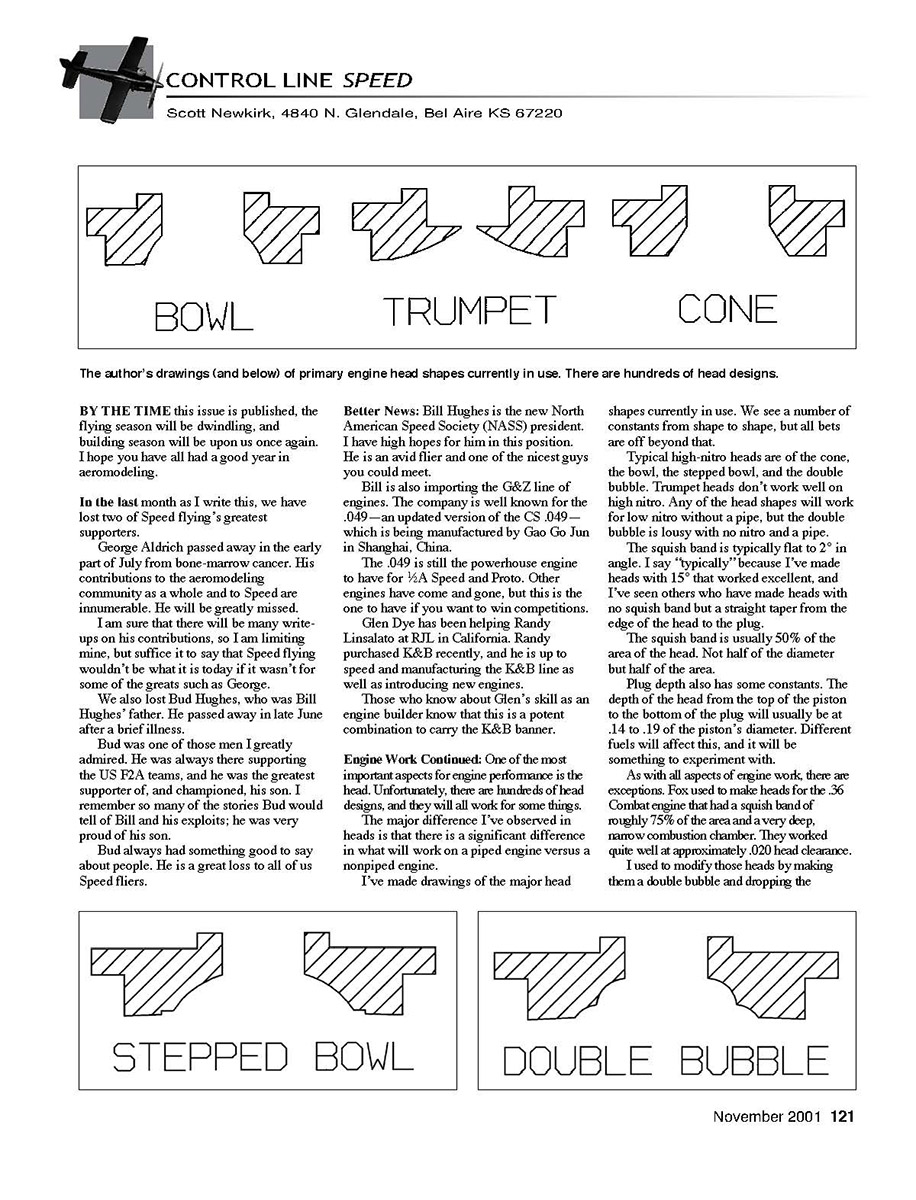
I've made drawings of the major head shapes currently in use. We see a number of constants from shape to shape, but all bets are off beyond that.
Typical high-nitro heads are of the cone, the bowl, the stepped bowl, and the double bubble. Trumpet heads don't work well on high nitro. Any of the head shapes will work for low nitro without a pipe, but the double bubble is lousy with no nitro and a pipe.
The squash band is typically flat to 2° in angle. I say "typically" because I've made heads with 15° that worked excellent, and I've seen others who have made heads with no squash band but a straight taper from the edge of the head to the plug.
The squash band is usually 50% of the area of the head. Not half of the diameter but half of the area.
Plug depth also has some constants. The depth of the head from the top of the piston to the bottom of the plug will usually be at .14 to .19 of the piston's diameter. Different fuels will affect this, and it will be something to experiment with.
As with all aspects of engine work, there are exceptions. Fox used to make heads for the .36 Combat engine that had a squash band of roughly 75% of the area and a very deep, narrow combustion chamber. They worked quite well at approximately .020 head clearance.
I used to modify those heads by making them a double bubble and dropping the clearance down to roughly .008. They performed almost the same; my modifications only added approximately 200 rpm.
There is only one way to find the optimum head: cut and try. Make a head, try it, shim it up, drop it down, and adjust the bowl size depending on what you learned from your test run.
For starters, try to make a head with smaller volume than the head that came from the manufacturer. You might immediately learn that it was a mistake, or you might learn that it was just the ticket; you don't know until you try it.
One thing that works quite well if the head is too small is to try to cut a step in the edge of the squash band, roughly .005- to .010-inch deep and .030- to .060-inch wide. This depends on the engine size and how much you want to increase the chamber size. See the stepped-bowl drawing.
I saw my first example of this shape in an engine Tim Gillotte made, and it is my shape of choice for AMA 10%-nitromethane events. I've used it on anything from a .15 to a .40. I haven't tried it on a D engine yet, but I will this winter.
Some people CC their engines' heads as the best way to do this is with a flat piece of plastic with a .032-inch hole in it. Put a plug in the head, and put your piece of plastic on the combustion-chamber side of it.
Fill the chamber using an insulin syringe or a finely graduated syringe with light oil and a needle that has been cut off square (no sharp point to cause accidents). You can see when it's full through the clear, plastic sheet. You can get useful syringes and needles from a veterinarian supply house. Make sure to be safe with them, and start by removing the pointed tip.
I don't CC my engine heads. From experience I have a rough idea of where to start and will make a set of heads that will have various depths and various widths of combustion chambers. Set them up on the test bench, and try them out.
This is one of the areas where you can only calculate so far, then the tachometer is the final proof.
You can do some adjusting on head size and shapes with glow plugs. I'm not going to go into them more than to say that a colder plug will help out a chamber that's too small, and a hotter plug will help out a chamber that's too large.
Sometimes you want to keep this in mind when the weather is changing a lot during the day or, for example, if a brief shower comes through, and it's your time to fly immediately afterward.
NASS has a new address: Box 205, Maple Ridge, British Columbia, Canada V2X7G1; Tel.: (604) 467-8050.
Are you a member? You should be! Dues are $25/year for US and Canada, and $30/year elsewhere.
Source:
RJL, K&B, and Mecoa engines: RJL Industries Box 5 Sierra Madre CA 91025 (626) 359-0016
CL Speed
Transcribed from original scans by AI. Minor OCR errors may remain.

