
Club Field Safety Bench Revisited
By Dave Mathewson
The August 2002 MA featured an article detailing a field safety bench designed by Charlie Meyer, a member of the Meroke RC Club (MRCC) on Long Island, New York. Charlie was the club’s safety officer in 2001 when club secretary Joe Di Prima approached him about designing and constructing a bench that could be used to help restrain models during engine start-ups.
The Merokes had experienced a rash of incidents when members were starting their engines, some of which resulted in serious injuries. Joe was looking for a way to reduce the number of mishaps. Charlie went to work, and it wasn’t long before he had his concept on paper and had it approved by the club membership. Since that time, using the bench has resulted in a major reduction of incidents at the MRCC field.
As a result of the 2002 article, Charlie’s bench or a close derivative can now be found at hundreds of AMA-chartered club fields throughout the United States. He has also received e-mail messages from clubs in several other countries — including Canada, Belgium, Australia, England, Panama, and South Africa — claiming that they too had built and used the bench.
I was invited to speak at a meeting of the MRCC. While there, Charlie and I had a conversation about his bench and the value it provides to clubs who use it. He suggested that it might be valuable to have several benches for use at the International Aeromodeling Center (IAC) in Muncie, Indiana. As chairman of AMA’s Insurance Committee, it occurred to me that not only would this bench be of value in Muncie, but it might be time again to remind AMA members of this popular design.
Although most insurance claims are relatively small, it's clear from reviewing the data that the majority of claims AMA receives each year result from a member being injured when starting a model. These claims aren't necessarily limited to airplanes powered by internal-combustion engines. More of a safety issue than an insurance issue, the committee has always felt that the best way to reduce claims is to have a proactive loss-prevention program that lets our members know where risks lie. A simple reminder every once in a while can go a long way in saving a member the aggravation, inconvenience, and even the pain of being struck by a spinning propeller.
The MRCC shares a facility with several other AMA clubs on Long Island at Cedar Creek Aerodrome, which is a Nassau County park in Wantagh, New York. In 1999 Charlie and his brother Bob Meyer decided to form the volunteer group "Friends of Cedar Creek Aerodrome" to make some improvements at the field. One of their major concerns was safety at the field. It was through this group that Charlie set out to build safety benches for use at the flying facility.
Because there are multiple runways at the field, the Friends of Cedar Creek Aerodrome felt that it would need at least 10–12 benches, costing roughly $40 each. Before the group went to the various clubs that use the Aerodrome asking for donations, the members decided to approach a local building-supply store to see if they would be offered a discount on materials. To Charlie's surprise, they didn't get a discount — all the materials needed to build the benches were donated at no charge.
The moral here is that many community businesses are happy to make small donations to help local groups. In some cases, clubs return the favor by printing the company's name that donated materials on the side of the bench. The club wins by getting a safety bench for nothing other than the cost of labor, and the business gains advertising.
Design and benefits
This bench's design promotes safety in several ways:
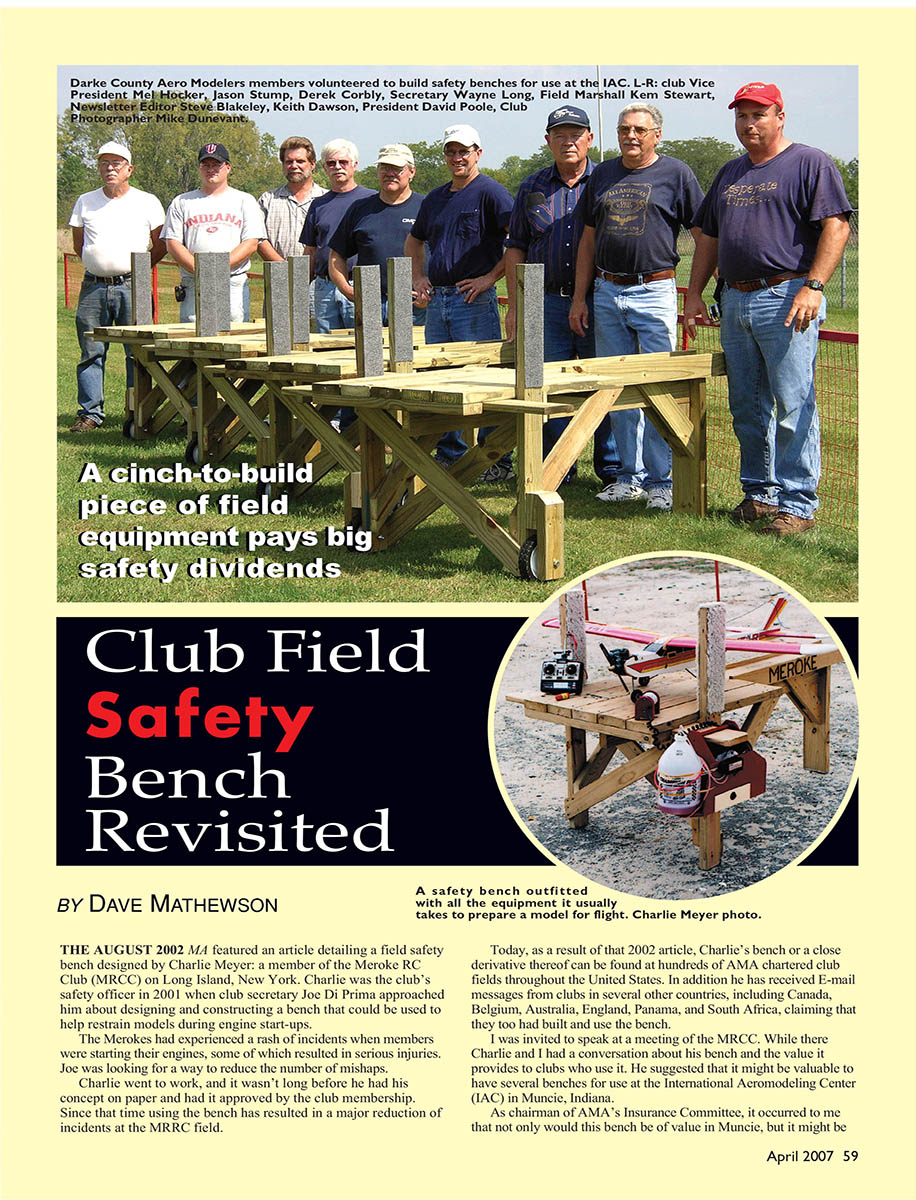
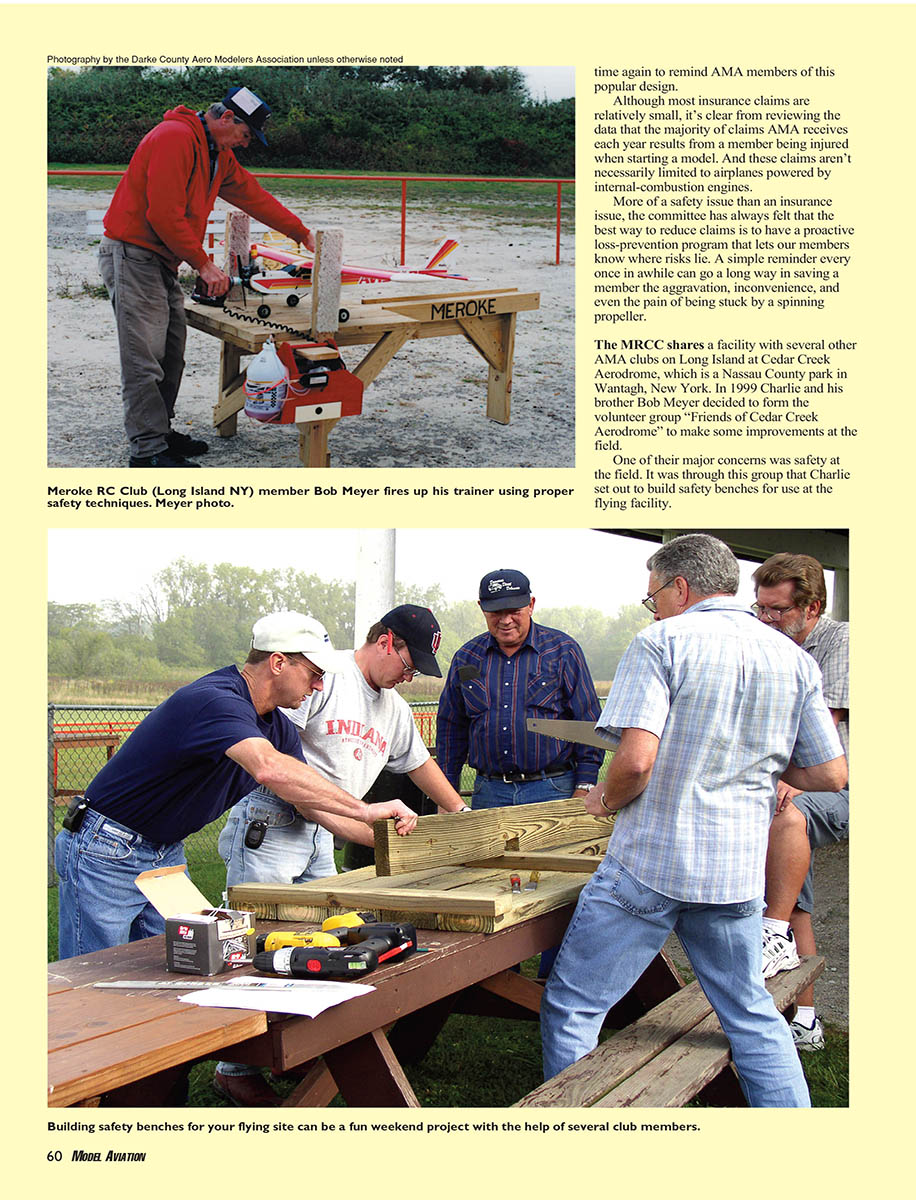
- Vertical wing restraints keep a model from moving forward, even with the engine at full throttle. Running full throttle without walking around to the side of the bench and holding the airplane from one side is not recommended.
- The bench provides a place to put a transmitter, starter, and glow-starter battery, keeping everything clear of a spinning propeller.
- It allows the pilot to stand behind the engine when making adjustments to a running engine, so a pilot does not have to lean over the model to pick it up and carry it to the runway.
- The design allows the bench to sit on uneven ground without rocking.
- An unintended benefit is that the bench has made flying much more enjoyable for members who have trouble kneeling to start their models.
The benches are light enough for two people to carry easily. Since the benches at the IAC continually need to be relocated for various events, we added wheels to ours for extra convenience.
Bench sizes and capacity
The "Standard Safety Bench" can hold a wide variety of RC airplanes. They have been used for most airplanes in the .049–1.60 size range, and perhaps larger.
If you need a bench for some of the bigger aircraft, Charlie has designed a larger variation called the "1/4 Scale Safety Bench." Its lower table height places the spinner at the right height for turning over the engine and makes the wing restraints longer for high-wing Cubs and biplanes. This larger bench can be used for all the smaller airplanes as well.
Both versions of the bench use the same amount of materials and cost the same. Models that are larger and heavier than 1/4 scale are better handled from the ground.
Construction and availability
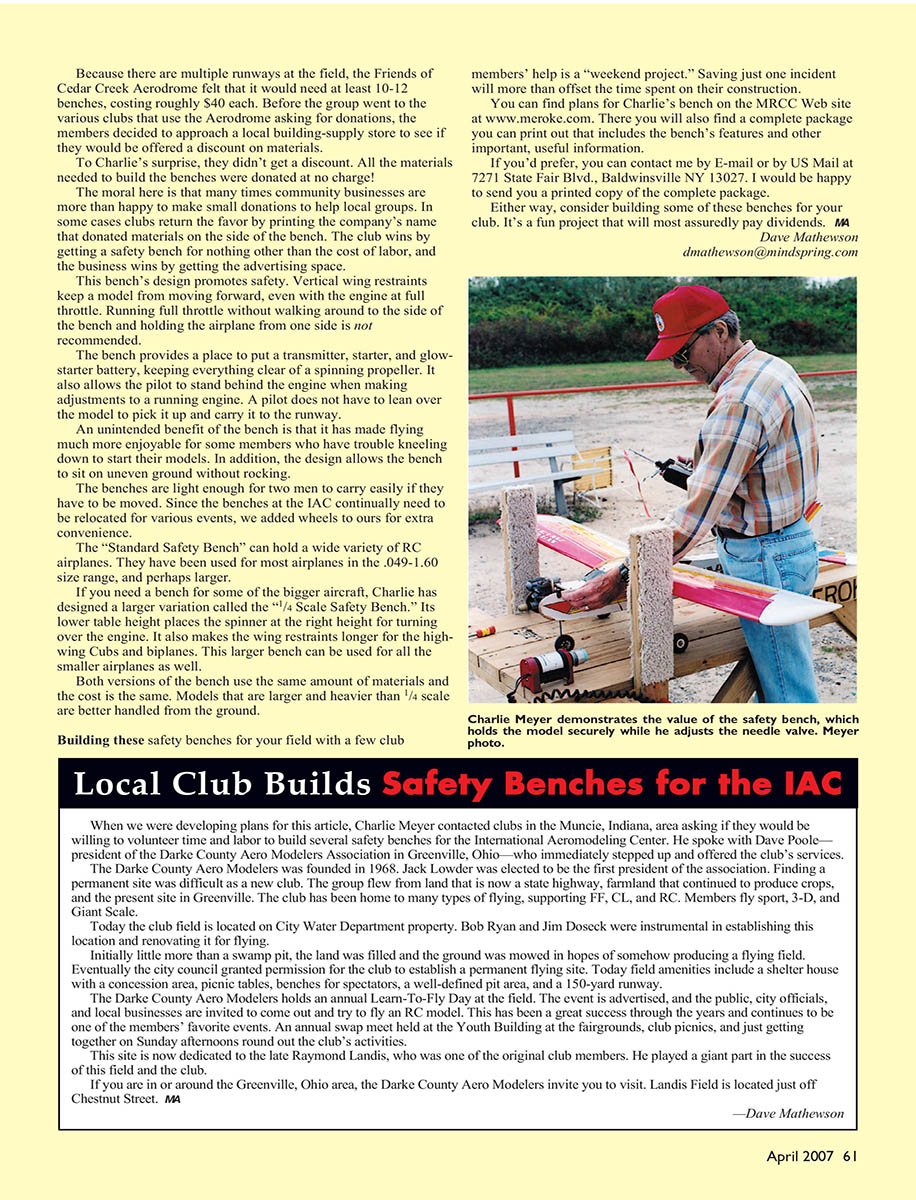
Building these safety benches for your field with a few club members' help is a weekend project. Saving just one incident will more than offset the time spent on their construction.
You can find plans for Charlie's bench on the MRCC web site at www.meroke.com. There you will also find a complete package you can print that includes the bench's features and other important, useful information.
Contact
If you'd prefer, you can contact me by e-mail or by US mail at:
- E-mail: [email protected]
- Mail: 7271 State Fair Blvd., Baldwinsville, NY 13027
I would be happy to send you a printed copy of the complete package.
Either way, consider building some of these benches for your club. It's a fun project that will most assuredly pay dividends.
MA
Dave Mathewson [email protected]
Transcribed from original scans by AI. Minor OCR errors may remain.

