
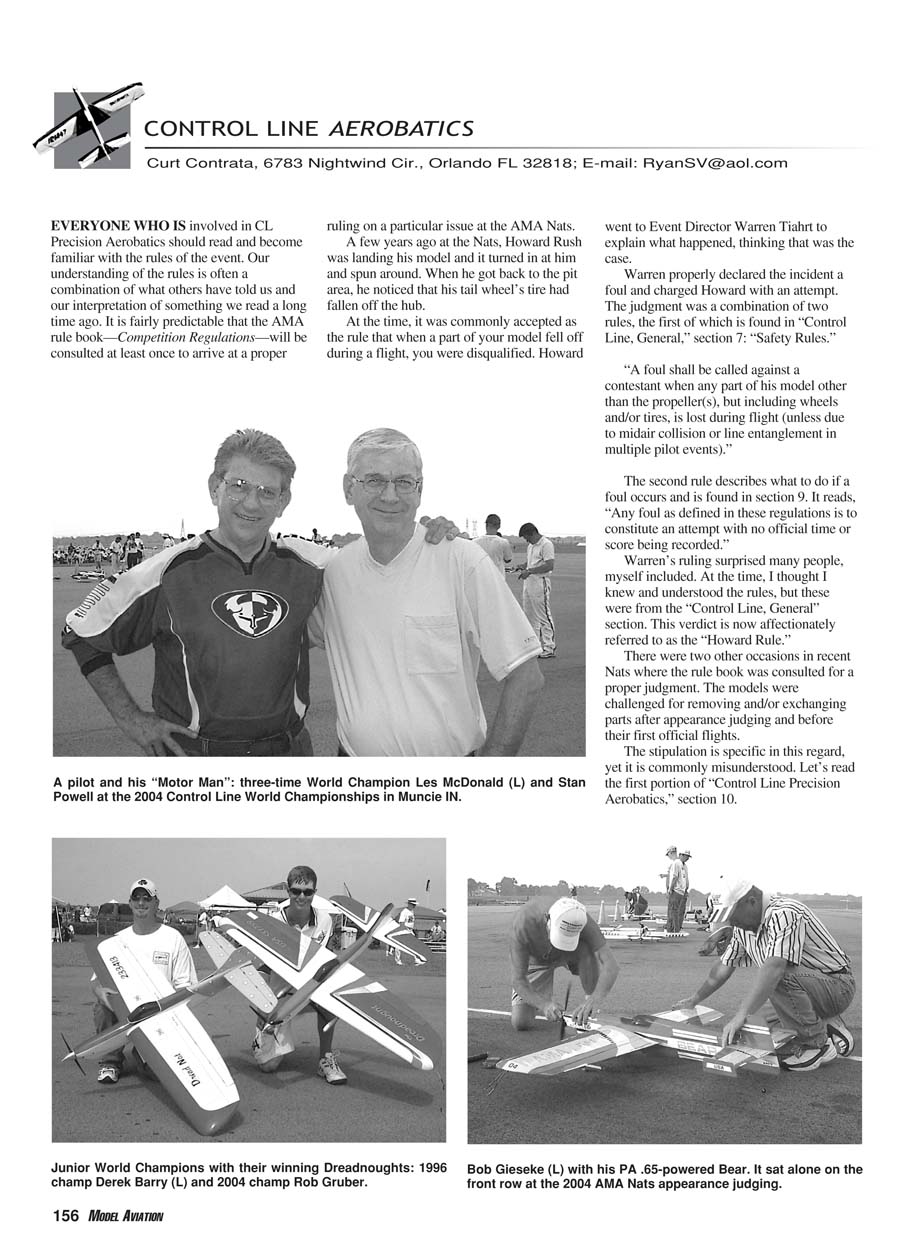
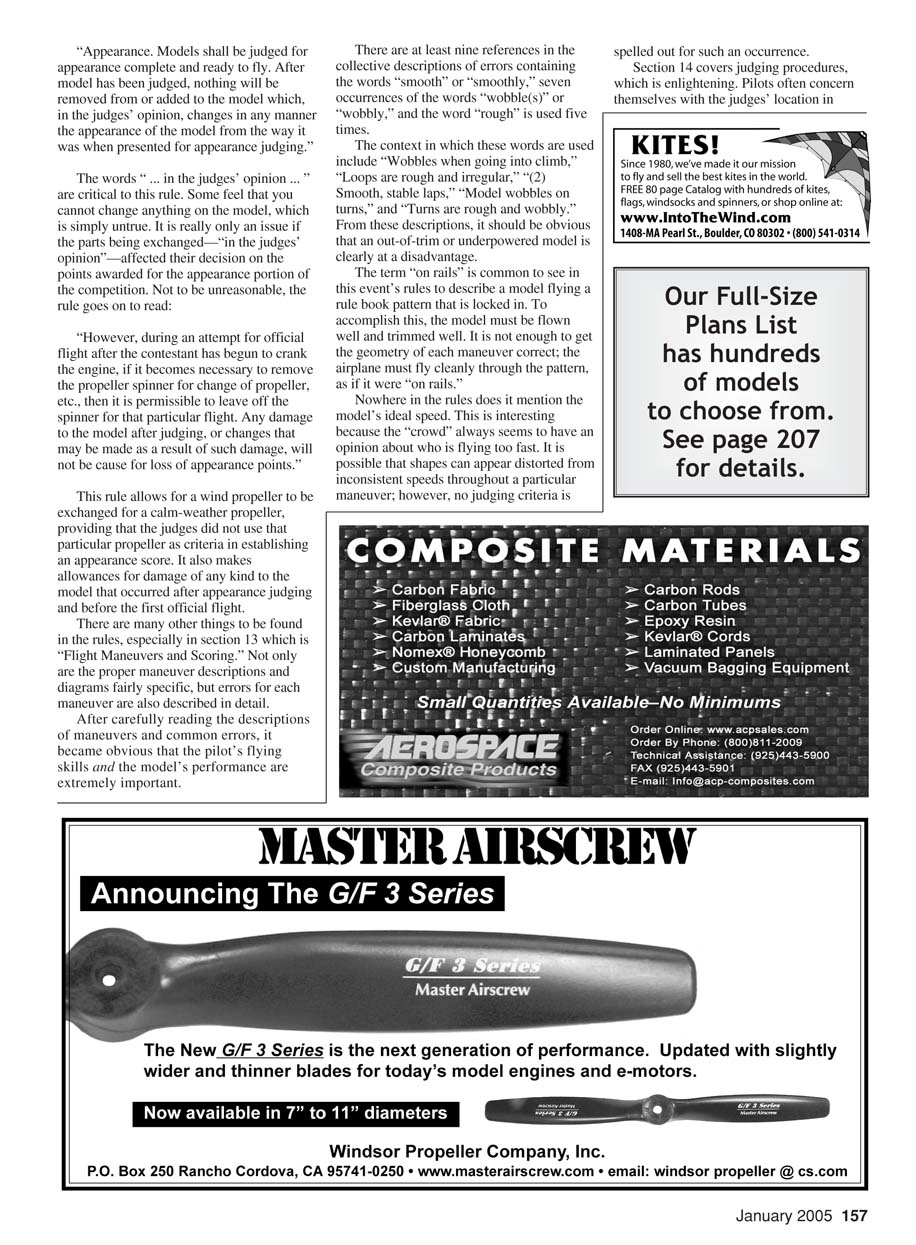

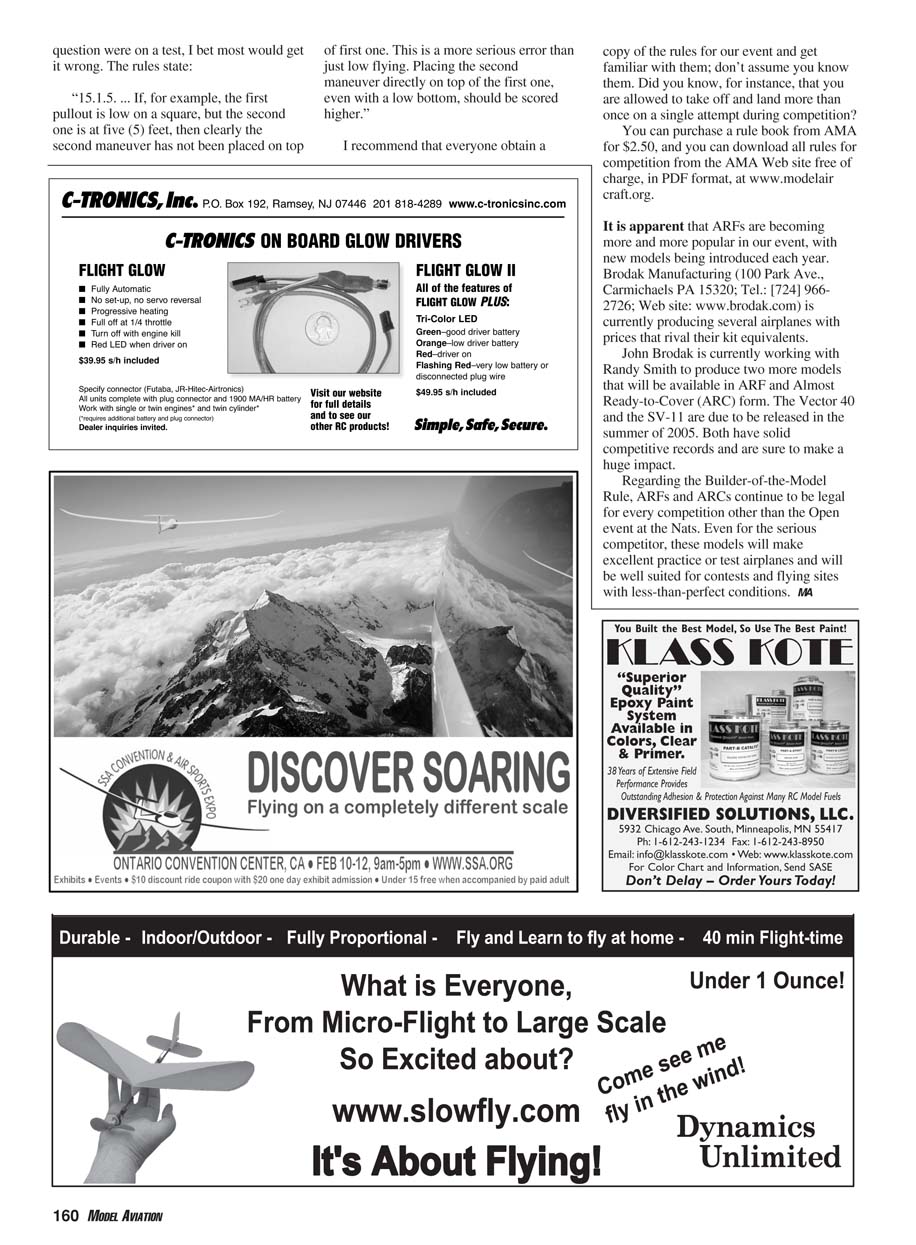
CONTROL LINE AEROBATICS - 2005/01
Curt Contrata
6783 Nightwind Cir., Orlando FL 32818 E-mail: [email protected]
Everyone who is involved in CL Precision Aerobatics should read and become familiar with the rules of the event. Our understanding of the rules is often a combination of what others have told us and our interpretation of something we read a long time ago. It is fairly predictable that the AMA rule book—Competition Regulations—will be consulted at least once to arrive at a proper ruling on a particular issue at the AMA Nats.
The "Howard Rule" — parts lost during flight
A few years ago at the Nats, Howard Rush was landing his model and it turned in at him and spun around. When he got back to the pit area, he noticed that his tail wheel’s tire had fallen off the hub. At the time, it was commonly believed that when a part of your model fell off during a flight you were disqualified. Howard went to Event Director Warren Tiahrt to explain what happened, thinking that was the case.
Warren properly declared the incident a foul and charged Howard with an attempt. The judgment was a combination of two rules:
- Control Line, General, section 7: “Safety Rules”:
"A foul shall be called against a contestant when any part of his model other than the propeller(s), but including wheels and/or tires, is lost during flight (unless due to midair collision or line entanglement in multiple pilot events)."
- Section 9:
"Any foul as defined in these regulations is to constitute an attempt with no official time or score being recorded."
Warren’s ruling surprised many people, myself included. At the time, I thought I knew and understood the rules, but these were from the Control Line, General section. This verdict is now affectionately referred to as the "Howard Rule."
Appearance judging and changing parts after inspection
There have been occasions at recent Nats when models were challenged for removing or exchanging parts after appearance judging and before their first official flights. The stipulation is specific, yet commonly misunderstood. From "Control Line Precision Aerobatics," section 10:
"Appearance. Models shall be judged for appearance complete and ready to fly. After model has been judged, nothing will be removed from or added to the model which, in the judges' opinion, changes in any manner the appearance of the model from the way it was when presented for appearance judging."
The words "... in the judges' opinion ..." are critical. Some feel you cannot change anything on the model, which is simply untrue. It is only an issue if the parts being exchanged—"in the judges' opinion"—affected the judges' decision on the appearance score.
The rule continues: "However, during an attempt for official flight after the contestant has begun to crank the engine, if it becomes necessary to remove the propeller spinner for change of propeller, etc., then it is permissible to leave off the spinner for that particular flight. Any damage to the model after judging, or changes that may be made as a result of such damage, will not be cause for loss of appearance points."
This allows, for example, a wind propeller to be exchanged for a calm-weather prop, provided the judges did not use that particular propeller when establishing the appearance score. It also allows for repairs or changes resulting from damage that occurred after appearance judging.
Flight maneuvers and scoring (Section 13)
Section 13, "Flight Maneuvers and Scoring," contains specific maneuver descriptions, diagrams, and detailed error definitions. After carefully reading the descriptions of maneuvers and common errors, it becomes obvious that both the pilot's flying skill and the model's performance are extremely important.
The rules emphasize smoothness and stability repeatedly:
- At least nine references contain the words "smooth" or "smoothly."
- Seven occurrences of "wobbles" or "wobbly."
- Five occurrences of the word "rough."
Examples from the rules include:
- "Wobbles when going into climb"
- "Loops are rough and irregular"
- "(2) Smooth, stable laps"
- "Model wobbles on turns"
- "Turns are rough and wobbly"
From these descriptions it should be clear that an out-of-trim or underpowered model is at a disadvantage. The term "on rails" is often used to describe a model flying the pattern locked in; to accomplish this the airplane must be flown well and trimmed well. It is not enough to get the geometry of each maneuver correct—the airplane must fly cleanly through the pattern, as if it were "on rails."
Nowhere in the rules is the model's ideal speed specified. Although spectators often have opinions about who is flying too fast, the rule book does not provide judging criteria specifically for speed variations, except insofar as they affect shape and smoothness.
Judging procedures (Section 14)
Section 14 covers judging procedures. Pilots often worry about judges' locations relative to the wind and pattern, the number of judges used, and how scores are compiled. Many tournaments use three judges and drop the high and the low score. The rules provide clear guidance:
- "14.1.3. Judges should change position when the wind changes."
- "14.1.4. Judges should move only during level flight between maneuvers."
Section 14 also details proper judge positions and the responsibilities of the judges' chief.
Maneuver assessment (Section 15)
Section 15 defines how each error should be scored and clarifies the importance of maneuver size and shape:
- "15.1.4. Size and shape are the most important parts of a maneuver. Without proper shape, there simply is no maneuver. Clearly the most difficult aspect of a pattern to execute is proper shape, providing it is done the proper size. The pattern is extremely difficult to fly at 45 degrees. As the pattern is flown larger, it becomes easier. A 60 degree maneuver, for example, is much easier than a 45 degree maneuver. To score them closely grossly distorts the event."
The rules are specific about flying too big and reference 45 degrees repeatedly. How to score someone who flies too small is not always clearly defined. A common question is: if the first loop is low, where should the next one be placed to maximize the score? The rules address this:
- "15.1.5. ... If, for example, the first pullout is low on a square, but the second one is at five (5) feet, then clearly the second maneuver has not been placed on top of the first one. This is a more serious error than just low flying. Placing the second maneuver directly on top of the first one, even with a low bottom, should be scored higher."
Read the rules — and where to get them
I recommend that everyone obtain a copy of the rules for Control Line Precision Aerobatics and get familiar with them; don't assume you know them. Did you know, for instance, that you are allowed to take off and land more than once on a single attempt during competition?
- You can purchase a rule book from AMA for $2.50.
- You can download all competition rules from the AMA web site (PDF) at www.modelaircraft.org.
ARFs, ARCs, and Builder-of-the-Model rule
ARFs (Almost Ready-to-Fly) are becoming more popular in the event, with new models introduced each year. Brodak Manufacturing is producing several airplanes with prices that rival their kit equivalents:
- Brodak Manufacturing, 100 Park Ave., Carmichaels PA 15320
Tel.: (724) 966-2726 Web site: www.brodak.com
John Brodak is working with Randy Smith to produce two more models to be available in ARF and Almost Ready-to-Cover (ARC) form. The Vector 40 and the SV-11 were due to be released in the summer of 2005. Both have solid competitive records and are likely to make an impact.
Regarding the Builder-of-the-Model rule: ARFs and ARCs continue to be legal for every competition other than the Open event at the Nats. Even for the serious competitor, these models make excellent practice or test airplanes and are well suited for contests and flying sites with less-than-perfect conditions.
Transcribed from original scans by AI. Minor OCR errors may remain.

