

CONTROL LINE AEROBATICS
Byline
Curt Contrata 6783 Nightwind Cir., Orlando, FL 32818 E-mail: [email protected]
Trends and eras
We can call them trends or refer to them as eras; it does not matter. They are a reality in CL precision aerobatics. Although it is sometimes difficult to identify trends while they are happening, they are easy to spot when one studies a few decades of our event’s evolution.
Look to any element of our equipment for examples of trends. The three most obvious areas are:
- finish
- style
- power
Finish and construction
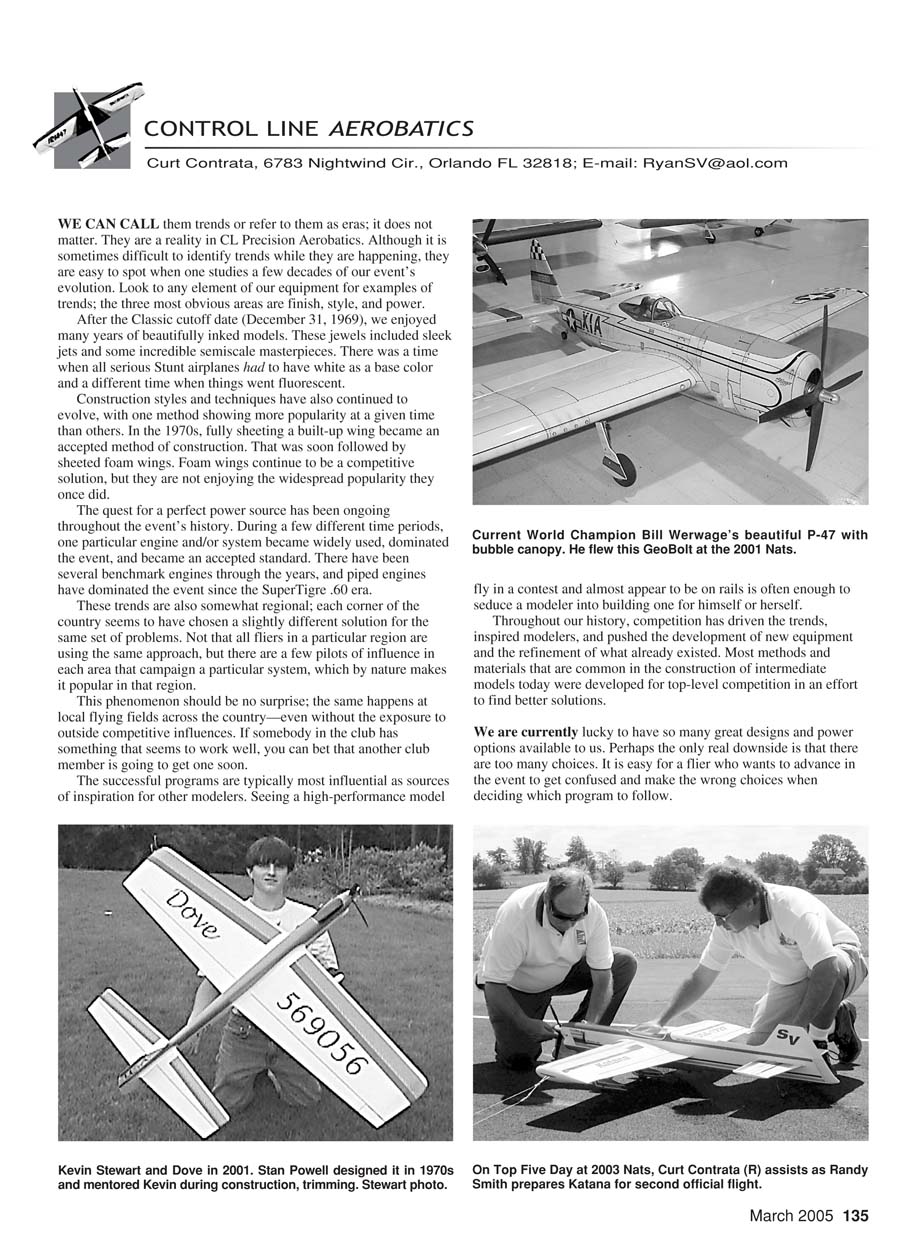
After the Classic cutoff date (December 31, 1969), we enjoyed many years of beautifully finished models. These jewels included sleek jets and some incredible semi-scale masterpieces. There was a time when all serious Stunt airplanes had to have white as a base color and a different time when things went fluorescent.
Construction styles and techniques have also continued to evolve, with one method showing more popularity at a given time than others. In the 1970s, fully sheeting a built-up wing became an accepted method of construction. That was soon followed by sheeted foam wings. Foam wings continue to be a competitive solution, but they are not enjoying the widespread popularity they once did.
Power trends
The quest for a perfect power source has been ongoing throughout the event’s history. During a few different time periods, one particular engine and/or system became widely used, dominated the event, and became an accepted standard. There have been several benchmark engines through the years, and piped engines have dominated the event since the SuperTigre .60 era.
Regional influences
These trends are also somewhat regional; each corner of the country seems to have chosen a slightly different solution for the same set of problems. Not all fliers in a particular region use the same approach, but there are a few pilots of influence in each area that campaign a particular system, which by nature makes it popular regionally.
This phenomenon should be no surprise; the same happens at local flying fields across the country—even without exposure to outside competitive influences. If somebody in the club has something that seems to work well, you can bet that another club member is going to get one soon.
Influence of successful programs
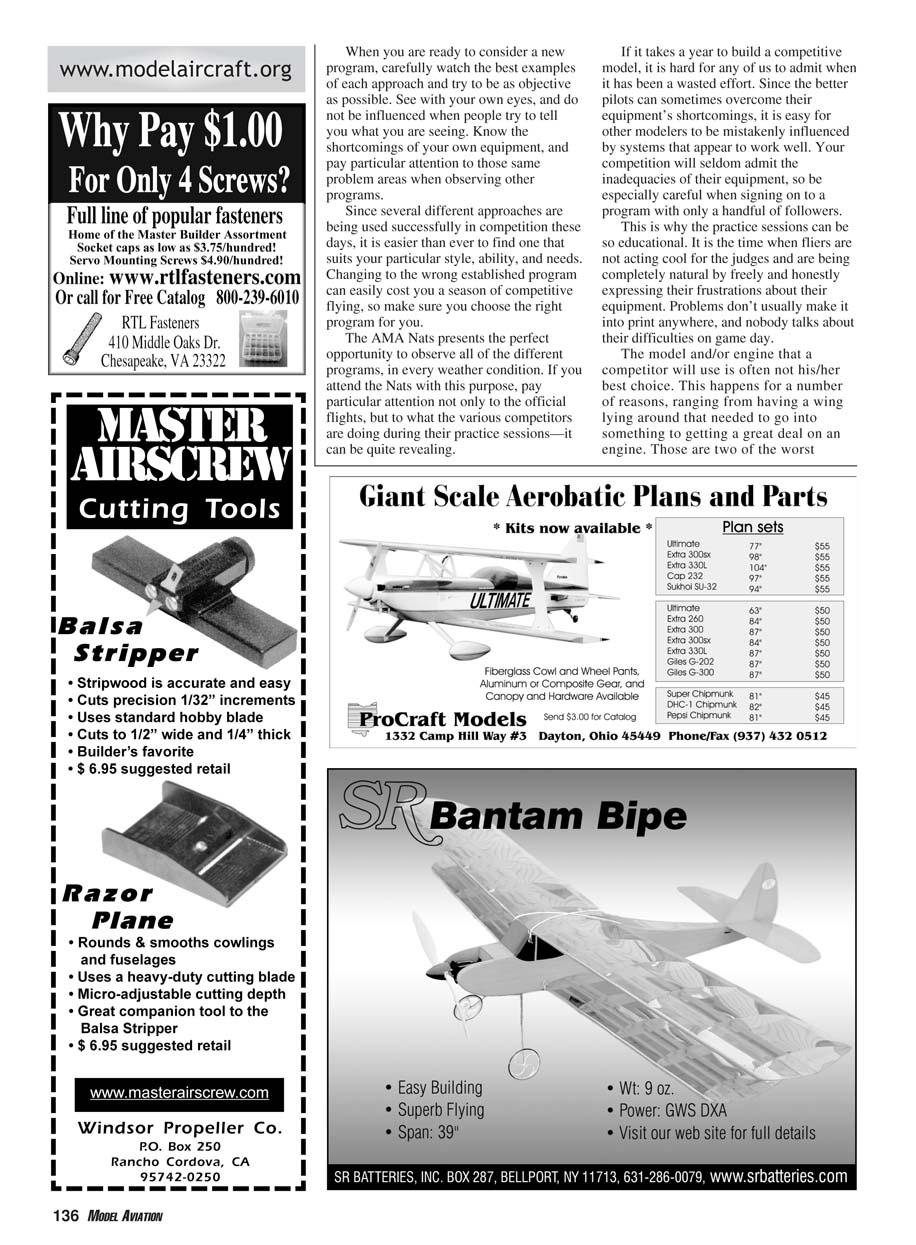
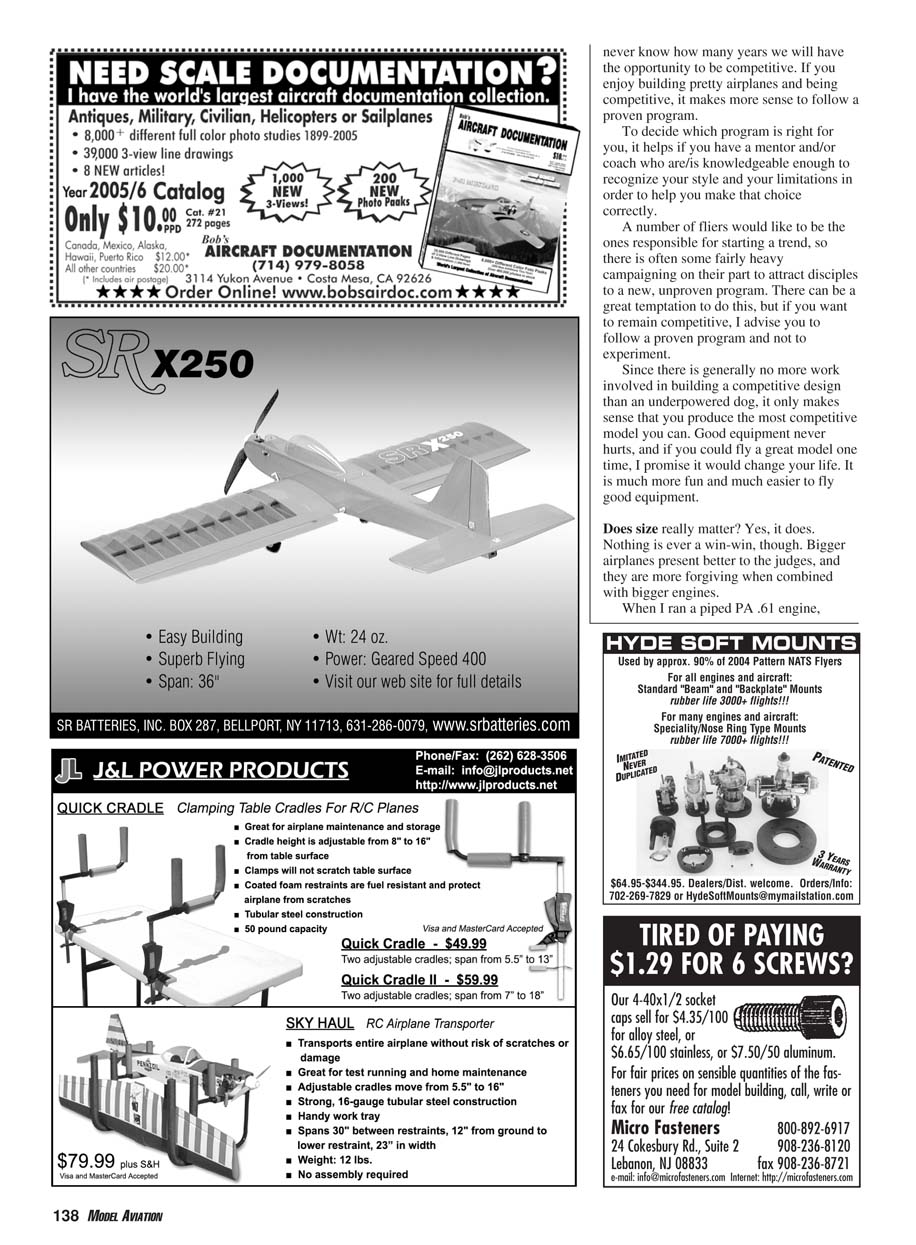
Successful programs are typically most influential as sources of inspiration for other modelers. Seeing a high-performance model fly in a contest and almost appear to be on rails is often enough to seduce a modeler into building one for himself or herself.
Throughout our history, competition has driven the trends, inspired modelers, and pushed the development of new equipment and the refinement of what already existed. Most methods and materials common in the construction of intermediate models today were developed for top-level competition in an effort to find better solutions.
We are currently lucky to have so many great designs and power options available. Perhaps the only real downside is that there are too many choices. It is easy for a flier who wants to advance in the event to get confused and make the wrong choices when deciding which program to follow.
Choosing a program
When you are ready to consider a new program, carefully watch the best examples of each approach and try to be as objective as possible. See with your own eyes, and do not be influenced when people try to tell you what you are seeing. Know the shortcomings of your own equipment, and pay particular attention to those same problem areas when observing other programs. Since several different approaches are being used successfully in competition these days, it is easier than ever to find one that suits your particular style, ability, and needs.
Changing to the wrong established program can easily cost you a season of competitive flying, so make sure you choose the right program for you.
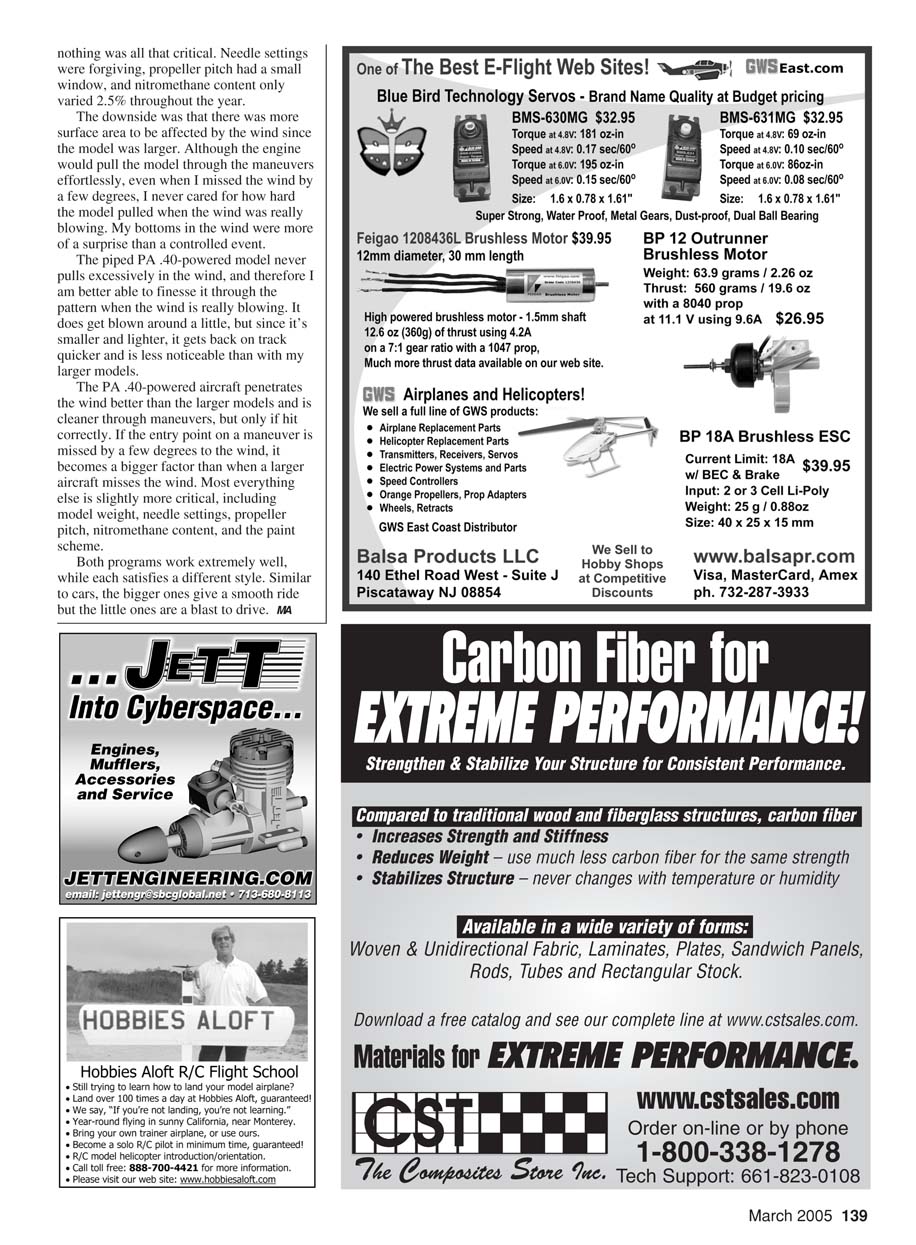
The AMA Nats presents the perfect opportunity to observe all of the different programs, in every weather condition. If you attend the Nats with this purpose, pay particular attention not only to the official flights, but to what the various competitors are doing during their practice sessions—it can be quite revealing.
Practice sessions and honest evaluation
If it takes a year to build a competitive model, it is hard for any of us to admit when it has been a wasted effort. Since the better pilots can sometimes overcome their equipment’s shortcomings, it is easy for other modelers to be mistakenly influenced by systems that appear to work well. Your competition will seldom admit the inadequacies of their equipment, so be especially careful when signing on to a program with only a handful of followers.
This is why the practice sessions can be so educational. It is the time when fliers are not acting cool for the judges and are being completely natural—freely and honestly expressing their frustrations about their equipment. Problems don’t usually make it into print anywhere, and nobody talks about their difficulties on game day.
The model and/or engine that a competitor uses is often not his or her best choice. This happens for a number of reasons, ranging from having a wing lying around that needed to go into something to getting a great deal on an engine. Those are two of the worst factors to consider when deciding what to build and what to power it with.
Many of the models flown in competition were not finished early enough to allow sufficient time for trimming, experimenting with power/propellers, and evaluating objectively. I have seen many modelers build airplanes with the intent of trying two engines to decide which was the best match, only to run out of time before the evaluation process was finished, or even started.
Running out of time before a contest is never a good thing, and competitors should be careful when deciding which is the right model to fly in competition. The shiny, unproven model with a new engine is the wrong one to fly at an important contest, yet it happens all the time.
Building schedule and competitiveness
Since building a full-blown Stunt aircraft can take some people an entire season, producing one competitive model per year is a good average to maintain. With that in mind, deciding to develop a new program can set a competitor back several years.
Consider that the first model will be a learning experience, the second will be a refinement, and the third might be competitive. That is three years of missed competition while others were getting better by refining their flying skills using dependable, contest-proven equipment.
I realize that developing something on your own is why some are involved in the event. If that is the case, go for it. We just never know how many years we will have the opportunity to be competitive. If you enjoy building pretty airplanes and being competitive, it makes more sense to follow a proven program.
To decide which program is right for you, it helps if you have a mentor and/or coach who is knowledgeable enough to recognize your style and your limitations in order to help you make that choice correctly.
A number of fliers would like to be the ones responsible for starting a trend, so there is often some fairly heavy campaigning on their part to attract disciples to a new, unproven program. There can be a great temptation to do this, but if you want to remain competitive, I advise you to follow a proven program and not to experiment.
Since there is generally no more work involved in building a competitive design than an underpowered dog, it only makes sense that you produce the most competitive model you can. Good equipment never hurts, and if you could fly a great model one time, I promise it would change your life. It is much more fun and much easier to fly good equipment.
Does size matter?
Yes, it does. Nothing is ever a win-win, though. Bigger airplanes present better to the judges, and they are more forgiving when combined with bigger engines.
When I ran a piped PA .61 engine, nothing was all that critical. Needle settings were forgiving, propeller pitch had a small window, and nitromethane content only varied 2.5% throughout the year.
The downside was that there was more surface area to be affected by the wind since the model was larger. Although the engine would pull the model through the maneuvers effortlessly, even when I missed the wind by a few degrees, I never cared for how hard the model pulled when the wind was really blowing. My bottoms in the wind were more of a surprise than a controlled event.
The piped PA .40-powered model never pulls excessively in the wind, and therefore I am better able to finesse it through the pattern when the wind is really blowing. It does get blown around a little, but since it's smaller and lighter, it gets back on track quicker and is less noticeable than with my larger models.
The PA .40-powered aircraft penetrates the wind better than the larger models and is cleaner through maneuvers, but only if hit correctly. If the entry point on a maneuver is missed by a few degrees to the wind, it becomes a bigger factor than with a larger aircraft. Most everything else is slightly more critical, including model weight, needle settings, propeller pitch, nitromethane content, and the paint scheme.
Both programs work extremely well, while each satisfies a different style. Similar to cars, the bigger ones give a smooth ride but the little ones are a blast to drive.
Transcribed from original scans by AI. Minor OCR errors may remain.

