
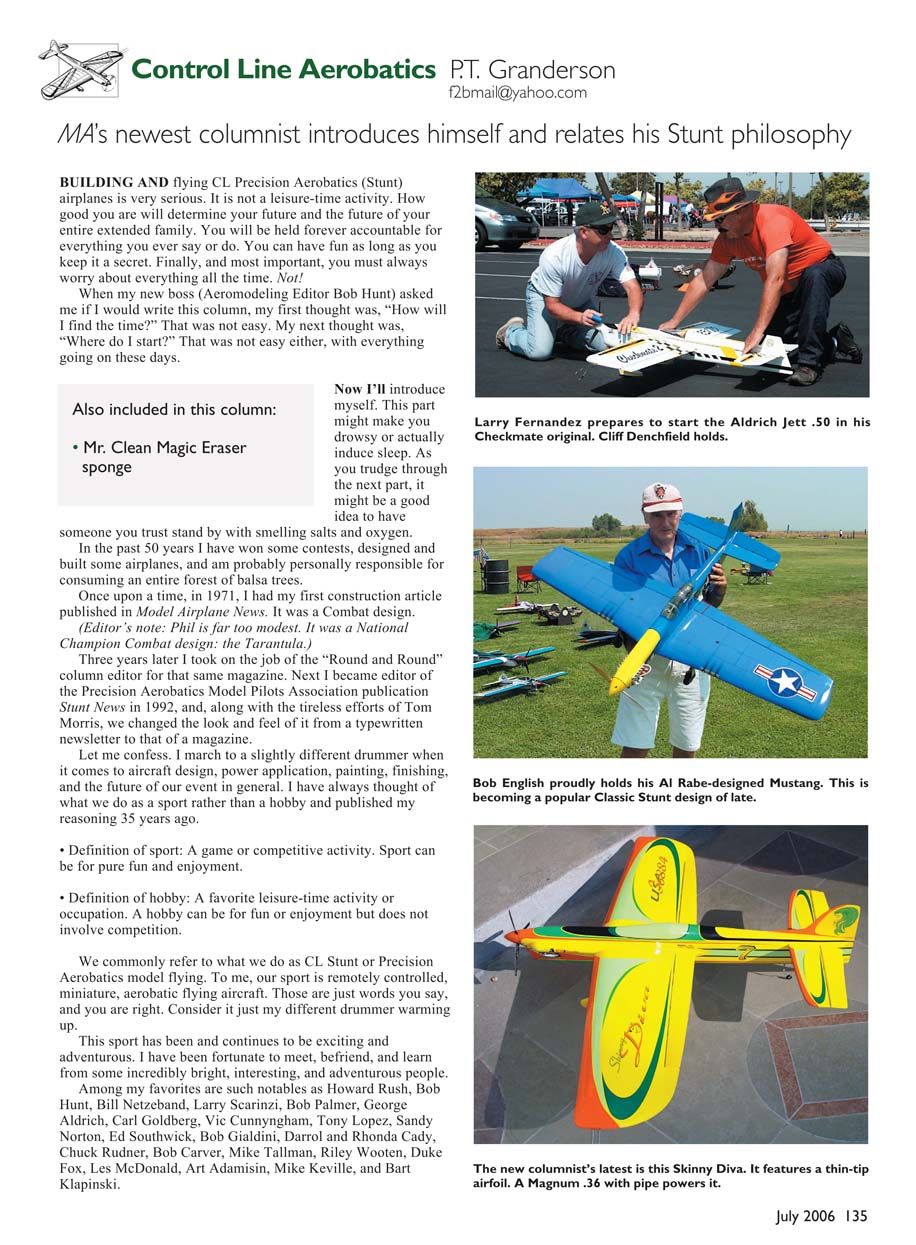
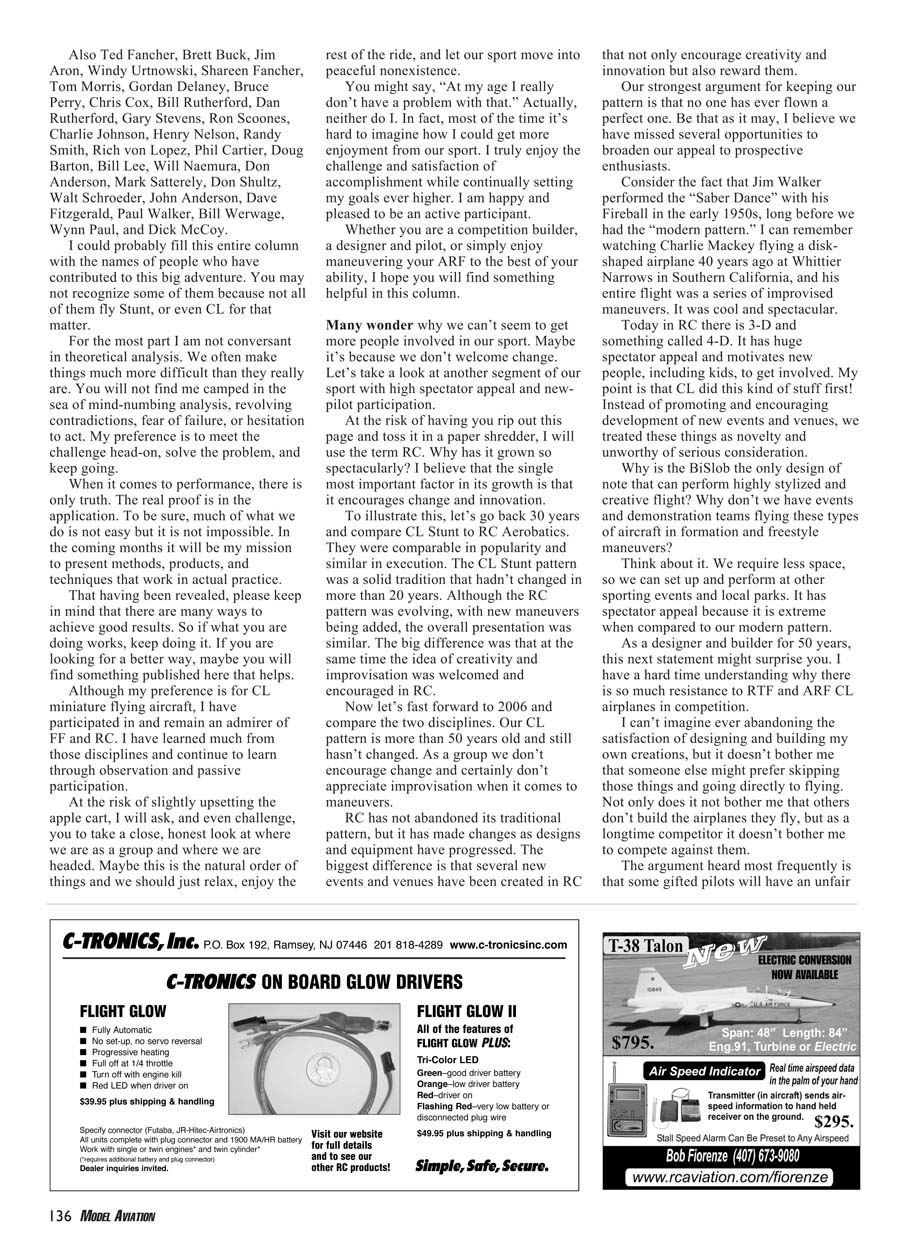
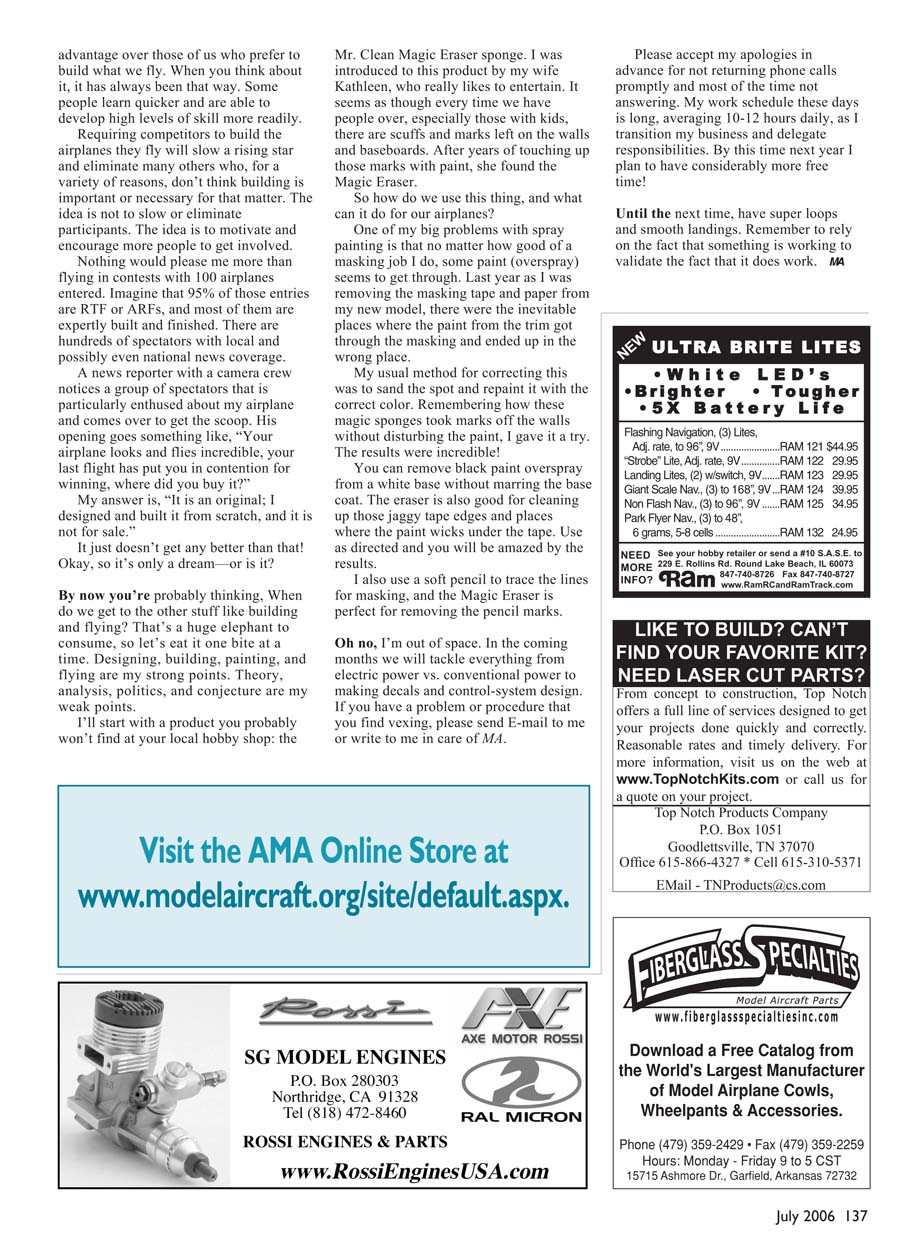
Control Line Aerobatics
P.T. Granderson
MA's newest columnist introduces himself and relates his Stunt philosophy
BUILDING AND flying CL Precision Aerobatics (Stunt) airplanes is very serious. It is not a leisure-time activity. How good you are will determine your future and the future of your entire extended family. You will be held forever accountable for everything you ever say or do. You can have fun as long as you keep it a secret. Finally, and most important, you must always worry about everything all the time. Not!
When my new boss (Aeromodeling Editor Bob Hunt) asked me if I would write this column, my first thought was, "How will I find the time?" That was not easy. My next thought was, "Where do I start?" That was not easy either, with everything going on these days.
Also included in this column:
- Mr. Clean Magic Eraser sponge
About me
Now I'll introduce myself. This part might make you drowsy or actually induce sleep. As you trudge through the next part, it might be a good idea to have someone you trust stand by with smelling salts and oxygen.
In the past 50 years I have won some contests, designed and built some airplanes, and am probably personally responsible for consuming an entire forest of balsa trees.
Once upon a time, in 1971, I had my first construction article published in Model Airplane News. It was a Combat design. (Editor's note: Phil is far too modest. It was a National Champion Combat design: the Tarantula.)
Three years later I took on the job of the "Round and Round" column editor for that same magazine. Next I became editor of the Precision Aerobatics Model Pilots Association publication Stunt News in 1992, and, along with the tireless efforts of Tom Morris, we changed the look and feel of it from a typewritten newsletter to that of a magazine.
Let me confess. I march to a slightly different drummer when it comes to aircraft design, power application, painting, finishing, and the future of our event in general. I have always thought of what we do as a sport rather than a hobby and published my reasoning 35 years ago.
Sport vs. hobby
- Definition of sport: A game or competitive activity. Sport can be for pure fun and enjoyment.
- Definition of hobby: A favorite leisure-time activity or occupation. A hobby can be for fun or enjoyment but does not involve competition.
We commonly refer to what we do as CL Stunt or Precision Aerobatics model flying. To me, our sport is remotely controlled, miniature, aerobatic flying aircraft. Those are just words you say, and you are right. Consider it just my different drummer warming up.
This sport has been and continues to be exciting and adventurous. I have been fortunate to meet, befriend, and learn from some incredibly bright, interesting, and adventurous people.
People who influenced me
Among my favorites are such notables as:
- Howard Rush
- Bob Hunt
- Bill Netzeband
- Larry Scarinzi
- Bob Palmer
- George Aldrich
- Carl Goldberg
- Vic Cunnyngham
- Tony Lopez
- Sandy Norton
- Ed Southwick
- Bob Gialdini
- Darrol and Rhonda Cady
- Chuck Rudner
- Bob Carver
- Mike Tallman
- Riley Wooten
- Duke Fox
- Les McDonald
- Art Adamisin
- Mike Keville
- Bart Klapinski
Also:
- Ted Fancher
- Brett Buck
- Jim Aron
- Windy Urtnowski
- Shareen Fancher
- Tom Morris
- Gordan Delaney
- Bruce Perry
- Chris Cox
- Bill Rutherford
- Dan Rutherford
- Gary Stevens
- Ron Scoones
- Charlie Johnson
- Henry Nelson
- Randy Smith
- Rich von Lopez
- Phil Cartier
- Doug Barton
- Bill Lee
- Will Naemura
- Don Anderson
- Mark Satterely
- Don Shultz
- Walt Schroeder
- John Anderson
- Dave Fitzgerald
- Paul Walker
- Bill Werwage
- Wynn Paul
- Dick McCoy
I could probably fill this entire column with the names of people who have contributed to this big adventure. You may not recognize some of them because not all of them fly Stunt, or even CL for that matter.
For the most part I am not conversant in theoretical analysis. We often make things much more difficult than they really are. You will not find me camped in the sea of mind-numbing analysis, revolving contradictions, fear of failure, or hesitation to act. My preference is to meet the challenge head-on, solve the problem, and keep going.
When it comes to performance, there is only truth. The real proof is in the application. To be sure, much of what we do is not easy but it is not impossible. In the coming months it will be my mission to present methods, products, and techniques that work in actual practice.
That having been revealed, please keep in mind that there are many ways to achieve good results. So if what you are doing works, keep doing it. If you are looking for a better way, maybe you will find something published here that helps.
Although my preference is for CL miniature flying aircraft, I have participated in and remain an admirer of FF and RC. I have learned much from those disciplines and continue to learn through observation and passive participation.
Where we are headed
At the risk of slightly upsetting the apple cart, I will ask, and even challenge, you to take a close, honest look at where we are as a group and where we are headed. Maybe this is the natural order of things and we should just relax, enjoy the rest of the ride, and let our sport move into peaceful nonexistence.
You might say, "At my age I really don't have a problem with that." Actually, neither do I. In fact, most of the time it's hard to imagine how I could get more enjoyment from our sport. I truly enjoy the challenge and satisfaction of accomplishment while continually setting my goals ever higher. I am happy and pleased to be an active participant.
Whether you are a competition builder, a designer and pilot, or simply enjoy maneuvering your ARF to the best of your ability, I hope you will find something helpful in this column.
RC vs. CL
Many wonder why we can't seem to get more people involved in our sport. Maybe it's because we don't welcome change. Let's take a look at another segment of our sport with high spectator appeal and new-pilot participation.
At the risk of having you rip out this page and toss it in a paper shredder, I will use the term RC. Why has it grown so spectacularly? I believe that the single most important factor in its growth is that it encourages change and innovation.
To illustrate this, let's go back 30 years and compare CL Stunt to RC Aerobatics. They were comparable in popularity and similar in execution. The CL Stunt pattern was a solid tradition that hadn't changed in more than 20 years. Although the RC pattern was evolving, with new maneuvers being added, the overall presentation was similar. The big difference was that at the same time the idea of creativity and improvisation was welcomed and encouraged in RC.
Now let's fast forward to 2006 and compare the two disciplines. Our CL pattern is more than 50 years old and still hasn't changed. As a group we don't encourage change and certainly don't appreciate improvisation when it comes to maneuvers.
RC has not abandoned its traditional pattern, but it has made changes as designs and equipment have progressed. The biggest difference is that several new events and venues have been created in RC that not only encourage creativity and innovation but also reward them.
Our strongest argument for keeping our pattern is that no one has ever flown a perfect one. Be that as it may, I believe we have missed several opportunities to broaden our appeal to prospective enthusiasts.
Consider the fact that Jim Walker performed the "Saber Dance" with his Fireball in the early 1950s, long before we had the "modern pattern." I can remember watching Charlie Mackey flying a disk-shaped airplane 40 years ago at Whittier Narrows in Southern California, and his entire flight was a series of improvised maneuvers. It was cool and spectacular.
Today in RC there is 3-D and something called 4-D. It has huge spectator appeal and motivates new people, including kids, to get involved. My point is that CL did this kind of stuff first! Instead of promoting and encouraging the development of new events and venues, we treated these things as novelty and unworthy of serious consideration.
Why is the BiSlob the only design of note that can perform highly stylized and creative flight? Why don't we have events and demonstration teams flying these types of aircraft in formation and freestyle maneuvers?
Think about it. We require less space, so we can set up and perform at other sporting events and local parks. It has spectator appeal because it is extreme when compared to our modern pattern.
RTF, ARF, and participation
As a designer and builder for 50 years, this next statement might surprise you. I have a hard time understanding why there is so much resistance to RTF and ARF CL airplanes in competition.
I can't imagine ever abandoning the satisfaction of designing and building my own creations, but it doesn't bother me that someone else might prefer skipping those things and going directly to flying. Not only does it not bother me that others don't build the airplanes they fly, but as a longtime competitor it doesn't bother me to compete against them.
The argument heard most frequently is that some gifted pilots will have an unfair advantage over those of us who prefer to build what we fly. When you think about it, it has always been that way. Some people learn quicker and are able to develop high levels of skill more readily.
Requiring competitors to build the airplanes they fly will slow a rising star and eliminate many others who, for a variety of reasons, don't think building is important or necessary for that matter. The idea is not to slow or eliminate participants. The idea is to motivate and encourage more people to get involved.
Nothing would please me more than flying in contests with 100 airplanes entered. Imagine that 95% of those entries are RTF or ARFs, and most of them are expertly built and finished. There are hundreds of spectators with local and possibly even national news coverage.
A news reporter with a camera crew notices a group of spectators that is particularly enthused about my airplane and comes over to get the scoop. His opening goes something like, "Your airplane looks and flies incredible, your last flight has put you in contention for winning, where did you buy it?"
My answer is, "It is an original; I designed and built it from scratch, and it is not for sale."
It just doesn't get any better than that! Okay, so it's only a dream—or is it?
What to expect in future columns
By now you're probably thinking, When do we get to the other stuff like building and flying? That's a huge elephant to consume, so let's eat it one bite at a time. Designing, building, painting, and flying are my strong points. Theory, analysis, politics, and conjecture are my weak points.
I'll start with a product you probably won't find at your local hobby shop: the Mr. Clean Magic Eraser sponge. I was introduced to this product by my wife Kathleen, who really likes to entertain. It seems as though every time we have people over, especially those with kids, there are scuffs and marks left on the walls and baseboards. After years of touching up those marks with paint, she found the Magic Eraser.
So how do we use this thing, and what can it do for our airplanes?
One of my big problems with spray painting is that no matter how good of a masking job I do, some paint (overspray) seems to get through. Last year as I was removing the masking tape and paper from my new model, there were the inevitable places where the paint from the trim got through the masking and ended up in the wrong place.
My usual method for correcting this was to sand the spot and repaint it with the correct color. Remembering how these magic sponges took marks off of walls without disturbing the paint, I gave it a try. The results were incredible!
You can remove black paint overspray from a white base without marring the base coat. The eraser is also good for cleaning up those jaggy tape edges and places where paint wicks under the tape. Use as directed and you will be amazed by the results.
I also use a soft pencil to trace the lines for masking, and the Magic Eraser is perfect for removing the pencil marks.
Oh no, I'm out of space. In the coming months we will tackle everything from electric power vs. conventional power to making decals and control-system design. If you have a problem or procedure that you find vexing, please send E-mail to me or write to me in care of MA.
Please accept my apologies in advance for not returning phone calls promptly and most of the time not answering. My work schedule these days is long, averaging 10–12 hours daily, as I transition my business and delegate responsibilities. By this time next year I plan to have considerably more free time!
Until the next time, have super loops and smooth landings. Remember to rely on the fact that something is working to validate the fact that it does work.
MA
Transcribed from original scans by AI. Minor OCR errors may remain.

