
The CL Stunt power package reviewed and explained
P.T. Granderson [email protected]
WHAT'S NEW? It just so happens that there is something new in Precision Aerobatics (Stunt). In fact, it may change the way we do things forever.
For as long as I can remember, the big mystery in Stunt has been power. Through the years there have been many solutions and methods of getting an acceptable power system to work consistently. The last significant improvement to power systems in general was the tuned pipe. For the majority of top competitors in the U.S., a good tuned-pipe system is a “must-have.”
The other big factor has been the availability of engines either designed specifically for our purpose or easily adapted to the rigors of Stunt. As these engines have been put into operation, many people have begun to modify and tweak them for a variety of reasons.
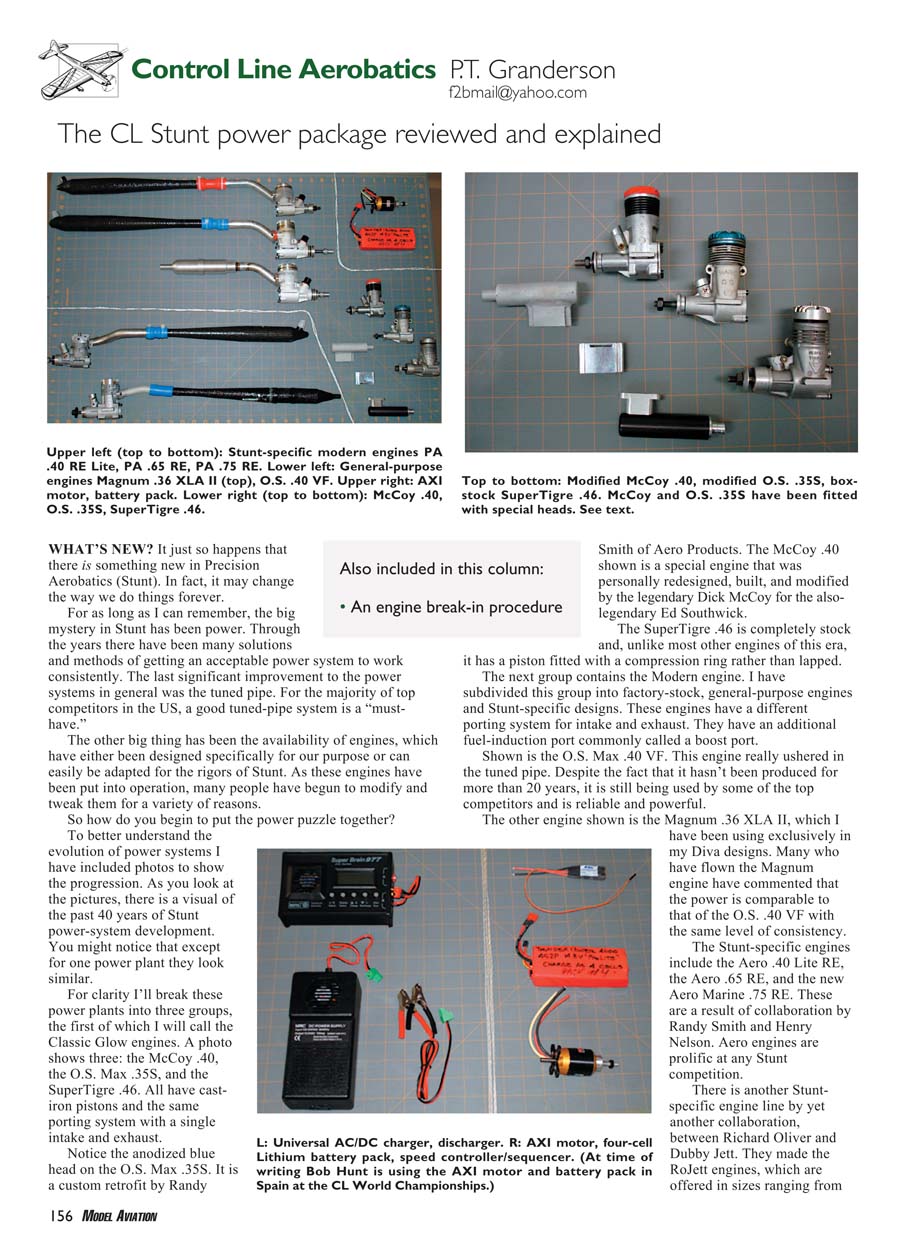
To better understand the evolution of power systems I have included photos to show the progression. As you look at the pictures, there is a visual of the past 40 years of Stunt power-system development. You might notice that, except for one power plant, they look similar.
Classic Glow engines
For clarity I'll break these power plants into three groups, the first of which I will call the Classic Glow engines. A photo shows three: the McCoy .40, the O.S. Max .35S, and the SuperTigre .46. All have cast-iron pistons and the same porting system with a single intake and exhaust.
Notice the anodized blue head on the O.S. Max .35S. It is a custom retrofit by Randy Smith of Aero Products. The McCoy .40 shown is a special engine that was personally redesigned, built, and modified by the legendary Dick McCoy for the also-legendary Ed Southwick. The SuperTigre .46 is completely stock and, unlike most other engines of this era, it has a piston fitted with a compression ring rather than being lapped.
Modern engines
The next group contains the Modern engine. I have subdivided this group into factory-stock, general-purpose engines and Stunt-specific designs. These engines have a different porting system for intake and exhaust: they include an additional fuel-induction port commonly called a boost port.
- O.S. Max .40 VF: This engine really ushered in the tuned pipe. Despite the fact that it hasn't been produced for more than 20 years, it is still being used by some of the top competitors and is reliable and powerful.
- Magnum .36 XLA II: I have been using this engine exclusively in my Diva designs. Many who have flown the Magnum engine have commented that the power is comparable to that of the O.S. .40 VF with the same level of consistency.
Stunt-specific engines include:
- Aero .40 Lite RE
- Aero .65 RE
- Aero Marine .75 RE
These Aero engines are the result of collaboration by Randy Smith and Henry Nelson and are prolific at any Stunt competition.
There is another Stunt-specific engine line produced by a collaboration between Richard Oliver and Dubby Jett. They made the RoJett engines, which are offered in sizes ranging from the RoJett .40 to the RoJett .85.
Electric and alternative power systems
The final power-system group is not centered around the internal-combustion engine; it is a modern electric power system. Electric packages and other alternative power plants are becoming part of the broader conversation about Stunt power systems.
Transcribed from original scans by AI. Minor OCR errors may remain.

